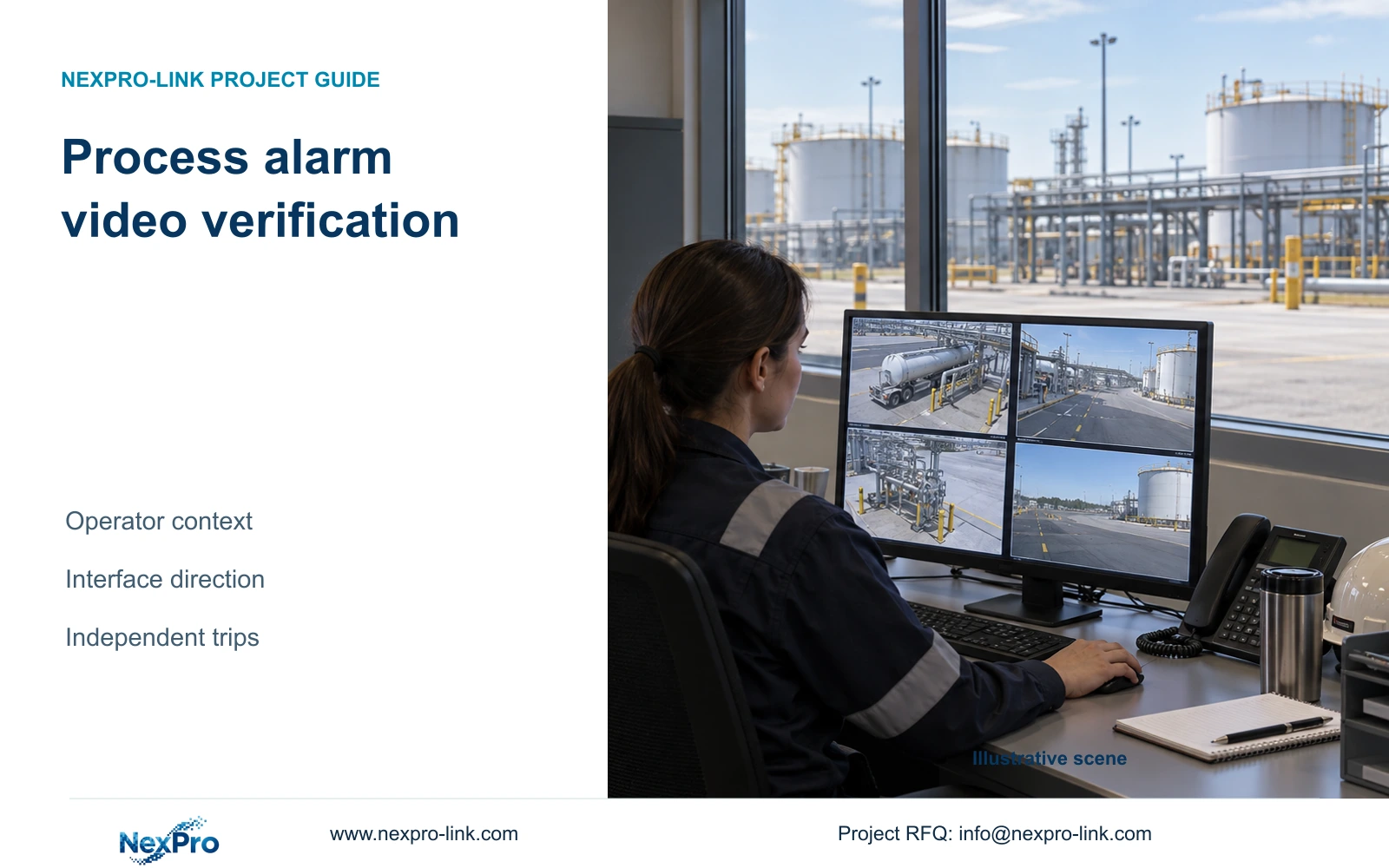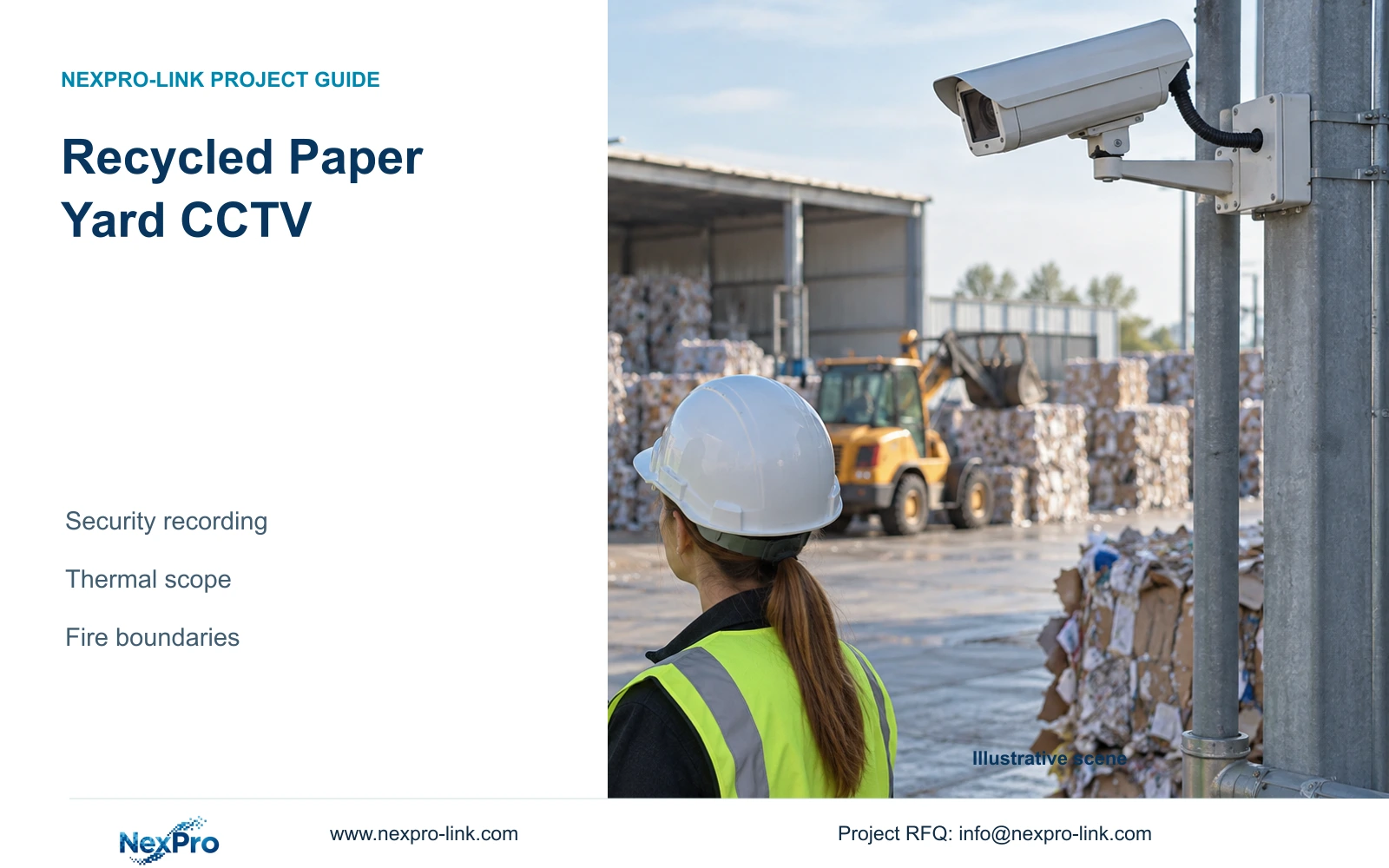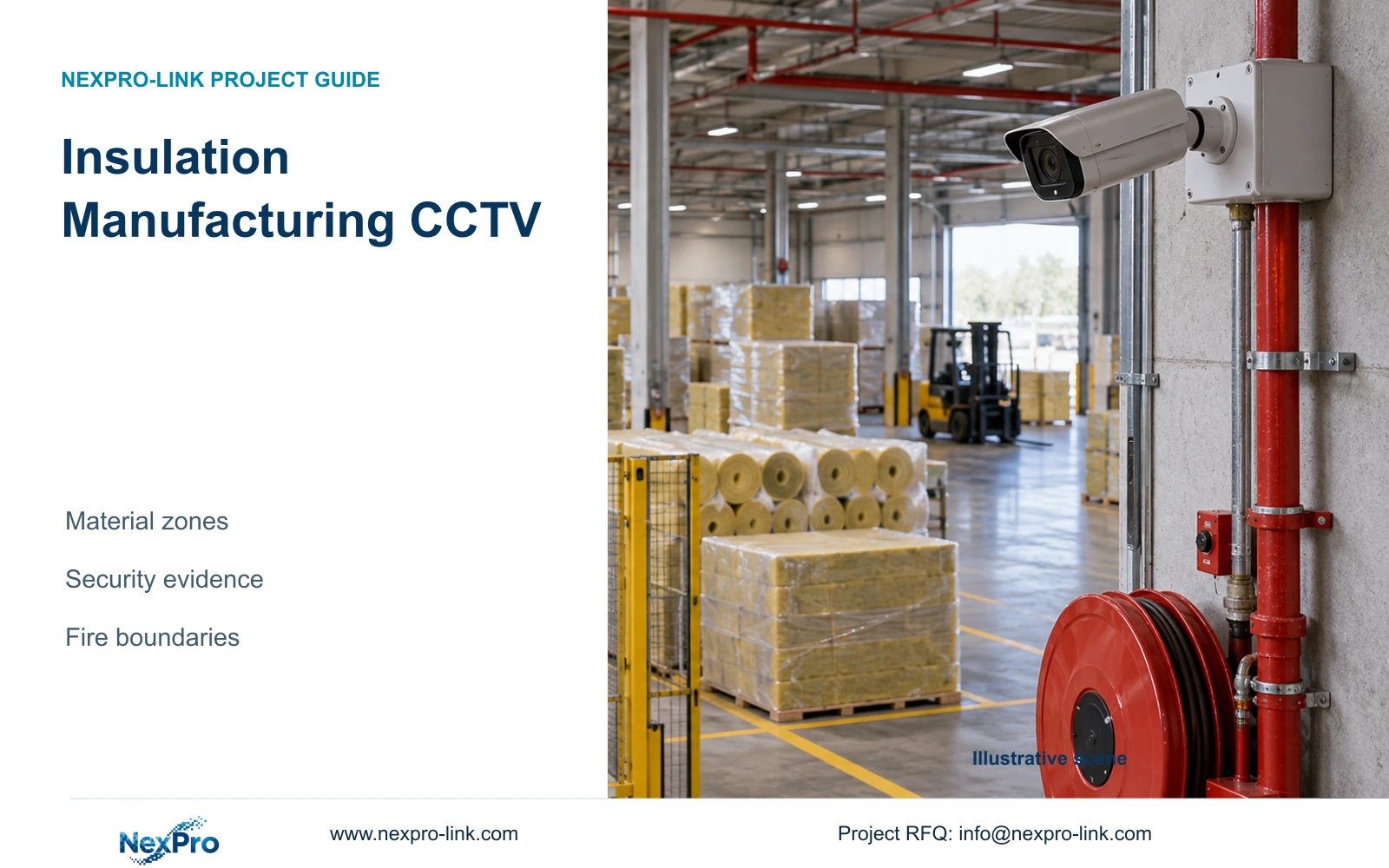
After a material-store use changes, ask the plant's responsible teams to confirm the affected location conditions and protective-system scope. Recheck only the linked camera positions and interfaces, while retaining independent fire protection.
Section 01
Keep fire protection independent while defining security views
After a material-store use changes, ask the plant's responsible teams to confirm the affected location conditions and protective-system scope. Recheck only the linked camera positions and interfaces, while retaining independent fire protection. Record unchanged, revised and unresolved responsibilities. A useful security image cannot close a missing specialist assessment.
The supplied ordinary CCTV references do not establish a replacement for fire detection or required protective systems in an insulation-products plant. Keep those systems independent and specify CCTV for access and handling context. Determine the actual material-zone conditions before selecting cameras, with specialist observation or detection functions treated as separate requirements.
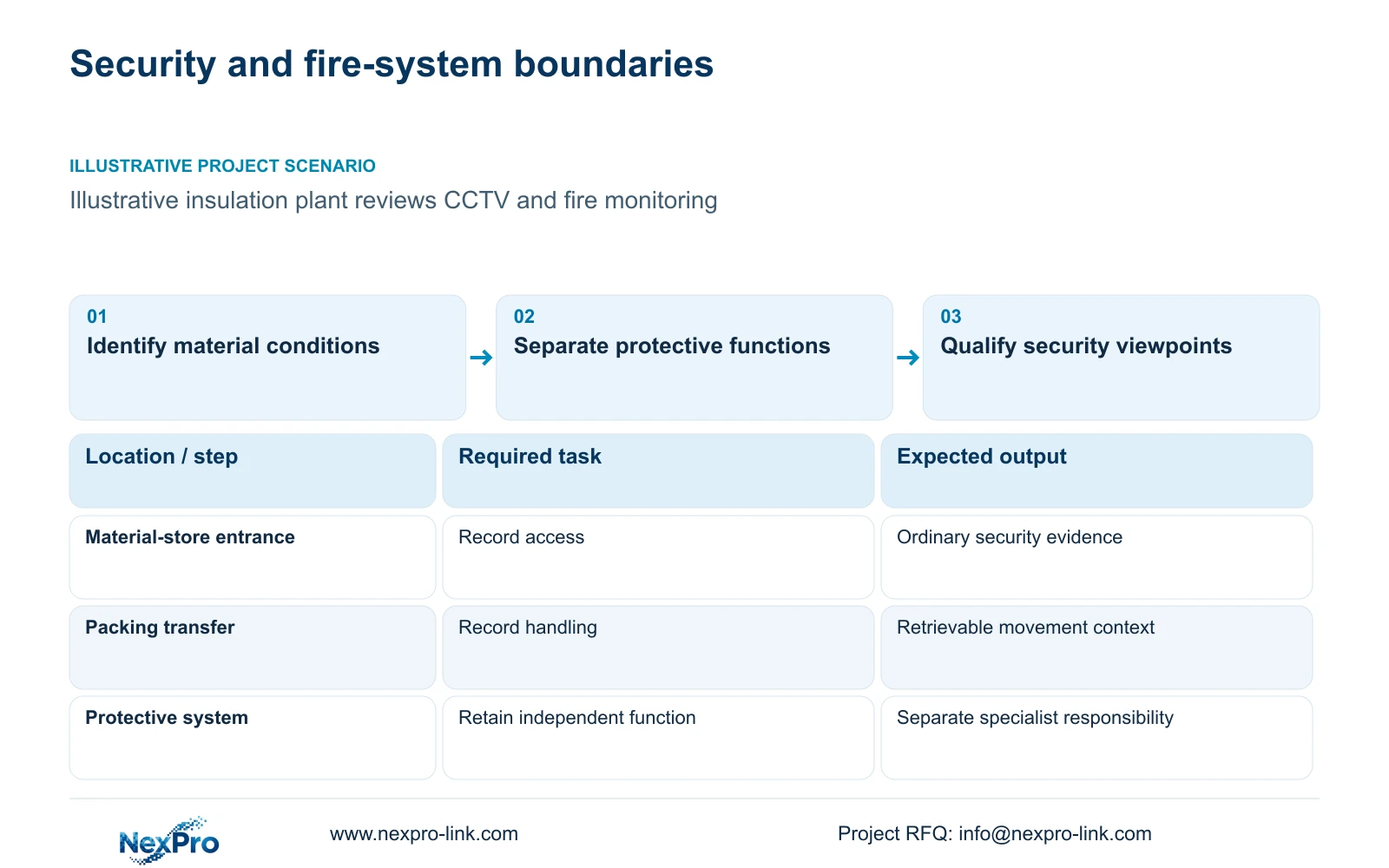
Illustrative project scenario: An insulation-products plant asks whether cameras can replace part of its fire monitoring. Assume the review also includes material-store access, a packing transfer and a suitable security service room. The proposed CCTV task is to record movement and support authorised review. No fire-detection performance or approved protective-system substitution is assumed.
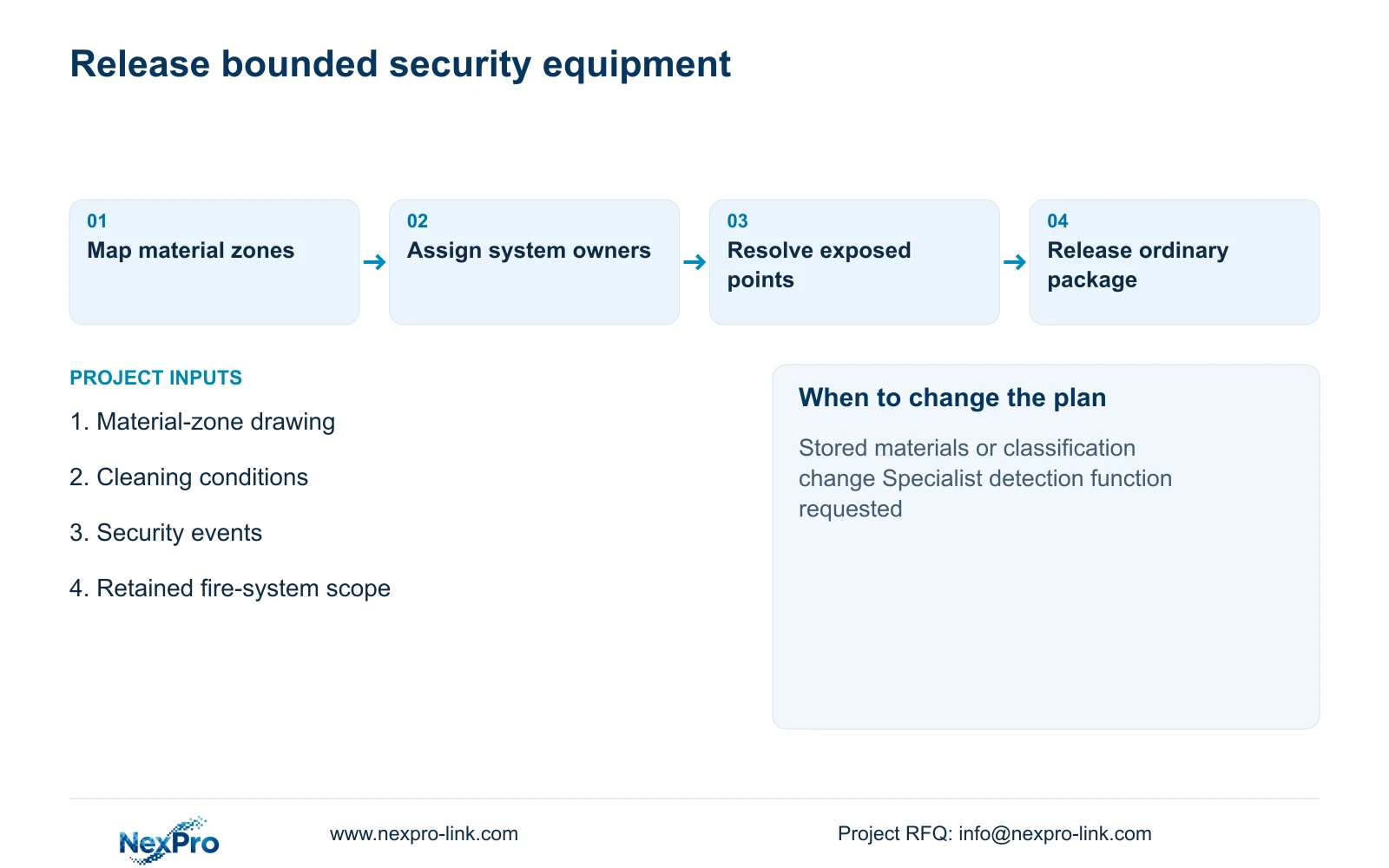
Ask the plant team to identify the actual materials, process boundaries, dust, radiant heat and cleaning conditions. The word insulation does not provide an environmental classification. Record each proposed camera position against the responsible team's assessment, and leave unresolved areas separate from the ordinary equipment release.
Section 02
Separate observation, alarm context and protective action
Write a function schedule distinguishing recorded security video, optional alarm-related viewing and the independent protective action. A guard may use footage to understand activity at a named material zone, but that workflow does not establish automatic fire detection, an approved alarm response or a safety trip.
If the owner wants an existing alarm to call up a relevant view, identify the alarm source, camera mapping, operator action and supported interface. Keep any automatic integration provisional until the exact equipment and software operation are demonstrated. Do not assume the camera's ordinary analytics or a network connection supplies the required specialist function.
Give the protective-system designer ownership of its detection and action scope. The CCTV integrator should own security recording and the agreed viewing workflow. Where laws or approval requirements affect the boundary, the responsible local team must verify current applicable requirements before changing the protective system; this article supplies no legal approval.
Section 03
Limit ordinary cameras to qualified access and handling positions
Select ordinary security tasks at observable boundaries: entry to a material store, release from packing or movement along a common route. Identify the event, stock obstruction and light state for each view. Large material stacks can hide a handover even when the camera itself is mounted in a suitable environment.
The supplied BL2812M55 and DM2812M55 Dome references list 2880×1620 output, 25fps, a 2.8 to 12mm motorized lens, PoE, IP66 and minus 20 to plus 60°C. Those fields support candidate selection for suitable ordinary locations. They do not establish flame detection, temperature measurement, explosion protection or chemical compatibility.
Place recorder, access switches and batteries in suitable accessible service areas. CASE01 provides a reference separation between the ordinary camera task, local recording, authorised clients and protected power nodes. Its 32-point CNC schedule is an illustrative method, not evidence that this insulation plant needs the same quantity or that CCTV infrastructure can serve its protective systems.
Section 04
Qualify the complete location and product scope
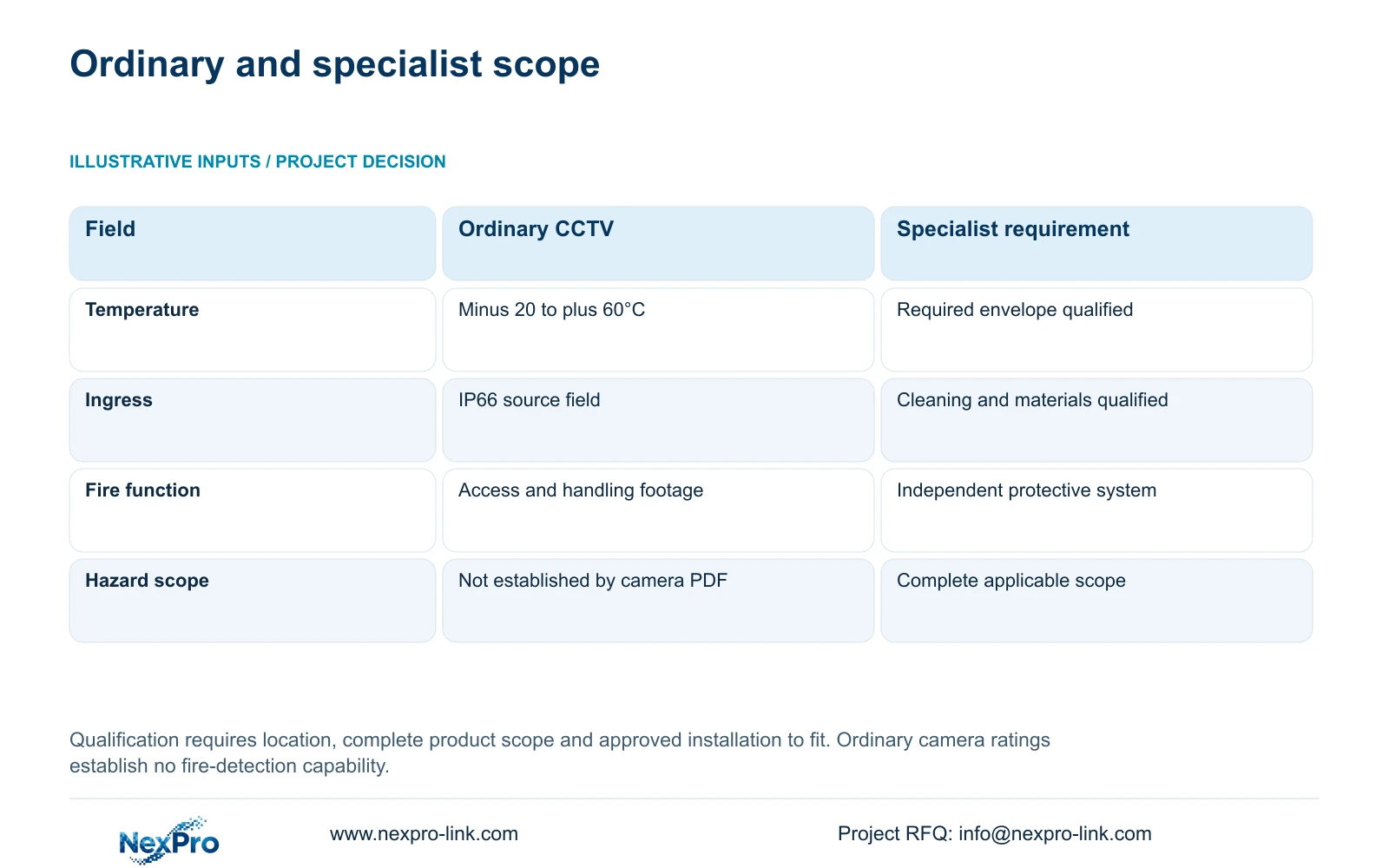
Apply the supplied conjunctive rule: location conditions AND complete product scope AND approved installation requirements must fit. The following matrix turns that rule into procurement choices for the illustrative material-store and packing tasks. Passing one catalogue field cannot override another unmet condition.
The decisive separation is between a qualified ordinary observation position and a position or function requiring additional evidence. IP66 is not proof of industrial cleaning compatibility, explosion protection or a fire-system role. A housing change alone should not be recorded as resolving those requirements.
If the ordinary position remains acceptable, release it with its required event and service method. If relocation preserves the task, price the changed mounting and link route. If the required function or exposure exceeds the supplied scope, retain a separately qualified specialist package and keep the ordinary recording node outside unsuitable conditions.
| Decision field | Ordinary security scope | Additional specialist scope |
|---|---|---|
| Temperature | Listed minus 20 to plus 60°C envelope | Actual required envelope separately qualified |
| Ingress and cleaning | IP66; cleaning method checked | Materials and exposure explicitly supported |
| Hazard protection | Ordinary location confirmed | Complete applicable protective configuration |
| Fire function | Access and handling footage | Independent detection and protective system |
| Infrastructure location | Accessible suitable service room | Ordinary nodes outside unsuitable zones |
Section 05
Compare packages without deleting the protective-system allowance
Recommend a defined ordinary CCTV package for access and material-handling evidence, alongside the independently retained protective system. Quote specialist functions separately where the responsible design requires them. This lets the owner approve useful security coverage without interpreting camera procurement as approval to remove part of fire monitoring.
Compare bids using the same observation events, environmental conditions and service boundaries. An offer including a specialist detector or approved integration cannot be normalised by simply substituting an ordinary camera. Keep that required function in every comparison, with its supporting installation and acceptance work visible.
Define the recording period, actual stream modes and local power objective for the CCTV package. Avoid attaching the security UPS to unspecified protective loads. A guardroom monitor can support review; any optional display wall has separate viewing, decoding and power requirements. Larger displays do not establish a more capable protective system.
Section 06
Release a responsibility schedule with each equipment group
Use separate BOQ headings for ordinary CCTV, exposed-position exceptions, proposed viewing interfaces and independent protective systems. Mark each item supplied, retained, optional or unresolved. The owner should approve the security task, the local designer the installation boundary and the protective-system party any change affecting its scope.
NexPro-Link's factory project supply and BOQ support can assist with ordinary equipment matching, coordinated lists and relevant technical submittals. Project-labelled packing can group units by material-store access, packing transfer and service node. The supply discussion should preserve the specialist exceptions instead of treating every plant position as an ordinary camera location.
Commission security recording by retrieving representative access and handover events. Test any agreed interface as its own workflow and record what happens when it is unavailable. A successful CCTV demonstration does not approve the protective system. Changes in stored materials or area conditions should reopen the affected qualification and responsibility records.
Section 07
Buyer questions
Can an operator watch cameras as part of an alarm response? A defined viewing workflow can provide context where the project approves it. It should state the relevant view and operator action while preserving independent detection and protective functions.
Does human and vehicle classification provide a fire-monitoring function? No fire-monitoring capability is established by that ordinary classification feature. A required specialist function needs its own supported equipment, configuration and acceptance scope.
Can ordinary cameras be ordered before every specialist point is resolved? Yes, when their locations and tasks are independently qualified. Keep unresolved points excluded from that release and identify the party responsible for resolving each one.
Section 08
Define the security and protective-system boundary
Send your material-zone drawing, environmental and cleaning assessment, required access or handling events, and retained fire-system scope to info@nexpro-link.com for an ordinary-area CCTV package discussion.
Engineering references
These sources support the general planning principles. Always use the selected product's current datasheet and applicable project standards for final design.