Build a segment register containing the crossing task, target/background conditions, visible verification view and operator response. Compare mixed and uniform proposals against that same register.
Section 01
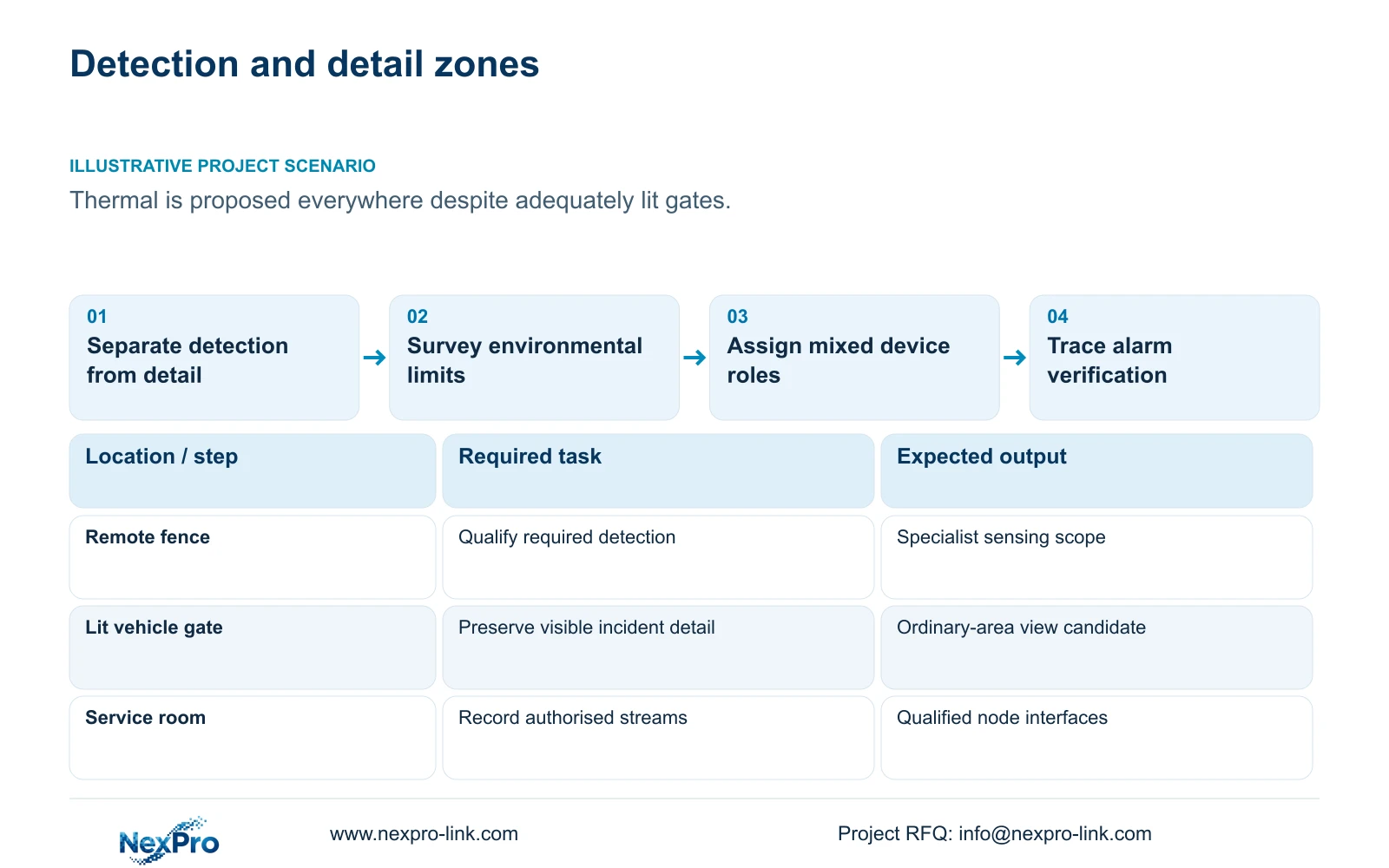
Separate the detection task from the identification view
Build a segment register containing the crossing task, target/background conditions, visible verification view and operator response. Compare mixed and uniform proposals against that same register. Mark an unverified detection segment separately from a missing identification view; one successful gate trial cannot qualify remote fence segments with different conditions.
Choose specialist thermal sensing where the defined perimeter detection task justifies it, while retaining visible detail views wherever the owner needs identification or incident context. Evaluate each fence segment separately. A proposal that uses thermal cameras everywhere should explain the required outcome at each position, including adequately lit gates, rather than relying on the technology label as its justification.
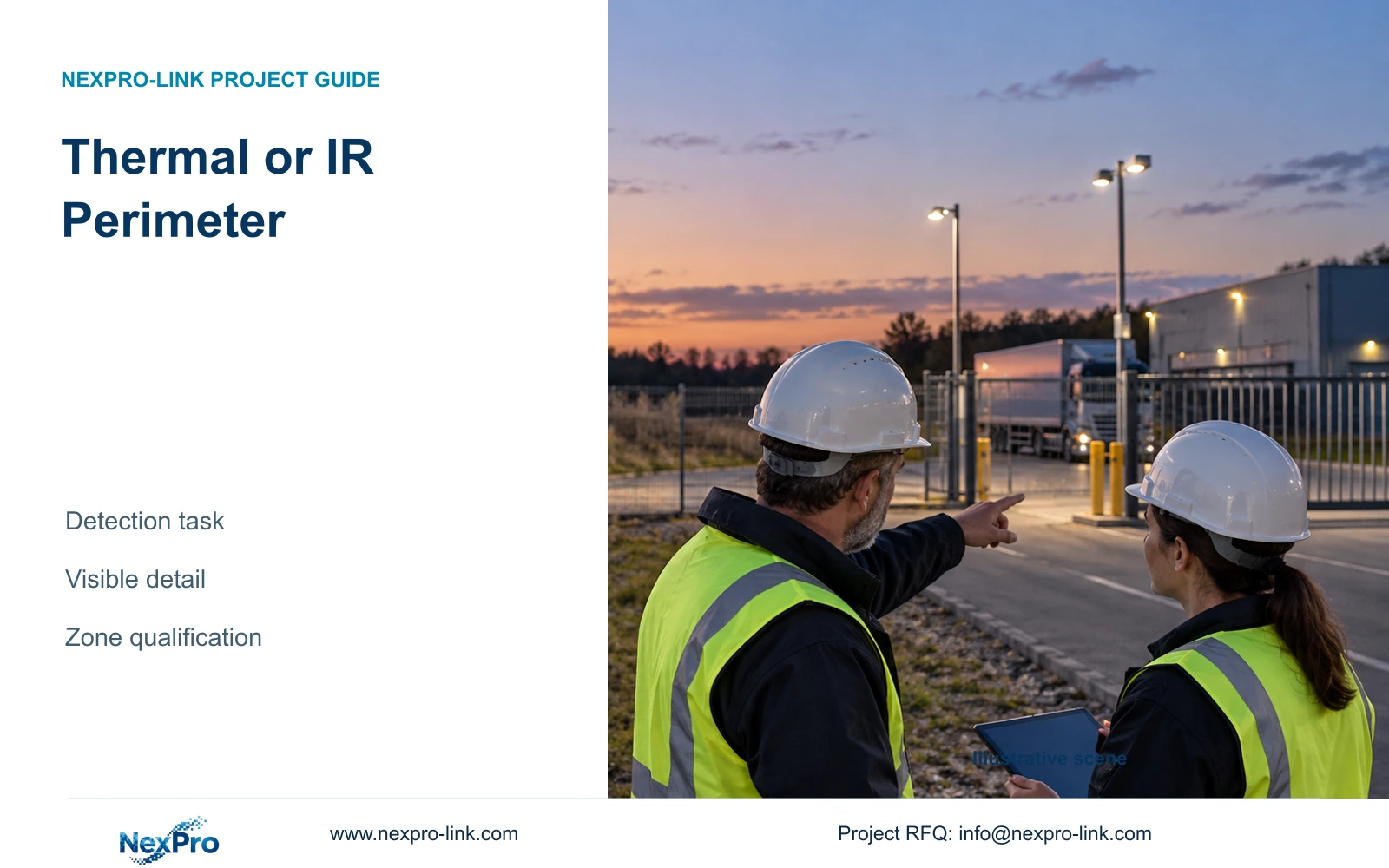
Illustrative project scenario: A remote fence proposal offers thermal cameras at every point although some gates have adequate lighting. Assume the owner wants an alert for activity at the remote boundary and useful recorded context at staffed entrances. Those hypothetical requirements create different equipment roles. The design engineer must confirm the actual crossing areas, lighting and operator response before accepting a uniform front-end package.
Write separate acceptance questions: did the selected sensor produce the required detection event, and can the associated image explain what happened? Keep plate reading and barrier safety under their own qualified equipment scope. No thermal model specification is supplied here, so detection ranges, analytical functions and environmental performance must remain explicit supplier inputs.
Here, IR means a day/night visual camera using near-infrared illumination, not a thermal imager. Axis's IR in Surveillance white paper distinguishes reflected near-infrared light from emitted thermal radiation. Its Thermal Cameras paper also notes that weather can reduce detection range and thermal images generally cannot identify a specific person. For this procurement decision, compare detection and usable visible detail separately: qualify illuminator coverage for the IR view and target/background contrast for the thermal view. These principles do not establish a NexPro-Link thermal capability or a site-specific range.
Section 02
Survey environmental limits before comparing technologies
For the remote fence, record terrain, vegetation, structures, night lighting and the target movement path. Ask suppliers to identify the conditions under which their proposed detection task is supported and what obstructions remain. Do not accept an all-weather or through-obstruction promise without the exact product and task evidence. A physical sightline problem may require relocating the sensor or changing the observation arrangement.
At the lit gates, review recorded visible images under actual headlights, shadows and vehicle movement. Adequate general lighting does not automatically prove adequate detail at the required position. The gate may need a narrower fixed view in addition to its overview, or a dedicated plate device. Keep these choices independent of whether the remote fence uses a specialist detector.
Environmental suitability is another decision. Identify condensation, corrosion, cleaning exposure and any classified location separately from optical performance. A device that performs the sensing task can still be unsuitable for installation at that position. Record unresolved conditions in the zone schedule so the quotation does not silently treat them as ordinary outdoor service.
Section 03
Build a mixed plan with named alarm and video owners
A practical mixed baseline assigns qualified specialist detection to the remote segment where it is justified, ordinary visible overview to suitable areas and dedicated detail to critical entrances. The sensor supplier must state the exact device, detection function and supported interface. The CCTV package must state the recording and viewing role. The owner defines who receives an alarm and what action follows it.
Develop an interface schedule for detection events, associated live view, playback and export. An event reaching a client does not establish that it is indexed or searchable in the recorder. ONVIF profiles provide a framework for checking exact device and client applicability, but required functions still need verification on the selected firmware. Price any middleware or platform work separately.
CASE08 supplies an architectural reference for local recording and authorised clients across four independent nodes. Its front-end schedule contains ordinary cameras, not qualified thermal devices. Use the distributed-node method while replacing stream, compatibility and demand inputs for each specialist addition. Shared fibre should preserve the approved ownership boundary rather than expose every view to every tenant.
Section 04
Apply every location requirement to the complete device
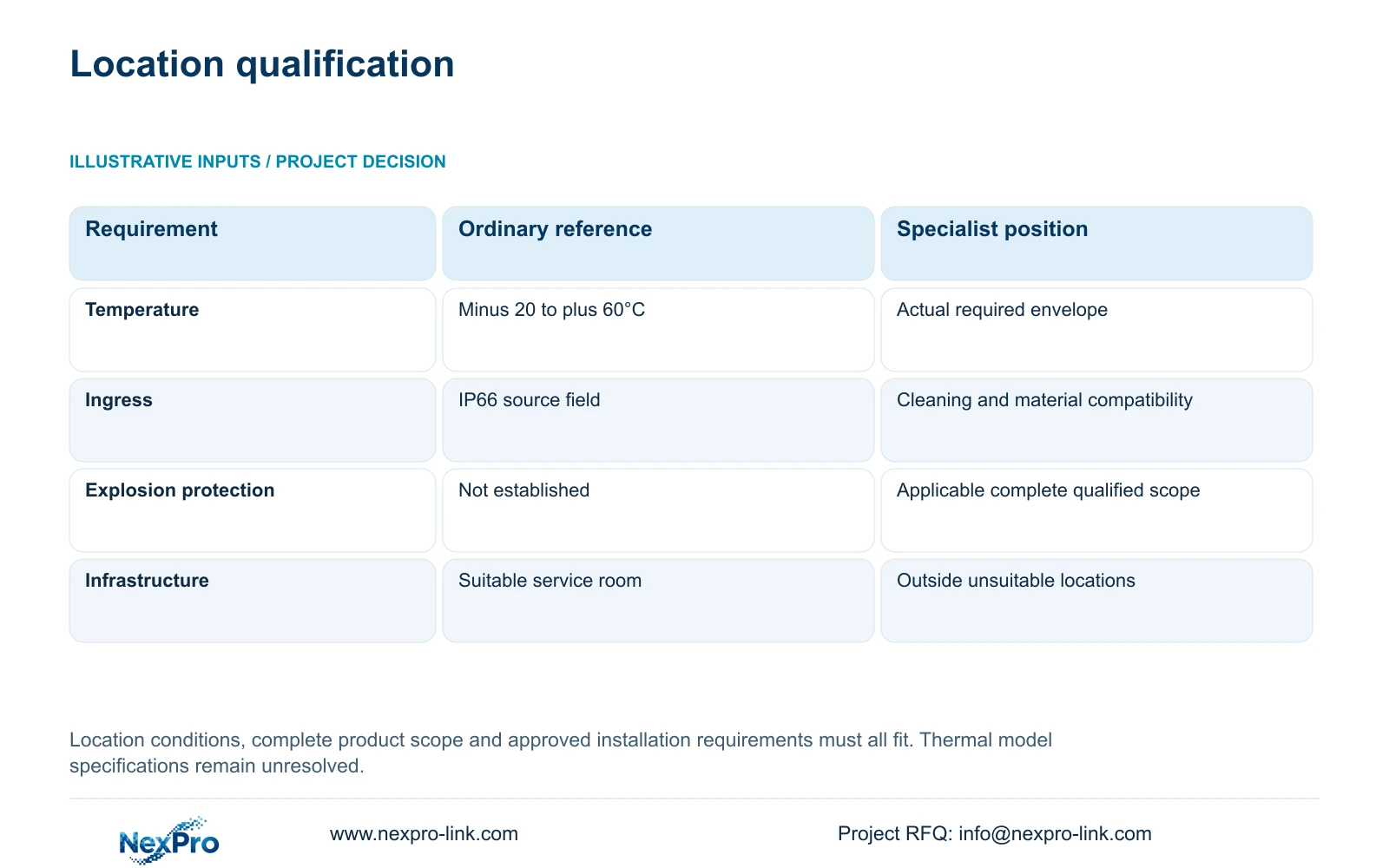
The supplied ordinary BL2812M55 and DM2812M55 references list IP66 and an operating range of minus 20 to plus 60°C. Those fields support consideration at suitable ordinary locations. They do not establish thermal sensing, chemical resistance, washdown compatibility or explosion protection. The purchasing rule is conjunctive: location conditions AND complete product scope AND approved installation requirements must fit.
The filled matrix separates normal-area candidates from positions that require further specialist qualification. Its decisive difference is the complete required scope, not whether the housing is metal or the camera uses PoE. At a classified position, the relevant qualified designer must establish the applicable location and installation requirements, with current local requirements verified before procurement. No jurisdiction-specific obligation is inferred from the supplied archived material.
Keep recorders, switches and batteries in suitable accessible service locations where possible. An approved specialist camera does not automatically qualify its power supply, connectors or surrounding cabinet. Conversely, a specialist sensing requirement at one remote segment does not require replacing ordinary gate equipment that already meets its accepted task and environment.
| Decision | Suitable ordinary location | Specialist position |
|---|---|---|
| Temperature | Check minus 20 to plus 60°C reference | Match actual required operating envelope |
| Ingress and cleaning | IP66 field; verify site exposure | Qualify cleaning and material compatibility |
| Explosion protection | Not established by ordinary source | Applicable complete certified scope required |
| Recording infrastructure | Accessible suitable service room | Keep ordinary infrastructure outside unsuitable zone |
| Price comparison | Accepted normal-area task | Retain necessary specialist scope |
Section 05
Recommend the mixed plan only where its tasks remain complete
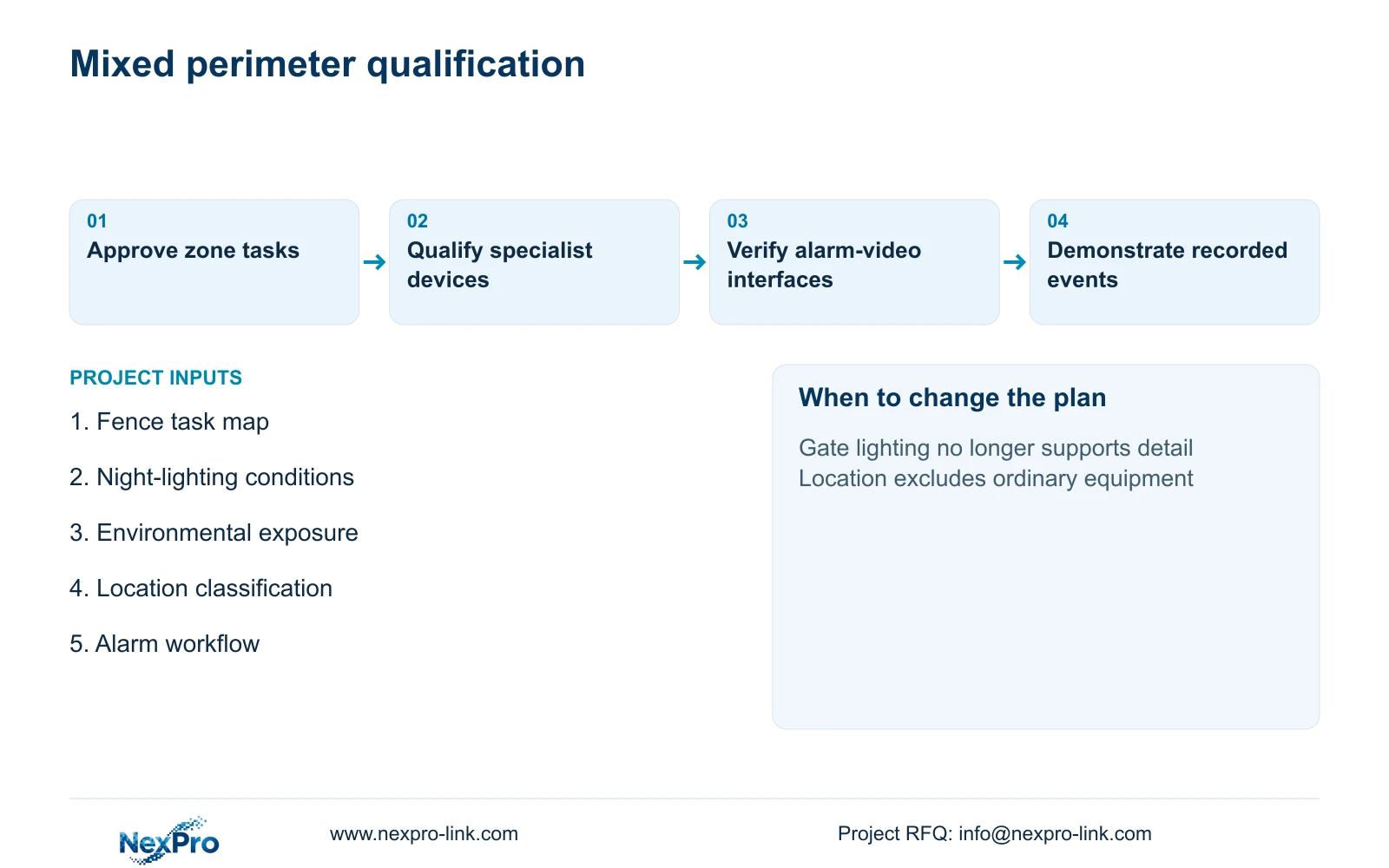
Prefer a mixed front-end plan when remote detection and lit-gate detail have different needs. Retain specialist sensing wherever the approved detection requirement demands it, and use ordinary visible cameras only where their view and installation conditions fit. Change the recommendation if a gate's lighting becomes unreliable, the response task changes or a site qualification excludes the ordinary equipment.
Compare a uniform thermal proposal and a mixed proposal using the same detection zones, required context, recording period and operator workflow. Include specialist interfaces, mounting, power, service and software in both offers. No matched quotation or field trial is supplied, so the comparison cannot establish a price saving, detection winner or false-alarm rate. Require departures from the agreed task to appear as explicit deviations.
For ordinary detail, the NexPro-BL2812M55-5MP-DIC-AI lists 2880×1620 output and a 2.8–12mm motorized lens. Use those source fields for framing discussion without inferring recognition distance. For specialist sensing, request its own supported geometry and demonstration. The two procurement lines serve different tasks and should not be treated as equivalent merely because both transmit video.
Section 06
Prepare a zone-based equipment and acceptance schedule
Issue a gate/perimeter task map identifying remote detection zones, lit entrances, required detail and unsuitable installation positions. Include local copper routes, fibre endpoints, recorder assignments and the actual AC source at each node. Obtain specialist maximum demand and power-interface requirements before choosing PoE capacity or backup. A central UPS does not protect an independently powered remote cabinet through the data backbone.
Acceptance should demonstrate the agreed target movement, alarm receipt, operator verification and recorded retrieval for each relevant zone. Test visible gate footage independently from the specialist detection event. Record environmental or lighting conditions that were not represented in the demonstration, and identify how the owner will review those unresolved conditions before final acceptance.
NexPro-Link can support suitable ordinary-area CCTV selection, coordinated recording equipment, technical documentation and project packing. Specialist sensing and any special installation scope remain named, qualified responsibilities. This lets procurement retain the necessary specialist package while seeking a clear ordinary-area alternative, without converting a standard camera into a capability absent from its specification.
Section 07
Buyer questions
Can a thermal detection view replace a gate detail camera? Only if it independently satisfies the approved detail task, which is not established by the supplied sources. Preserve a qualified visible view whenever the gate investigation needs detail that the detection package has not demonstrated.
Should environmental qualification wait until after the lowest bid is selected? No. Excluding necessary environmental scope makes the initial comparison misleading. Identify the unsuitable or specialist positions before requesting comparable offers.
How should the buyer handle an unsupported all-weather claim? Request the exact model, declared task conditions and a demonstration relevant to the site. Keep unproven conditions visible as unresolved inputs rather than accepting them as a performance guarantee.
Section 08
Compare sensing by perimeter zone
Send the fence task map, day and night conditions, environmental or classification information, and required alarm-to-video workflow to info@nexpro-link.com for a mixed ordinary and specialist scope discussion.
Engineering references
These sources support the general planning principles. Always use the selected product's current datasheet and applicable project standards for final design.