After each visit, compare the finding with the previous intervention and exposure record. Propose an interval or mounting change only for the affected condition, then check whether it preserves the accepted view.
Section 01
Set inspection tasks from exposure and view usefulness
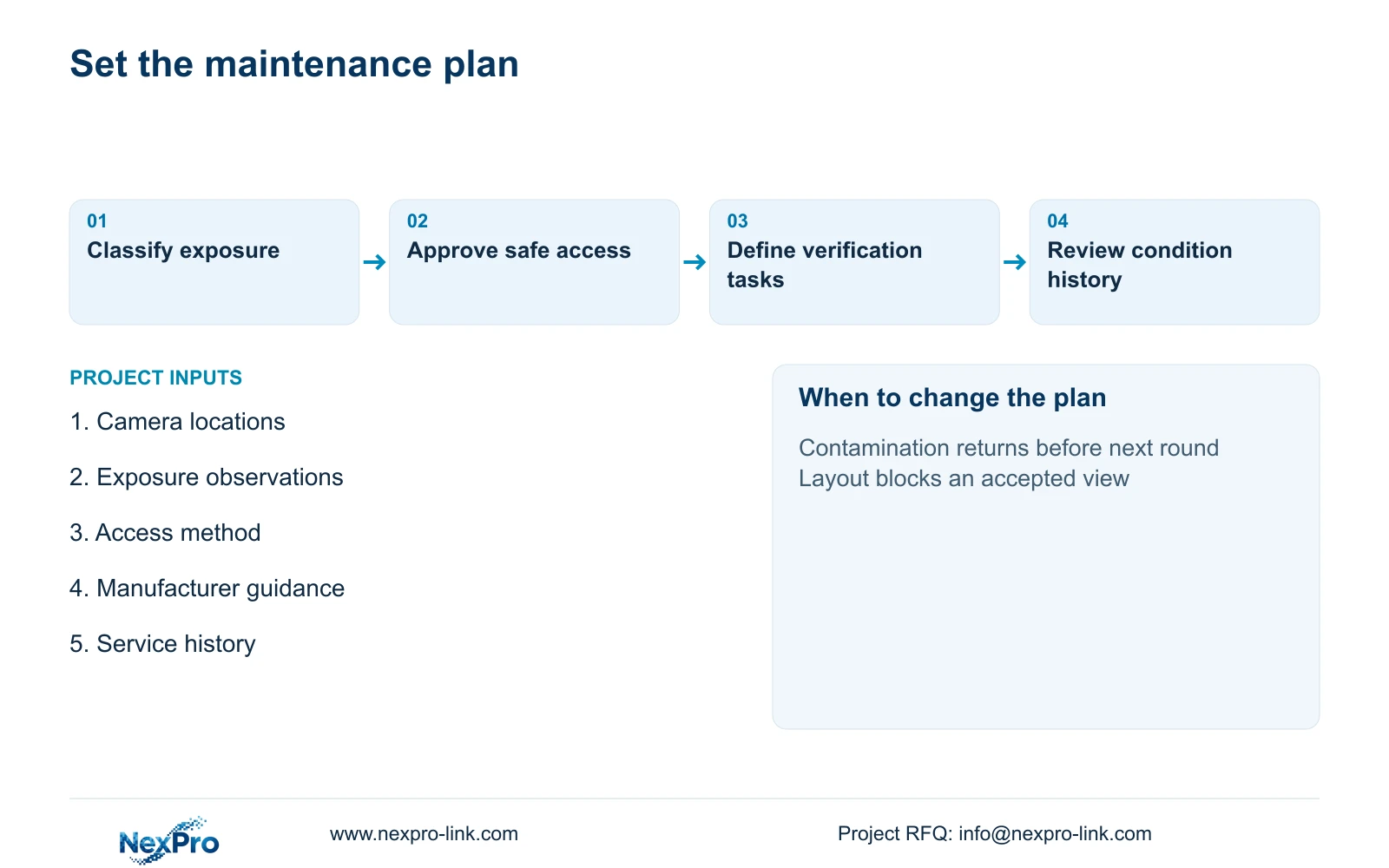
After each visit, compare the finding with the previous intervention and exposure record. Propose an interval or mounting change only for the affected condition, then check whether it preserves the accepted view. Retain the owner's approval and manufacturer instructions. One clean inspection cannot establish a universal schedule for other camera locations.
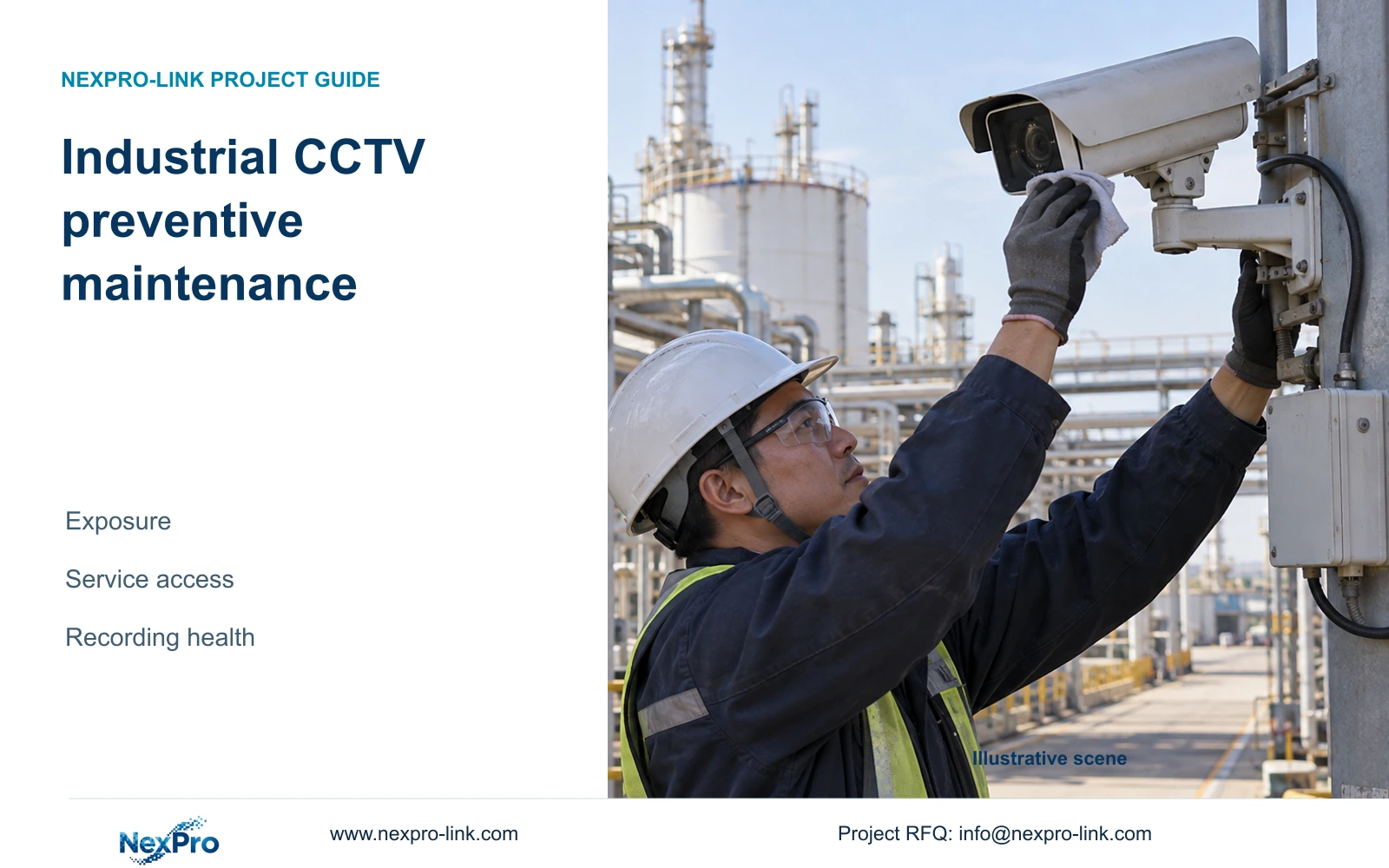
Set industrial CCTV preventive maintenance tasks and intervals from the site's exposure, manufacturer guidance and operating history. Inspect whether the required event remains visible, not simply whether a camera is online. A generic quarterly visit may be a planning starting point, but it does not establish a suitable interval for every location or prevent every failure.
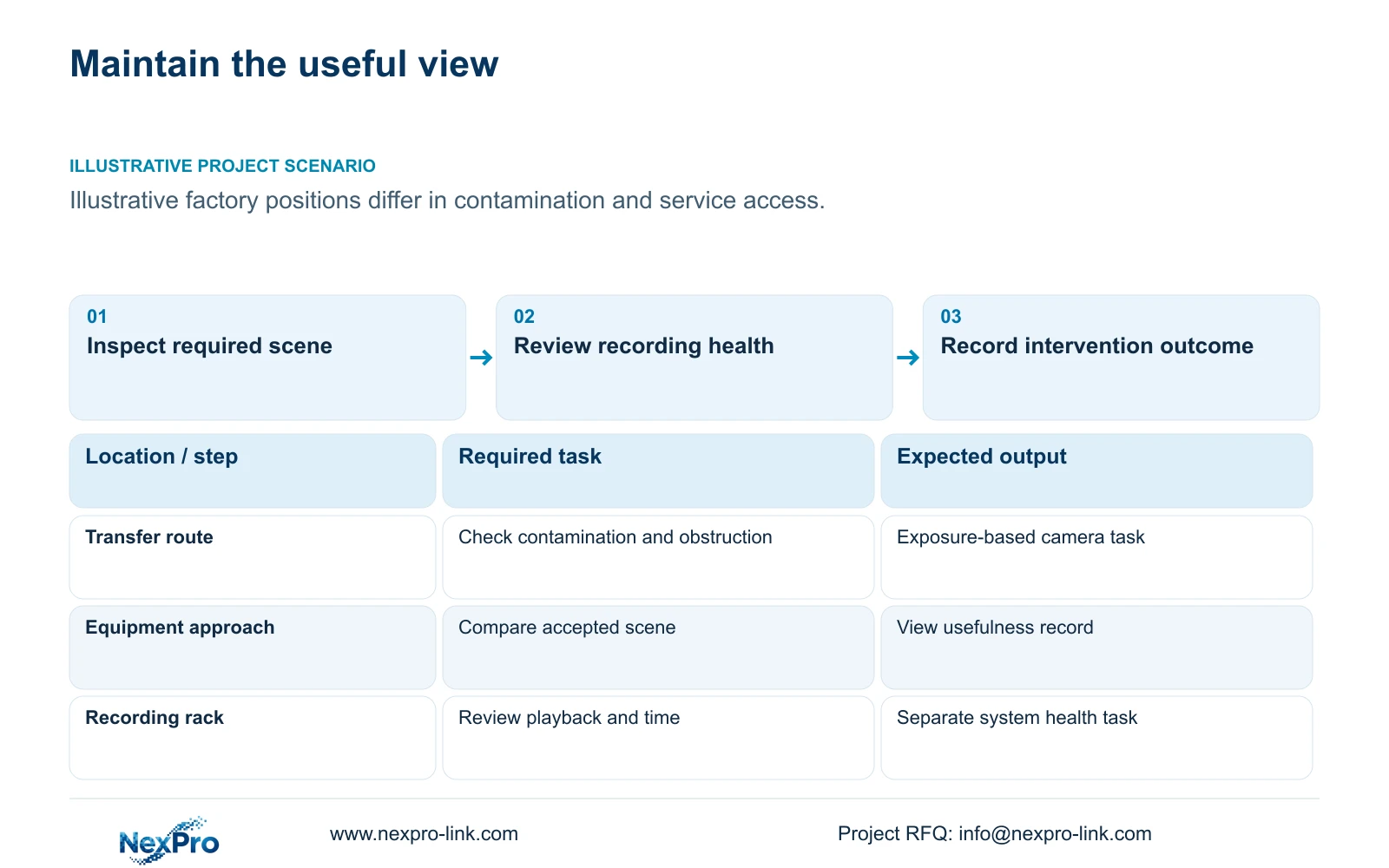
Illustrative project scenario: Camera cleanliness and service access vary substantially across the plant. Use the supplied 32-camera CNC reference for the overall ordinary-area system, and a separate 24-camera teaching group for the access-effort comparison. Assume permitted transfer routes accumulate different levels of contamination from sheltered approaches. No inspection results or cleaning productivity have been measured.
For each position, record the observation task, visible contamination, changing obstructions and safe access method. Compare a current image with the accepted scene under relevant operating conditions. Distinguish a dirty optical surface from a moved bracket, changed lighting or a new stack blocking the subject. Each condition requires a different intervention and a different follow-up check.
Section 02
Check recording, time and protected power as separate tasks
Include playback and retrieval checks in the maintenance plan. Review recent recording for required channels, the oldest accessible footage and any gaps reported by operators. Check the relevant schedule and storage status before attributing a gap to camera hardware. Time alignment matters when video must be matched with a gate, dispatch or material-transfer record.
The CNC reference plans 30 days of continuous recording, but that design target is not evidence of achieved retention. Verify the installed outcome against the accepted stream settings and actual use. NexPro-NVR4449-4K is the reference recorder; four disk bays establish a capacity arrangement, not RAID protection or proof that stored footage remains available.
Review the protected power chain separately from routine lens inspection. Confirm the equipment actually connected to the UPS and inspect relevant alarms or service records through the responsible party. NexPro-Link's rack UPS capacities do not establish runtime. Any discharge test or electrical intervention needs its own approved procedure, battery configuration and site coordination.
Section 03
Record the intervention and its operational result
Use one service entry per affected role or device, with date, project tag, observed condition, authorised task and result. Record settings or hardware changes so later faults can be compared with a known state. A note saying 'camera cleaned' is incomplete if the handover detail remains unreadable afterwards or the required night view has not been checked.
Separate inspection, cleaning, alignment, cable correction and component replacement in the work record. Follow the selected equipment's instructions for handling and cleaning; do not invent a universal chemical or pressure-wash method. Site personnel should define access, isolation and production constraints. A maintenance contract must identify which party supplies the necessary access resources.
Retain unresolved conditions with an owner and next action. If contamination recurs before the next planned round, review positioning, exposure and interval rather than repeatedly recording the same intervention as complete. These records also support a focused warranty or RMA discussion, while routine maintenance labour remains separate from the hardware remedy unless expressly included.
Section 04
Calculate access effort before comparing service costs
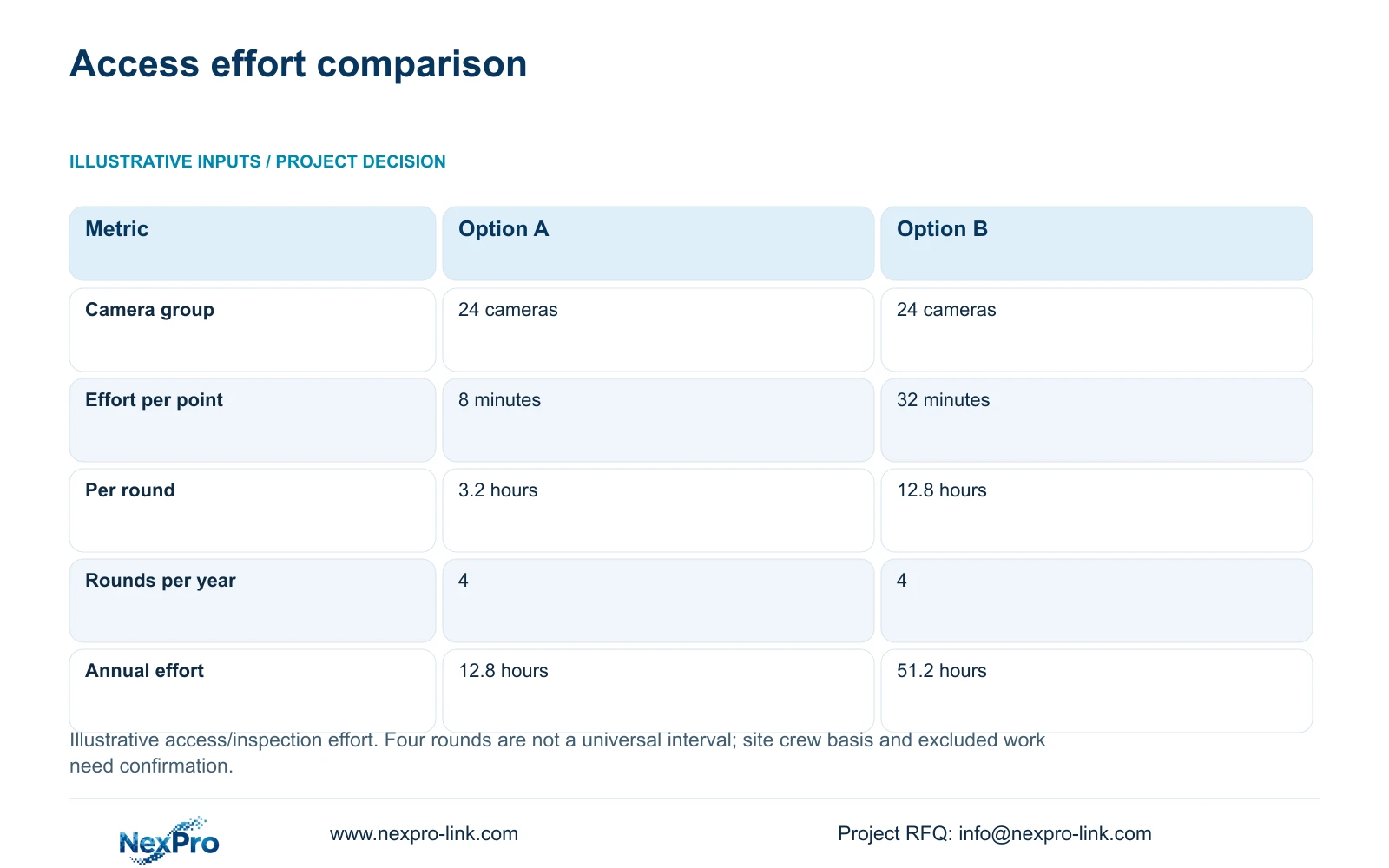
The supplied teaching comparison uses 24 cameras, assumed access/inspection effort of 8 versus 32 minutes per point, and four rounds per year. The formula is annual_hours = cameras × minutes_per_point × rounds / 60. Option A gives 24 × 8 × 4 / 60 = 12.8 hours/year; Option B gives 24 × 32 × 4 / 60 = 51.2 hours/year.
For one round, the corresponding calculations are 24 × 8 / 60 = 3.2 hours and 24 × 32 / 60 = 12.8 hours. The decisive input is the time required to reach and inspect the point. Identical camera purchase prices can therefore coexist with materially different service effort. The illustrative annual difference is 51.2 − 12.8 = 38.4 hours.
Replace the minutes and frequency with the site's approved plan before pricing. Clarify whether measured effort is elapsed time or labour-hours for a stated crew, and add excluded activities such as mobilisation or equipment hire separately. Four rounds are an example, not a recommended universal interval. This calculation does not promise productivity, avoided failures or a financial return.
| Metric | Option A | Option B |
|---|---|---|
| Camera group | 24 cameras | 24 cameras |
| Assumed effort per point | 8 minutes | 32 minutes |
| Effort per round | 3.2 hours | 12.8 hours |
| Example annual rounds | 4 | 4 |
| Annual effort | 12.8 hours | 51.2 hours |
Section 05
Adjust intervals and mounts without losing the view
Prefer accessible mounting where it preserves the required scene and meets the installation conditions. The service-effort comparison gives the engineer a reason to evaluate access during design, not a reason to move every camera to the easiest wall. Check occlusion, detail and environmental exposure after any relocation before accepting the maintenance benefit.
Set an initial inspection plan using manufacturer guidance and the site's known exposure, then refine it from recorded condition changes. A dusty transfer route may need a different inspection pattern from an equipment-room approach. An event-triggered check after a layout change or reported image degradation can supplement scheduled work without imposing the same physical intervention everywhere.
Change the equipment or maintenance approach when the location exceeds ordinary product suitability or cannot be serviced under acceptable conditions. The supplied ordinary camera ratings do not establish resistance to every industrial contaminant. Keep specialist requirements where needed. Compare service proposals using the same required tasks, access arrangements and evidence checks, with real quotations for cost conclusions.
Section 06
Prepare an exposure-based maintenance scope
Give the maintenance contractor a location schedule with the required view, exposure observations, access method and verification task. Separate camera-point work from recorder checks, cable testing and UPS servicing. State whether equipment, consumables, access hire and replacement parts are included or separately approved. Unknown scope should remain visible rather than disappearing into a single annual fee.
NexPro-Link can discuss equipment identification, replacement matching and technical documents within its project supply scope. The local service team remains responsible for site intervention and its approved methods. Use the agreed warranty terms to separate covered equipment remedies from maintenance visits, freight and installation labour.
At review, compare what each intervention achieved and whether the required recording task stayed usable between visits. Update the repeat-order configuration where a documented mounting, accessory or equipment change resolves an exposure problem. Keep unresolved issues in the service register so the next quotation addresses actual conditions instead of reproducing the original maintenance frequency unchanged.
Section 07
Buyer questions
Is an online camera sufficient evidence that maintenance is complete? No. Check the accepted scene and the relevant recording or retrieval task. Connectivity can remain available while contamination or obstruction makes the footage unusable.
Can the worked hours be used directly in a labour quotation? Only after replacing the assumptions with site-specific effort, crew basis and frequency. Identify mobilisation, access equipment and other excluded work before applying a labour rate.
Does IP66 mean any factory cleaning method is acceptable? No. Use the selected equipment's cleaning and handling instructions and evaluate the actual exposure. An ingress rating does not establish universal chemical or washdown suitability.
Section 08
Scope maintenance around actual exposure
Send your camera location schedule, contamination and access observations, recording-check requirements and local maintenance responsibilities to info@nexpro-link.com to discuss equipment and replacement support.
Engineering references
These sources support the general planning principles. Always use the selected product's current datasheet and applicable project standards for final design.