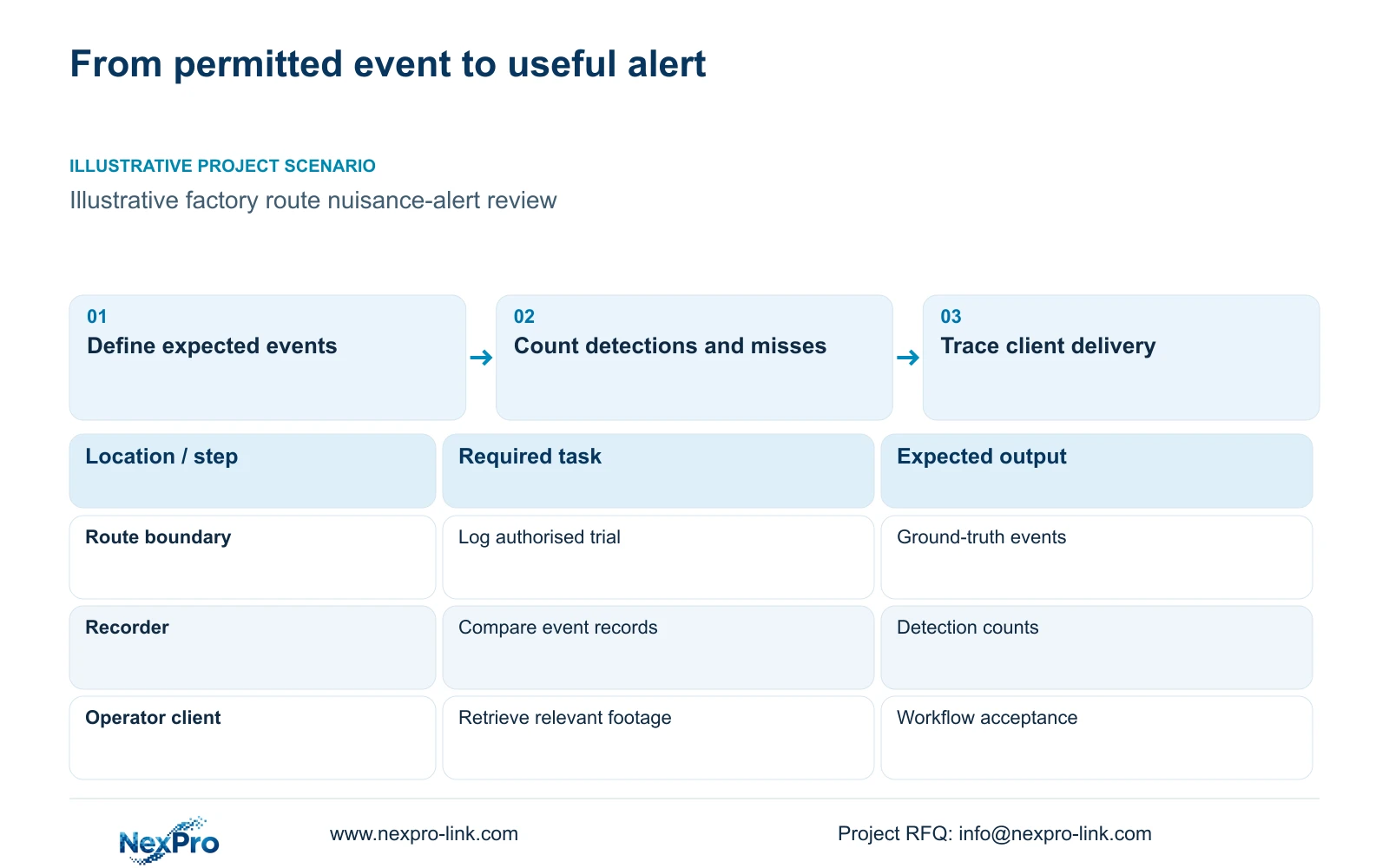
An authorised factory analytics trial should count expected events, nuisance alerts and misses, then trace each useful alert through the actual recorder and client.
Section 01
Define which events should produce a useful alert
Evaluate human and vehicle detection in factories with an authorised event-based trial whose expected outcomes are known. Count useful detections, nuisance alerts and missed events separately. People/vehicle classification does not establish identity recognition, plate reading or certified safety detection, so keep those requirements outside the ordinary surveillance acceptance task.
Illustrative project scenario: A buyer wants fewer irrelevant alerts from changing light and moving objects near a factory route. Use the supplied CNC reference for ordinary route and gate recording, and assume the owner wants alerts for defined activity during an agreed operating period. The event policy and trial results remain hypothetical.
Define the event boundary, permitted test movements and conditions under which an alert is expected. A person crossing the selected boundary may be relevant during one period but routine during another. The owner must resolve that policy before the engineer can distinguish an unwanted alert from a correct detection of authorised activity.
Section 02
Count misses alongside nuisance alerts
Prepare a ground-truth event log with time, target type, route and expected outcome. Compare it with the system event log and corresponding footage. A relevant event detected as expected is a true positive; a relevant event without the expected detection is a false negative; an unwanted detection is a false positive.
Agree how repeated notifications from one event will be counted. Otherwise, one configuration may look worse because it generates several alerts for the same movement while another groups them. Keep duplicate-notification burden visible as an operational issue even when the underlying detection is counted once.
Record results by relevant conditions, including representative lighting and partial obstruction. Do not combine every condition into a single attractive percentage that conceals a weak night or distant-view result. If settings change during the trial, retain separate results for the original and revised configurations so the comparison remains interpretable.
Section 03
Follow the event into the actual operator workflow
Check detection at the camera, event reception at the recorder or platform, notification at the intended client and retrieval of the relevant recording. A successful camera event does not establish that the operator receives a useful alert or can find the associated footage. Record those stages separately.
The supplied BL2812M series evidence includes human/vehicle classification context for ordinary security use. NexPro-Link's Seetong System page provides app and PC-client context, but does not establish universal mixed-brand event functionality. Where ONVIF is proposed, confirm exact device/client profiles and firmware; basic video connectivity does not prove the event workflow.
Assign camera configuration and model evidence to the supplier, recorder/client integration to the appointed integrator and alert policy to the owner. The resulting mixed-model schedule should retain ordinary recording while listing alert functions as qualified per location. Do not make continuous evidence dependent on an analytics feature that has not passed its workflow test.
Section 04
Compare precision and recall using the same event set
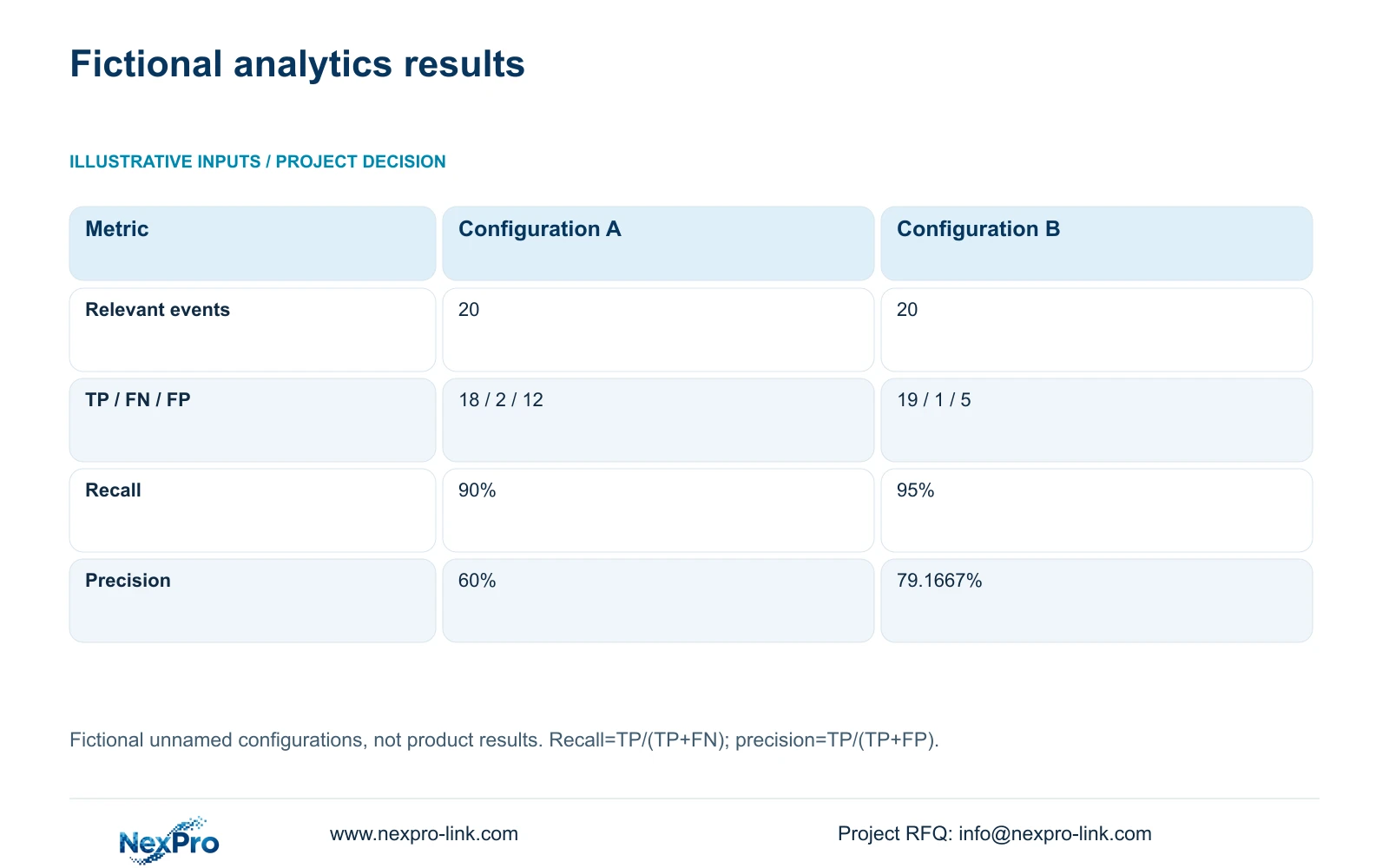
The fictional teaching dataset contains 20 relevant events. Unnamed configuration A detects 18, misses 2 and produces 12 false alerts. Configuration B detects 19, misses 1 and produces 5 false alerts. These are illustrative counts, not results from NexPro-Link or a competing product.
Recall = TP / (TP + FN). A gives 18 / 20 = 90%; B gives 19 / 20 = 95%. Precision = TP / (TP + FP). A gives 18 / 30 = 60%; B gives 19 / 24 = 79.1667%, rounded to 79.17%. A generates 30 total alerts and B 24 under this counting convention.
B has fewer false alerts and fewer missed relevant events in this fictional set. That makes it the preferable trial configuration on these measures, but does not establish field accuracy or a product winner. Replace all counts with the authorised trial and check the missed-event circumstances before approving the setting.
| Metric | Configuration A | Configuration B |
|---|---|---|
| Relevant events | 20 | 20 |
| True positives | 18 | 19 |
| False negatives | 2 | 1 |
| False positives | 12 | 5 |
| Recall | 90% | 95% |
| Precision | 60% | 79.1667% |
Section 05
Select a configuration the operator can use
Prefer the configuration that meets the owner's missed-event tolerance and produces a manageable set of useful alerts in the intended client. Do not select solely by the smallest false-alert count. A setting that suppresses unwanted events but loses important crossings may fail the task despite looking quieter.
Inspect misses before changing thresholds. If the event was obscured or too small in the image, adjust the view or add a justified detail point rather than expecting a sensitivity change to solve the geometry. Repeat the relevant trial after changing lighting, framing or detection rules.
Keep commercial consequences tied to the identified failure. The change may require configuration work, another camera, different software scope or integration services. The supplied 32-camera reference remains an ordinary recording baseline, not an analytics accuracy claim. Retain specialist safety and identity systems where the project requires them; surveillance analytics must not become worker scoring or machine protection.
Section 06
Freeze the event policy and evidence with the order
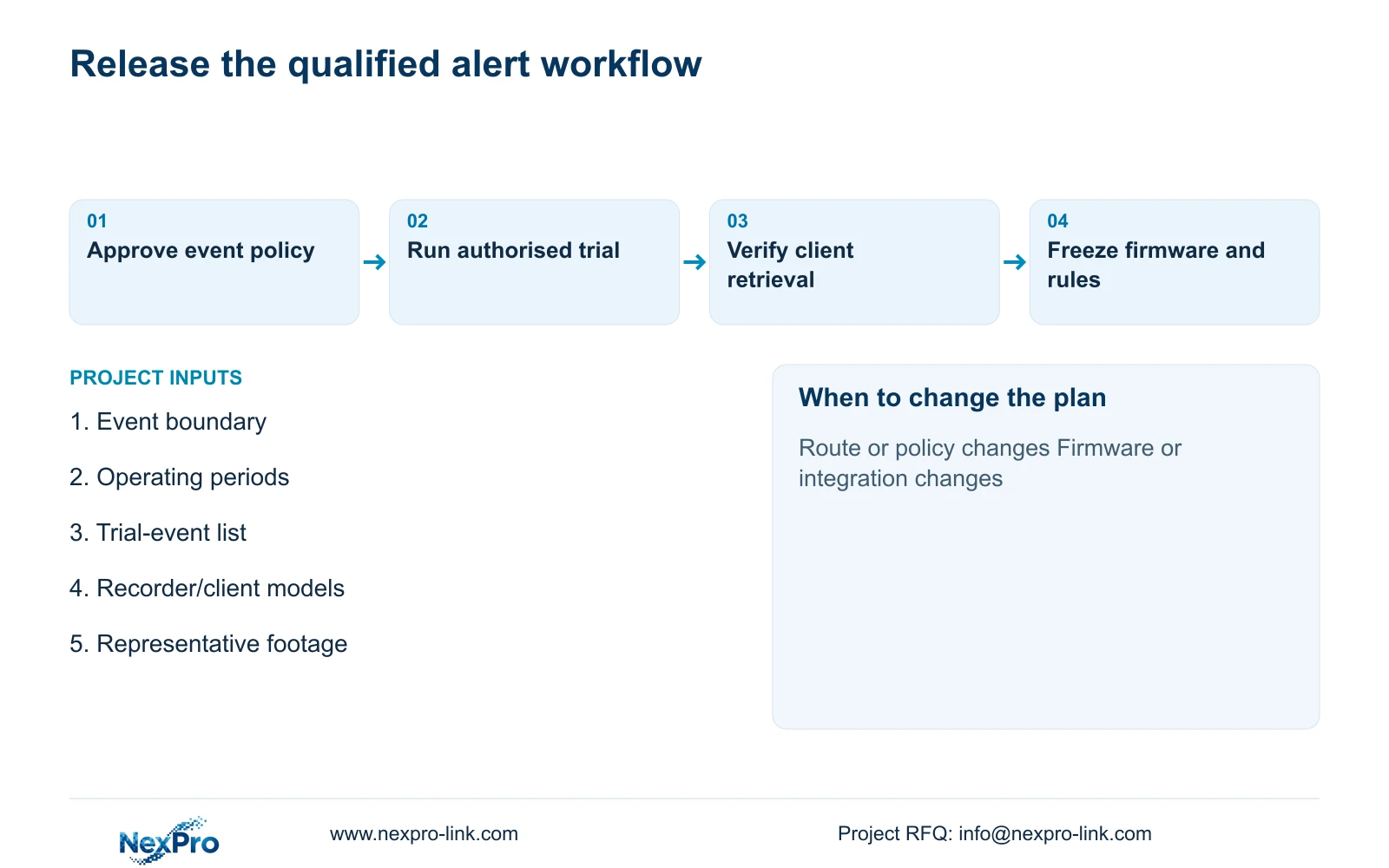
The release record should include location, event rule, operating period, exact model and firmware, trial conditions and the accepted client path. Attach relevant recordings and the counting convention. This lets commissioning reproduce the decision and makes a later firmware or model substitution visible.
NexPro-Link can discuss model matching, technical documents and coordinated factory project supply. Its BOQ support can identify deviations where an alternative changes the analytics or platform requirement. Local integration and owner approval remain explicit responsibilities, with notification and playback checks included in acceptance.
After a route or shift-policy change, review the affected event rule before interpreting new alerts as a camera fault. A different event population can change precision and workload without a hardware change. Preserve the earlier baseline and record the revised policy so operators and procurement evaluate the same service.
Section 07
Buyer questions
What if a trial produces no alerts at all? If relevant events occurred, investigate misses and the event-delivery path. Precision has no meaningful value when its denominator is zero; do not describe silence as perfect accuracy. Check camera detection and client delivery separately.
Should authorised vehicles be counted as false alerts? Only if the agreed policy says those movements should not alert. Classification and authorisation are different questions. Define the expected outcome before the trial, and avoid assigning identity or access-authorisation capability to basic vehicle classification.
Section 08
Prepare an authorised analytics trial
Send the event boundary and operating policy, representative day/night route footage, permitted test-event list and recorder/client models to info@nexpro-link.com for a focused detection and alert-workflow scope.
Engineering references
These sources support the general planning principles. Always use the selected product's current datasheet and applicable project standards for final design.