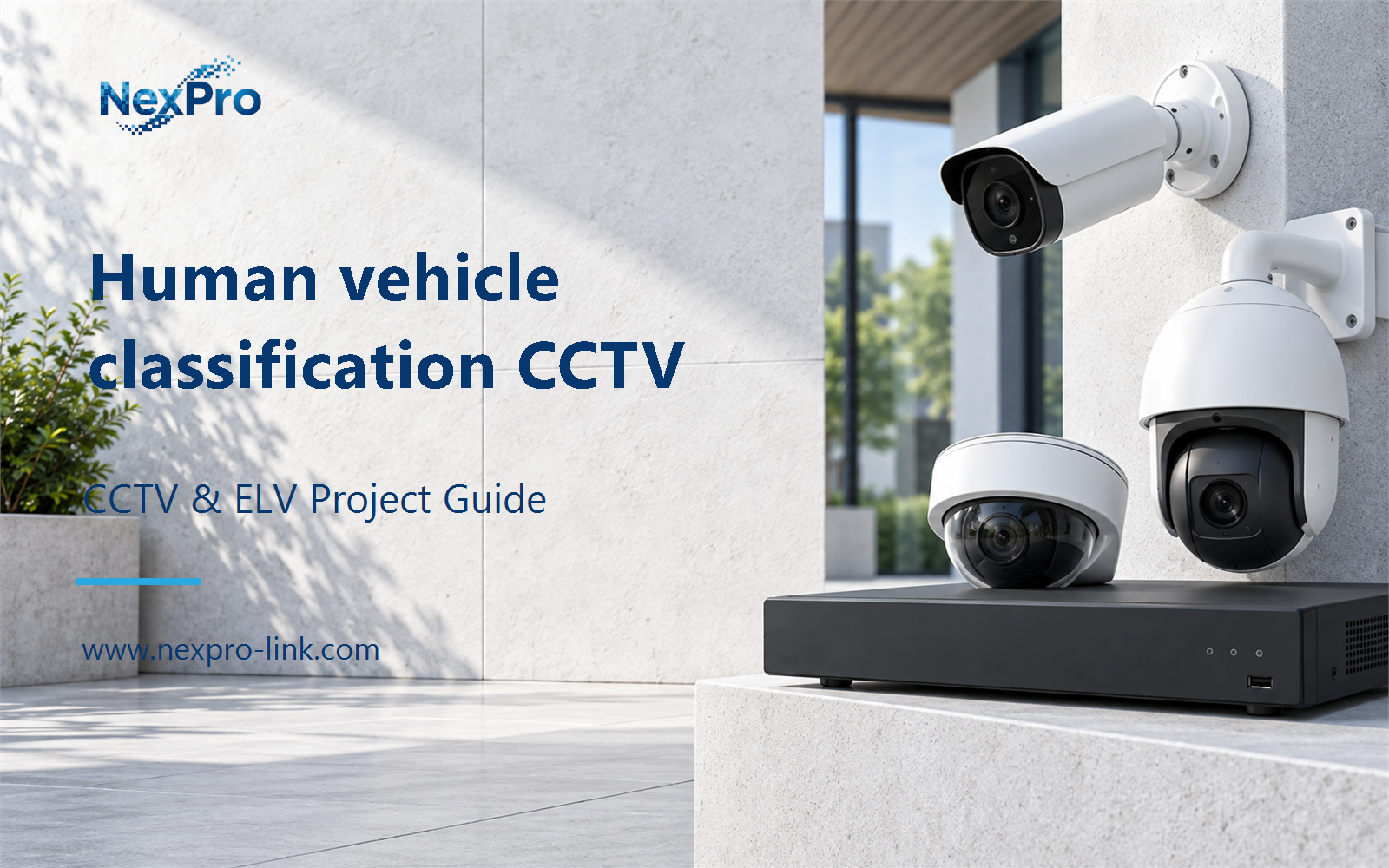
Plan human vehicle classification CCTV with practical guidance on start from the alarm workload and evaluate false alarms and missed events. NexPro-Link project guide.
Section 01
Start from the Alarm Workload
It adds value when it helps the operation distinguish relevant events from background activity without unacceptable missed events. Define what needs a response and what should be ignored. Judge the complete alarm workflow rather than paying for an AI label that is not connected to recording, search or operator action.
Turn the answer into a working record using Event type, Required response, Background trigger, Workflow benefit.
| Decision area | Buyer question | Required output |
|---|---|---|
| Start from the Alarm Workload | When does human and vehicle classification add value? | It adds value when it helps the operation distinguish relevant events from background activity without unacceptable missed events. |
| Choose Edge or Server Processing | Should analytics run in the camera or at the recorder? | Choose according to supported functions, processing load, integration and maintenance needs. |
| Distinguish Detection from Identity | Is human classification the same as face recognition? | No. |
Section 02
Choose Edge or Server Processing
Choose according to supported functions, processing load, integration and maintenance needs. Edge processing can distribute the workload, while server processing can centralize management, but neither arrangement guarantees better results. Confirm how events and metadata reach the platform and what happens when the connection is lost.
Use Processing location, Event output, Platform dependency, Failure behavior to compare options on the same basis. Keep product capability, project assumption and operating responsibility in separate columns.
Section 03
Distinguish Detection from Identity
No. Classifying an object as a person is different from detecting a face, capturing a usable face image or comparing identity against a database. Similar distinctions apply to vehicle classification and plate recognition. Describe the exact function and avoid promoting a basic event detector as an identity-recognition system.
The project output should make Function, Input, Output, Additional requirement traceable from input to acceptance.
- Confirm the answer to: Is human classification the same as face recognition?
- Record the project fields: Function / Input / Output / Additional requirement.
- Keep product capability, project assumptions and site responsibility in separate records.
Section 04
Evaluate False Alarms and Missed Events
Use a defined event set with both relevant and irrelevant activity, and count missed events alongside false alarms. Include difficult lighting, occlusion and the intended mounting geometry. A lower alert count can reflect useful filtering or an overly restrictive configuration; the metric needs the underlying event context to be meaningful.
Record Test event, Expected result, Actual result, False or missed before selecting a product family. That makes later substitutions possible without silently changing the operational requirement.
Section 05
Understand Recording and Bandwidth Effects
No. Bandwidth changes only if the recording or streaming policy changes, or if a supported encoding feature alters the stream. An event classifier can operate while full continuous video is still transmitted and recorded. Calculate traffic from the deployed profiles rather than subtracting a generic AI savings percentage.
Review Analytics mode, Stream policy, Recording duty, Measured Mbps with the party that will operate or maintain the system.
Section 06
Price the Complete Analytics Workflow
Include recorder or VMS support, licenses where applicable, configuration time, operator training and future firmware management. Also assess whether the required event search and export are usable. NexPro-Link's supplied human, vehicle, intrusion and line-crossing specifications are useful inputs, but the project value comes from the supported end-to-end workflow.
Use Function, Camera, Platform, Licence, Operator action as the handoff between design and procurement.
Engineering references
These sources support the general planning principles. Always use the selected product's current datasheet and applicable project standards for final design.