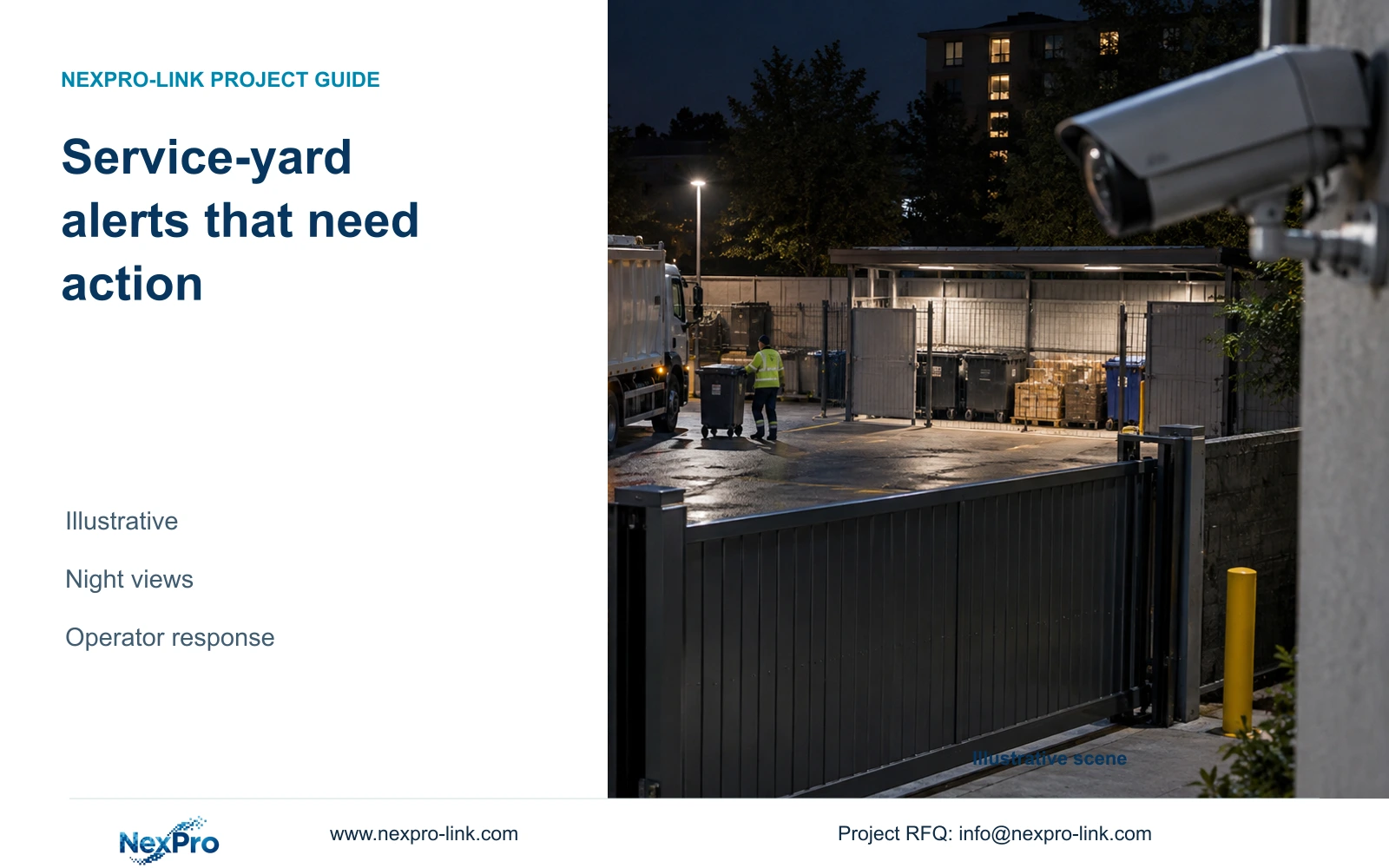
Reduce unnecessary service-yard alerts by defining which events require action, when the yard is closed, and how operators verify and respond to each notification.
Section 01
Define the event that needs a response
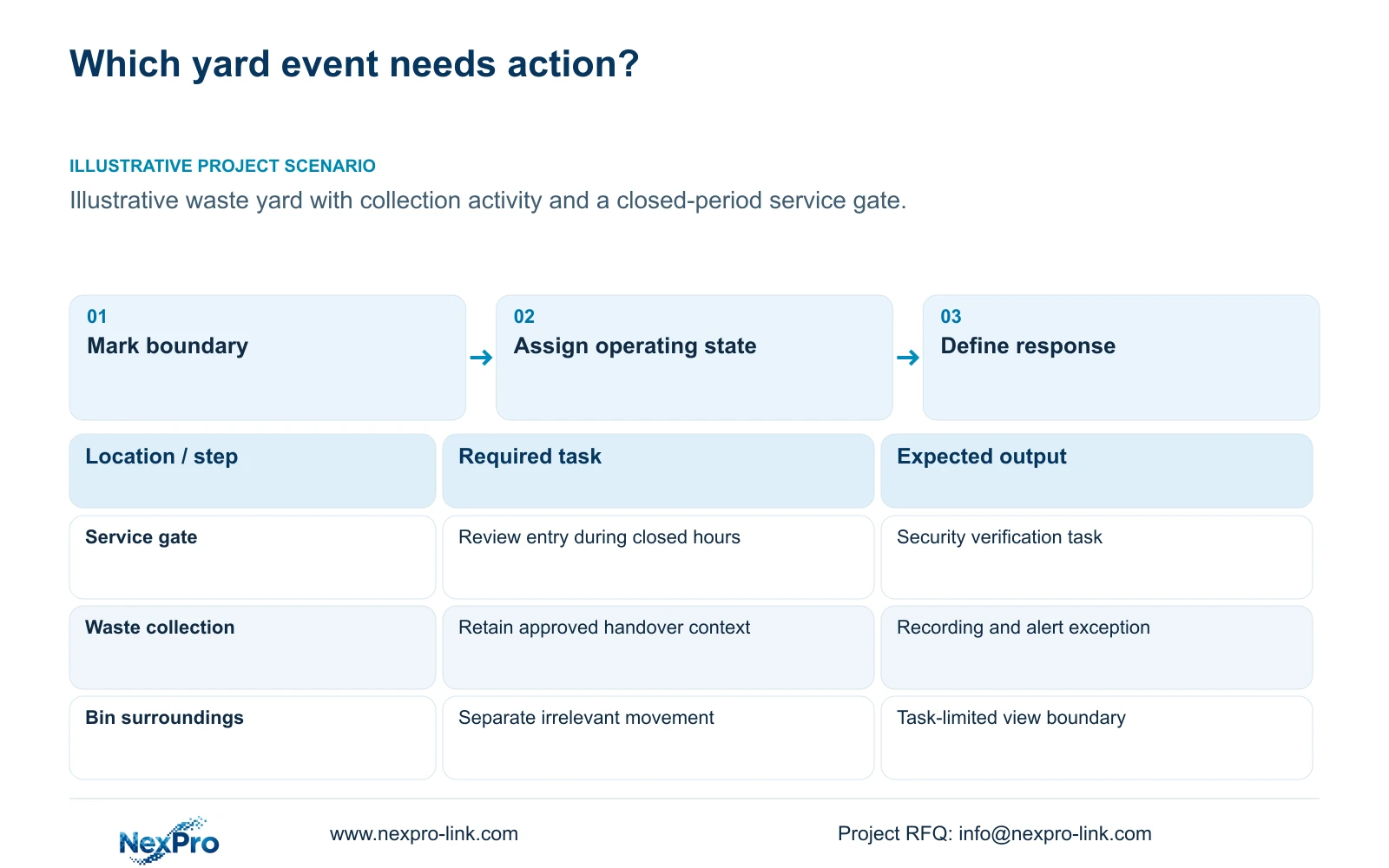
Choose event-specific notifications for the hotel service yard when ordinary waste collection, staff movement and lighting changes are overwhelming operators. First agree which boundary crossing or access event requires a response and during which operating state. If the selected equipment cannot implement that distinction, revise the camera position or operating workflow before buying more analytics.
An actionable event needs a location, an observable occurrence and an assigned response. In an illustrative yard, movement through the service gate during a closed period might require security to inspect the live view. Movement around bins during an authorized collection might need recorded context without an immediate notification. Neither example establishes a universal hotel rule.
The project manager should obtain agreement from security and the yard's operating team. CCTV can support authorized access and asset handover; it should not become an undefined employee performance monitor. A camera's human or vehicle detection description also does not establish authorization, intent or a verified nuisance-alert rate.
| Required task | Given information | Decision still needed |
|---|---|---|
| Review closed-period gate entry | Service gate and approved access route | Closed hours, recipient and response |
| Retain collection handover context | Waste collection uses the yard | Required view and notification exceptions |
Section 02
Map working and closed hours
Build the alert schedule around the actual collection and service timetable. Include authorized late collections, kitchen activity and staff access exceptions. An apparently closed yard may remain an approved route for a specific duty. The person maintaining the operating schedule must be identified so a changed collection time does not leave an obsolete alarm rule in service.
Keep recording policy and notification policy separate. A hotel may need footage of a collection even when it has decided against interrupting the operator for every movement during that period. Confirm that the selected recorder and client can support the intended combination; a schedule drawn on paper does not prove a software feature.
Compare a single overnight rule with distinct working, closed and authorized-exception states. The latter is useful when those states genuinely produce different responses and the equipment supports them. If the yard operates continuously, use approved boundaries and tasks instead of inventing a closed interval. Any temporary exception should have an owner and a defined return to the normal rule.
Section 03
Compare lighting and camera positions
Inspect the required gate or handover view under the lighting conditions in which it will be used. Vehicle lights, reflective surfaces and transitions between lit service doors and darker yard areas belong in the comparison. Record where animals and ordinary work appear relative to the response boundary. Moving the view away from irrelevant activity may preserve the task more effectively than changing sensitivity alone.
The supplied BL2812M product PDF lists dual-light capability and a 2.8-12 mm motorized lens for NexPro-BL2812M55-5MP-DIC-AI. Those fields support consideration of framing and illumination options. They do not establish a nuisance-alert rate, maximum camera power or a guaranteed night result. Confirm the selected mode and review recorded movement at the relevant light level.
Use visible illumination where the hotel permits it and it supports the required task. Change to an appropriate IR or other arrangement when light disturbance near occupied areas is unacceptable. Keep the comparison on the same route and required detail. A static color preview cannot establish how clearly the system records a moving person during a collection.
Section 04
Measure the operator's alert workload
For a pilot, classify each notification by operating state, apparent cause and required action. Record whether the operator could open the correct view and whether useful footage existed. Count notifications that required investigation separately from ordinary activity that the approved rules were intended to leave unannounced. Without actual observations, no alert-reduction percentage or response-time saving can be reported.
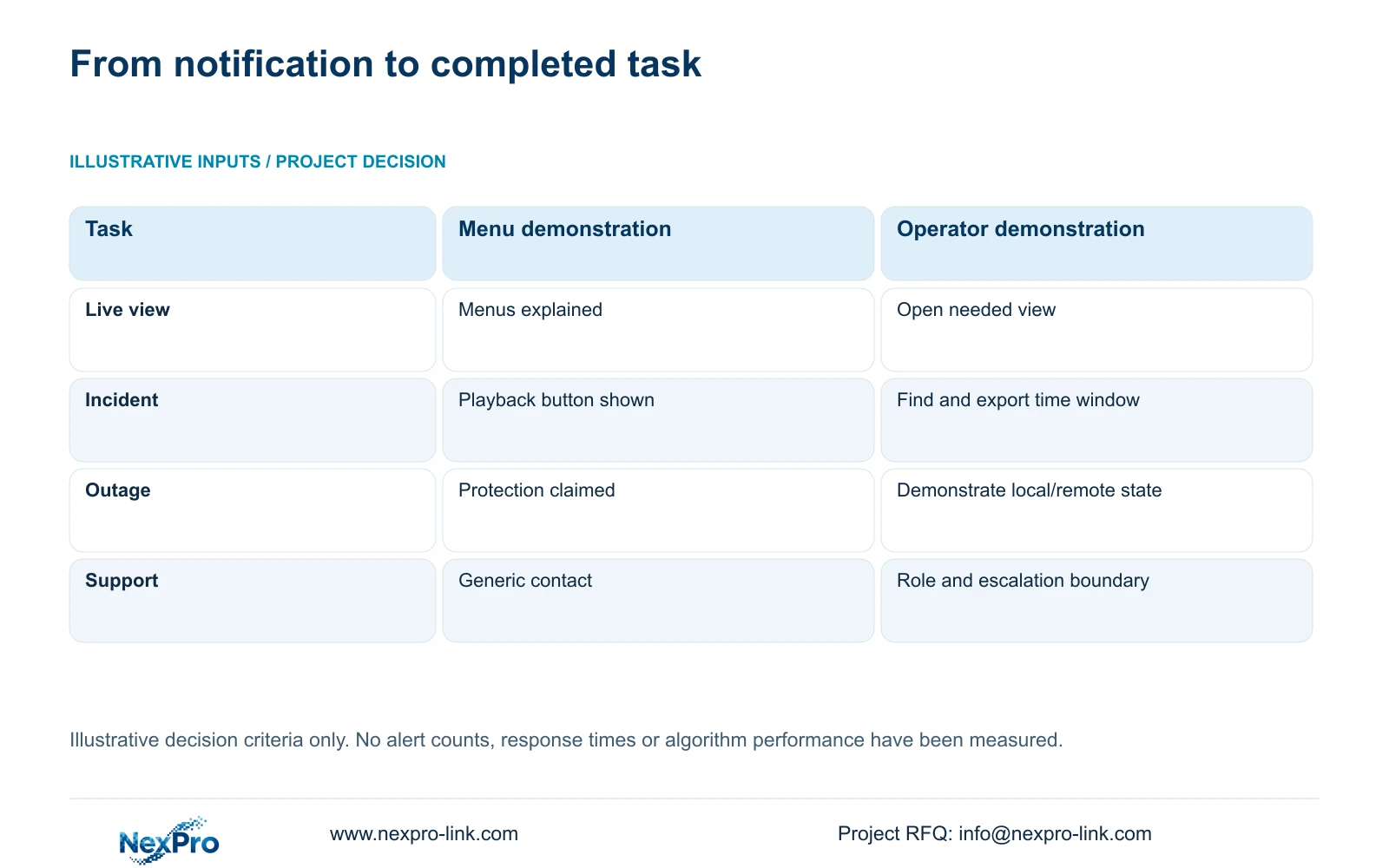
The supplied comparison is an operating decision matrix, not a numerical workload test. It compares a feature-list handover with a task-based handover. Its inputs are representative hotel duties and supported interfaces; there are no measured minutes, detection scores or field results. It changes procurement by making operator completion an acceptance requirement.
Review daytime collection activity and closed-period movement separately. A quieter notification list is acceptable only if required events remain observable and retrievable. When an adjustment removes needed gate coverage, restore the coverage and reconsider the boundary, light or notification rule. Keep the relevant configuration version with the observation record so later comparisons use an identifiable baseline.
| Metric / condition | Feature-list handover | Task-based operator handover |
|---|---|---|
| Live view | Menus explained | Authorized user opens the needed view |
| Incident work | Playback button shown | Find and export a defined time window |
| Outage | All equipment called protected | Demonstrate the selected local/remote state |
| Support | Generic phone number | Correct role, contact and escalation boundary |
Section 05
Trace notification and response
Trace an approved yard event from the camera through its supported notification path to the person on duty. Confirm how that person verifies the event, contacts the appropriate local team and records the outcome. Security, IT and the installer need different access and responsibilities. A shared administrator account should not be assumed necessary for routine viewing.
Separate local recording from remote notification. An unavailable WAN may affect a remote workflow even when the local recorder remains operational. Continued recording also depends on the camera and intermediate network equipment receiving power. The outage demonstration should state which local and remote functions remain available; an illuminated NVR alone is insufficient evidence.
Buy additional notification or platform scope when the required recipient, escalation or supported workflow cannot be achieved with the existing arrangement. Keep integration, installation and any software or service charges explicit. NexPro-Link's hotel and BOQ support can help match equipment and document supply boundaries, while local response and site work remain assigned project responsibilities.
Section 06
Agree on a representative pilot period
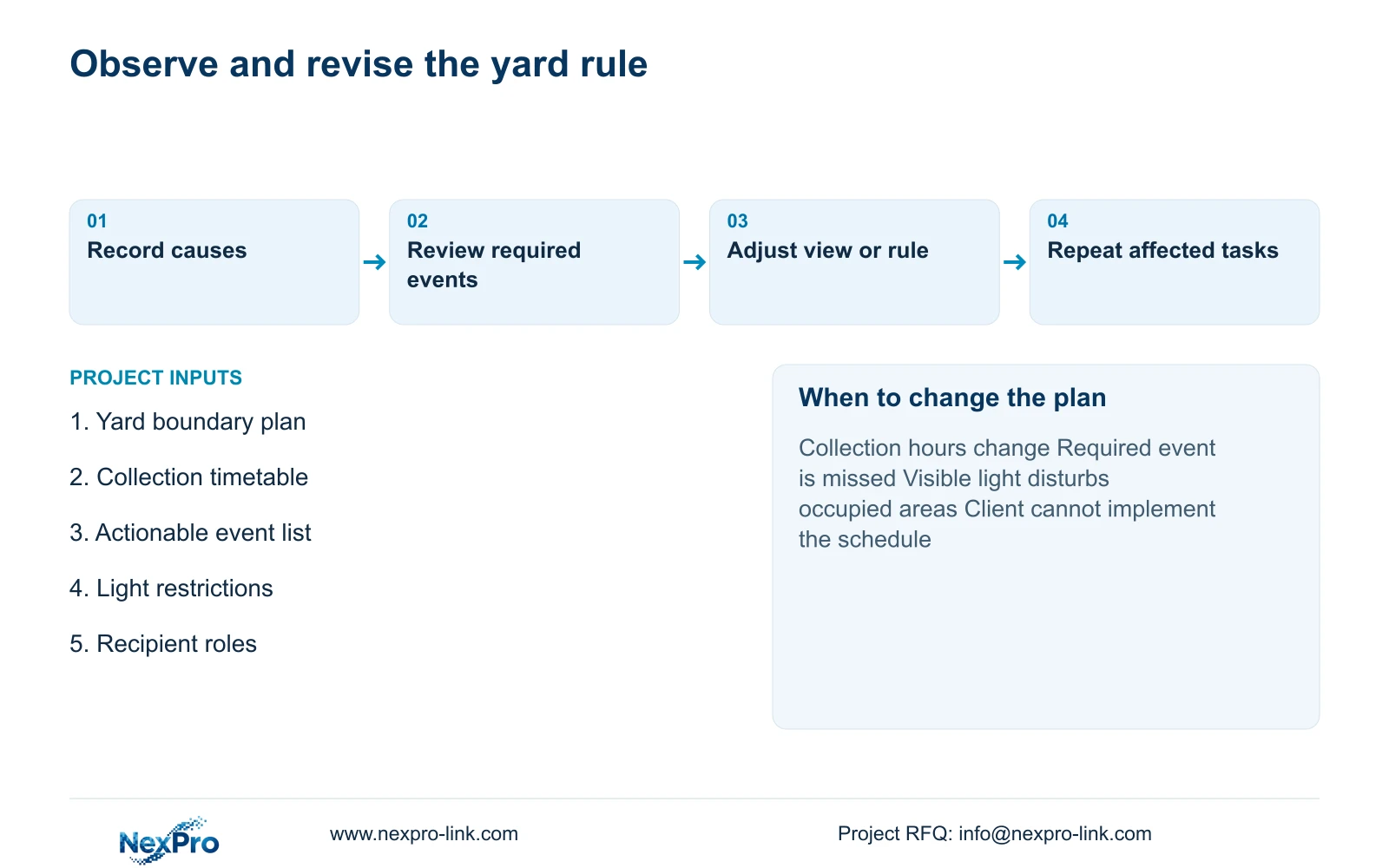
Choose a pilot period that includes the hotel's relevant collections, closed intervals and lighting transitions. Agree the events to observe and who will review them before starting. No fixed number of nights is justified by the source evidence. If the observation window omits a relevant operating condition, extend that part of the pilot instead of treating the existing sample as complete.
Retain the task-based arrangement when required events are recorded, operators can complete their duties and unnecessary notifications are acceptably controlled against the hotel's agreed criteria. Change the proposal when a mandatory platform, light restriction, missed task or unsupported schedule prevents that outcome. Record unresolved observations and repeat affected tasks after adjustment without describing planned results as passes.
For a scoped proposal, email info@nexpro-link.com with the service-yard plan, collection and closed-hours schedule, events requiring response, and intended notification recipients. Add existing camera/client identities and any visible-light restriction. NexPro-Link can discuss model matching and coordinated equipment supply; initial inquiries do not need guest footage, passwords or unrelated confidential material.
Section 07
Buyer questions
Must alert scheduling also stop recording? Specify the two policies separately and ask the supplier to demonstrate their interaction on the proposed version. Suppressing routine notifications should not silently remove footage required for a collection dispute or access review.
Can a supplier promise fewer alerts from a catalog description? A catalog can identify supported functions. A reduction claim needs observations under the agreed yard conditions, with the configuration and event classification recorded. Request a task demonstration instead of an unsupported percentage.
What belongs in the operator support card? Include the relevant camera tags, client and recorder identities, authorized duties, and contacts for notification faults, local response and equipment support. Keep credentials out of publicly circulated documents.
Engineering references
These sources support the general planning principles. Always use the selected product's current datasheet and applicable project standards for final design.