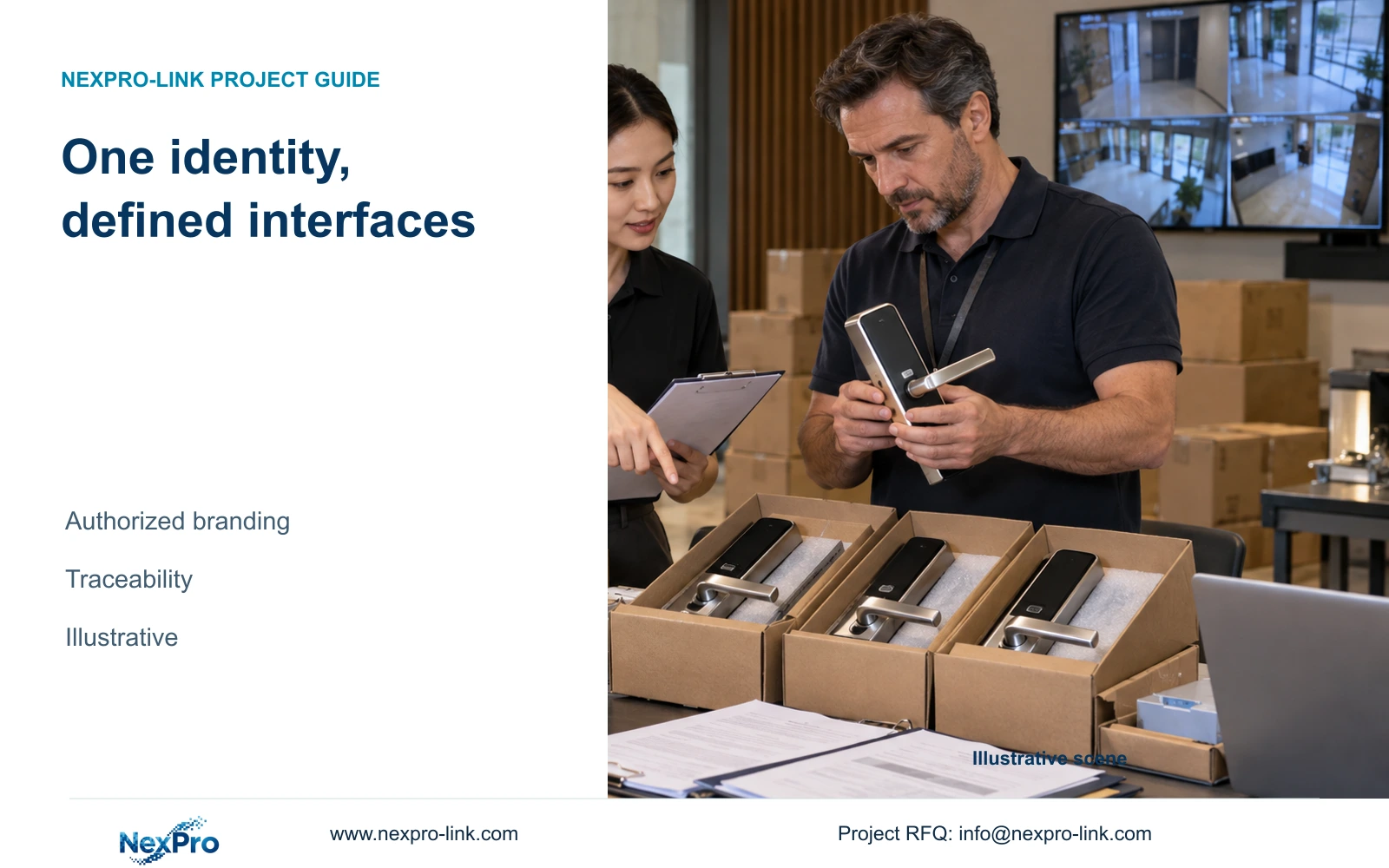
Matching logos can simplify hotel equipment identification and delivery, but they do not change protocols. Specify branding, technical interfaces and service identity separately.
Section 01
Choose the authorized brand assets
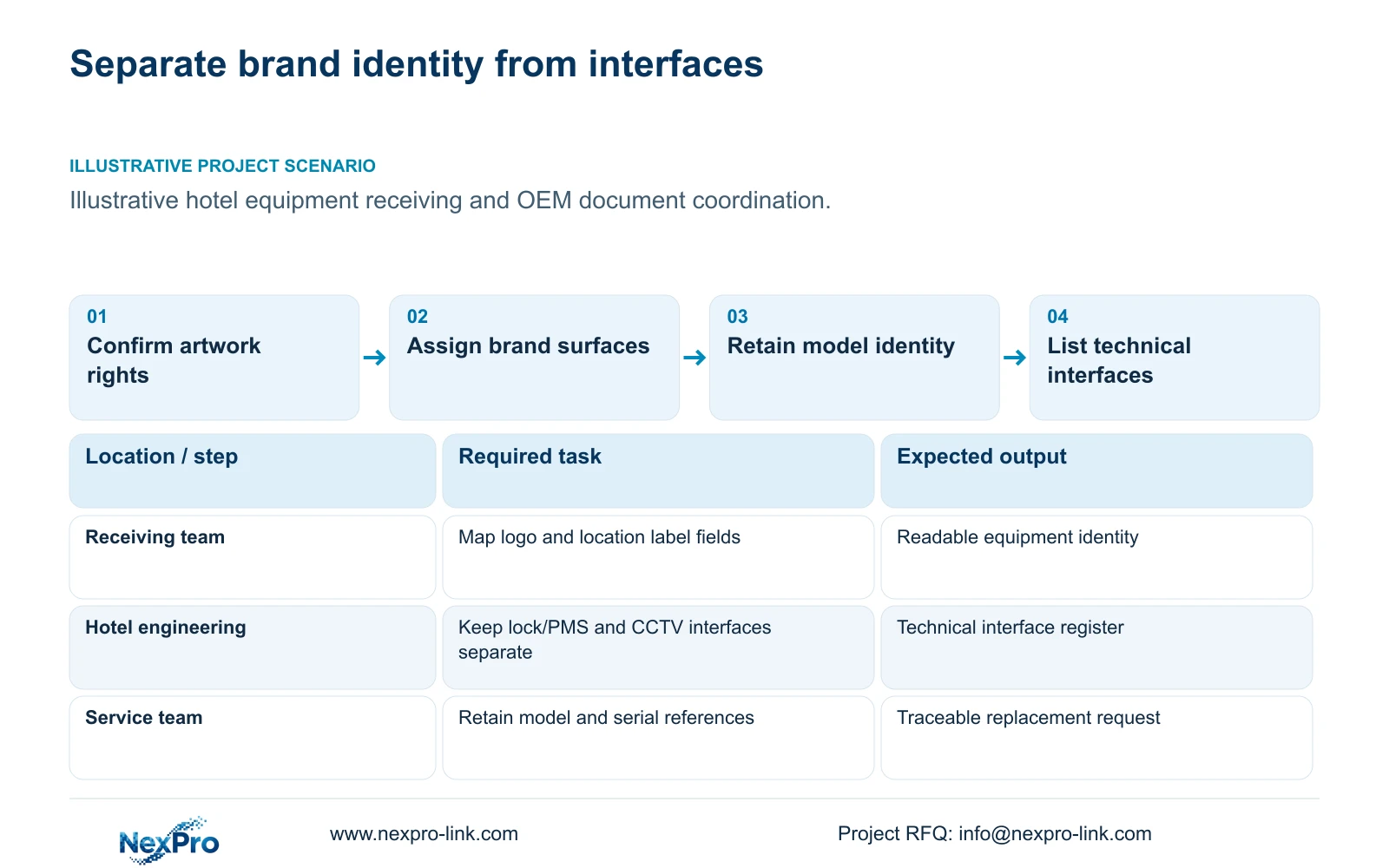
Choose shared branding for locks and CCTV when it helps the hotel receive, identify and maintain the equipment. Keep technical interfaces and software identity in separate records. A common logo does not establish native interoperability, a common application or permission to rename third-party software. Increase customization only when the proposed material or document serves a defined project task.
Establish who is authorized to supply the logo and which artwork version controls the order. Identify the surfaces and documents where it will appear. A lock face, camera housing and shipping carton have different constraints; accepting one placement does not settle the others. NexPro-Link's OEM scope includes logo, label, barcode, manual and packaging options subject to the actual project.
Separate permanent brand elements from variable installation information. Hotel name or contractor branding may stay constant while floor allocation and door references change. This allows a later location change to update the project label without reopening every graphic or implying that the technical model has changed.
| Required task | Given information | Decision still needed |
|---|---|---|
| Shared project identity | Authorized customer logo proposed | Artwork version, surface and placement |
| Installation sorting | Door and camera schedules available | Location label fields and carton grouping |
Section 02
Separate hardware identity and protocol
Maintain a technical schedule beside the branding schedule. For locks, identify the actual credential and PMS workflow where requested. For CCTV, identify recording, viewing and event functions with their device and software versions. Branding changes do not settle these interfaces, and coordinated procurement does not turn separate subsystem functions into one platform.
ONVIF Profiles provide a basis for checking relevant device and client functions. A general ONVIF statement does not prove all events, audio, recording searches or account bindings work across the proposed combination. Likewise, the Seetong system source describes application and PC-client workflows without granting a right to rename the software or establishing universal hardware compatibility.
Preserve the original model identity beneath any authorized commercial presentation. A customer-facing name can be accompanied by a controlled model cross-reference where agreed, but service records must still identify the actual device. Avoid packaging language such as a fully integrated hotel ecosystem unless the stated interfaces have their own supported scope.
| Item | Branding scope | Technical scope | Hotel consequence |
|---|---|---|---|
| Logo | Authorized artwork and placement | No interface change established | Consistent visible identity |
| PMS connection | Cannot be established by a label | Actual lock/system version and interface | Credential workflow needs separate support |
| CCTV client | Software identity retained unless authorized | Supported device and client functions | Operator workflow remains version-specific |
Section 03
Compare logo and label methods
Compare laser marking, printed labels, silk-screen printing and carton printing against the actual material and batch. Laser-logo capability is described in the supplied business information, but the achievable appearance on a chosen surface needs an agreed process and sample. Do not assign an unverified durability, finish or process result to every device.
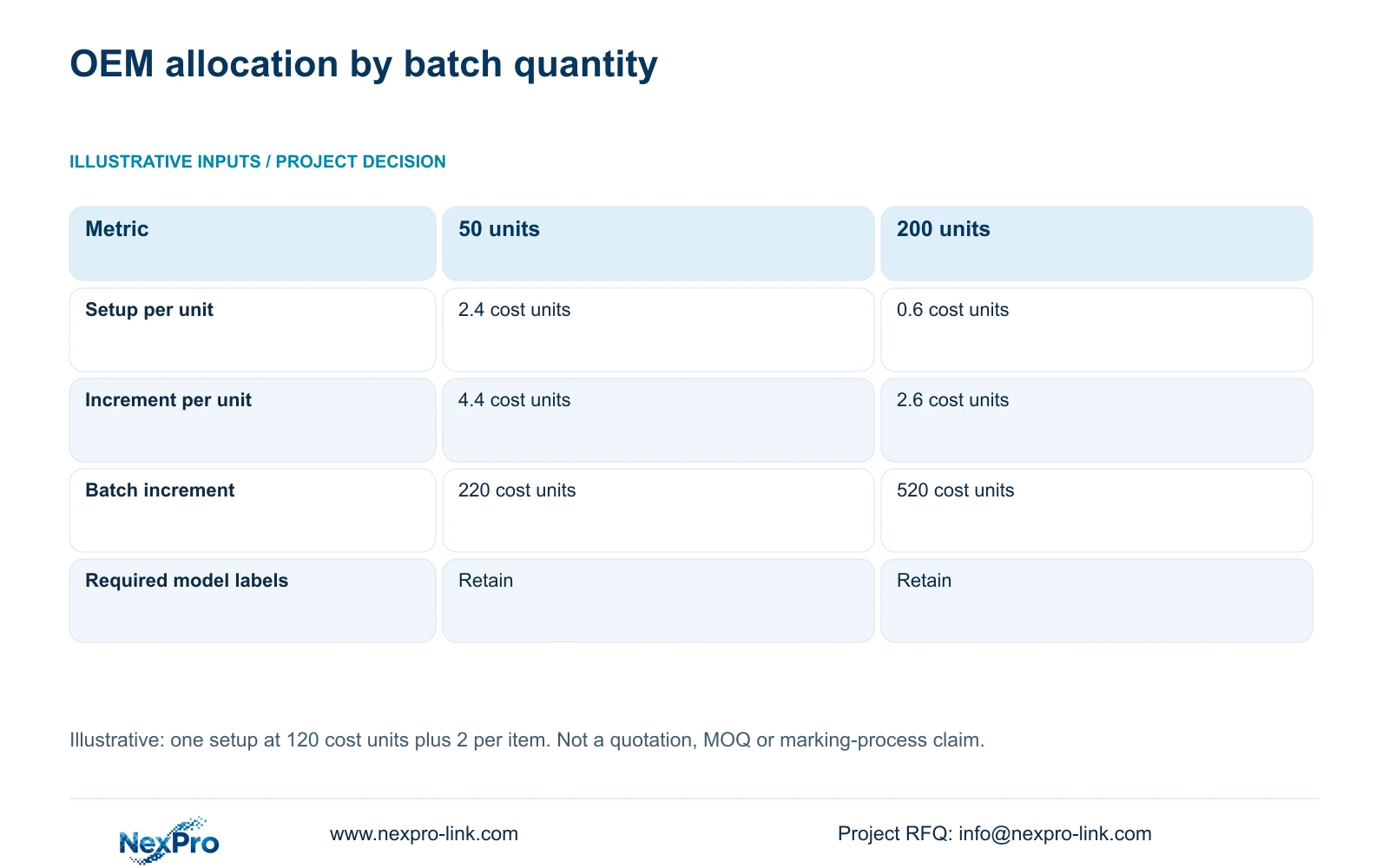
The illustrative costing below assumes one authorized artwork/setup effort of 120 cost units and a marking, label and packing increment of 2 cost units per item. Increment per unit equals setup divided by batch quantity, plus the per-unit increment. Total incremental batch cost equals 120 plus quantity multiplied by 2. These are teaching units, not prices, minimum order quantities or laser-process specifications.
The setup allocation falls from 2.4 to 0.6 units per item when quantity rises from 50 to 200. The total batch increment still rises from 220 to 520. Choose quantity from the real equipment requirement; the lower allocation alone does not justify buying excess stock. Obtain quotations for the actual surfaces, methods and variants.
| Metric / condition | 50-unit teaching batch | 200-unit teaching batch |
|---|---|---|
| Batch quantity | 50 | 200 |
| Setup cost per unit | 2.4 cost units | 0.6 cost units |
| Total incremental cost per unit | 4.4 cost units | 2.6 cost units |
| Total incremental batch cost | 220 cost units | 520 cost units |
| Model and required labels | Retain | Retain |
Section 04
Count package and document variants
Create a variant register by model and work front. Record which manual applies, which accessories belong with the equipment and how cartons relate to installation locations. Distinguish technical variants from different floor labels. Otherwise, two visually similar packages can hide different hardware or send a correct product to the wrong door group.
Count spare equipment separately from location-assigned equipment. A replacement unit should preserve the technical identity needed for service without acquiring a misleading installed-location label. Where practical, manage variable location information through a controlled project label and packing list while keeping stable product information unchanged.
The calculation assumes one setup scope. Additional artwork versions or processes may change the commercial basis, so its 50- and 200-unit totals cannot be applied unchanged to a mixed order. CASE01's 32-camera reference is an independent system scenario and does not define an OEM batch or lock quantity. Grouping for installation can be more useful than a separate retail-style box for every work front.
Section 05
Keep traceable model references
Retain model, serial identity and required markings in the product and service records. Add the hotel asset or location reference as a distinct field. When an installer moves equipment, the location record can change while its device identity remains stable. This supports a clear replacement inquiry and avoids ordering by housing appearance alone.
Connect each branded item to its technical document and packing record. A repeat order should identify the approved configuration and any permitted substitutions. Shared branding cannot confirm that a replacement has the same power method, interface or firmware behavior. Model matching must revisit the operating task when those details change.
Keep warranty terms attached to the controlling equipment and order scope. The supplied policy record gives applicable main equipment a receipt-based 24-month limited hardware baseline. OEM-specific terms and batteries, storage or cables are separately scoped. A customer's logo does not extend that term or establish free local installation support.
| Retained outcome | Extra scope | When useful | Counter-condition |
|---|---|---|---|
| Traceable equipment | Customer brand plus model cross-reference | Shared branding is required for the project | Branding hides the service identity |
| Correct work-front delivery | Floor or door-group labels | Several installation groups receive equipment | Locations remain unresolved |
| Repeatable reorder | Controlled artwork and technical register | Later batches must match the accepted scope | Substitution changes the supported function |
Section 06
Release a controlled OEM sample
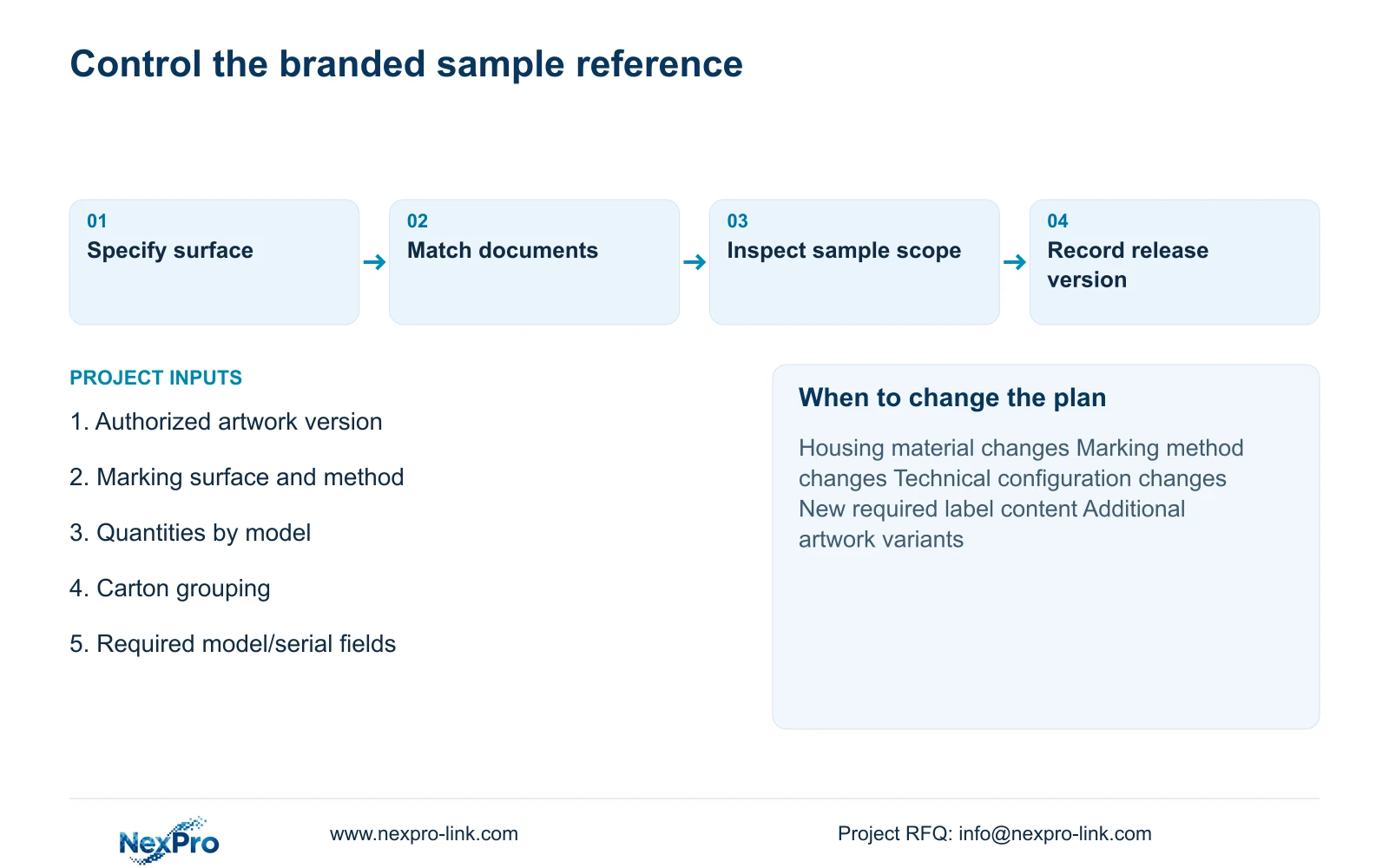
Define a representative sample around the proposed surface, label and packing method. Record its model and artwork version, and inspect the information needed for receiving and service. Review appearance separately from any requested operating demonstration. A readable label does not establish a PMS connection or a camera-client event workflow.
Use the agreed sample as the reference for the scoped order, without turning a small observation into a claim about batch defect rates or lifetime performance. Change the reference when the housing material, marking process, technical configuration or required label content changes. Reuse stable artwork for repeat orders only where those controlling conditions remain applicable.
Recommend authorized branding with retained model identity and useful project labels as the starting scope. Add more elaborate packaging when the operator's presentation requirement or distribution task justifies it. Send authorized artwork, intended marking surfaces, quantities by model and carton-grouping requirements to info@nexpro-link.com. Include any required lock or CCTV interfaces as a separate technical list for the hotel project and OEM support teams.
Section 07
Buyer questions
Can the hotel logo replace the client application's name? Hardware OEM permission does not grant third-party software naming rights. Keep the application's identity unless a separate authorized software arrangement explicitly allows a change.
Does the 200-unit example establish a minimum OEM order? No. Both quantities are teaching inputs. Request the actual setup, process and quantity terms for the proposed model and branding surface.
What should remain unchanged on a repeat order? Reuse approved brand assets and technical references where applicable. Update quantities and location fields explicitly, and review any change to material, process or device configuration.
Engineering references
These sources support the general planning principles. Always use the selected product's current datasheet and applicable project standards for final design.