
A mock-up change can affect lock fit, accessories, installation work and delivery. Preserve the original scope and calculate each effect before accepting a revised total.
Section 01
Identify the changed door interface
Price the mock-up change by affected door group, retaining the original hardware and commercial baseline. Reuse prepared items only where their fit and operating function remain supported. Replace the affected scope when door thickness, handing or hardware changes invalidate that match. The variation should explain quantities, specification changes and shared work separately before the buyer accepts a revised total.
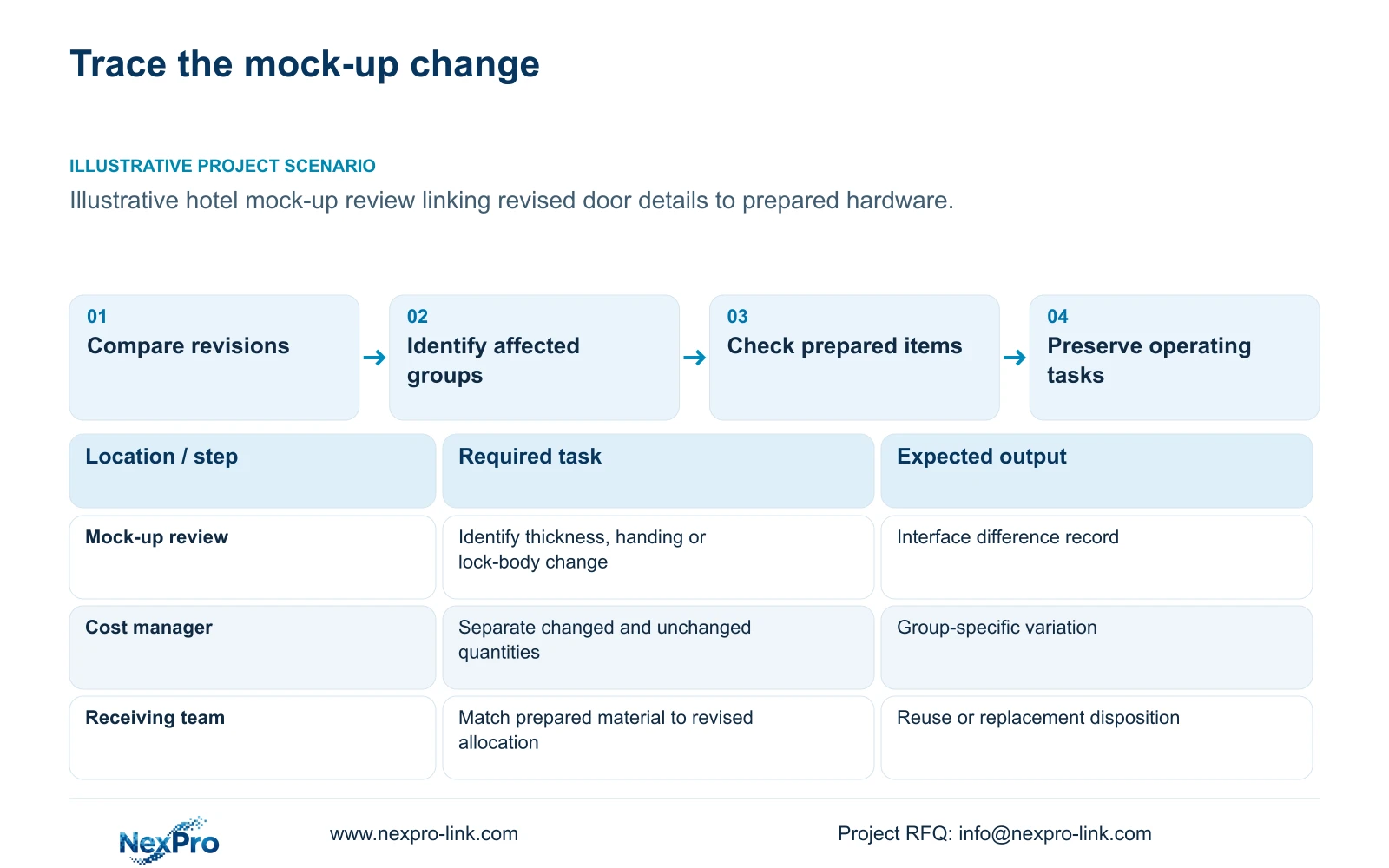
Keep the old and new door schedules with their revision dates. Describe the actual change at each affected interface, including door construction, lock body and permitted operation. A note saying revised door hardware gives the estimator too little information to distinguish a different component from additional installation work.
Establish whether the accepted mock-up applies to one door type or several groups. Record the affected quantity instead of multiplying the change across the entire hotel. Unaffected doors can remain under their existing configuration, subject to the project's release arrangements. This limits unnecessary replacement and prevents a local design decision from becoming an unexplained project-wide uplift.
| Required task | Given information | Decision still needed |
|---|---|---|
| Confirm revised fit | Old and new mock-up details | Affected thickness, handing and lock-body interfaces |
| Establish quantities | Door schedule revisions | Changed groups and unaffected groups |
| Preserve operating outcome | Original access requirement | Whether the revised hardware retains it |
Section 02
List affected models and accessories
Translate the changed interface into an item-level list. Separate the lock assembly from affected accessories and site work. Where the design requires a changed supporting component, identify its role and quantity. Do not assume every accessory changes with the main item, or that the original unit rate covers new installation steps.
NX-HL-DQ is a hotel IC card lock candidate with mechanical-key support described in the supplied hotel source. Its door thickness, lock body, handing and battery details remain configuration-specific. This limited description cannot establish that a prepared unit fits a revised mock-up. Request the actual matching information before treating it as reusable.
Maintain the original rate boundary beside the revised scope. Identify whether it included accessories, packing, installation or interface work. If the old quotation was equipment-only, a new installed price cannot be compared through its unit rate alone. Show added services separately so the cost manager can evaluate the same commercial boundary.
| Item | Original scope | Revised review | Effect on the hotel task |
|---|---|---|---|
| Lock assembly | Original door-group match | Fit and operation against new interface | May retain or change model configuration |
| Accessories | Previously included components | Affected items listed individually | Avoid replacing unchanged material |
| Installation | Original work allowance | Revised preparation and fitting scope | Separate labor from equipment rate |
| Packing | Original door allocation | Revised model and group labels | Prevent incorrect installation release |
Section 03
Separate reusable and replacement items
Give prepared material a recorded disposition: retained, reassigned where supported, replaced or awaiting a decision. Visual similarity cannot establish interchangeable fit or operation. The reuse decision needs the exact model and revised interface. Keep any proposed alternative tied to the original credential and emergency-operation requirements.
Separate physical availability from commercial credit. An item may be suitable for another door group without creating an automatic refund or cancellation right. The controlling order determines what can be changed commercially. List reuse, return, cancellation and remaining site work as distinct entries, with unresolved amounts left open.
Timing belongs beside that disposition. Identify whether material is still under preparation, packed or already allocated for site work. A hardware change may also require different instructions or carton labels. Obtain the real sequence and agreed dates; this article's costing example supplies no production or transport duration, and a revised total cannot establish an unchanged delivery commitment.
Section 04
Calculate the variation scope
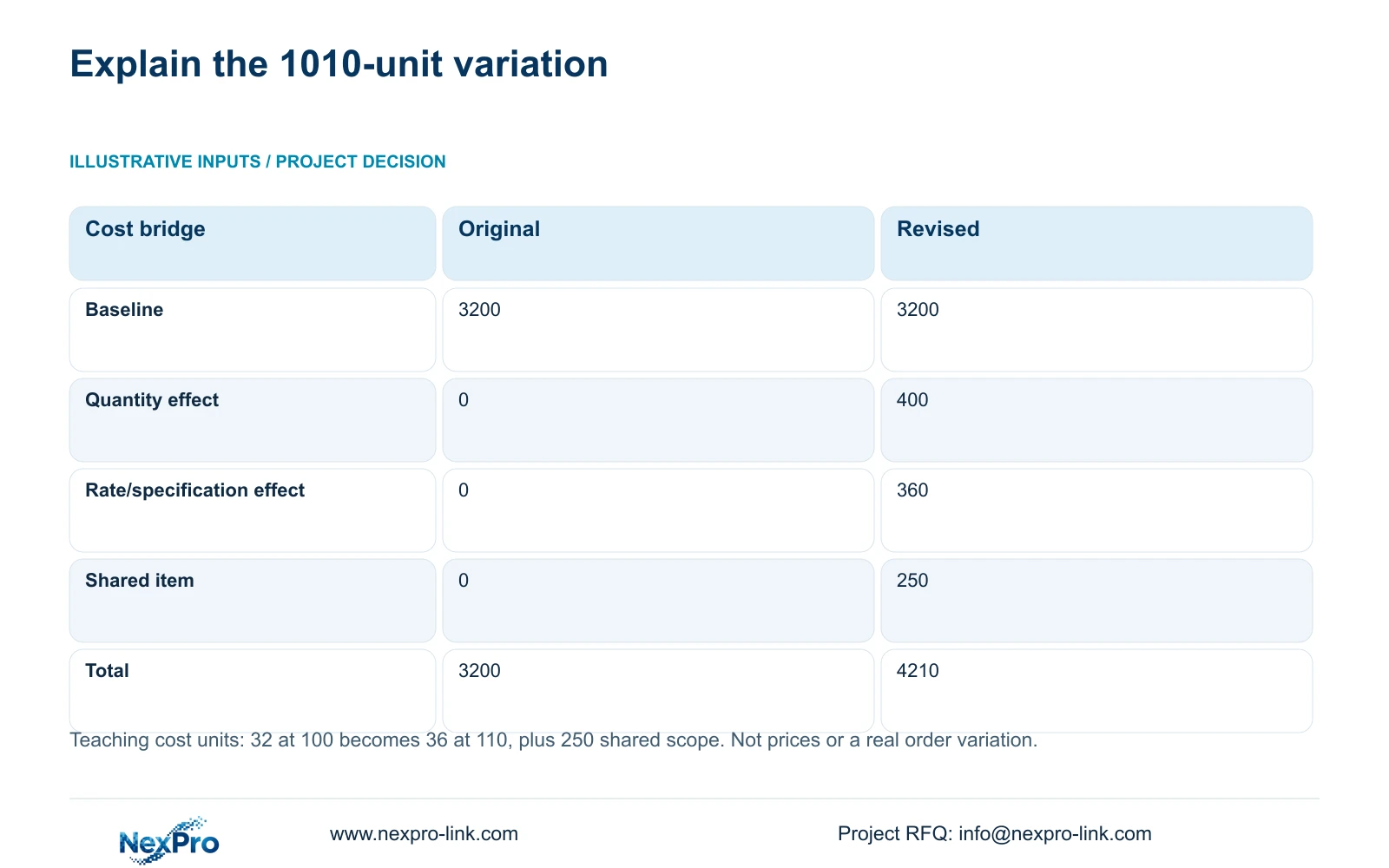
The illustration uses cost units, not supplier prices: 32 original items at 100 units each, revised to 36 at 110, with an additional shared item of 250. Original cost is 32 × 100 = 3,200. Calculate the quantity effect at the old rate: (36 minus 32) × 100 = 400. Then apply the rate effect to the revised quantity: 36 × (110 minus 100) = 360.
Adding the 250 shared-resource change gives 3,200 + 400 + 360 + 250 = 4,210. The difference is 1,010 units. Applying the rate effect to all 36 revised items includes its effect on the four additions, so no further quantity-and-rate adjustment should be added. The table preserves the sequence for review.
The original 32-item count is independent of CASE01's 32-camera scenario. It does not establish a lock quantity or a video load. For actual changes, examine capacity thresholds only where affected: centrally powered doors can alter supply loads, while added video tasks can alter PoE, recorder or storage requirements. Those changes need actual configuration calculations and separate scope entries.
| Metric / condition | Original: 32 at 100 | Revised: 36 at 110 |
|---|---|---|
| Original total | 3200 | 3200 |
| Quantity effect | 0 | 400 |
| Rate/specification effect | 0 | 360 |
| Shared-resource change | 0 | 250 |
| Final teaching total | 3200 | 4210 |
Section 05
Recheck approved operating tasks
Evaluate the changed hardware against the task that justified the original selection. Check the required credential workflow and permitted fallback operation at the revised door interface. Where a central controller or PMS connection is involved, identify the actual version and supported interface. A mechanically fitting substitute does not establish every operating function.
Use a representative revised door group to define the required observation or demonstration. Record the configuration and the conditions being examined. A sample review supports the observed scope; it does not prove that every hotel door has passed site acceptance. Keep any unresolved local safety interface assigned to its responsible designer.
Compare retention of the original item with a supported replacement on both technical and complete commercial terms. A replacement is justified when the original cannot meet the revised interface or task. If both remain suitable, compare real reuse costs and installation consequences before changing the whole group.
| Retained outcome | Extra scope | When worthwhile | Counter-condition |
|---|---|---|---|
| Approved entry workflow | Supported revised hardware | Original item no longer fits or functions | Original remains suitable |
| Correct site installation | Revised instructions and group labels | Fit or allocation changes | Existing records remain accurate |
| Required interface | Configuration or interface work | Actual supported connection changes | Brand or appearance alone changes |
Section 06
Update the door and packing schedules
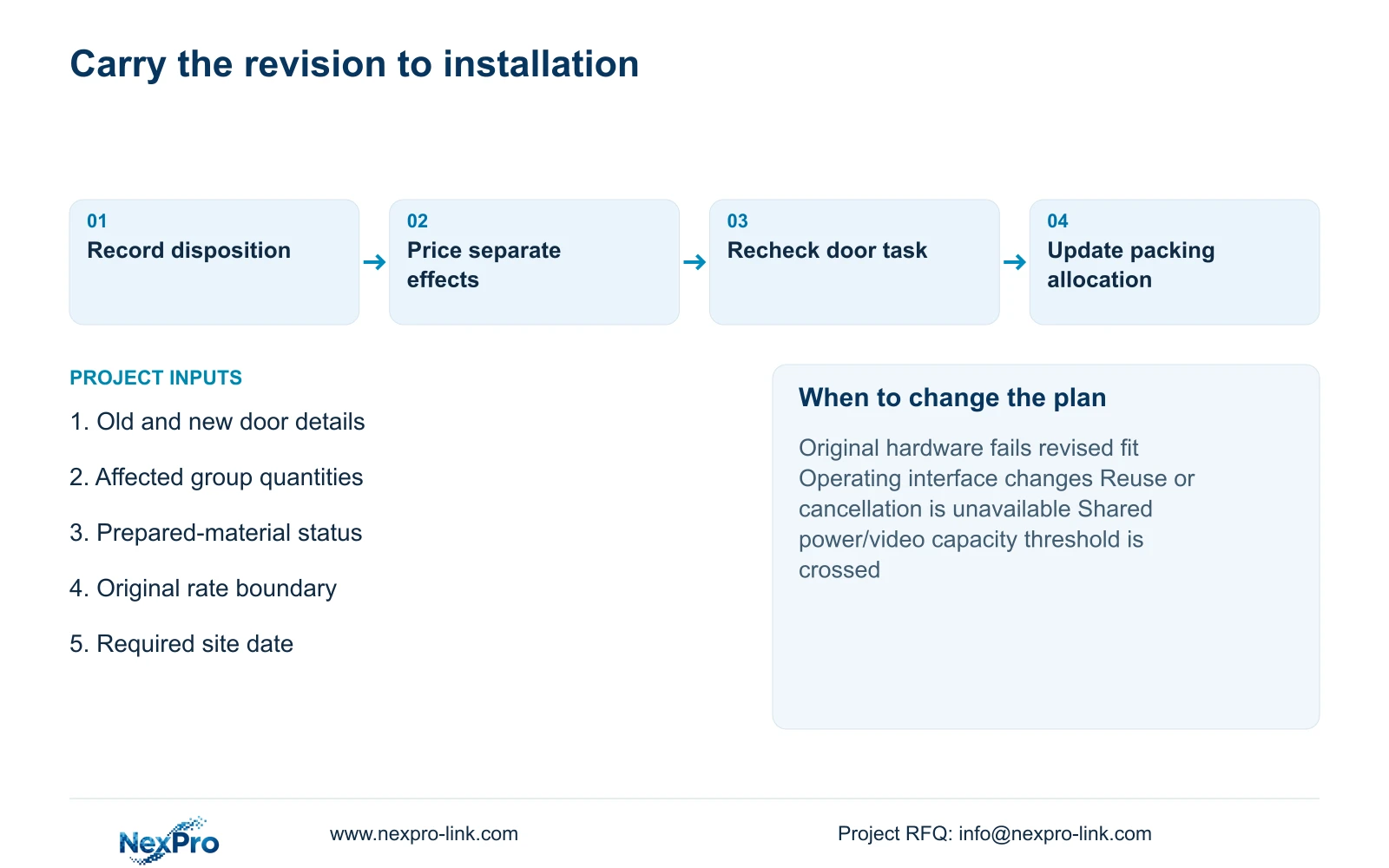
Carry the confirmed revision through the door schedule, BOM or BOQ and packing allocation. Keep door-group references connected to the actual hardware configuration and accessories. An updated quotation without matching packing information can leave installers working from an obsolete allocation. Separate spares from location-assigned items.
Recommend a group-specific variation with documented reuse and a fixed calculation sequence. Change the procurement plan when fit, operating function or preparation status makes reuse unavailable, or when a shared capacity threshold introduces additional equipment. Release unaffected scope only where its independence and order conditions allow it; do not promise every late change is free or leaves dates unchanged.
Send the old and new door details, affected quantities, prepared-material status and original commercial scope to info@nexpro-link.com. Add the required site date and any interface changes. NexPro-Link can discuss model matching, BOQ revisions and project packing within a coordinated supply scope. The buyer's confirmed procurement version remains distinct from a preliminary variation discussion.
Section 07
Buyer questions
Why is the rate effect calculated on 36 items? This example applies the revised rate to the full revised quantity. The quantity effect first uses the original rate, and the subsequent 360-unit rate effect accounts for the change across all 36 items.
Can unchanged door groups proceed while a revision is resolved? Potentially, if their configuration and packing are independent and the order permits separate release. Confirm the affected dependencies and dates before treating partial release as available.
Does reusable material automatically create a variation credit? No. Technical reuse and commercial credit are separate decisions. The order terms and actual disposition determine whether a cancellation, reassignment or credit is available.
Engineering references
These sources support the general planning principles. Always use the selected product's current datasheet and applicable project standards for final design.