Reconcile the final hotel security purchase against a preserved concept baseline. A clear arithmetic bridge shows which costs arise from quantities, specifications, added scope and commercial terms.
Section 01
Freeze the estimate used as the comparison baseline
Reconcile the final purchase against one preserved baseline, then bridge quantity, specification, shared scope and commercial changes separately. Accept the revised total when each difference has a traceable cause and the proposed configuration retains the required hotel tasks. An unexplained increase is insufficient grounds for either acceptance or rejection.
Keep the concept schedule and its estimate unchanged as the starting record. Include the revision date, quantities, assumed models or performance requirements, currency and delivery boundary. Identify allowances and exclusions. If the baseline omitted installation or disks, their later addition is a scope completion, not automatically a supplier price increase.
A concept estimate and a final PO have different levels of definition. RICS distinguishes cost-plan and detailed-measurement uses; this article's bridge is an independent illustration, not a contractual valuation rule. The project team must use its applicable commercial and measurement basis when resolving entitlement or payment.
| Required task | Given information | Decision still needed |
|---|---|---|
| Explain the quantity difference | Concept and current schedules | Match task identities across revisions |
| Explain the rate difference | Original pricing assumptions | Separate technical and commercial causes |
| Explain final scope | Current proposal inclusions | Identify baseline omissions and additions |
Section 02
Separate added quantities from changed rates
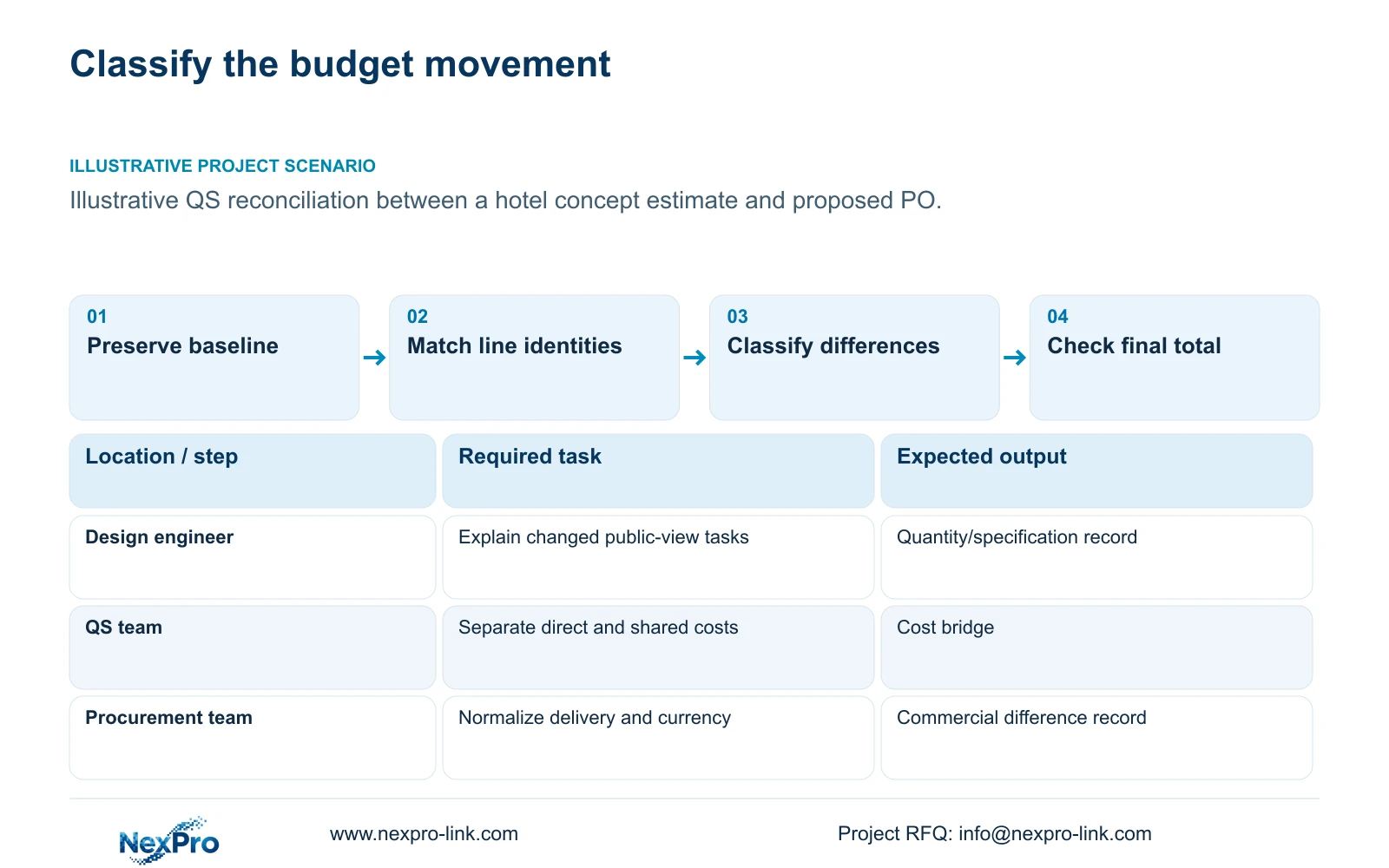
Match line identities before subtracting quantities. A camera moved to another public-route position is not necessarily an added device. Show additions, removals and retained units separately, with the drawing or task change that explains them. Keep spare units distinct from installed positions.
The teaching example changes quantity from 32 to 36. At the original rate of 100 cost units, the quantity effect is (36 − 32) × 100 = 400. This intermediate step preserves the old rate, so the owner can see the cost of the extra quantity independently of any specification or commercial rate change.
Check dependent scope before treating extra cameras as a simple extension. Added points can change switch allocation, recording input and storage demand. These consequences should have their own quantities and explanation. Spare ports alone do not establish sufficient PoE power, and spare NVR channels do not establish supported image modes.
| Item | Baseline | Revision | Effect |
|---|---|---|---|
| Direct teaching quantity | 32 at original rate | 36 at original rate | 400-unit quantity effect |
| Shared infrastructure | Original allocation | Recalculated allocation | Separate supported scope change |
| Cancelled material | Previously included | Confirmed reusable or cancelled | Credit depends on actual status |
Section 03
Isolate specification changes at the revised quantity
After the quantity bridge, apply the rate difference to the revised quantity. Here the rate moves from 100 to 110 cost units, giving 36 × (110 − 100) = 360. The revised direct subtotal is therefore 3200 + 400 + 360 = 3960, equal to 36 × 110.
Label the 360 as a combined rate/specification effect until the actual records establish its cause. A lens change, revised recording requirement and currency movement should not all be described as a technical upgrade. In a real reconciliation, divide that rate effect into supported subcomponents while preserving the same arithmetic total.
Keep exact product identity when a model changes. The NexPro-NVR2232-4K source record contains conflicting 2 × 8 TB and 2 × 18 TB capacity descriptions, as well as recording/playback differences. Do not justify a lower-cost substitution by selecting the larger conflicting value. Resolve the procurement configuration in the written scope before treating it as equivalent.
Section 04
Add shared scope and commercial differences explicitly
Identify shared additions that do not belong in every device rate. The teaching example adds one shared-resource item at 250 cost units. Its purpose is to show an independently priced addition; it does not identify a real recorder, switch or service package. Count it once and retain its scope explanation.
Separate freight, destination charges, software, OEM preparation and local site work where they change the evaluated boundary. Normalize currencies using an identified project conversion basis when necessary. Do not use an unexplained currency adjustment to conceal a model change, or count freight again if the revised unit rates already include it.
Keep recurring obligations outside the immediate PO bridge unless the order expressly includes them. Service duration, warranty coverage and local response responsibilities can affect the purchase decision, but future assumed visits are not current order quantities. Actual credits, partial releases and cancellation costs require their own records.
Section 05
Build an arithmetic bridge that reaches the final total
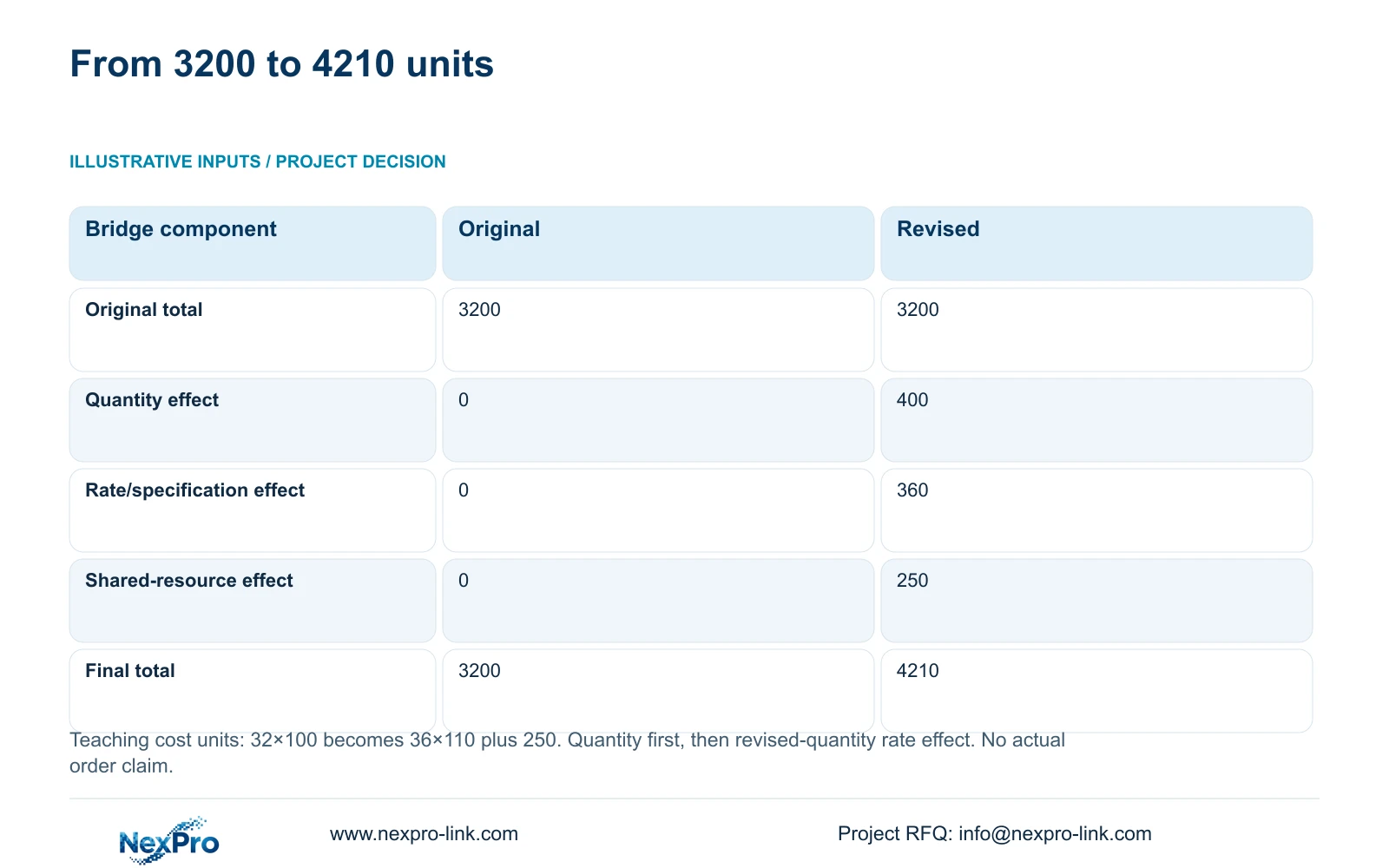
Original total equals 32 × 100 = 3200 cost units. Add the quantity effect of 400, the rate/specification effect of 360 and the shared-resource change of 250. The final teaching total is 4210, which also equals 36 × 110 + 250. The two routes to the total provide a useful arithmetic cross-check.
The 1010-unit difference is fully attributed by this example. It is not a hotel price increase, a branded quotation or the total of the independent 32-camera engineering reference. That reference can explain system dependencies, but its disk, power and cable assumptions must not be imported as priced additions here.
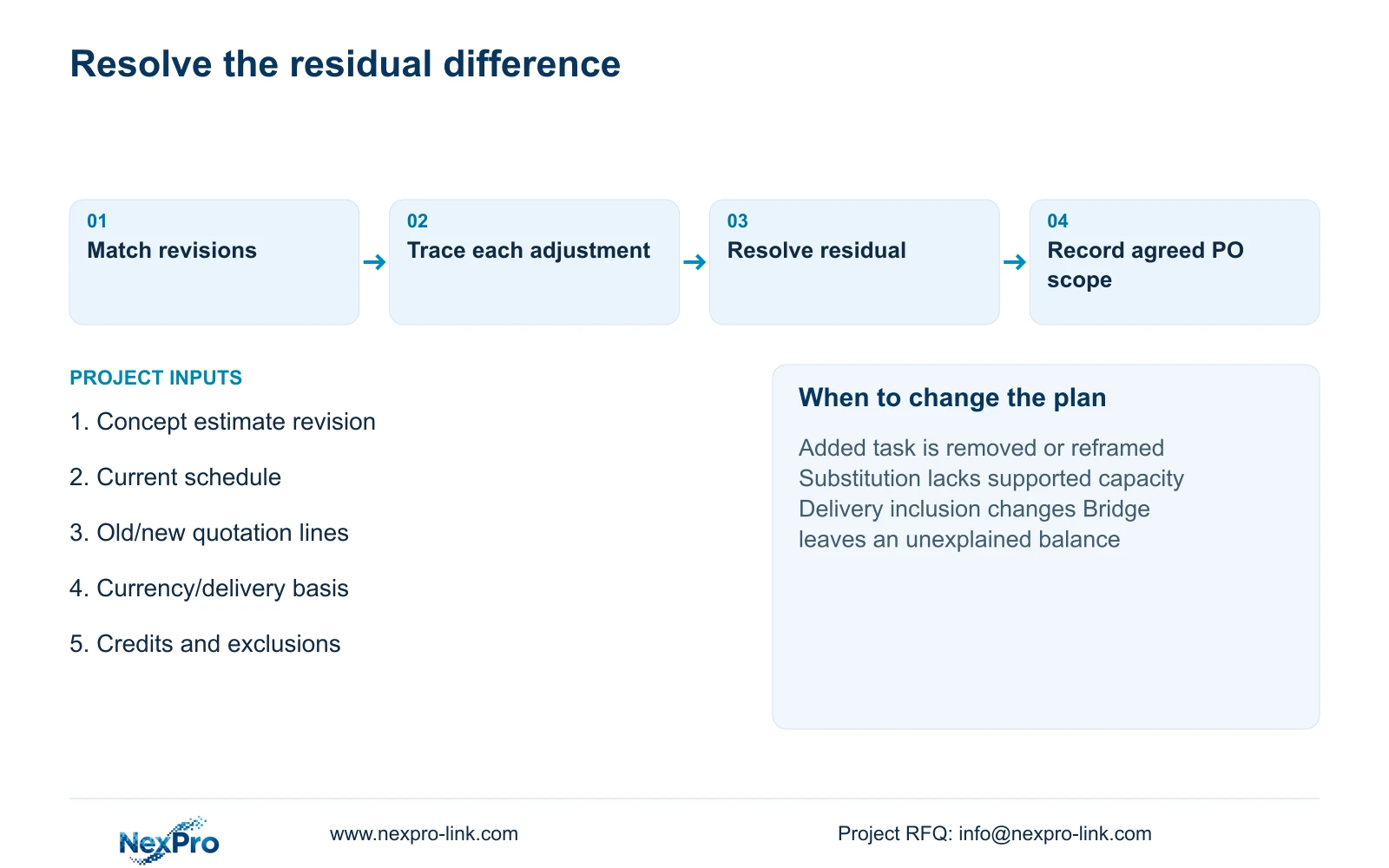
For a real PO, complete the bridge with negative changes and credits as well as additions. Any residual difference should remain visible and assigned for clarification. Avoid forcing the bridge to balance by creating an unsupported miscellaneous amount. The owner needs to know whether the residual is rounding, an omitted commercial adjustment or unresolved scope.
| Metric / condition | Original | Revised |
|---|---|---|
| Original total | 3200 | 3200 |
| Quantity effect | 0 | 400 |
| Rate/specification effect | 0 | 360 |
| Shared-resource change | 0 | 250 |
| Final teaching total | 3200 | 4210 |
Section 06
Explain the procurement choice and its change conditions
Recommend the reconciled revised option when its added quantities and specifications meet the approved task and its commercial boundary is complete. Change the proposal when an addition is unnecessary, an existing item can meet the task, or a supported alternative retains the outcome at lower evaluated cost. Keep any mandatory operator platform or brand requirement visible.
The final explanation should distinguish essential scope correction from optional enhancement. Required storage omitted from the concept cannot be removed simply to recover the original total. A larger display may be deferred if the ordinary operator screen meets the brief. Show the retained task, available alternative and cost effect for each choice.
Send info@nexpro-link.com the old and new schedules, affected quotation lines and the disputed scope or commercial differences, with destination and delivery assumptions. NexPro-Link can discuss model matching and a coordinated equipment response through BOQ and tender support. Use the agreed revision for the eventual order; a calculation explains the change but does not itself authorize production.
| Retained outcome | Extra scope | Worth retaining when | Counter-condition |
|---|---|---|---|
| Approved recording policy | Previously omitted storage | Needed for the required capacity | Verified existing capacity already meets it |
| Operator viewing task | Enhanced display | The brief requires the enhanced layout | The baseline screen meets the task |
| Public-route coverage | Added view and dependencies | A documented gap remains | Repositioning achieves the approved task |
Section 07
Buyer questions
Why calculate quantity changes at the original rate? It isolates the quantity effect. Applying the rate difference afterward to the revised quantity gives a complete bridge without leaving the rate change on added units unexplained.
Is every higher rate a specification upgrade? No. A rate can change because of delivery terms, currency basis or package inclusions. Require the quotation or configuration record to support its classification.
What if the bridge does not equal the supplier total? Show the remaining difference and request clarification against the actual quotation. Do not assign it to contingency or miscellaneous scope merely to make the arithmetic balance.
Can a reconciled comparison be sent straight to production? The order should reference the agreed configuration and commercial revision. Reconciliation supports the decision; it does not replace the buyer's order authority or resolve outstanding technical limitations.
Engineering references
These sources support the general planning principles. Always use the selected product's current datasheet and applicable project standards for final design.