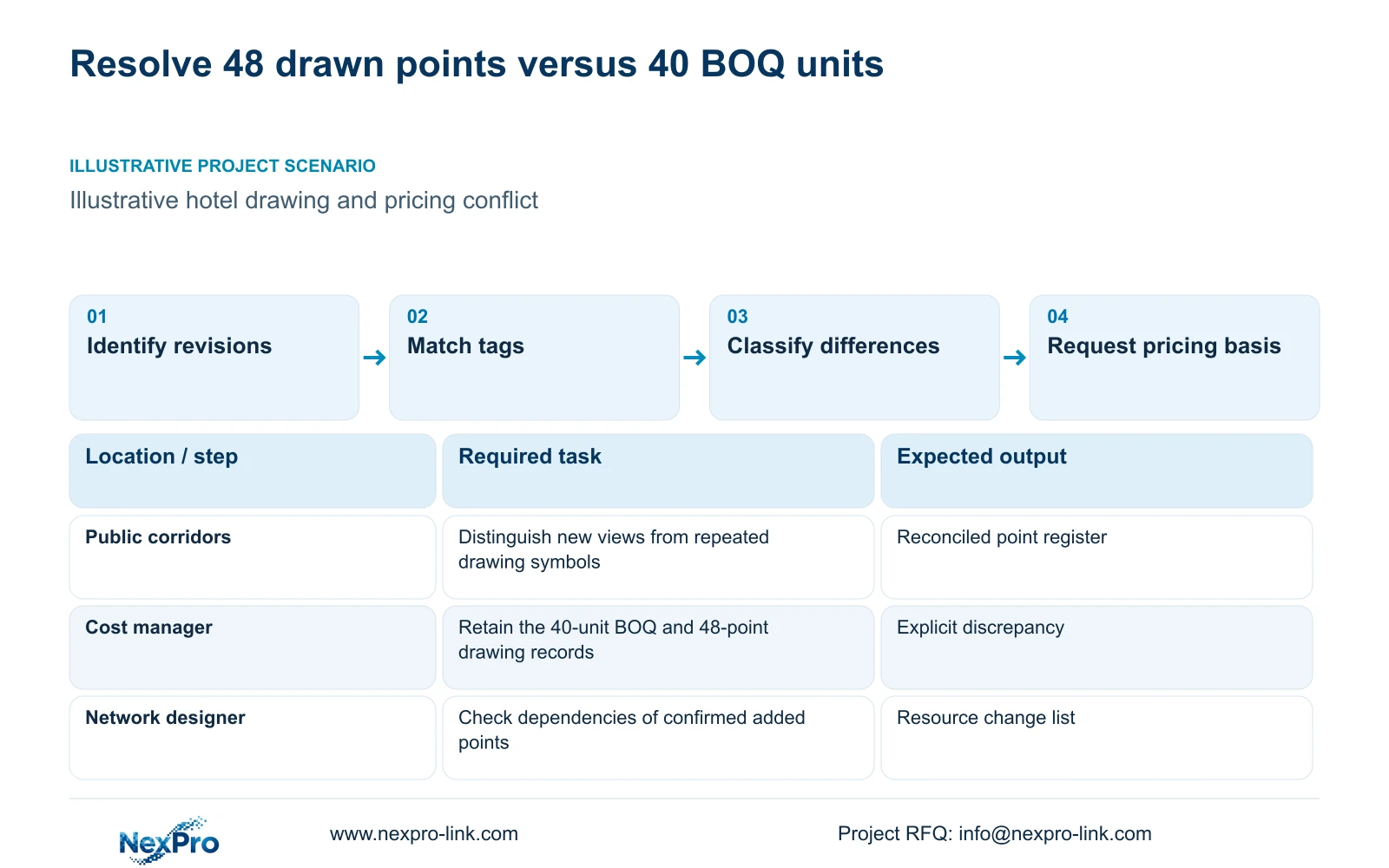
When hotel drawings show 48 cameras and the BOQ lists 40, preserve both records and obtain the authorized pricing basis. A tagged reconciliation and explicit variation keep omitted scope from becoming an unexplained price change.
Section 01
Identify the controlled drawing revision
When drawings show 48 cameras and the BOQ lists 40, use the pricing basis expressly established by the tender or an authorized clarification. If that basis is unresolved, preserve both counts and present the difference separately. Do not silently price 40 as complete or treat 48 as an authorized replacement.
Establish the document set before recounting points. Record the drawing issue, revision, BOQ issue and relevant addenda against the quotation. A newer file date does not by itself establish contractual precedence. The project party responsible for instructions must resolve any conflict that the tender documents leave open.
Keep the original model, interface assumptions and commercial boundary with the count. Otherwise a later increase can conceal a specification change or additional installation work. The cost manager needs a baseline that explains what the original price covered and which requirement remains undecided.
| Required task | Given information | Decision still needed |
|---|---|---|
| Price the tender baseline | BOQ lists 40 cameras | Confirm whether this is the governing pricing quantity |
| Account for drawn coverage | Drawing shows 48 cameras | Confirm tags and treatment of the difference |
Section 02
Reconcile point tags and quantities
Build a tag register that maps every drawn camera to a BOQ line and observation task. Record its zone, location and whether it is retained, added, relocated or deleted. A total-count comparison can reveal a discrepancy, but it cannot explain whether the extra points represent required views or repeated symbols.
Group the register by public areas such as the entrance, reception, corridors, back-of-house routes and parking. This makes missing areas visible without assuming that camera numbers follow guest-room count. For repeated floor layouts, confirm which floors the drawing applies to before multiplying the symbols.
Carry each genuine added point into the cable, switch and recorder allocations. A camera may fit an existing recorder's channel count while exceeding a local switch's available ports or power. The price of the device alone therefore cannot establish the total cost of resolving the drawing difference.
| Point condition | Quantity treatment | Dependency treatment | Effect |
|---|---|---|---|
| Existing tag relocated | Retain one camera | Revise route and mounting | Installation scope can change without extra hardware |
| New public-route view | Add only after clarification | Check network, recording and power | Device rate alone may understate the addition |
Section 03
Locate duplicates and omissions
Check repeated tags across overview plans, enlarged details and schedules. One camera shown in several drawing views should remain one physical device unless the design clearly requires separate views. Conversely, one symbol cannot automatically satisfy distinct overview and detail tasks; the design team must confirm the intended observation requirement.
Inspect omissions beyond cameras. A new external point may need a different mounting arrangement or backbone connection, while a corridor relocation may reuse the device but require a new cable route. Record reusable material, cancelled work and remaining site activity separately so the change statement reflects the actual scope.
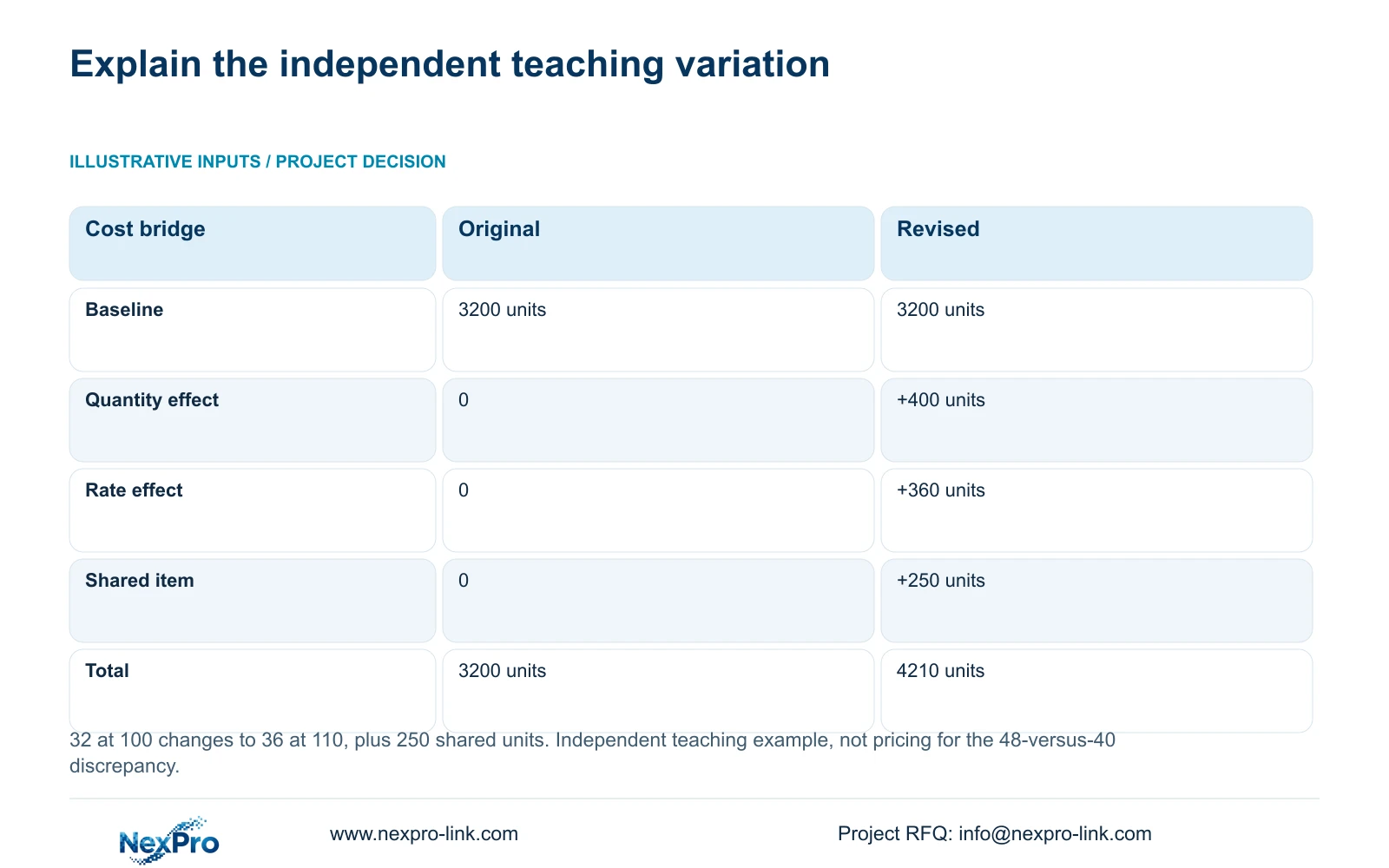
The calculation used below is a separate teaching example: an original quantity of 32 at 100 cost units changes to 36 at 110, with a shared item of 250. It is neither a price for the 48-versus-40 discrepancy nor a commercial total for CASE01. Its purpose is to keep quantity, rate and shared-resource effects distinct.
Section 04
Calculate the scope difference
Calculate the teaching baseline as 32 × 100 = 3200 cost units. Hold the original rate for the quantity bridge: (36 − 32) × 100 = 400. Then apply the rate change to the revised quantity: 36 × (110 − 100) = 360. Add the shared-resource change of 250 once.
The revised total is 3200 + 400 + 360 + 250 = 4210 cost units. The increase of 1010 comprises three identifiable decisions. This fixed sequence avoids counting the rate change on the four added devices twice. An alternative calculation sequence can be valid, but its allocation must be stated consistently.
Before replacing these inputs with actual quotations, check channel limits, aggregate recording input, usable storage and each switch's power budget. An addition that crosses a capacity threshold can require a larger shared resource. Identify that configuration change explicitly instead of hiding it inside an increased camera rate.
| Record | Value or status | Evidence/next action |
|---|---|---|
| Drawing symbols | 48 in the stated illustration | Controlled revision, tags and floor applicability |
| BOQ quantity | 40 in the stated illustration | Identified tender line and pricing instruction |
| Apparent difference | 8; not yet an authorized extra package | Remove duplicates and confirm distinct required tasks |
| Confirmed added/relocated points | Pending reconciliation | Point IDs plus route, mounting and resource consequences |
| Commercial delta | Unpriced until scope is known | Exact rates/inclusions and shared-resource changes; independent 32→36 cost example is not this price |
| Order basis | Await authorized clarification where unresolved | Update drawing/tag register, configuration and quote together |
Section 05
Present the base and clarification option
Issue the base quotation against an identified pricing instruction and show the unresolved drawing difference in a separate clarification schedule. State the affected tags, extra equipment, route work and resource checks. The alternative should be understandable without asking the evaluator to reconstruct the arithmetic.
For the 48-versus-40 issue, the eight-point difference is only a count reconciliation until the tags and required tasks are confirmed. Avoid presenting it as a complete extra package while cable lengths, mounting conditions or network dependencies remain unknown. Identify provisional quantities and the conditions under which their amounts will change.
If procurement timing requires consideration of partial release, identify genuinely unaffected items and the dependencies of each released group. A recorder or switch should not be treated as unaffected when the unresolved count determines its configuration. Reuse and cancellation options belong in the comparison only where they are actually available.
| Retained outcome | Extra scope | When needed | Counter-condition |
|---|---|---|---|
| Confirmed public-zone views | Additional tagged points | Instruction confirms distinct required tasks | Symbols duplicate retained points |
| Approved recording and outage operation | Shared-resource upgrade | Recalculation exceeds existing capacity | Documented capacity accommodates the addition |
Section 06
Update only after the instruction
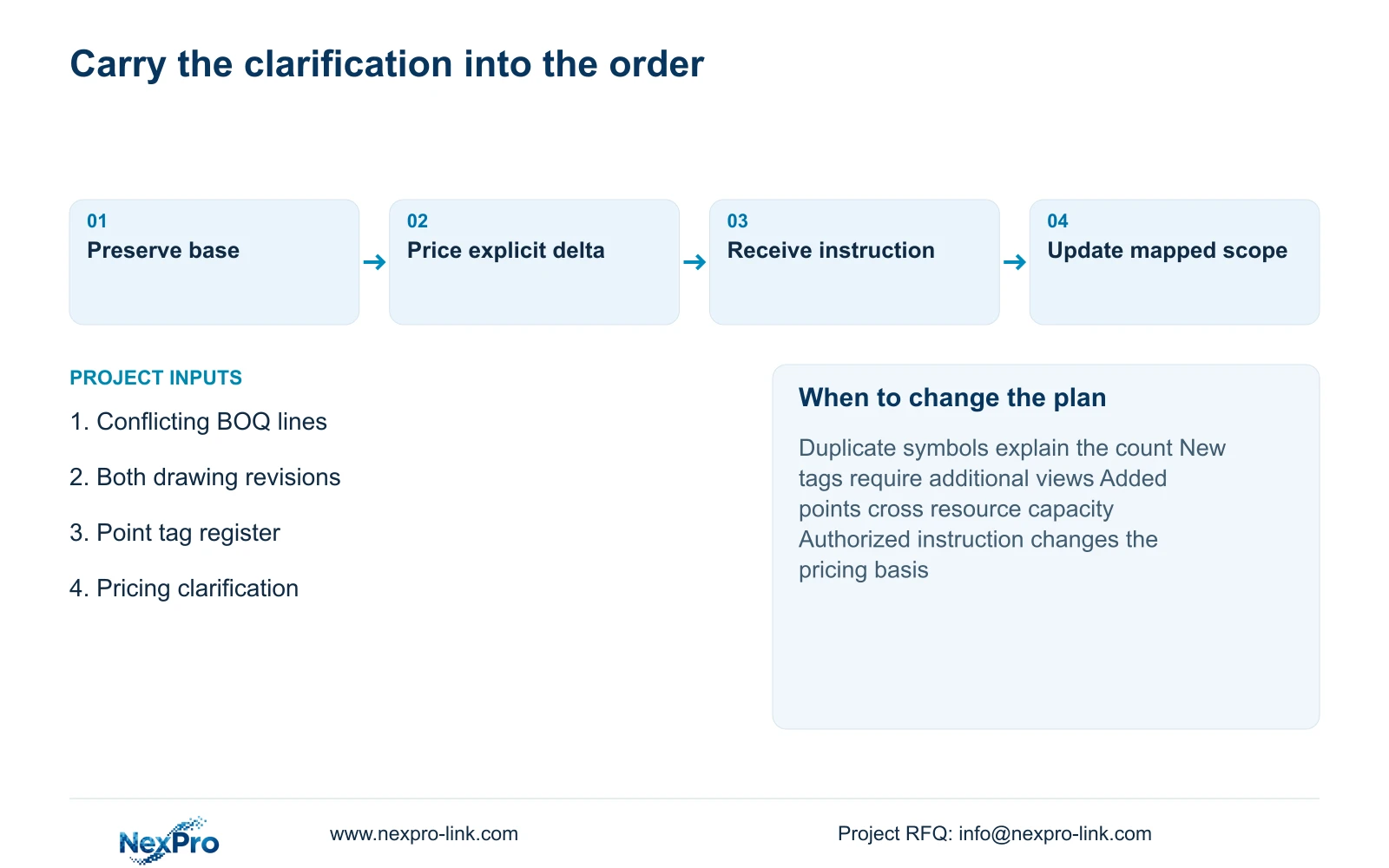
Once the authorized clarification arrives, revise the quantity register, configuration and quotation together. Attach the instruction reference to the changed lines and mark the previous price basis as superseded for that scope. Preserve the earlier version so subsequent changes can still be explained.
Recommend a visible baseline plus separately stated clarification increment while document precedence remains unresolved. Change to one consolidated procurement schedule when the responsible party confirms the required tags and pricing basis. If the instruction changes recording policy or platform requirements as well, recalculate those dependencies before releasing equipment.
NexPro-Link's BOQ and tender support at /project-supply/boq-tender-support can assist with model matching and a coordinated equipment response. It cannot decide the contract's governing quantity or guarantee consultant acceptance. Email info@nexpro-link.com with the conflicting BOQ lines, both drawing revisions, the camera tag register if available and relevant clarifications. Identify the destination and the decision blocking pricing; passwords and guest footage are unnecessary.
Section 07
Buyer questions
Can the extra drawn cameras use the original unit rate? Only if the device specification and included work remain the same and shared resources can support them. Different mounting, routes or capacity upgrades need separate treatment. State the rate basis before extending it.
Can unaffected equipment be ordered before the count is resolved? It can be considered where its configuration and quantity are genuinely independent of the discrepancy and the project authorizes release. Identify cancellation, reuse and timing consequences; do not assume a shared recorder is unaffected.
What can a supplier return from conflicting documents? A tagged discrepancy register, model-matched base scope and separately described clarification option can support the buyer's decision. Contract precedence and authorization remain with the designated project parties.
Engineering references
These sources support the general planning principles. Always use the selected product's current datasheet and applicable project standards for final design.