A useful hotel security BOQ connects each priced line to an operating task, preserves drawing references and assigns shared infrastructure once. This worked comparison shows how to expose missing scope before evaluating quotations.
Section 01
Define the functional work packages
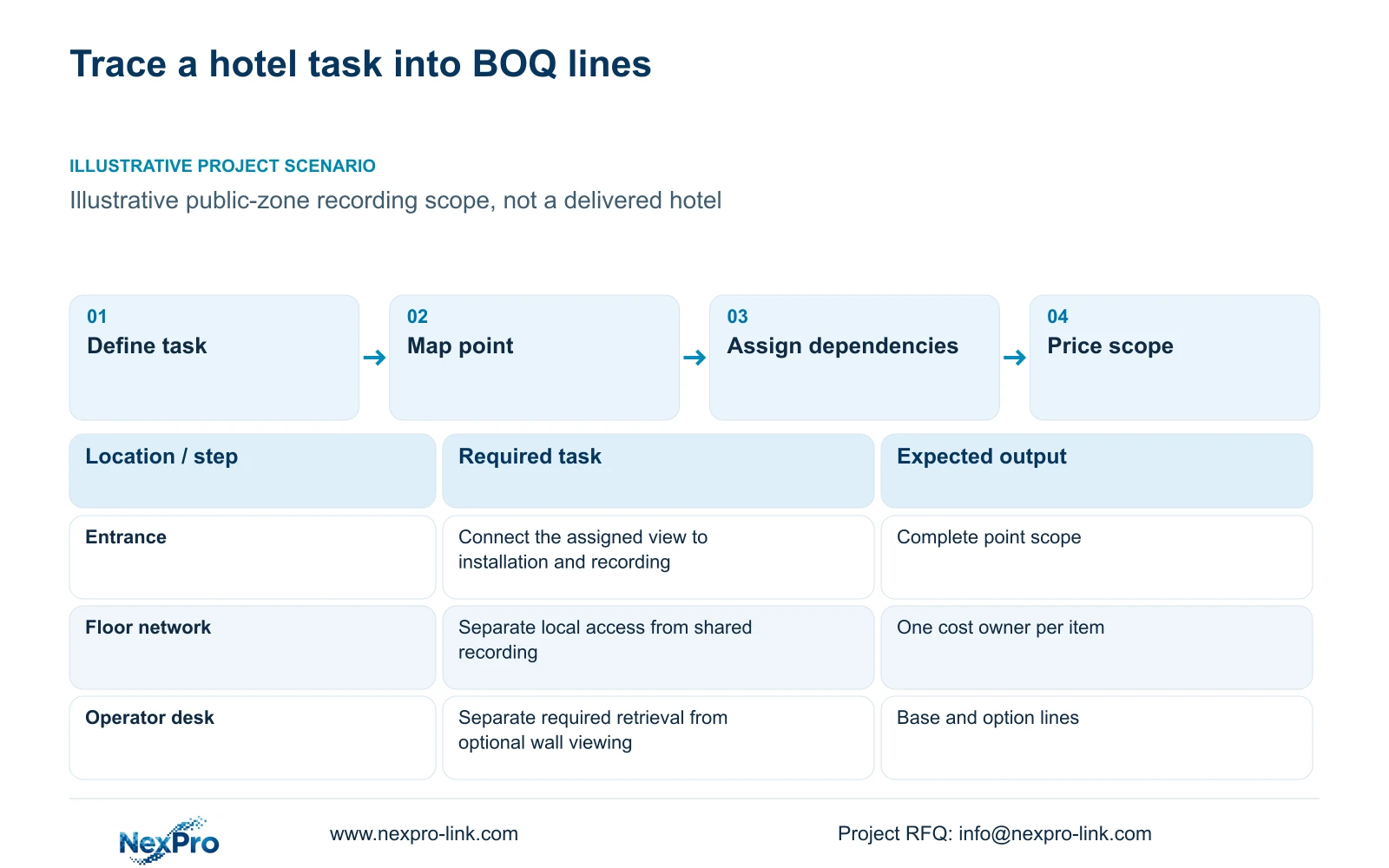
Organize the hotel security BOQ around complete operating tasks, then assign the equipment and services needed for each task. Use this structure when the tender must deliver a working recording system. A camera-only allowance is acceptable only when the remaining infrastructure is explicitly provided elsewhere and its capacity and responsibility are established.
Separate public-zone camera points, recording, floor access networks, operator viewing, protected power and installation work. Describe the outcome of each package. An entrance point must provide its assigned view; the recording package must retain and retrieve the approved footage; the power package must maintain the selected recording path during the agreed outage.
The illustrative CASE01 reference uses 32 public-zone views in a 100-room city hotel. Room count is background, not a camera quantity formula. Its operator display is separate from the recording path, so an optional wall can be evaluated without removing essential recording resources. Guest-room interiors and other sensitive private spaces are outside this reference scope.
| Required task | Given information | Decision still needed |
|---|---|---|
| Record entrance activity | Camera task and point location | Mounting, cable and recording allocation |
| Continue recording during an outage | Selected protected functions | Every required power zone and runtime configuration |
| Retrieve an incident | Authorized operator workflow | Viewing, playback and export scope |
Section 02
Preserve drawing and schedule references
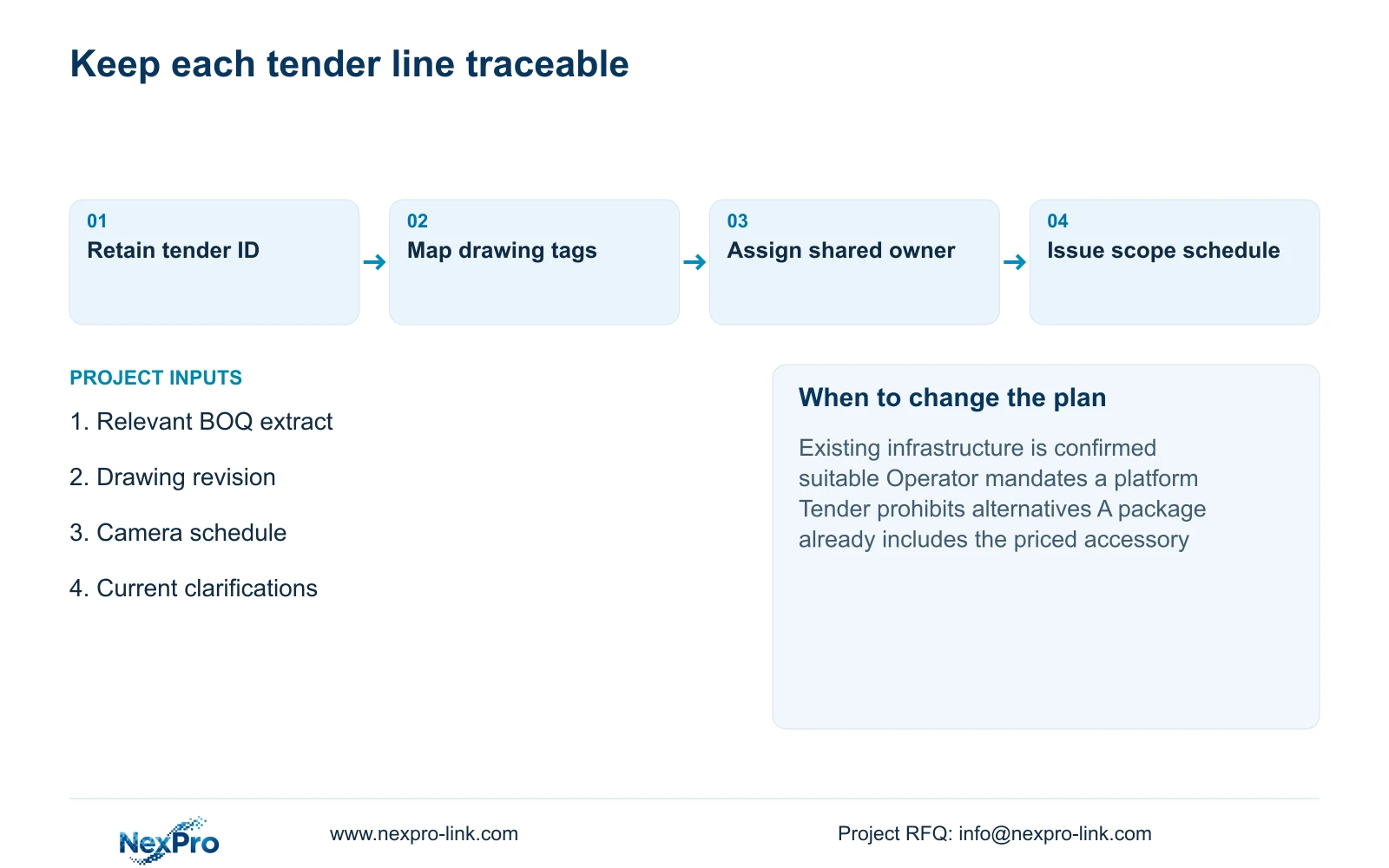
Keep the original tender line number alongside the supplier's proposed model. Add the drawing number, revision and camera tag so the evaluator can trace the quantity to a location and task. Supplier numbering may help internal ordering, but it should remain an additional reference rather than replace the tender identity.
A camera schedule and a door schedule describe different equipment populations. Preserve both where the supply package includes CCTV and locks or access control. A shared order does not establish software integration, identical power arrangements or common acceptance responsibilities. Each interface needs an identified owner.
When a drawing revision changes a corridor endpoint, update the affected point mapping and its dependencies. Record whether the change adds a view, moves an existing point or changes its accessories. This allows the cost manager to distinguish a genuine quantity increase from a renamed tag or a mounting revision.
| Item | Unmapped offer | Mapped offer | Effect on the hotel task |
|---|---|---|---|
| Camera line | Supplier model only | Tender line, tag and drawing revision | Location and required view remain traceable |
| Recording package | One system total | Package reference and served camera groups | Retention responsibility can be checked |
Section 03
Separate equipment and supporting items
Specify whether a camera line means a supplied device or a completed installation point. List mounting hardware, terminations, cable, configuration and testing as included components or separate lines. The same discipline applies to disks and software: a recorder model name does not establish that storage or optional licenses are included.
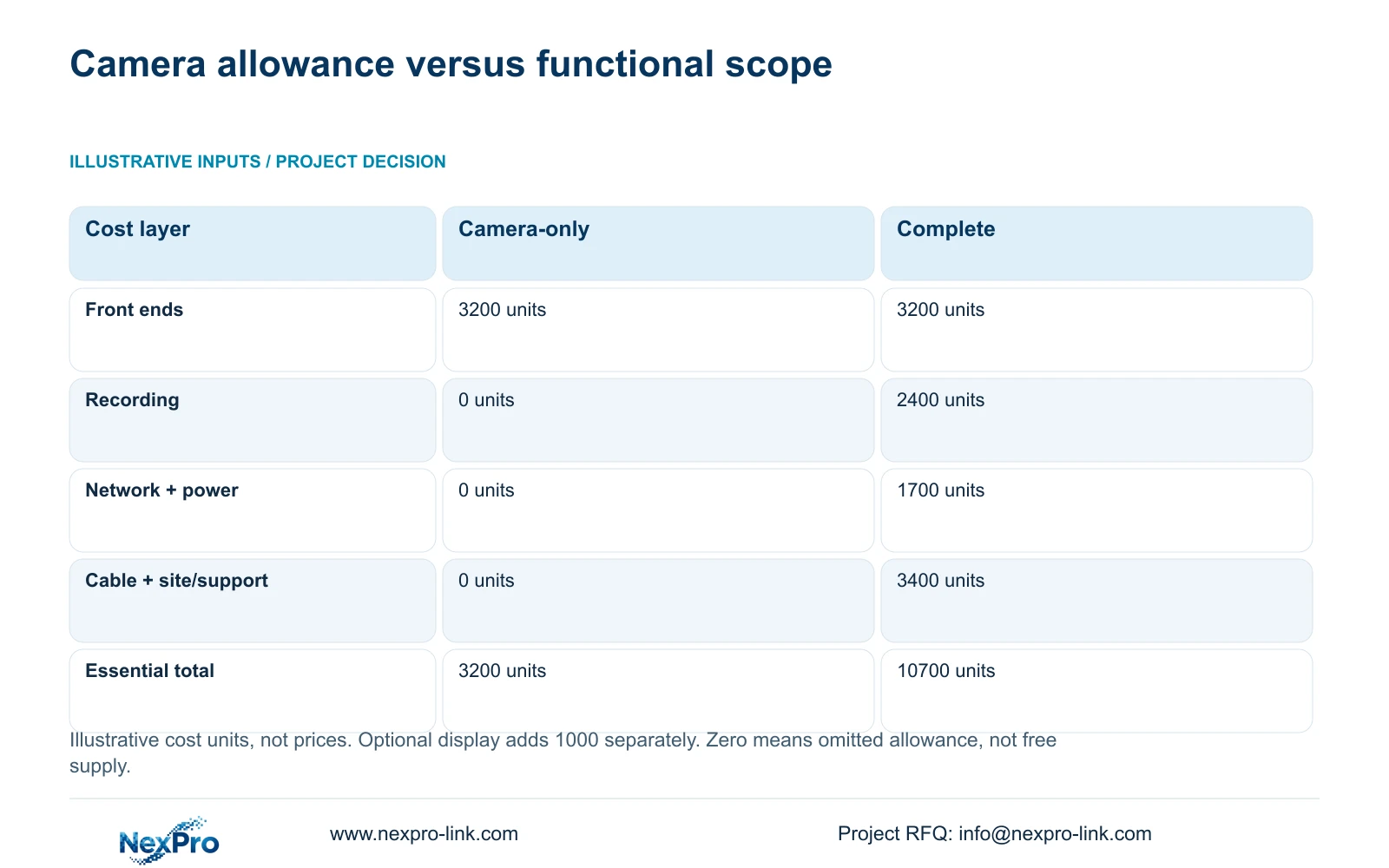
The following independent teaching allowance uses cost units, not a currency, supplier quotation or typical hotel budget proportion. Inputs are 3200 for front ends, 2400 for recorder and storage, 800 for networking, 900 for power, 1600 for cabling and 1800 for installation and support. Optional display is another 1000.
The original budget illustration shows how missing layers increase an allowance from 3200 to 10700 teaching units; it is not a BOQ template or a priced hotel. Use the line structure below to turn those layers into measurable scope. Complete quantities from the controlled drawing or supported system design, and distinguish included components from separately charged items.
| Line/function | Location or served scope | Unit and quantity basis | Required composition/evidence | Cost status |
|---|---|---|---|---|
| Public-camera point | Tag + drawing revision + task | Each or defined point; confirmed tag count | Exact model; mounting/cable/configuration inclusions | Included / separate / by others / unresolved |
| Recording package | Served camera groups | System with component quantities | Recorder, drives, usable retention and retrieval scope | One owning line; cross-reference dependent floors |
| Floor network/protection | Node and protection zone | Actual node/component counts | Port, traffic, PoE and supported backup configuration | Shared versus local costs identified |
| Cable/site work | Route group and approved access | Installed metres/tasks on defined basis | Cable, ends, pathway, tests and local owner | Procurement reels separate from installed length |
| Optional display | Approved operator task | Separate option with component quantities | Decoding, mounting, power and service boundary | Exclude from compliant base unless mandatory |
Section 05
Compare complete quoted scopes
Normalize quotations against the same retention requirement, camera tasks, cable basis and service boundary. Add excluded required work to the evaluation using identified quotations or unresolved allowances. Keep unknown amounts visible. Treating an unpriced disk package as zero can make an incomplete offer appear commercially preferable.
Technical suitability also needs its own record. A switch requires confirmed port characteristics and total PoE output; an NVR requires the approved recording and disk configuration. General labels such as complete system or compatible equipment cannot replace those checks. The evaluation should separate unresolved technical fields from missing commercial amounts.
RICS New Rules of Measurement provides context for distinguishing cost planning, detailed measurement and maintenance costs. The table here is a project teaching example, not a RICS schedule or contract rule. Preserve the project's actual measurement conventions and show optional improvements separately from the compliant base.
| Retained outcome | Extra scope | When worth buying | Counter-condition |
|---|---|---|---|
| Recording and incident retrieval | Larger operator display | Approved sustained viewing requires it | Ordinary operator screen meets the task |
| Approved outage recording | Additional protected loads | Those loads must operate during the outage | They are outside the approved continuity scope |
Section 06
Issue a traceable tender schedule
Use a schedule with tender line, function, location or tag, drawing revision, quantity, unit, proposed model, package inclusions, exclusions and quotation reference. Identify whether each quantity is measured, provisional or an explicit allowance. Put alternatives in separate rows linked to the baseline, with deviations and approval status visible.
Recommend the complete functional allowance when this procurement must supply the recording path and associated work. Retain a narrower equipment-only scope when existing resources are documented and their interfaces are assigned. Reconfigure the schedule if the operator requires a particular platform or prohibits brand alternatives; the BOQ itself cannot grant approval.
NexPro-Link can discuss model matching, technical information and a coordinated equipment quotation through BOQ and tender support at /project-supply/boq-tender-support. Its CCTV manufacturing core and coordinated supporting supply do not imply that every category is manufactured in-house or that local installation is included. Send the relevant BOQ extract, associated schedule or drawing revision, and current clarifications to info@nexpro-link.com, stating the destination and permitted alternative scope.
Section 07
Buyer questions
What if the drawing count differs from the BOQ? Record both counts against their document revisions and request the authorized pricing basis. Keep any alternative quantity separately priced until the clarification is issued; a supplier should not decide which document controls the contract.
Can an alternative brand appear beside the baseline? Yes, if the tender permits alternatives. Preserve the specified base, identify exact proposed models and disclose technical or service deviations. The buyer or designated consultant retains the acceptance decision.
Is the whole confidential tender needed for an initial quotation? A relevant BOQ extract, associated equipment schedule and key requirements can support an initial discussion. Remove unrelated confidential material and personal data. Further inputs can be requested against the unresolved scope.
Engineering references
These sources support the general planning principles. Always use the selected product's current datasheet and applicable project standards for final design.