Each, set, lot and system can all work in a hotel security BOQ when their contents are explicit. Component schedules and clear installation boundaries make bundled prices comparable and later changes measurable.
Section 01
Define each measurement unit
Choose each for separately counted devices and set for a repeatable kit only when its components are defined. Accept a lot or system price when it includes a supporting breakdown of quantities, interfaces and exclusions. Change the measurement basis if an evaluator cannot determine what one unit buys or how a later variation will be measured.
An each line can describe a camera supplied loose, while an installed point can include mounting and termination work. A set can describe one door arrangement with an identified lock and associated components. A lot needs a stated work boundary, and a system needs an equipment and service schedule. None of these labels establishes its own contents.
Separate confirmed quantities from provisional work and explicit design allowances. A measured camera count does not make an unresolved cable quantity firm. RICS New Rules of Measurement distinguishes cost planning, detailed measurement and maintenance purposes; the project's chosen measurement and contract rules still determine how this BOQ is used.
| Required task | Given information | Decision still needed |
|---|---|---|
| Buy camera hardware | Tagged device count | Supply-only each or defined installed point |
| Buy a door kit | Door type and operation | Components and interfaces included per set |
| Buy recording service | Required retention and retrieval | System equipment and service breakdown |
Section 02
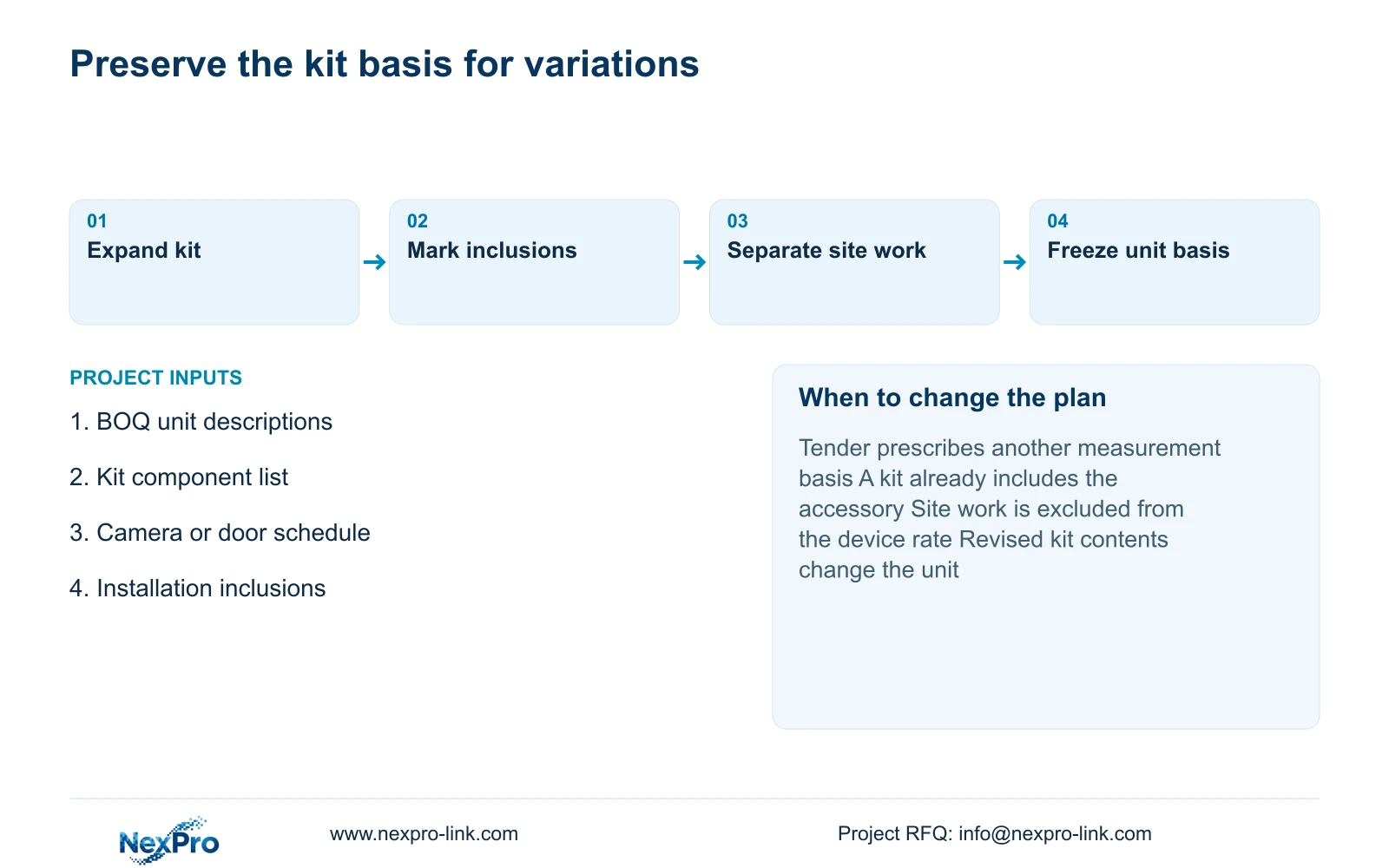
Expand every kit into components
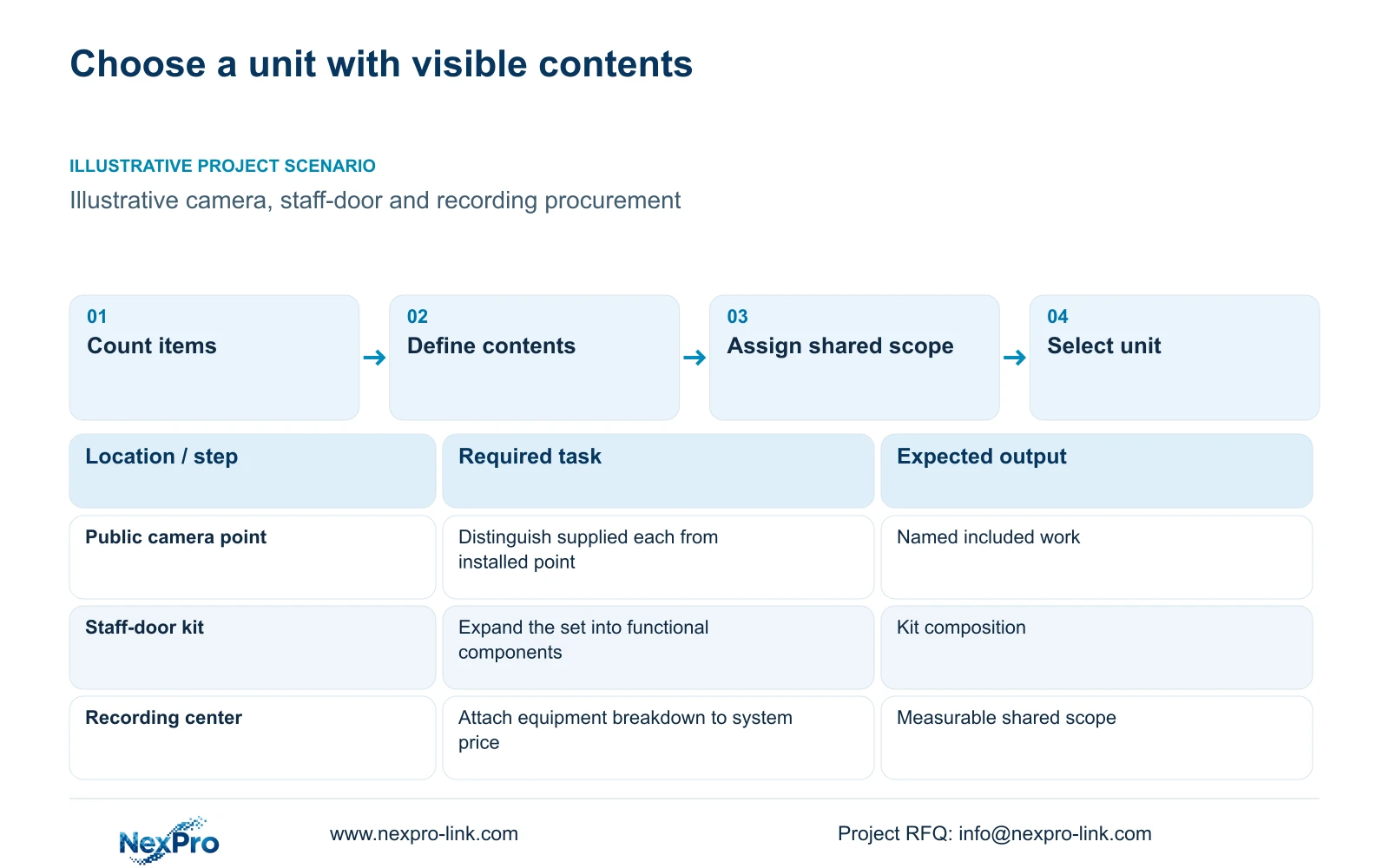
Attach a kit composition to every set line. Identify the device, mounting items, connectors and any configuration or testing included in the rate. Distinguish components supplied within the kit from quantities charged elsewhere. Where a package contains disks or software, name them in the recording or software schedule even if the package retains one commercial price.
Door kits need particular care. A battery-operated room lock, a centrally powered staff access arrangement and a mechanical backup have different component and power boundaries. A shared hotel equipment order does not prove PMS integration or common controller compatibility. Safe door operation remains a matter for the responsible local specialists.
Preserve product identities in the breakdown. SP5648 is a Cat6 48-port data patch panel, while DT968MX is a Cat6 module. Neither is a bulk cable reel. A system line that lists either component still needs its cable, patch leads and testing scope defined; the component category alone does not establish the complete installed link.
| Item | Opaque unit | Defined unit | Effect |
|---|---|---|---|
| Camera set | One complete set | Device plus named mounting and termination items | Accessories can be checked without duplicate charging |
| Recording system | One system | Recorder, disks and identified configuration scope | Capacity and service boundaries remain visible |
Section 03
Assign common infrastructure once
Give shared infrastructure a single cost owner. Floor camera sets can depend on a central recorder without each set including another recorder. Cross-reference the shared line and state which camera groups it serves. Use the same method for core networking, cabinets and system-wide configuration.
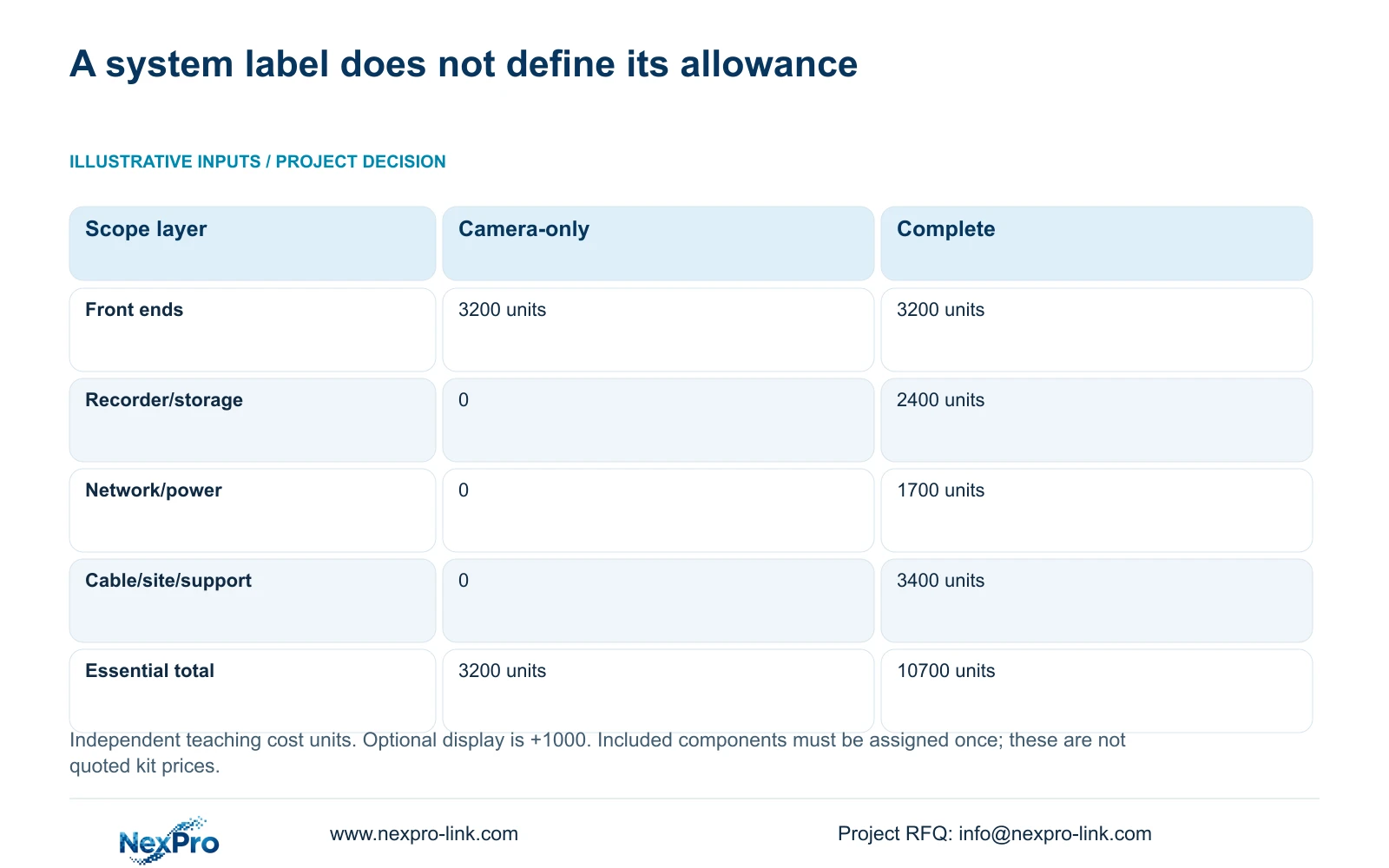
The independent teaching budget uses 3200 cost units for front ends, 2400 for recording and storage, 800 for networking, 900 for power, 1600 for cabling and 1800 for installation and support. These are hypothetical allocations, not quoted rates. The essential allowance equals the sum of required rows, with optional display kept separate.
Review package contents before summing those rows. If a supplier bundles a disk into its recorder price, the separate disk line can disclose the quantity as included rather than charge it again. If the project reuses existing infrastructure, document capacity, connection work and ownership before reducing the new supply allowance. These commercial inputs do not represent CASE01 totals.
Section 04
Compare priced schedules on one basis
Normalize offers using component quantities and retained functions before comparing their unit rates. A cheaper system line may omit storage, site work or licenses that another offer includes. Mark each required item as included, separately priced, supplied by others or unresolved. An unresolved amount must not disappear into a zero allowance.
In the teaching comparison, 3200 + 2400 + 800 + 900 + 1600 + 1800 = 10700 cost units. Networking and power combine to 1700, while cabling and site/support work combine to 3400. The camera-only allowance of 3200 leaves these layers unpriced. Optional display adds 1000 separately; it is not included in the essential total.
This result supports a complete component breakdown, not a preference for the higher total. For phased procurement, compare a functional first release with waiting for the full package. An optional display can have a later release only if the approved operator workflow remains available. Site readiness and unresolved integration inputs can still block a usable first phase.
| Unit | Composition to attach | Measurement and variation boundary |
|---|---|---|
| Each | Exact supplied device plus explicit inclusions | Actual device count; installation not implied |
| Defined installed point | Device, mounting, ends and named completion tasks | Tagged points; separate route/shared work if not included |
| Set | Repeatable kit with named component quantities | Count complete kits; changed contents shown separately |
| Lot | Defined activity/work package and exclusions | Retain activity basis, not an unexplained lump sum |
| System | Equipment, served groups and service breakdown | Shared resources counted once; variations use the retained composition |
Section 05
Separate installation quantities
Keep device quantities separate from route lengths, terminations and installation activities unless a defined installed-point rate genuinely includes them. Identify whether cable is priced by installed length or purchased reel, and whether testing covers the completed link. Different measurement bases need reconciliation before comparing totals.
CASE01 illustrates why procurement length and route quantity differ. Its independent 32-route schedule totals 1826 m and has a feasible seven-reel plan using 305 m reels. That example is not a universal cable quantity for a hotel or a cost input in the table above. Actual continuous cuts and route allowances determine procurement.
An installation package should also identify access and local responsibilities. Mounting a camera, configuring a recorder and demonstrating authorized export are different activities. If these are covered by one lot, preserve an activity breakdown so changes in point count do not automatically multiply every shared service.
| Retained outcome | Extra scope | When needed | Counter-condition |
|---|---|---|---|
| Completed camera point | Separate mounting and termination work | Supply-only device line | Defined point rate already includes it |
| Usable recording system | Configuration and task demonstration | Not included in equipment package | Same activity is already priced once |
Section 06
Keep a measurable change baseline
Retain the agreed unit definitions with the original component quantities and quotation revision. When the design changes, show additional units, changed kit contents and revised shared resources separately. A system price can remain commercially convenient while its supporting breakdown provides the basis for a transparent variation.
Recommend each or a defined installed point for individually traceable cameras, repeatable sets for confirmed kits, and a supported system breakdown for shared recording. Change that approach when the tender requires a different measurement convention, but preserve the same visibility of composition and exclusions. Brand alternatives remain subject to the procurement rules.
For a model-matched response, send info@nexpro-link.com the disputed unit descriptions, kit composition if available, relevant camera or door schedule and installation inclusions. State the delivery destination. NexPro-Link can discuss equipment matching and coordinated supply through /project-supply/boq-tender-support; its CCTV manufacturing and supporting supply coordination do not automatically include local installation or every third-party interface.
Section 07
Buyer questions
Does a system price need separate component prices? It needs a component and service breakdown that makes scope measurable. Whether individual prices are required depends on the tender. At minimum, retain quantities, inclusions and the agreed basis for pricing changes.
Should an included disk appear again in the BOQ? Its identity and quantity should remain visible, but it should be marked included against the owning package rather than charged twice. This preserves the storage check without duplicating the commercial amount.
What should be sent when only the BOQ unit wording is disputed? Send the affected lines, proposed kit contents and relevant schedule extract. Include the intended supply or installation boundary. The entire confidential tender is unnecessary for an initial discussion of unit composition.
Engineering references
These sources support the general planning principles. Always use the selected product's current datasheet and applicable project standards for final design.