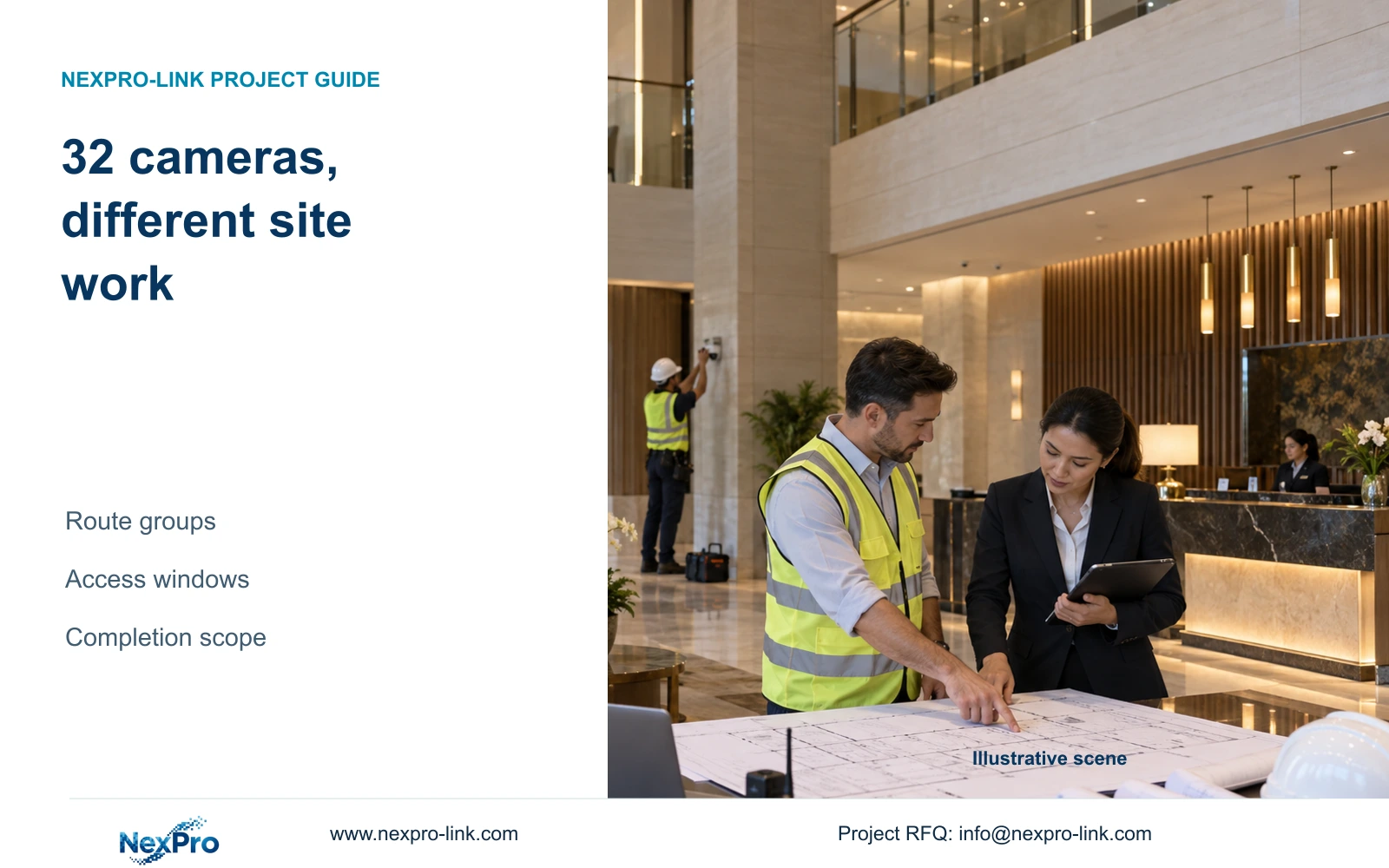
Two 32-camera installation quotations can cover different work. Group routes and mounting tasks by actual site conditions, then compare preparation, testing and access assumptions on the same basis.
Section 01
Classify the work before comparing installation rates
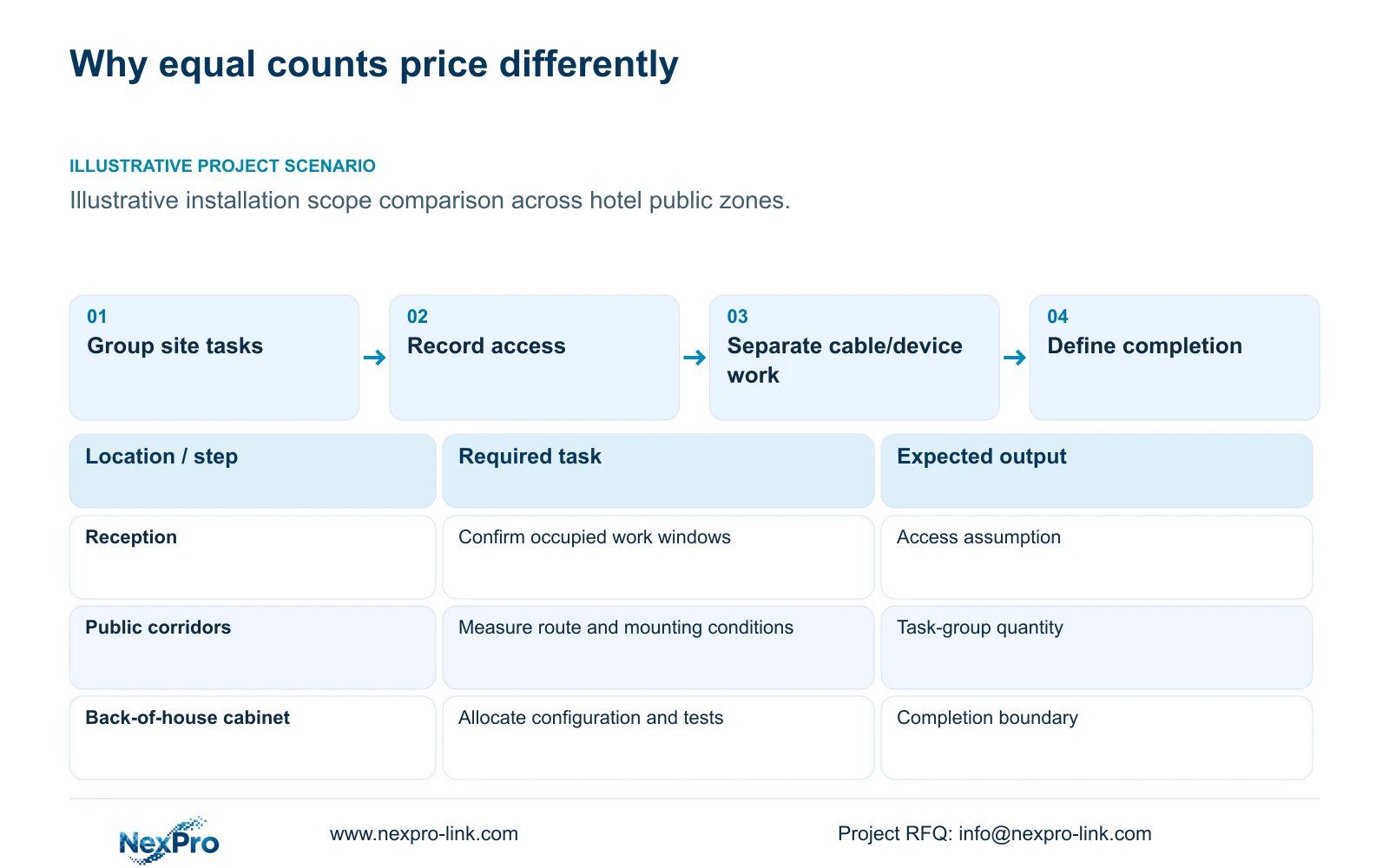
Request task-grouped installation quotations when two offers for the same 32 cameras differ substantially. Compare mounting height, cable routes, hotel operating restrictions and preparation scope before selecting the lower labour total. A per-camera rate is useful only when its included work and site conditions are sufficiently consistent.
Separate mounting and aiming from cable pulling, termination, rack work and system configuration. Include the actual acceptance and handover tasks. A quotation for fixing cameras to prepared outlets covers less than one including new pathways, cable tests and recorded-image checks, even though both may say '32 cameras installed'.
Use public-zone groups such as entrance, lobby, public corridors and back-of-house routes. The supplied hotel reference assigns 32 views to those and exterior tasks, but gives no installation productivity rates. Its hotel size and camera quantity therefore cannot establish crew hours or local labour prices.
| Required task | Given information | Decision still needed |
|---|---|---|
| Mount and aim cameras | Position schedule | Height, support and access method |
| Install continuous cable | Outline endpoints | Actual route and pathway condition |
| Make the system operational | Equipment list | Configuration, tests and handover scope |
Section 02
Record access conditions and permitted work windows
Identify whether each zone is accessible before installation or remains in operation. Public corridors and reception areas may require agreed working windows, protection of finishes and coordination with hotel staff. Record the permitted access arrangement in the pricing scope so contractors do not base their rates on different assumptions.
Distinguish a work window from productive task time. Moving tools, gaining access and restoring an area are activities that may recur whenever a zone is reopened for work. Ask the installer to state how these activities are included, without imposing an unsupported universal percentage for disruption.
Mounting height and maintenance access also influence the method. A difficult position may need a different access arrangement from an ordinary accessible ceiling. Local contractors should define the appropriate safe method and its cost. The equipment supplier's preparation support does not replace local safety or access responsibilities.
| Item | Offer assumption A | Offer assumption B | Effect |
|---|---|---|---|
| Public-zone access | Unrestricted installation access | Agreed occupied-hotel windows | Different mobilization and working conditions |
| Mounting | Prepared accessible supports | Support/access work included | Different mounting scope |
| Completion | Device fitted | Configuration and task checks included | Different definition of completion |
Section 03
Separate cable work from device work
Cable labour follows the actual route and installation method. Measure horizontal and vertical sections with explicit termination allowances; do not substitute the straight-line distance between camera and cabinet. State whether pathways already exist, and keep pathway provision separate where another trade supplies it.
Cable procurement and labour quantities have different boundaries. The supplied reference case uses 1826 m of illustrative continuous cuts and a feasible seven-reel plan at 305 m per reel. Its 309 m of distributed tails is purchased remainder, not installed route length. Those figures do not establish labour effort and must not be converted into hours without local productivity inputs.
Confirm the required test basis and associated termination scope. The supplied Fluke guidance distinguishes the typical 90 m permanent link from a 100 m channel including patch leads. SP5648 is a Cat6 patch panel and DT968MX a Cat6 module; neither identifies the bulk cable or proves the completed link's category. Price the specified cable, components and tests as a complete installation task.
Section 04
Compare preparation with the remaining site steps
Preparation can include device identification, agreed configuration and package mapping to installation zones. Define the configuration information available before shipment, and identify changes that still depend on hotel IT or final positions. Preparation should produce records the installer can use, not an unsupported claim that all commissioning is finished.
Site work still includes physical installation, final framing and relevant operational checks. Recorded moving targets, playback and export address different questions from an online-device indicator. An approved preparation record can reduce repeated decisions, but no supplied test or time study establishes a fixed labour saving.
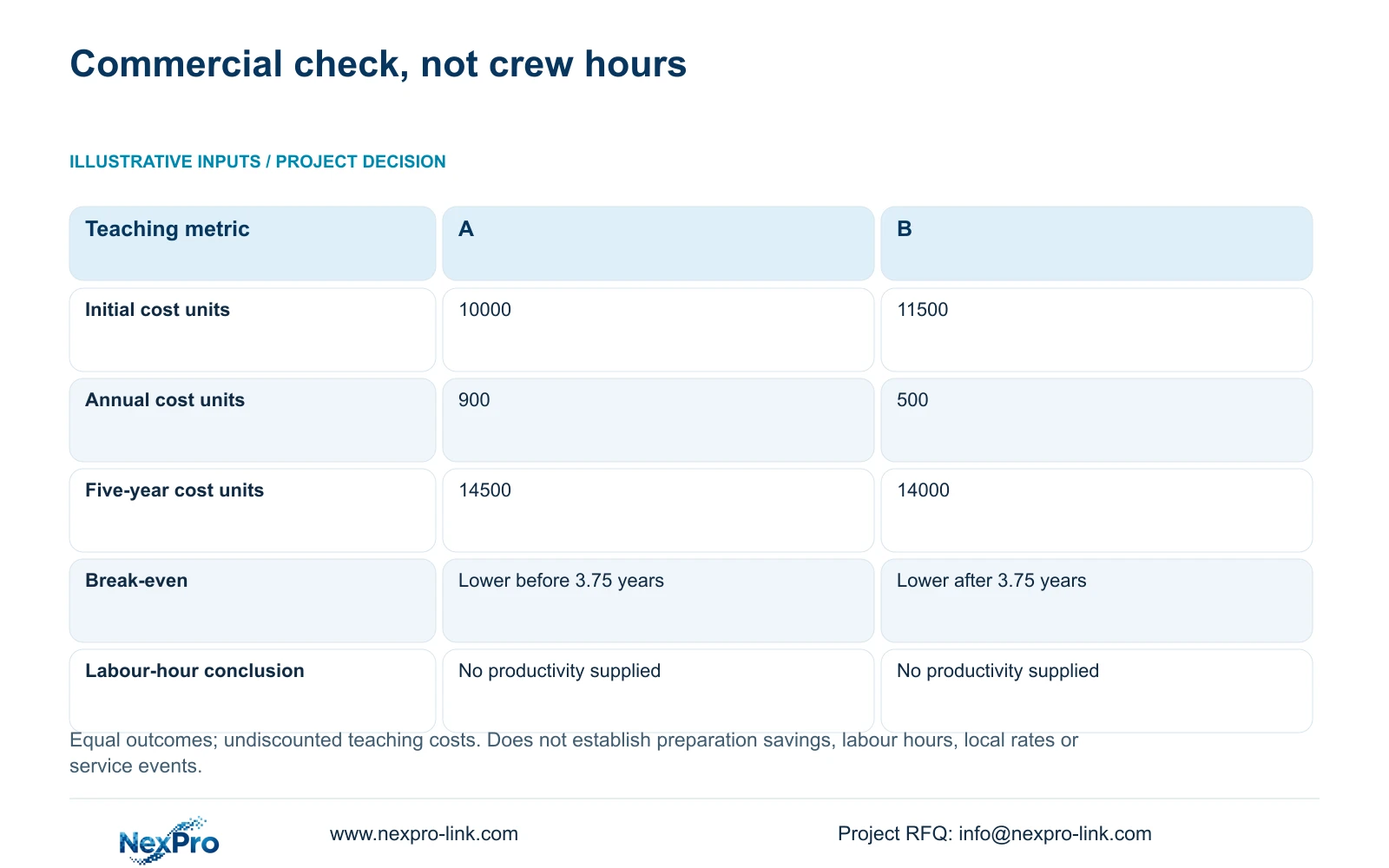
A preparation-inclusive offer can be evaluated commercially, but the original ownership-cost illustration is not a crew-hour model. Its annual difference does not prove a saving caused by preconfiguration. Compare the actual preparation deliverables with the site work still needed, and keep any later service terms separate.
Section 05
Build an effort range from supported task inputs
Estimate person-hours by task group: quantity multiplied by supported person-hours per task, plus separately identified shared activities. For cable, use route-group metres and the contractor's applicable productivity basis. Low and high cases should change named conditions such as accessible routes or restricted work windows while retaining the same completion requirement.
No crew productivity or hourly rate is supplied here, so a numerical labour-hour range cannot be justified. Leave those inputs open for the local installer. Do not divide the teaching cost totals by an invented wage rate to create an apparent site estimate.
Use the task inputs below to request an effort range. Each low/high productivity basis must come from the responsible installer and describe the site condition it assumes. Convert person-hours into crew duration only after crew size and available work windows are stated. The separate commercial illustration establishes none of those inputs.
| Task group | Quantity basis | Person-hour calculation | Condition to state |
|---|---|---|---|
| Mounting and aiming | Tagged devices in the same access class | Quantity × supported person-hours/device | Height, support and occupied-zone access |
| Cable installation | Measured continuous route group | Metres × supported person-hours/metre | Existing pathway, pulling method and work window |
| Termination and link tests | Actual ends/links in the specified scope | Count × supported person-hours/task | Components and agreed test basis |
| Shared setup and handover | Defined common activities | Separately supported person-hours | Do not multiply the whole system setup by every camera |
| Low/high case | Same completion scope | Sum task groups under named assumptions | Installer evidence required; no numerical range supplied |
Section 06
Request a quotation with the same completion boundary
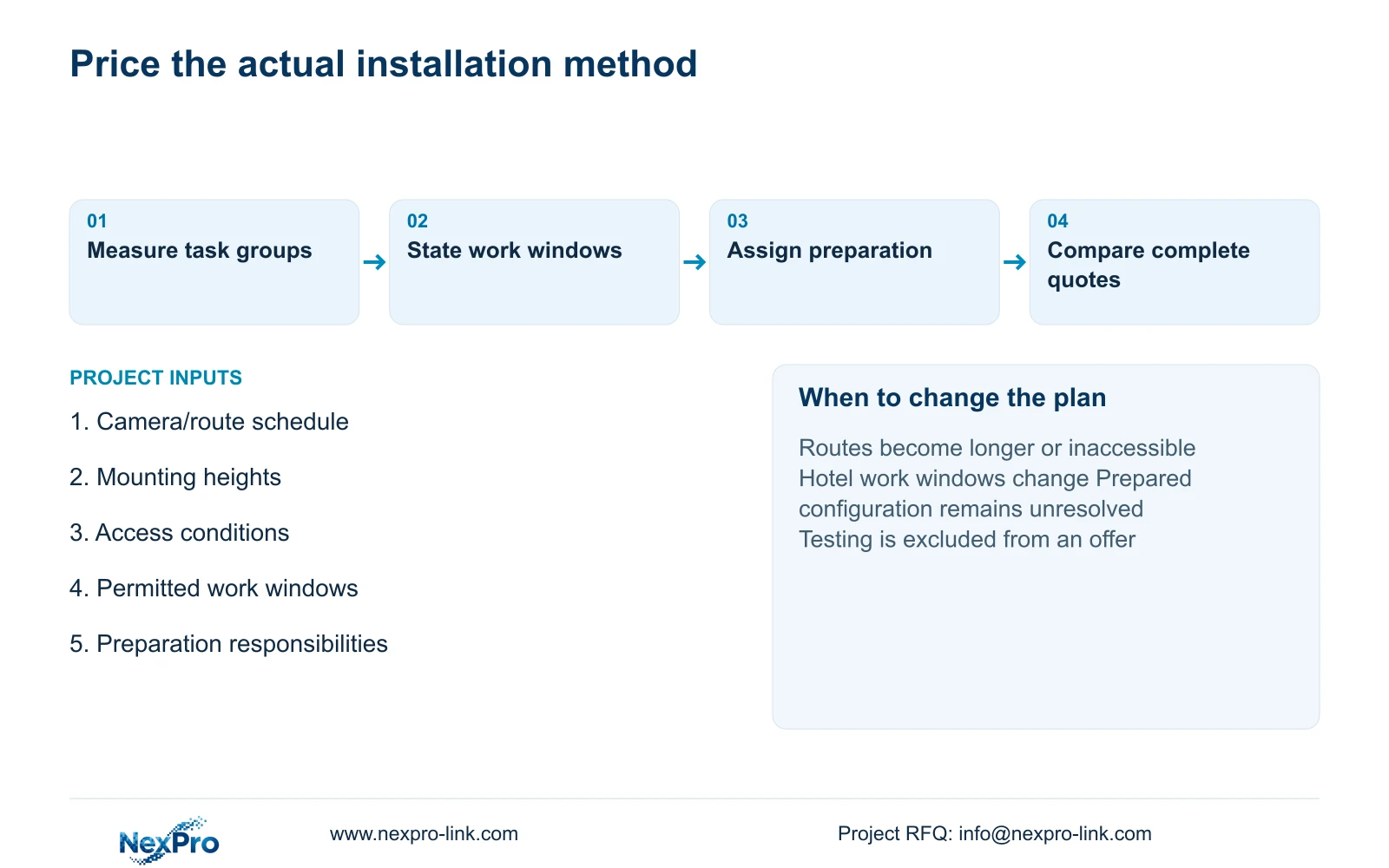
Choose the economical installation offer after both contractors have priced the same task groups, access assumptions and completion checks. Change the estimate when route surveys, permitted windows or preparation responsibilities change. Reconcile the difference by affected work package instead of attributing it to camera count.
Keep equipment supply, local installation and later service responsibilities separate. NexPro-Link can support model matching, BOQ/BOM information and project preparation within an agreed scope; that does not include local labour by default. A supported installation comparison must price the same completion tasks rather than reuse an ownership-cost difference as an efficiency claim.
Send info@nexpro-link.com a camera and route schedule, mounting-height/access notes and permitted work windows, plus the preparation tasks already assigned. State the destination and whether the request concerns equipment preparation or a comparison boundary for local installer offers. Hotel project equipment support and BOQ and tender support can help make those boundaries explicit.
| Retained outcome | Extra scope | Worth buying when | Counter-condition |
|---|---|---|---|
| Installed and checked CCTV | Documented preconfiguration | Required inputs are available and work is clearly allocated | Configuration depends on unresolved site inputs |
| Same completion tasks | Higher preparation-inclusive charge | Supported total-cost comparison justifies it | Annual service difference is merely assumed |
Section 07
Buyer questions
Can two per-camera labour rates be compared directly? Only after checking included cable, support, access, configuration and testing work. Request a task breakdown where site conditions differ so a low rate does not conceal excluded activities.
Should purchased cable metres determine pulling labour? Use the installed route schedule and method. Reel tails are procurement remainder; they do not represent cable pulled or tested on site.
Can an early installer quotation proceed without final routes? Yes, as a provisional quotation with named route and access assumptions. Ask the contractor to identify the inputs that will trigger repricing, rather than treating the allowance as a firm final installation total.
Engineering references
These sources support the general planning principles. Always use the selected product's current datasheet and applicable project standards for final design.