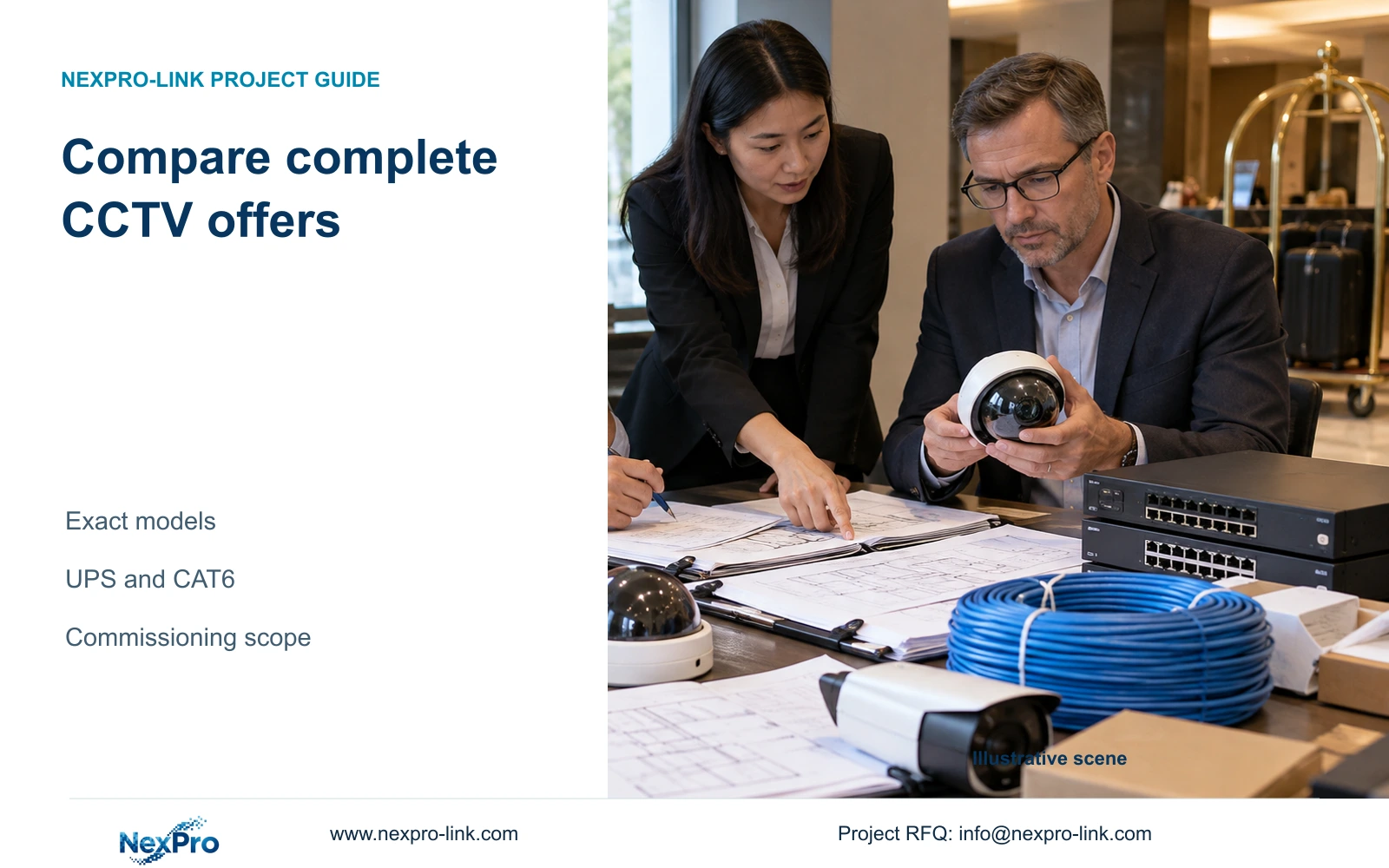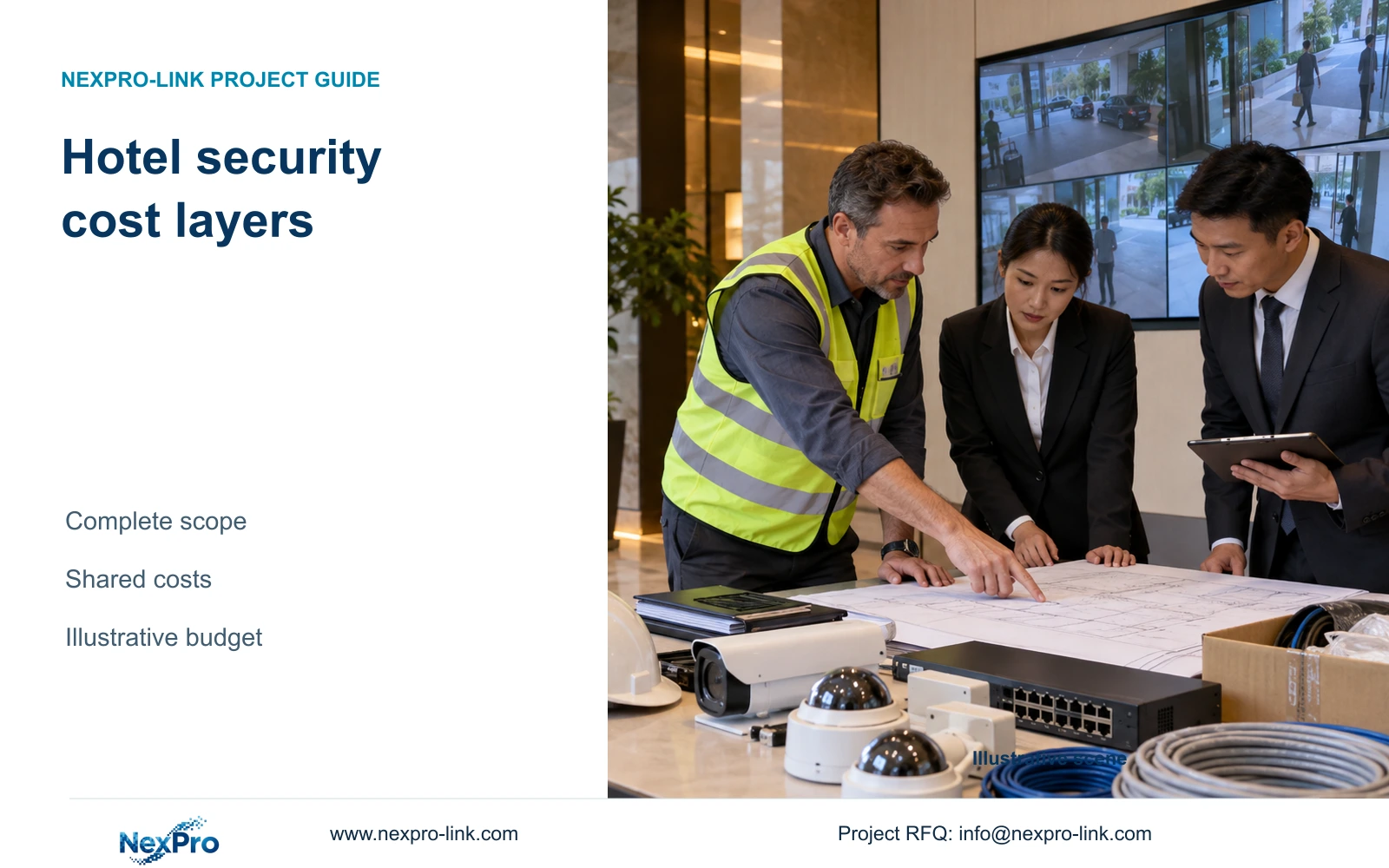
A camera allowance becomes a usable hotel security budget only when recording, networking, protected power, cabling and site responsibilities have clear cost boundaries.
Section 01
Set the estimate boundary
Use a functional cost breakdown before approving a hotel security budget. Include the equipment and work needed for the agreed recording and operating tasks, and keep optional displays separate. A camera-only allowance is suitable for purchasing cameras when the remaining infrastructure is already identified and funded. If those conditions are missing, expand the estimate before comparing suppliers.
Define where the proposed supply ends. Equipment delivered to a named destination, installed equipment, and a commissioned system have different boundaries. State whether the estimate includes recording disks, cable termination, network configuration and operator handover. Assign excluded work to a responsible package so that an exclusion does not become an unfunded requirement.
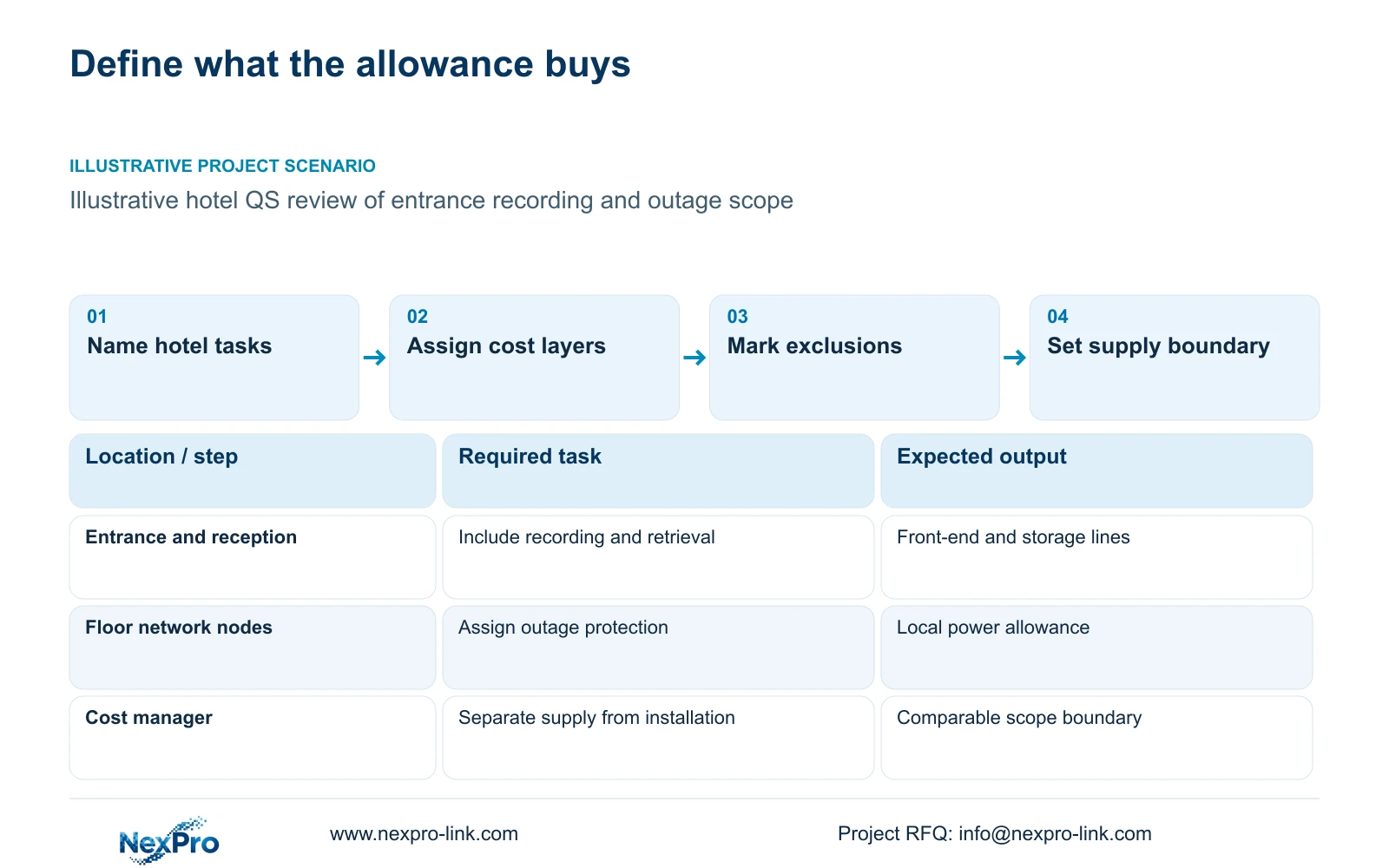
Connect the boundary to observable hotel tasks. An entrance view needs a suitable image, a recording destination and an authorized retrieval workflow. An outage requirement adds protected network and power dependencies. Mark quantities as confirmed, provisional or dependent on a named design decision. Room count can describe the property, but it does not establish camera quantities or cable routes.
| Required task | Given information | Decision still needed |
|---|---|---|
| Retrieve entrance recordings | Camera positions proposed | Retention, disks and commissioning scope |
| Record during an outage | NVR backup requested | Protection of required access and core network |
Section 02
Group functional equipment costs
Arrange equipment costs by the function they support. Front ends cover the required views and associated mounting accessories. Recording includes the recorder and selected disks. Networking covers access nodes and the approved backbone. Protected power includes the supported UPS and battery configuration for each protection zone. Cabling includes the specified cable and termination components.
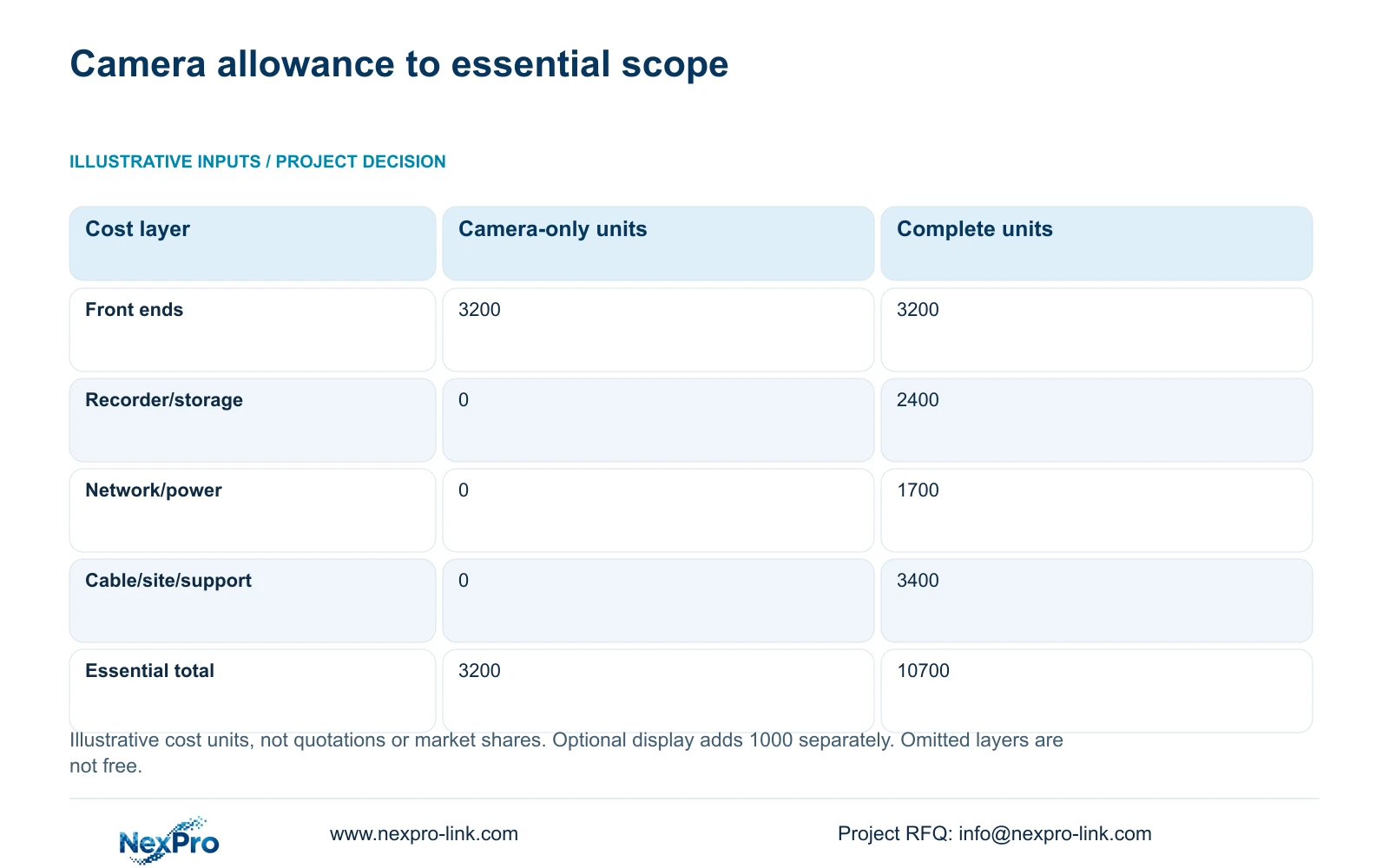
The teaching estimate assigns 3200 cost units to front ends, 2400 to recording and storage, 800 to networking, 900 to power, 1600 to cabling and 1800 to installation and support. These inputs demonstrate how omitted scope changes a total. They are neither currency quotations nor typical hotel cost proportions, and they should not be attached to a named supplier.
Keep the basis beside each allowance. Recording cost depends on the approved stream profiles and usable capacity. Network cost depends on actual node locations and traffic paths. A coordinated quotation should identify which components are included in a package and which need separate pricing. An equipment category without its quantity or specification basis remains an estimate, even when its amount looks precise.
Section 03
Separate shared infrastructure
Assign each shared item to one cost line and one responsible package. A central recorder should not reappear as a complete recorder under every floor. The same applies to shared cabinets, backbone components, PDUs and configuration work. Floor schedules can reference the central line while retaining their own cameras, cable runs and local accessories.
Check package inclusions before adding separate accessories. A disk already included in an NVR package cannot also enter the storage allowance. Existing infrastructure may reduce new equipment purchases, but inspection, capacity checks and configuration can still require work. Record those activities explicitly rather than describing reuse as automatically free.
For this independent teaching estimate, the essential evaluated allowance equals the sum of required scope rows. Network and power combine to 1700 units; cabling and installation/support combine to 3400. Adding those groups to front ends and recording produces 10700 units. The zeros in the camera-only column mean that the allowance omits those layers, not that the hotel can obtain them without cost.
| Metric / condition | Camera-only allowance | Complete allowance |
|---|---|---|
| Front ends | 3200 | 3200 |
| Recorder and storage | 0 | 2400 |
| Network and protected power | 0 | 1700 |
| Cabling and site/support work | 0 | 3400 |
| Essential total | 3200 | 10700 |
| Optional display | Not included | +1000 separately |
Section 04
Include installation and operation
The 10700-unit result covers the stated teaching scope only. Freight, taxes and any services outside those rows still need an explicit treatment. For an equipment-only comparison, show local installation separately. For an installed-system comparison, add the required local work to each offer on the same basis. Unknown charges remain unresolved inputs.
Separate physical installation from remote technical assistance. Mounting, cable testing, electrical work and site commissioning require defined local responsibilities. Remote configuration guidance can support those activities, but it does not establish that attendance, travel or local labor is included. Describe the deliverable and responsible party for each service.
Operating costs need their own evaluation period. Obtain applicable software, maintenance and support terms before comparing later expenditure. The supplied warranty policy record states a 24-month limited hardware baseline from receipt for applicable main equipment, subject to controlling order terms. Batteries, disks, cable and OEM scope require their own treatment. Technical support does not imply unlimited free repair or local attendance.
Section 05
Compare complete alternatives
The difference between 3200 and 10700 units represents missing cost layers. It does not establish that a complete supplier is more expensive for the same service. First restore the required recording, network, power and installation scope in every alternative. Then compare qualified configurations using actual quotations.
Keep the 1000-unit optional display allowance outside the essential total. Its justification should come from an operating task, such as several staff needing a shared overview. If an ordinary operator screen meets the approved retrieval and viewing tasks, a larger display can remain optional. If the hotel makes the wall mandatory, its associated decoding, mounting and power work belongs in the revised baseline.
Use the illustrative 32-camera reference only to understand system dependencies; its engineering quantities do not price this independent cost model. Removing required disks or an access-node UPS changes the delivered task. A lower total obtained that way should be presented as a scope reduction with an explicit consequence.
Section 06
Issue a transparent cost summary
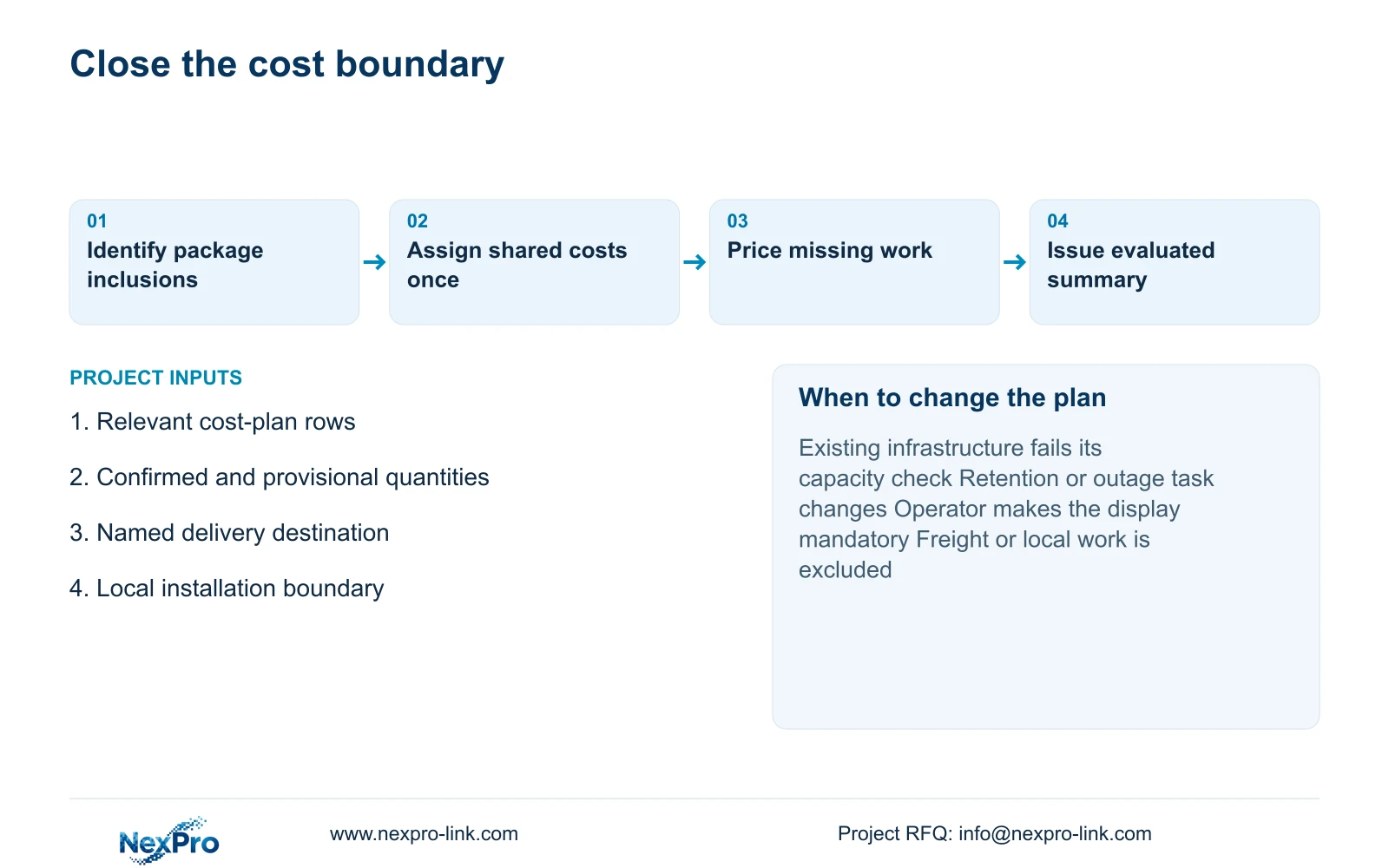
Issue one summary showing the required scope, optional additions, exclusions and unresolved amounts. Each supplier should respond against the same rows. Explain price differences where they arise, such as a different disk arrangement, delivery boundary or commissioning responsibility. RICS separates cost-planning, detailed measurement and maintenance-cost purposes; this teaching breakdown is not a RICS contract template.
Recommend the complete functional allowance when infrastructure and services remain unpriced. Retain a camera-only purchase boundary when the other packages are confirmed and funded. Reopen the estimate if camera tasks, retention, backup requirements or mandatory operator systems change, because these can alter several cost layers together.
NexPro-Link's hotel project and BOQ support can help match models and coordinate equipment scope. Its CCTV manufacturing core and coordinated supply categories should be identified separately, with local installation responsibilities stated in the proposal. Send the relevant cost-plan rows, current quantities, named delivery destination and equipment-only or installed boundary to info@nexpro-link.com. Include the specific unresolved item that prevents a fair comparison.
Section 07
Buyer questions
Can an incomplete design still support a useful estimate? Yes. Keep provisional quantities visible and name the decision that will fix each one. Update quantity changes separately from specification changes so the owner can follow the revised allowance.
Does a lower purchase price justify higher annual fees? Compare actual recurring terms over the hotel's chosen evaluation period. Keep equipment and setup costs separate from annual services, and show the break-even condition before selecting an option.
What should accompany an existing-equipment reuse allowance? Identify the reused equipment, its allocated capacity and the required inspection or configuration work. Include replacement scope if the check fails, without counting the same shared item twice.
Engineering references
These sources support the general planning principles. Always use the selected product's current datasheet and applicable project standards for final design.