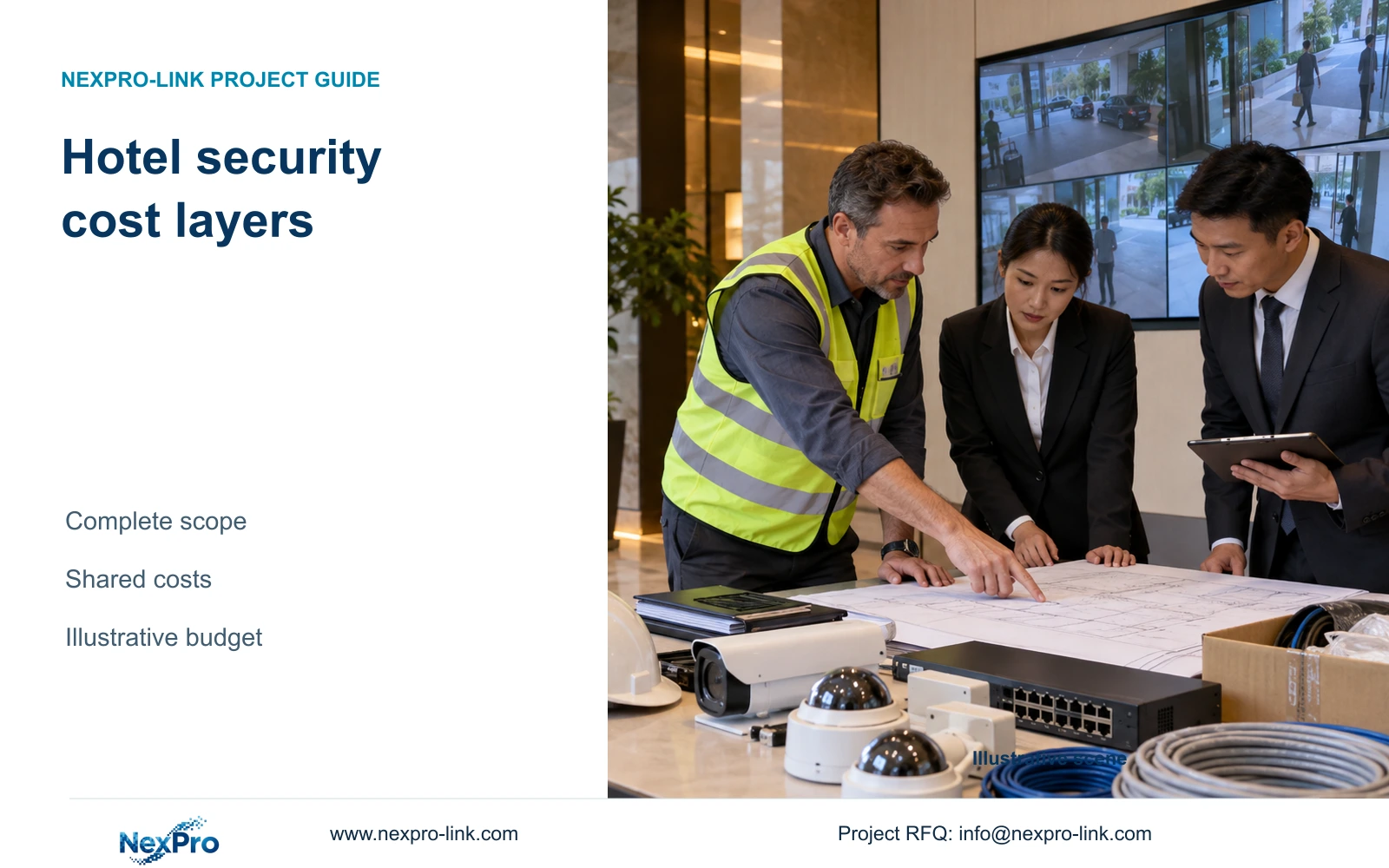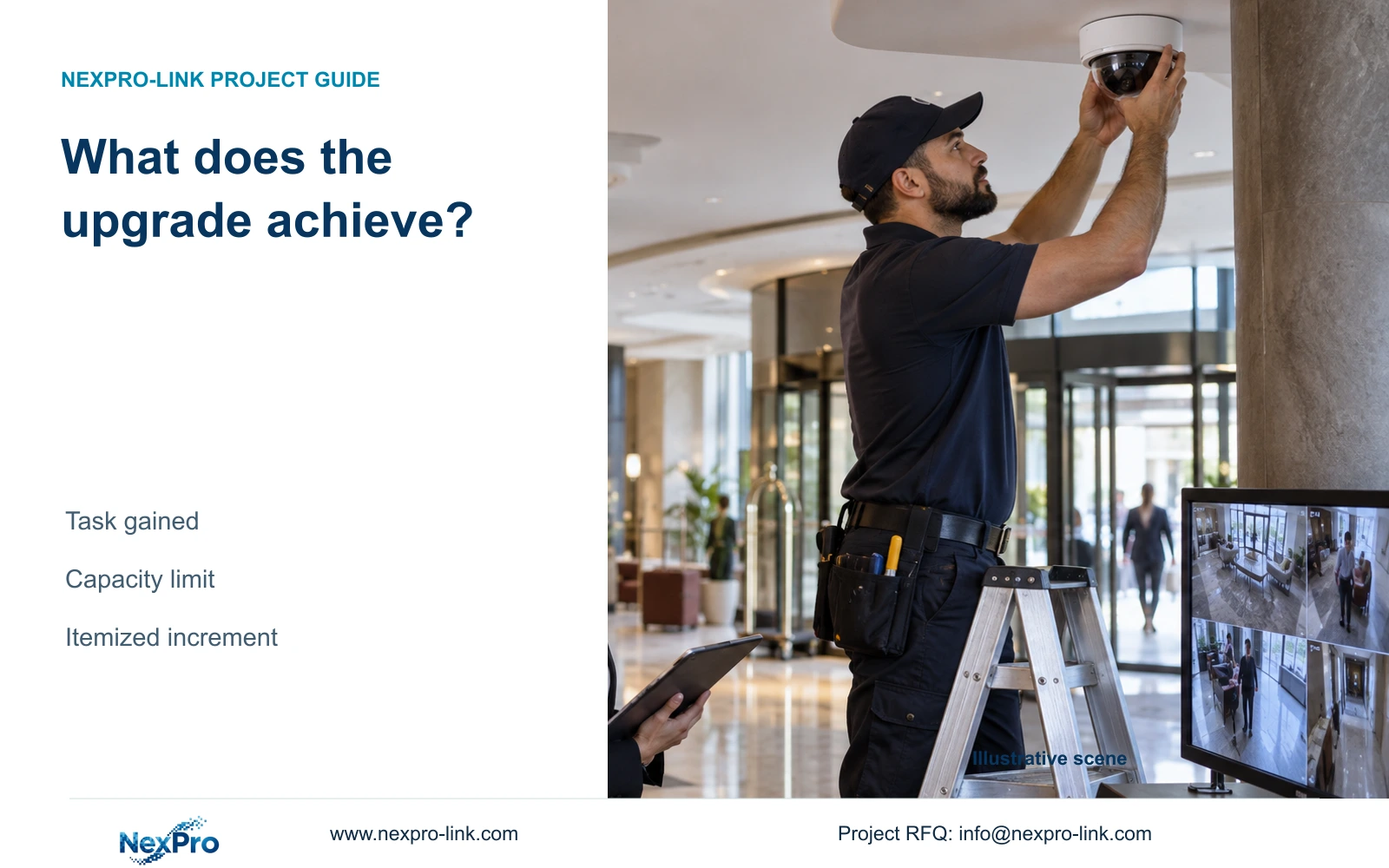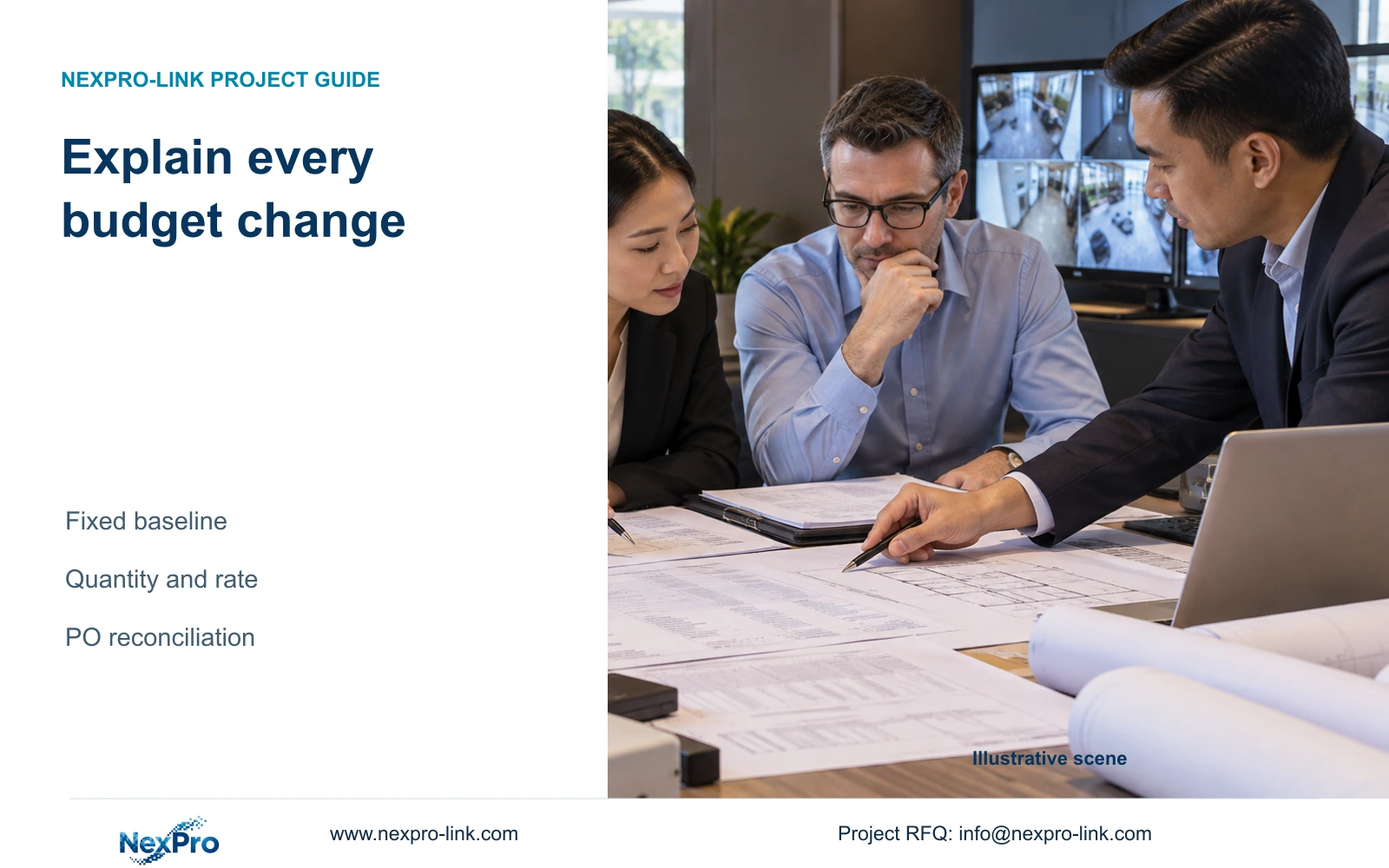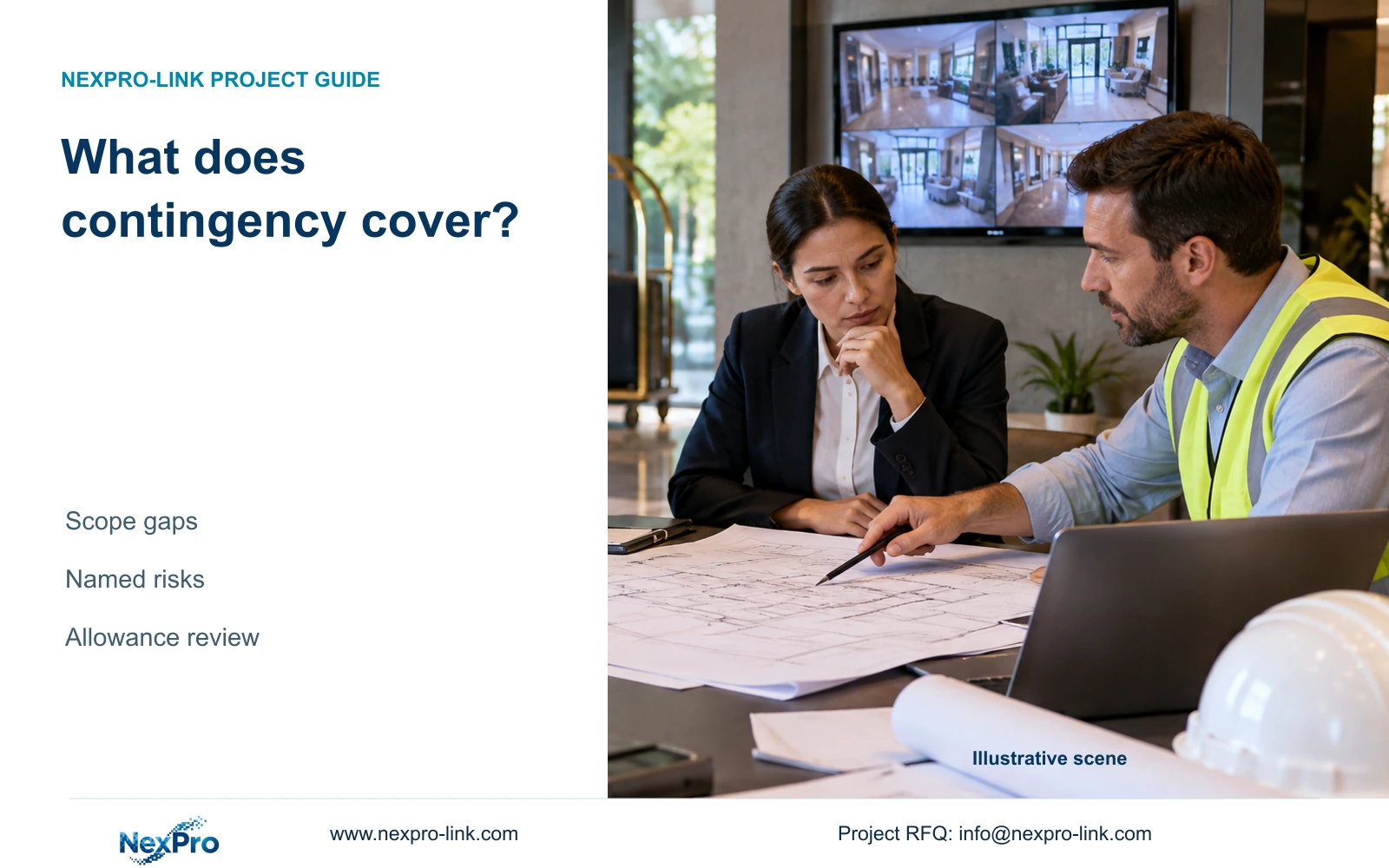
A hotel security contingency should identify the uncertainty it covers. Complete the essential scope first, then assign allowances to unresolved quantities, site conditions and commercial exposure.
Section 01
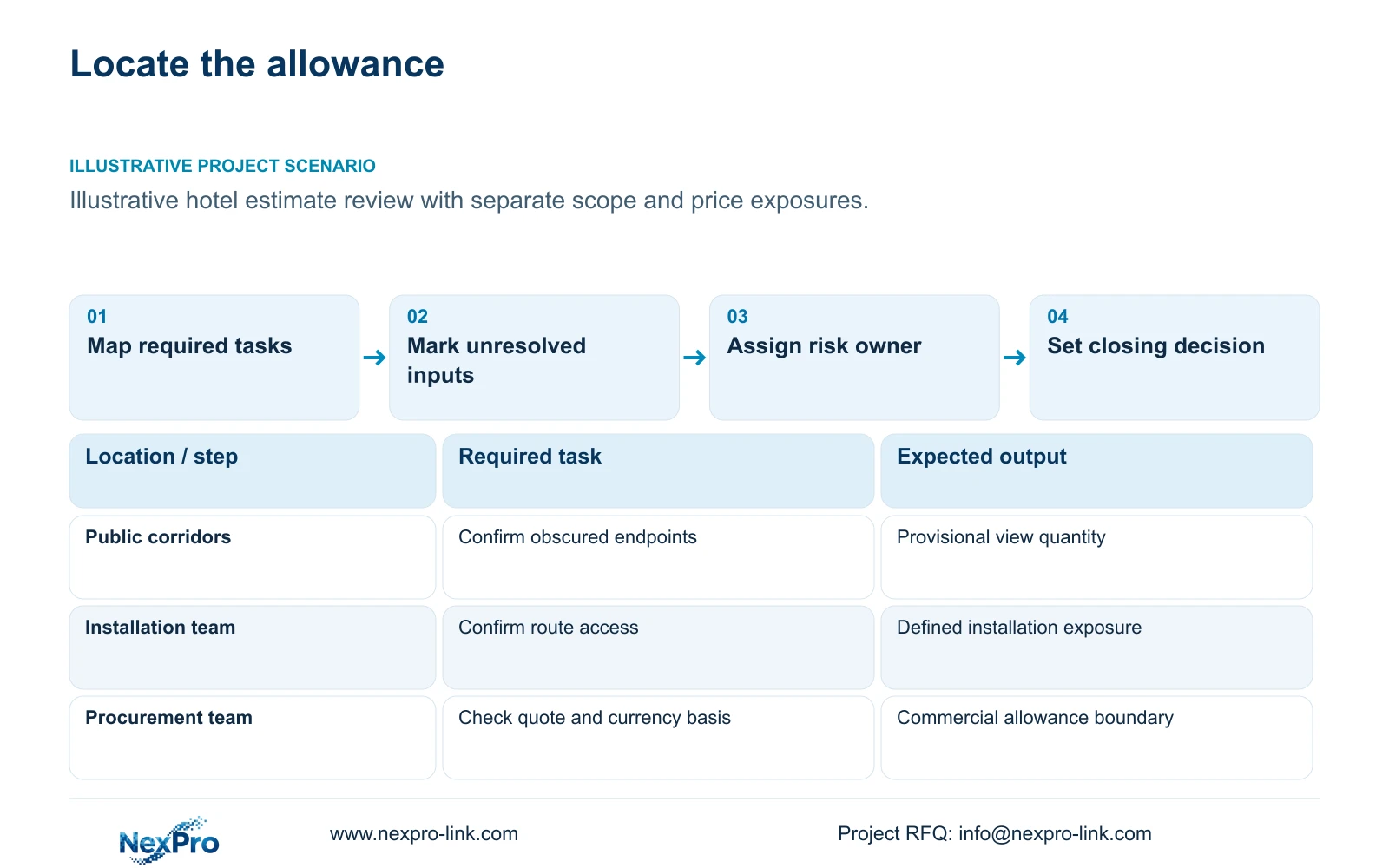
Identify what remains uncertain in the estimate
Use an itemized risk allowance once the required security scope is complete. A blanket 10% addition cannot establish whether unresolved camera positions, difficult cable routes or currency exposure are covered. The cost manager should identify each uncertainty, its affected scope and the information that will resolve it before accepting the contingency total.
Begin with the hotel's required functions: public-zone views, recording, incident retrieval and the agreed outage state. Connect those functions to equipment and work packages. Mark quantities as measured or provisional, and distinguish an unpriced required item from an allowance for a possible change. An omitted recorder is missing scope; an unresolved recorder configuration is a design uncertainty.
Keep the uncertainty register short enough to use during design meetings. For each entry, name the responsible party and the next decision. A corridor layout decision may close a camera quantity allowance, while a route survey may replace provisional cable quantities. Room count alone resolves neither issue.
| Required task | Given information | Decision still needed |
|---|---|---|
| Observe public corridor endpoints | Initial camera schedule | Confirm occlusions and final positions |
| Keep recording during an outage | Backup function requested | Define protected nodes and runtime |
| Install cable without disrupting operations | Outline routes | Confirm access and permitted work windows |
Section 02
Separate scope exposure from price exposure
Scope exposure changes what the project buys. More public-route views may require extra cameras, cable and switch capacity. Price exposure changes the cost of an otherwise defined purchase, such as a quotation expiring before order placement. Record these separately so the owner can see whether a decision concerns coverage, procurement timing or commercial terms.
Compare equipment, installation, freight, taxes, software and later services on consistent boundaries. An offer excluding site installation cannot be ranked directly against an installed package. Restore the excluded work to the comparison or leave it explicitly unresolved. A zero in a spreadsheet should never conceal an unknown required cost.
Ask suppliers to identify inclusions and exclusions against the same schedule. NexPro-Link's BOQ and tender support can assist with model matching and coordinated equipment scope. Local installation, third-party integration and approval responsibilities must remain named. Coordinated supply does not establish that every category is manufactured by the same supplier.
| Item | Scope exposure | Price exposure | Effect on the hotel task |
|---|---|---|---|
| Camera schedule | Additional required views | Revised quoted unit rate | Coverage changes only with the task schedule |
| Cable installation | Longer or inaccessible routes | Changed labour quotation | Installation method and cost need separate review |
| Delivery | Additional destination services | Currency or freight movement | Compare the same delivery boundary |
Section 03
Assign allowances to explicit inputs
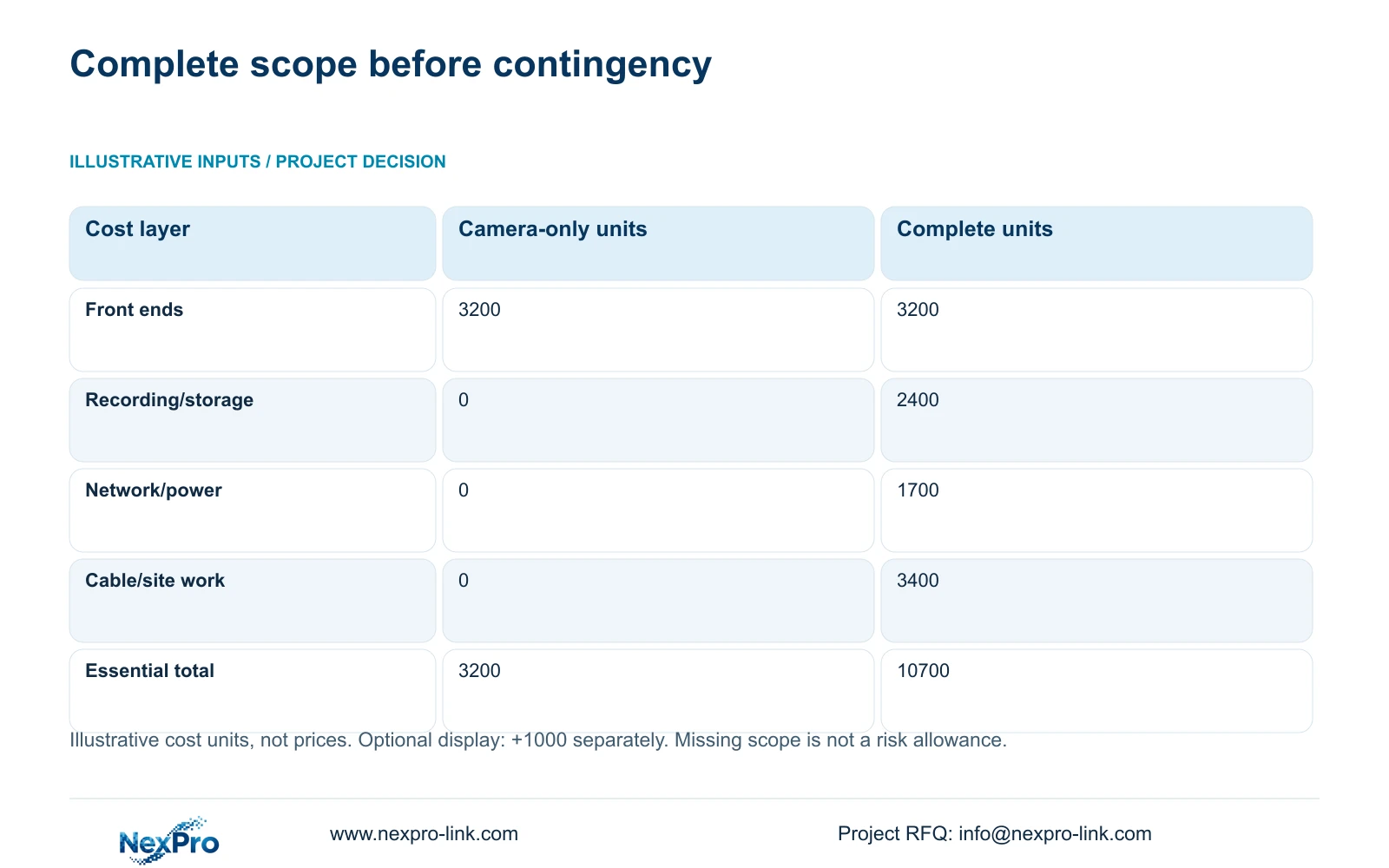
The following calculation uses teaching cost units, not currency, supplier prices or typical hotel budget proportions. Front ends are 3200 units; recorder and storage are 2400; networking is 800; protected power is 900; cabling is 1600; installation and support are 1800. An optional display allowance of 1000 remains separate.
Essential evaluated allowance equals the sum of required scope rows. Networking and protected power therefore combine to 1700, while cabling and site/support work combine to 3400. The complete essential allowance is 10700 units. These are known illustrative scope layers, so they belong in the base estimate before any genuine risk allowance.
The original cost illustration shows omitted base scope, not a contingency amount. Its zeros do not mean free recording, power or installation, and a percentage on 3200 cannot explain those omissions. Once the base is complete, use the risk record below to identify the exposure, evidence still needed and the cost line that will absorb any confirmed change. No project range or risk probability is invented.
| Uncertainty | Evidence or decision needed | Allowance boundary and close-out |
|---|---|---|
| Unconfirmed public view | Approved task/position and tag count | Affected point/dependencies; close after layout decision |
| Unsurveyed cable route | Continuous route and access survey | Route/site-work line; do not duplicate base access inclusion |
| Occupied work window | Hotel-authorized schedule and contractor method | Named mobilization/access exposure; release when confirmed |
| Unresolved equipment configuration | Mandatory supported mode or interface evidence | Complete base scope first; missing equipment is not contingency |
| Quote/delivery exposure | Validity, destination and stated commercial basis | Physical scope unchanged; retire covered exposure after agreement |
Section 04
Compare sensitivity cases without changing the task
Test the estimate by changing one unresolved input at a time. A quantity case should retain the original specification and rate basis. A specification case should retain the agreed observation task while showing the revised equipment and dependent infrastructure. A commercial case should keep physical scope unchanged and identify the affected quotation or delivery assumption.
The 10700-unit example provides a complete illustrative starting boundary, not a contingency percentage. The optional 1000-unit display should remain an owner choice unless the operating brief makes it essential. Neither amount establishes how much allowance a real hotel needs for uncertain routes or currency movement.
Present the low and high cases using project-supported quantities or quotations. Where those inputs are unavailable, show the variable and the decision needed instead of inventing a range. RICS distinguishes cost planning, detailed measurement and maintenance-cost uses; this article's tables are independent decision aids, not RICS measurement rules or contract templates.
Section 05
Remove duplicate scope before retaining contingency
Trace shared items back to their package inclusions. Disks included in a recorder package should not also appear as separately purchased storage. The same applies to adapters, patch leads and configuration services. Retain a separate line only when it represents an additional quantity or a clearly different activity.
Check allowances against each other as well as against base costs. A provisional installation rate may already include difficult access. Adding a second access allowance requires a stated exposure beyond that inclusion. Ask which cost line will absorb the allowance when the uncertainty becomes a confirmed purchase.
An optional wall display illustrates the distinction. It can support a defined multi-operator viewing task, but it should not consume the recording allowance or be described as necessary merely because it appears in an enhanced package. Price its dependent decoding, power and installation scope separately when the hotel actually requires it.
| Retained outcome | Extra scope | Worth buying when | Counter-condition |
|---|---|---|---|
| Required recording and retrieval | Wall display and associated equipment | Continuous multi-operator viewing is required | An ordinary operator screen meets the brief |
| Complete installation | Additional access provision | It exceeds the base contractor inclusion | The same provision is already priced |
Section 06
Review allowances as design decisions become firm
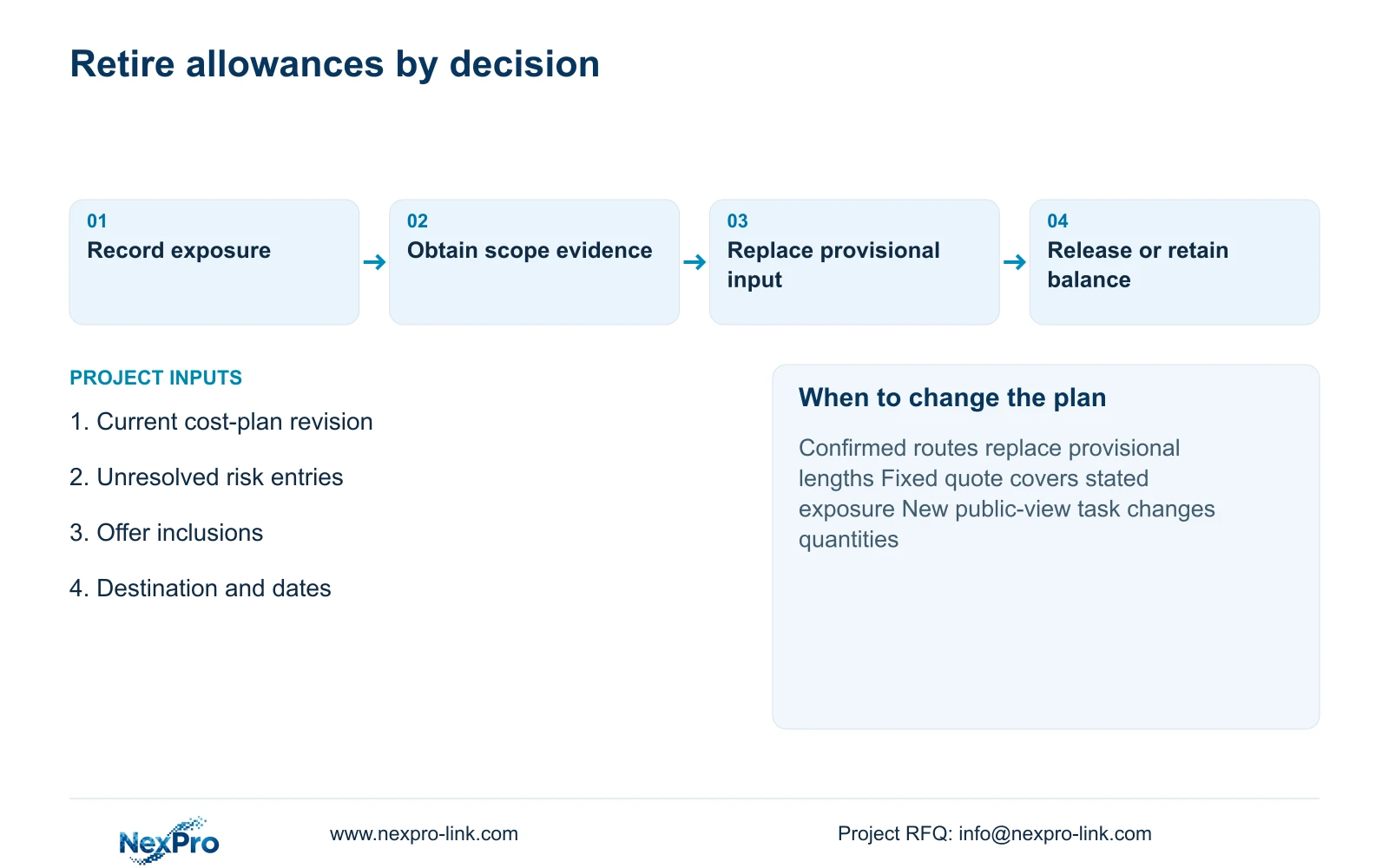
Replace provisional inputs with confirmed quantities and quotations as the design matures. Record whether each allowance was used, reduced or released, together with the scope line receiving the cost. Keep unresolved risks visible rather than retaining an unchanged contingency after their underlying decisions have closed.
Recommend an itemized allowance where quantities, installation conditions or commercial exposure remain open. Change that approach when a defined fixed-price offer demonstrably covers the relevant exposure, or when revised site information creates a different risk. The record should show why the allowance changed and which hotel function remains protected.
Send info@nexpro-link.com the current cost-plan scope, the unresolved allowance entries and comparable offer inclusions, plus the delivery destination and required dates. Hotel project equipment support and BOQ and tender support can help establish a common equipment response; the inquiry need not include guest footage, passwords or unrelated confidential documents.
Section 07
Buyer questions
Must suppliers disclose every internal pricing component? The comparison needs clear quantities, inclusions, exclusions and allowance assumptions. It does not require disclosure of every internal cost. Request enough detail to establish whether the quoted scope covers the same hotel task.
Can an unresolved required item remain outside the total? Keep it visible as an unresolved input and identify who will price it. Do not present the subtotal as a complete project allowance until the required item has a supported value.
Can NexPro-Link price an early cost plan? A scoped equipment response can begin with provisional quantities and stated assumptions. Identify which lines need budget guidance and which need firm quotations, so the two are not confused.
Engineering references
These sources support the general planning principles. Always use the selected product's current datasheet and applicable project standards for final design.