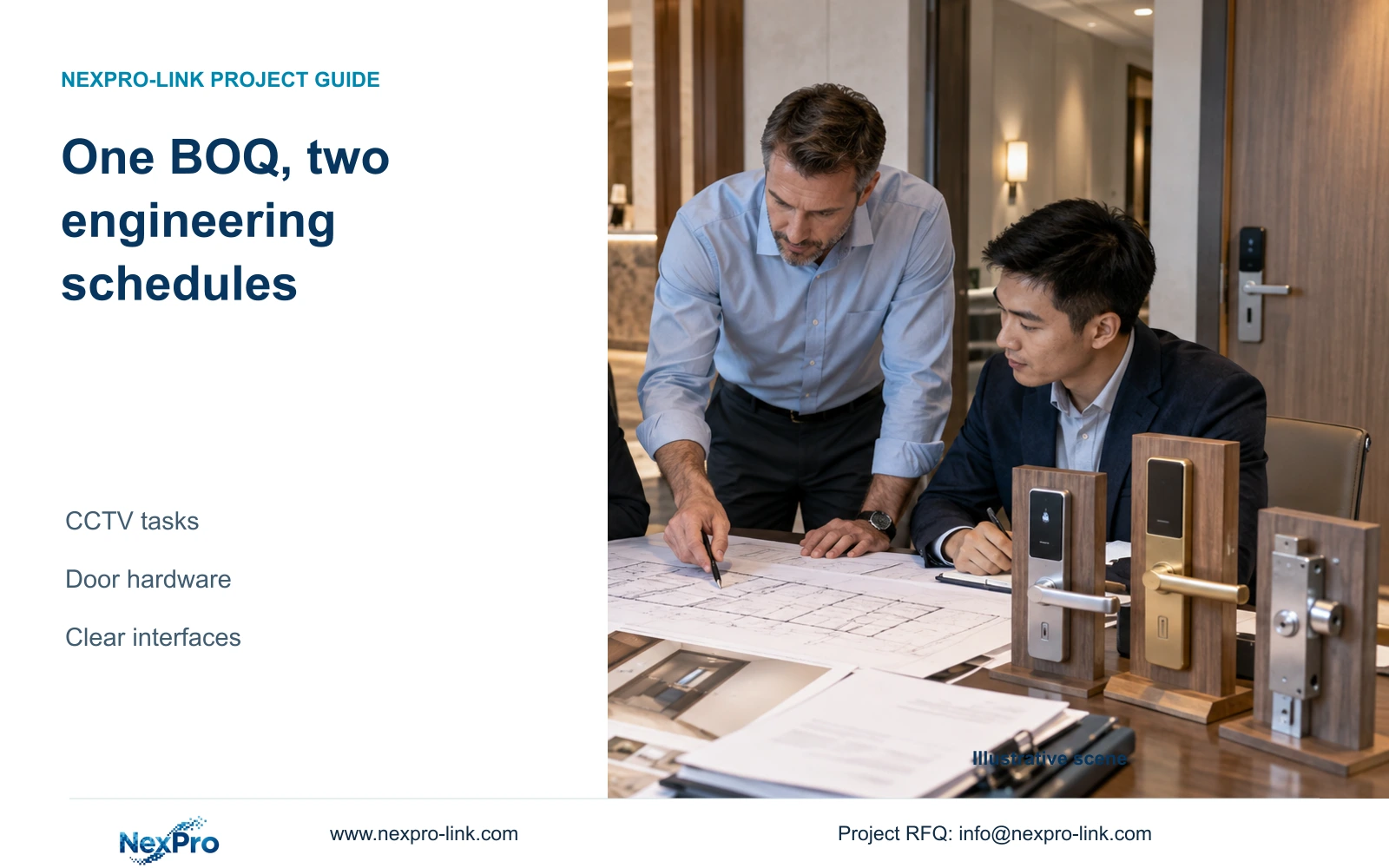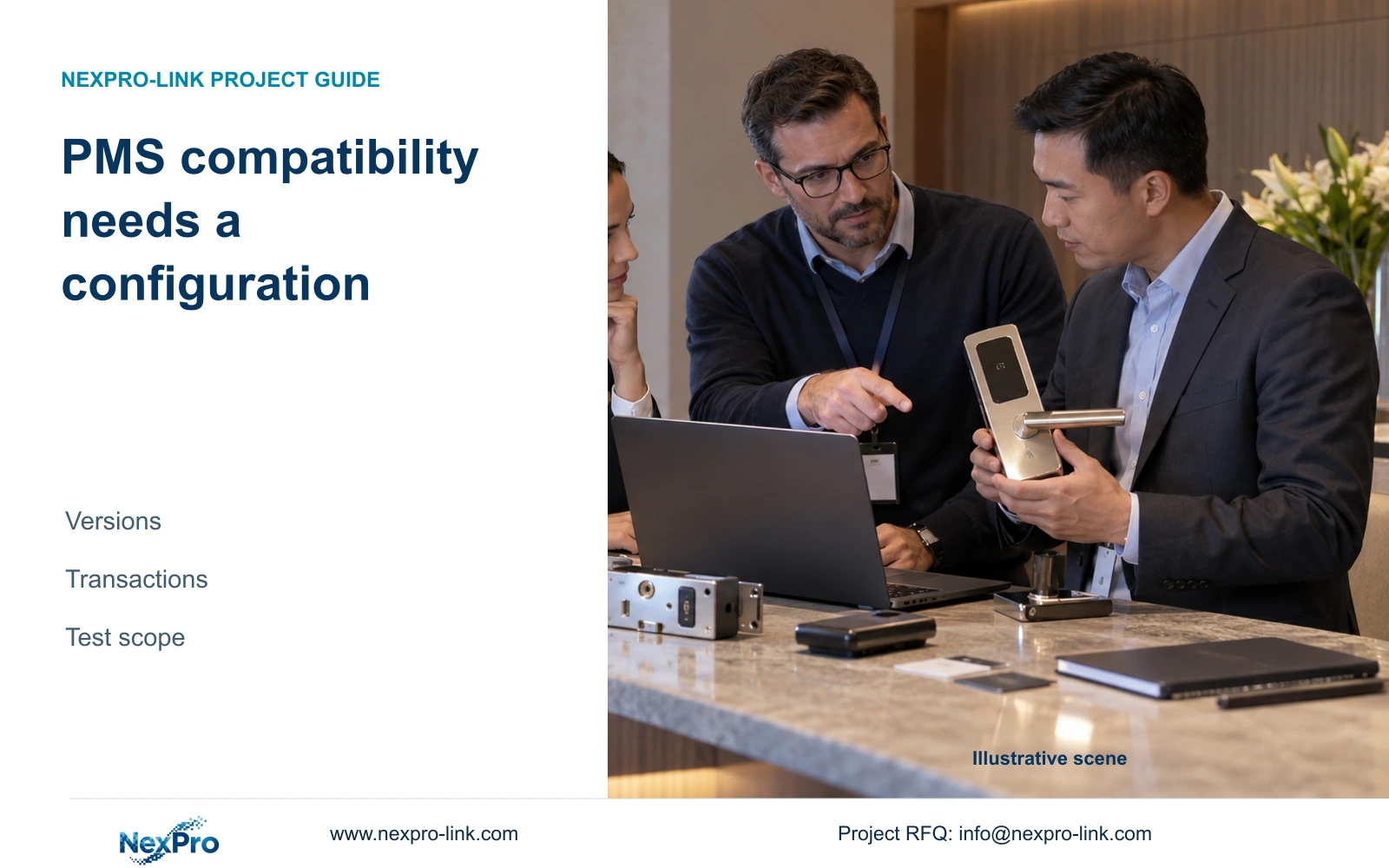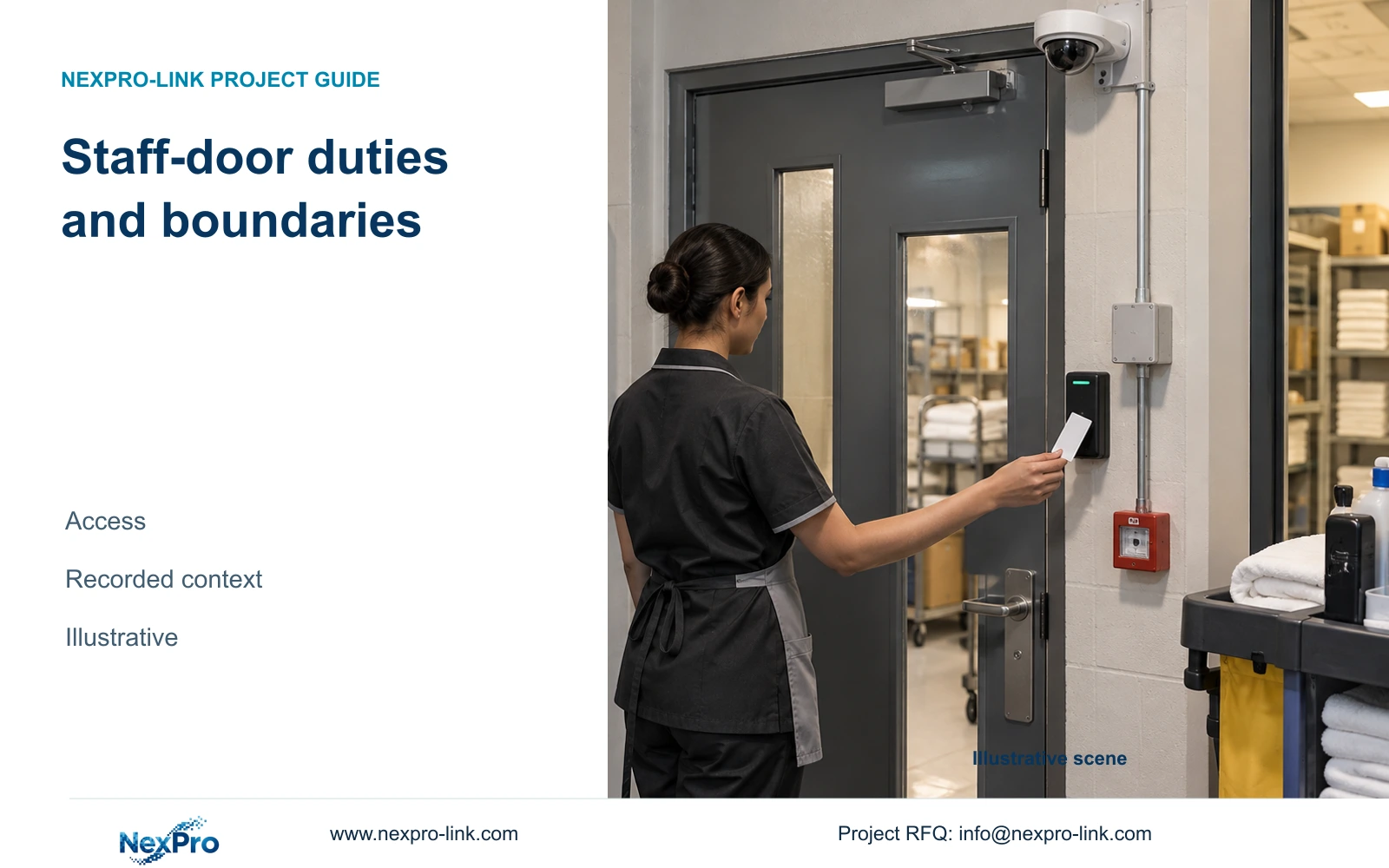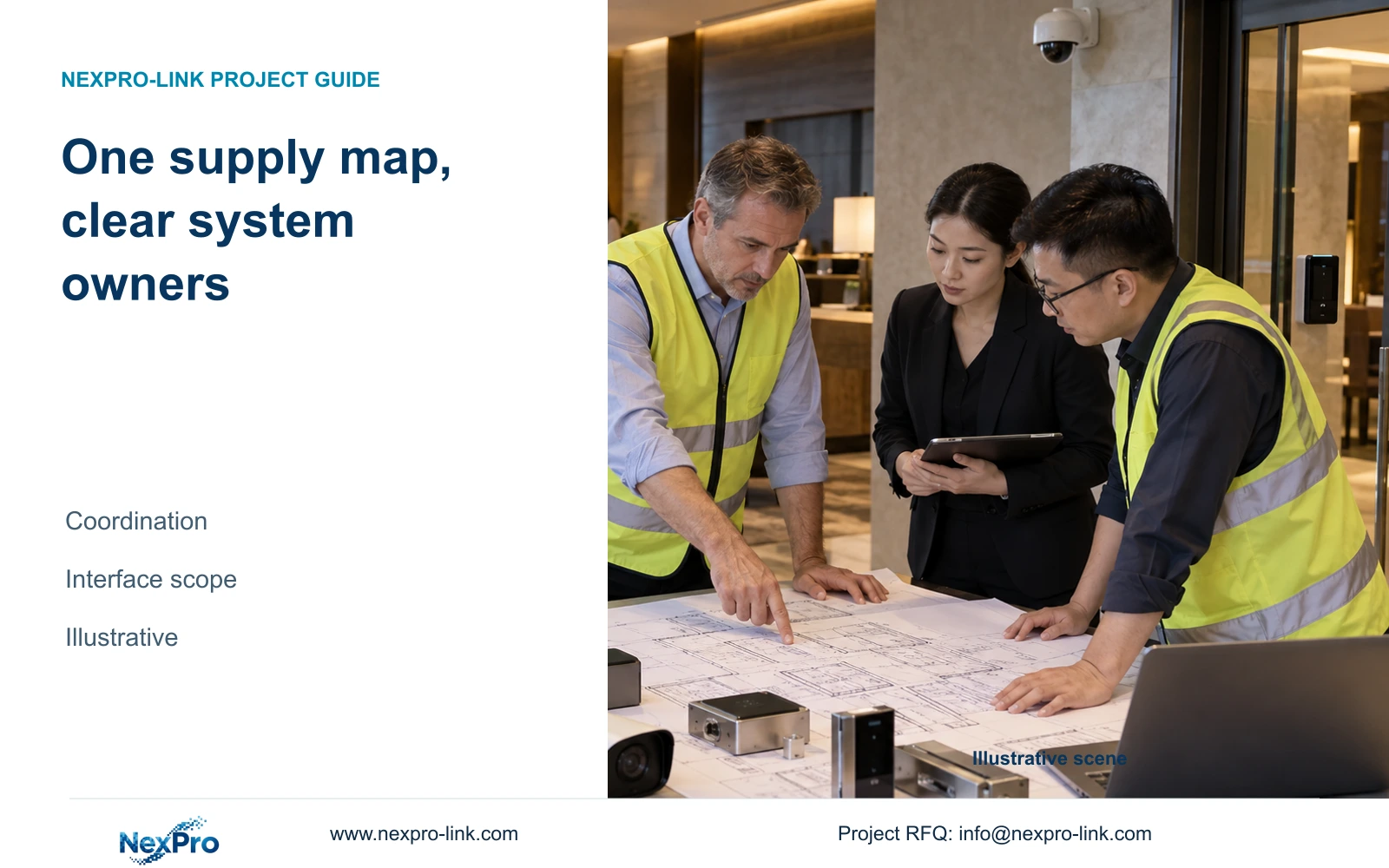
One coordinated hotel equipment order can simplify model matching and delivery. A useful integration map still assigns each function, interface and site responsibility to a named scope.
Section 01
Map the required hotel functions
Use one coordinated supply package when it provides a clear equipment schedule, matching technical documents and defined responsibility boundaries. Require separate evidence for software integration and local installation. If the hotel needs a common platform or safety-linked operation, add that as an explicit supported scope; a multi-category order does not establish it.
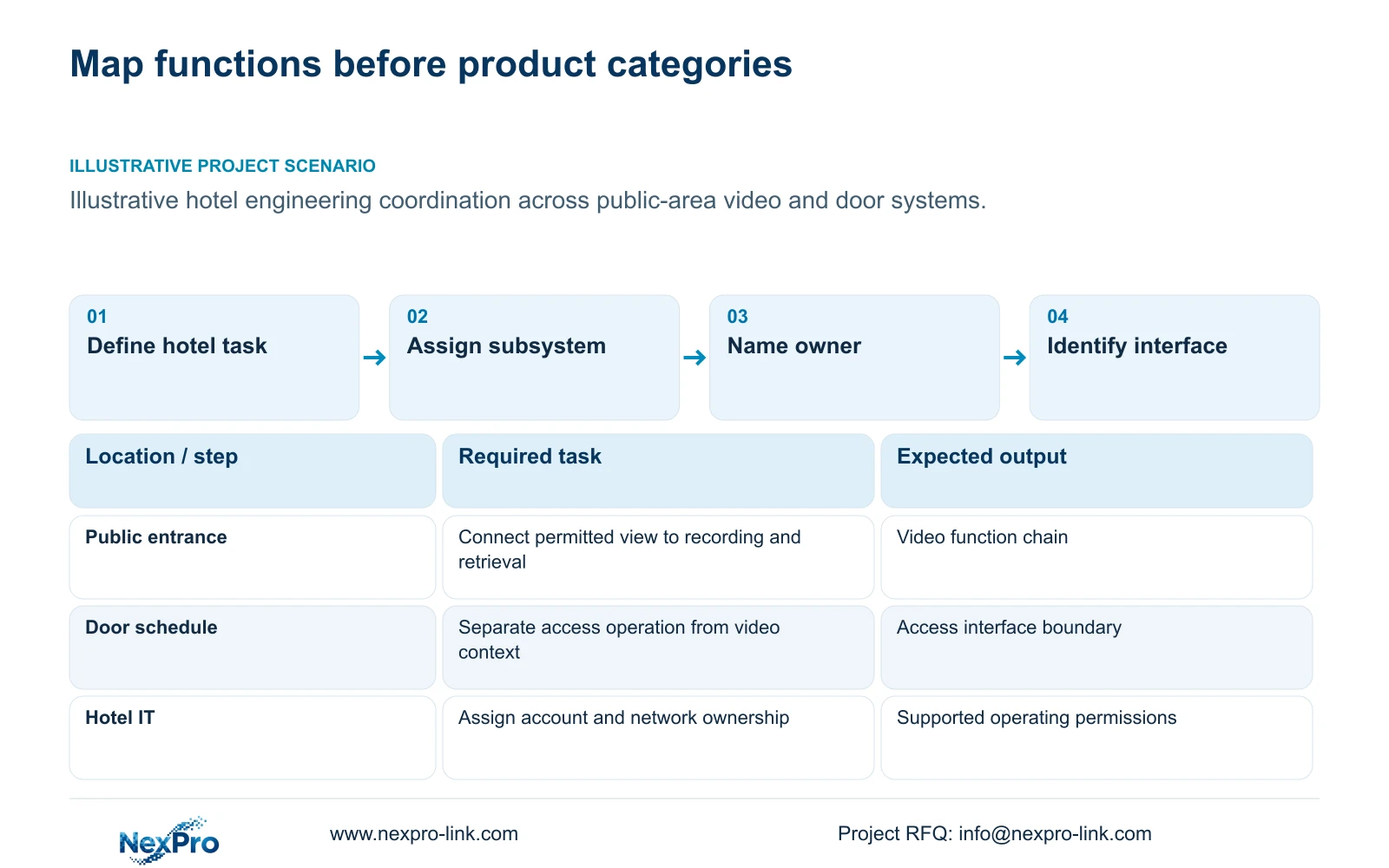
Begin with the hotel tasks: capture permitted public-area activity, retain recordings, retrieve an authorized incident and maintain selected functions during an outage. Add door and credential duties through their own schedule. The functional map should show which task belongs to which subsystem and what must remain available when a dependency fails.
Use drawings and task schedules to establish quantities. CASE01 is an illustrative 100-room hotel with 32 camera positions derived from public-zone duties, not room count. It does not establish lock quantities or a universal hotel package. Guest-room interiors and other private spaces are outside its camera coverage, and required interfaces remain independent design inputs.
| Required task | Given information | Decision still needed |
|---|---|---|
| Public-area recording | Camera task schedule | Stream profiles, retention and retrieval duties |
| Door and credential operation | Door schedule | Actual power and supported management interface |
| Outage continuity | Required operating state | Protected nodes and local responsibility |
Section 02
Assign devices to system owners
Distinguish supply coordination from operating ownership. The camera and recorder configuration supports video capture and retrieval. Hotel IT manages the agreed network and access arrangements. Door specialists address hardware interfaces, while responsible local professionals define electrical and safety work. Record who supplies, configures and demonstrates each assigned function.
NexPro-Link's scope combines a CCTV manufacturing core with coordination of supporting equipment categories. A proposal can cover model matching, BOM or BOQ preparation, technical records and agreed supply arrangements. It should identify which supporting items are coordinated supply and which site services belong to another party. Shared branding cannot replace those distinctions.
Product fields help qualify candidates within those boundaries. NexPro-NVR4449-4K lists 49 channels, 320 Mbps input and four SATA positions with an 18 TB per-drive field. Its summary lists 49 × 5MP / 9 × 4K; it does not establish arbitrary 49-camera 8MP operation or a specific RAID level. Assign recording-mode and disk-layout confirmation to the actual configuration review.
| Item | Coordinated supply scope | Additional implementation scope | Effect on the hotel |
|---|---|---|---|
| CCTV recording | Matched equipment and documents | Actual configuration and retrieval demonstration | A listed recorder becomes an operating service |
| Door equipment | Door-group model and accessory schedule | Fit, power and supported interfaces | Shared order retains separate access duties |
| Protected power | Capacity candidate and battery requirements | Local circuits and outage validation | Backup follows real locations |
Section 03
Separate data and power connections
Draw the camera-to-recorder data path and the protected-power path in separate layers. Show the actual backbone and each active remote node. Fiber carries data and does not automatically supply remote equipment. A central UPS proposal must identify how required remote supplies are protected, without implying an undesigned central circuit.
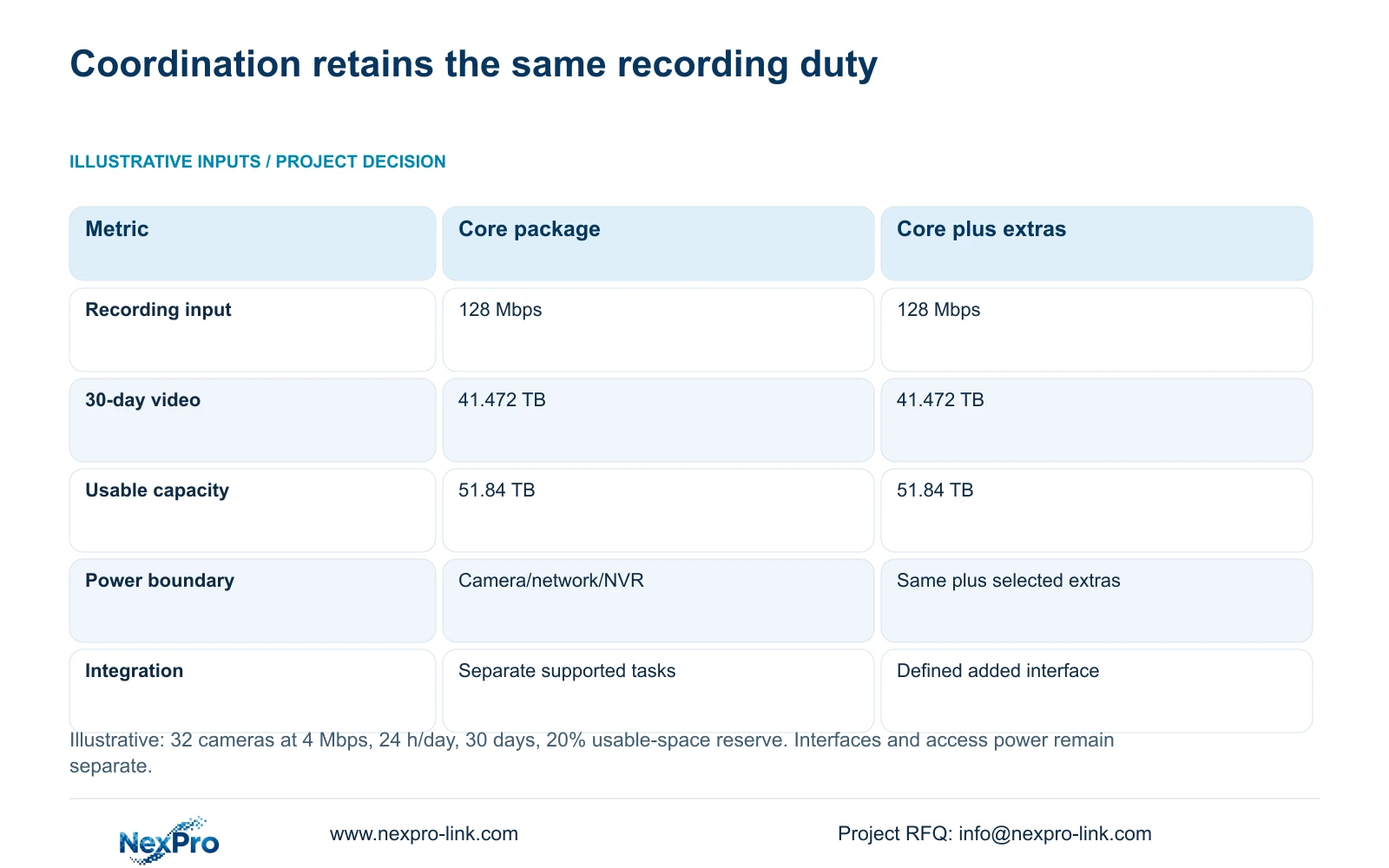
The recording illustration assumes 32 streams averaging 4 Mbps, 24 hours daily for 30 days, with 20% of usable space reserved. Input equals n × 4 Mbps. Decimal video TB equals 0.0108 × n × 4 × 30, and required usable TB equals video TB divided by 0.80. Calculate traffic on the links that carry it; viewing and export flows require their own path accounting.
PoE and UPS calculations use different boundaries. Confirm per-port capability and total output budget, then calculate or measure switch AC input for the UPS schedule. Do not count downstream camera power twice. NexPro SW-POE1618G's source has conflicting port-speed descriptions and no numerical total PoE budget, so it remains a candidate requiring clarification rather than a proven fit.
Section 04
Compare coordination and integration scope
A coordinated quotation can present a complete recording-first package and a separate optional display or recovery scope. Keep the essential service unchanged during comparison. The table's input is 128 Mbps, its 30-day video payload is 41.472 decimal TB and its required usable capacity is 51.84 TB. Reserving 20% means dividing by 0.80, not adding 20% to the payload.
Those recording values agree with CASE01, but its power and cable assumptions are separate. The table contains no access load or cloud-storage allowance. Actual disks require a supported layout and usable-capacity calculation. Neither a camera count nor the total raw capacity confirms recording modes, playback concurrency or the planned retention outcome.
Integration requires a supported interaction between systems. Define the sending device or service, receiving platform and requested action. The Seetong source describes client workflows; ONVIF Profiles support function-specific checks. Neither establishes universal event exchange, third-party account binding or PMS integration. Price any required implementation separately from basic supply coordination.
| Metric / condition | Essential recording-first package | Same core plus optional display/recovery scope |
|---|---|---|
| Recording input (Mbps) | 128 | 128 |
| 30-day video data (TB) | 41.472 | 41.472 |
| Required usable capacity (TB) | 51.84 | 51.84 |
| Protected path | Cameras + network + recording | Same plus explicitly selected extras |
| Operator display | Task-sized monitor/workstation | Optional wall; independent recording |
| Cost comparison | Complete scope quotation required | Add only documented incremental scope |
Section 05
Close shared-interface gaps
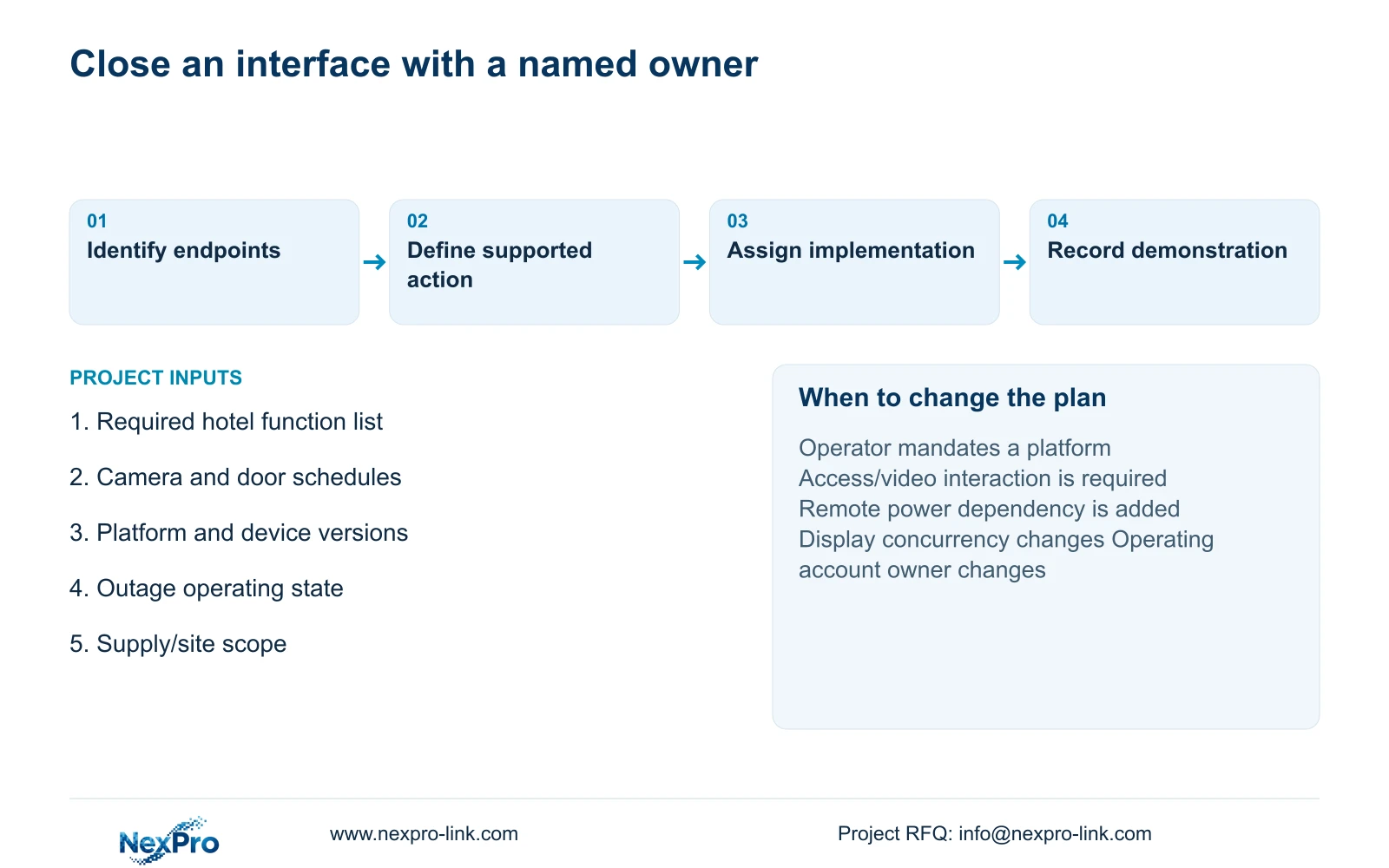
Give each shared interface a record stating the intended task, exact endpoints and implementation owner. Identify the available evidence and the remaining configuration or demonstration. An unresolved interface should appear as unresolved in the proposal, with its consequence for the hotel task. Do not bury it beneath a general integrated-system description.
Review optional display boundaries in the same way. NX-VP-5535 is a 55-inch Full HD LCD, not direct-view LED. NX-VD-4K16 is a decoder candidate whose name does not establish 16 simultaneous 4K streams. Confirm actual stream, window and output requirements before adding a wall. Essential recording must remain independent of whether that display is operating.
Retain the base package when its independent subsystem workflows satisfy the hotel. Expand to a supported interface or platform when operators need a specific linked action, multi-site task or mandated system. Compare the full implementation and support scope at that point; identical equipment categories do not guarantee identical delivered functions.
| Retained outcome | Extra scope | When useful | Counter-condition |
|---|---|---|---|
| Local recording and retrieval | Supported common platform | Defined operator task needs shared management | Separate workflows meet the requirement |
| Recorded incident context | Verified access/video event interface | A specific linked action is required | Only matching logos or a shared order are requested |
| Authorized viewing | Wall and decoder configuration | Continuous observation duty is established | Ordinary workstation fulfills the task |
Section 06
Present one accountable supply map
Issue one map connecting equipment schedules to their supply, configuration and operating owners. Include the actual account ownership and approved access process. Viewing, search, export and administration are different duties; assign supported permissions and document transfer or removal when the hotel operator or support party changes.
Keep the warranty and service boundary beside the map. The supplied policy record gives applicable main equipment a 24-month limited hardware baseline from receipt. Batteries, storage, cables and OEM orders have specific scope, and remote technical support does not establish free onsite work. Identify local labor and transport responsibilities in the commercial record.
Recommend unified equipment coordination with separate subsystem owners and explicit interface records. Change the proposal when a mandatory platform, safety interface or verified operating dependency requires additional scope. Send a brief function list, camera and door schedule extracts, existing platform versions and required outage state to info@nexpro-link.com. Include destination and required dates so hotel project and BOQ support can discuss a bounded response.
Section 07
Buyer questions
Can the quotation describe every supplied category as NexPro-Link-manufactured? The scope must distinguish the CCTV manufacturing core from coordination of supporting equipment. A single order or common project label does not establish common manufacture.
What proves an interface belongs in the offered scope? The proposal should identify its exact endpoints, versions, intended task and implementation responsibility, with a defined way to demonstrate the requested interaction.
Does remote viewing mean recordings are stored in the cloud? No. Identify the actual recording destination separately. Application access, local recording and cloud storage are different services and need their own supported scope.
Engineering references
These sources support the general planning principles. Always use the selected product's current datasheet and applicable project standards for final design.