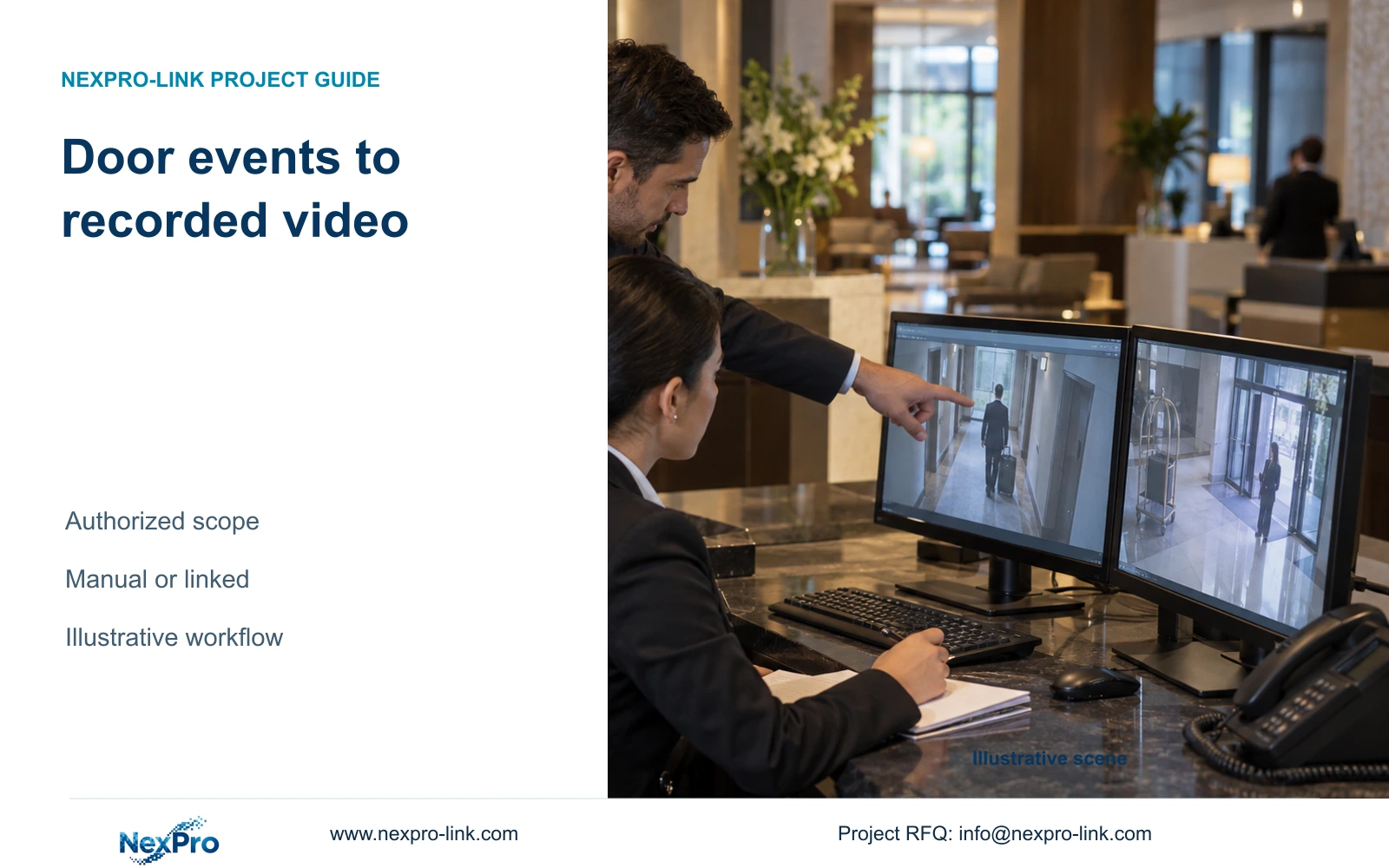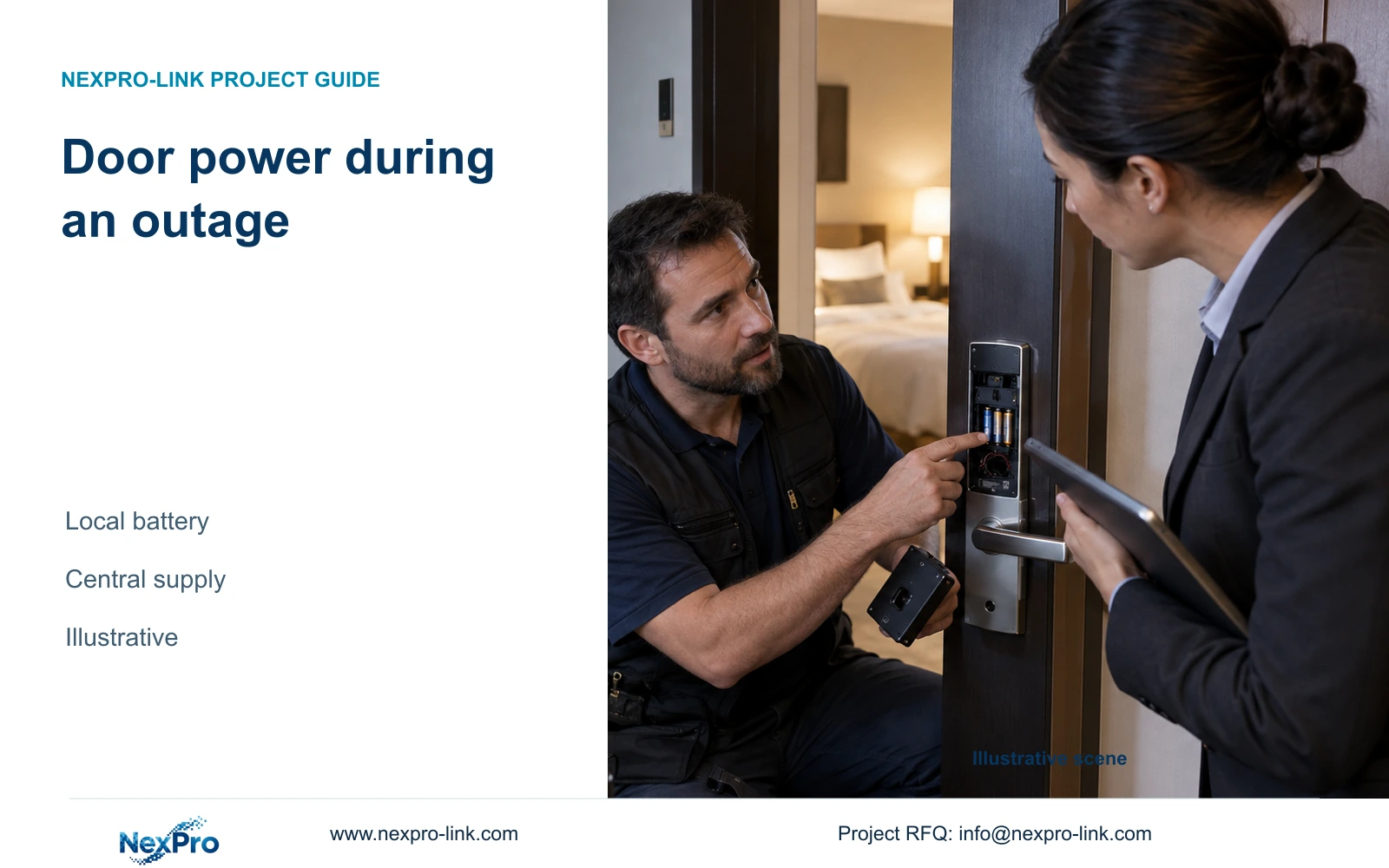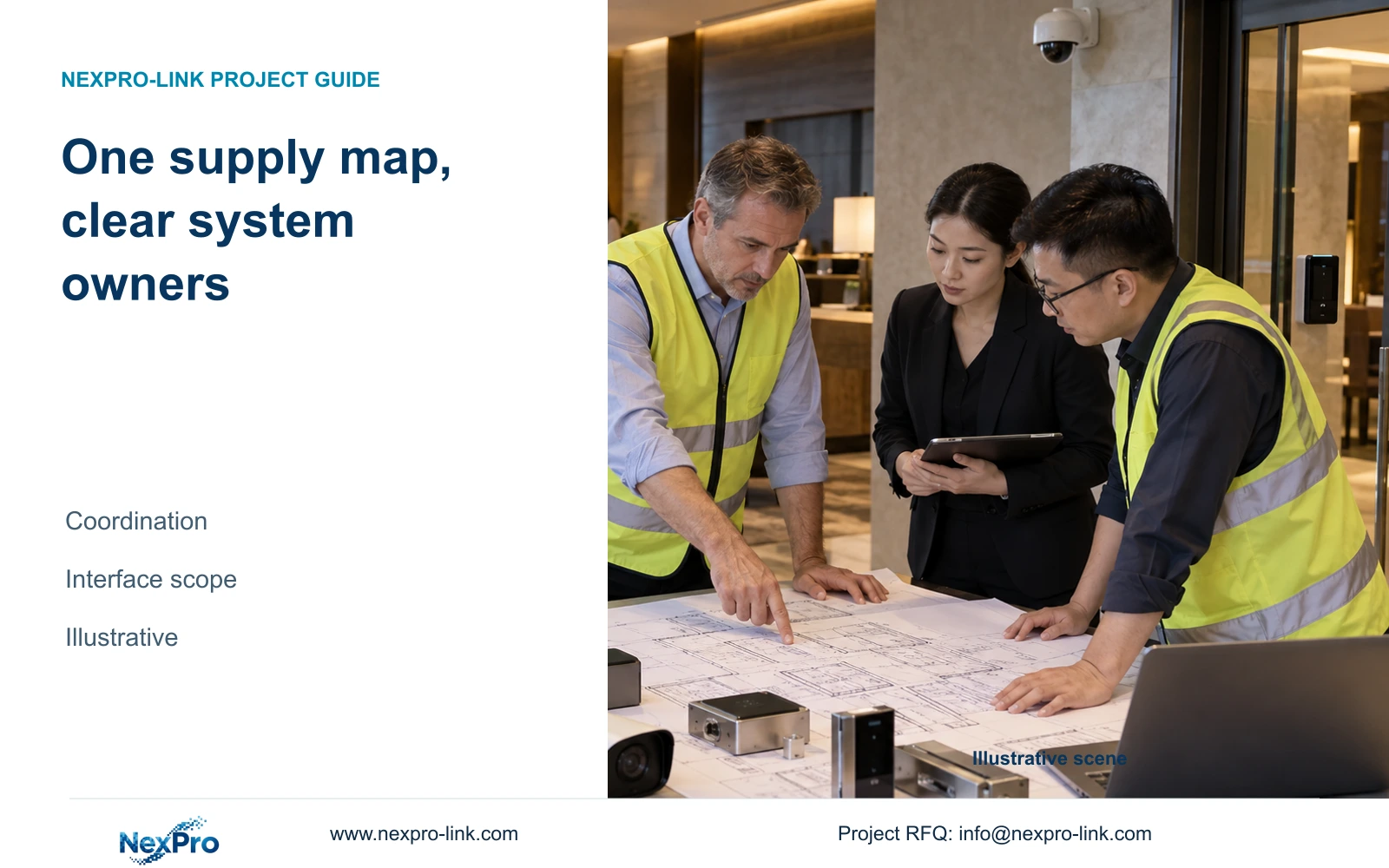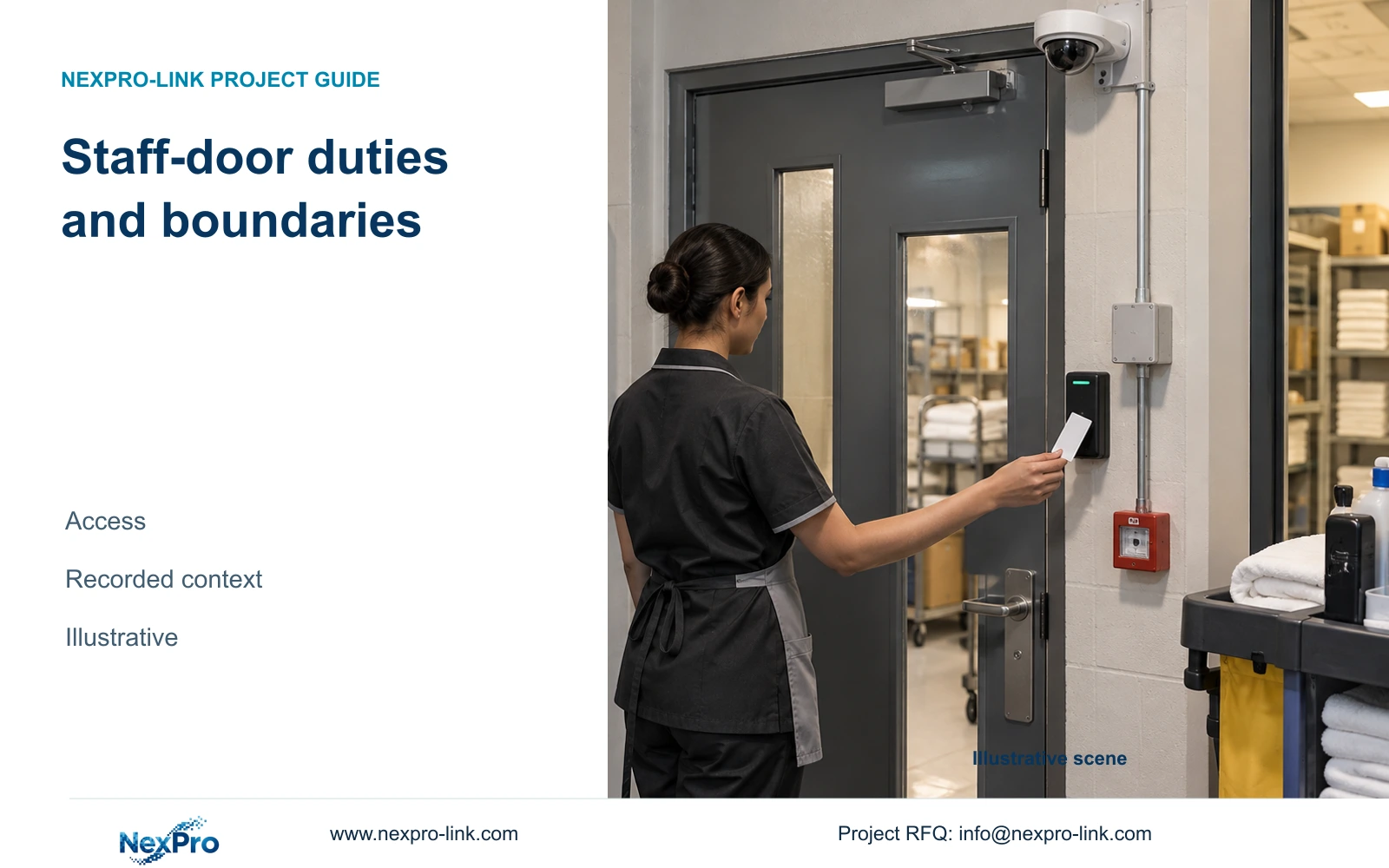
A staff entrance needs a defined access workflow, a complete power path and an assigned safety interface. CCTV records the event while the access system controls authorized entry.
Section 01
Define the staff-door operating workflow
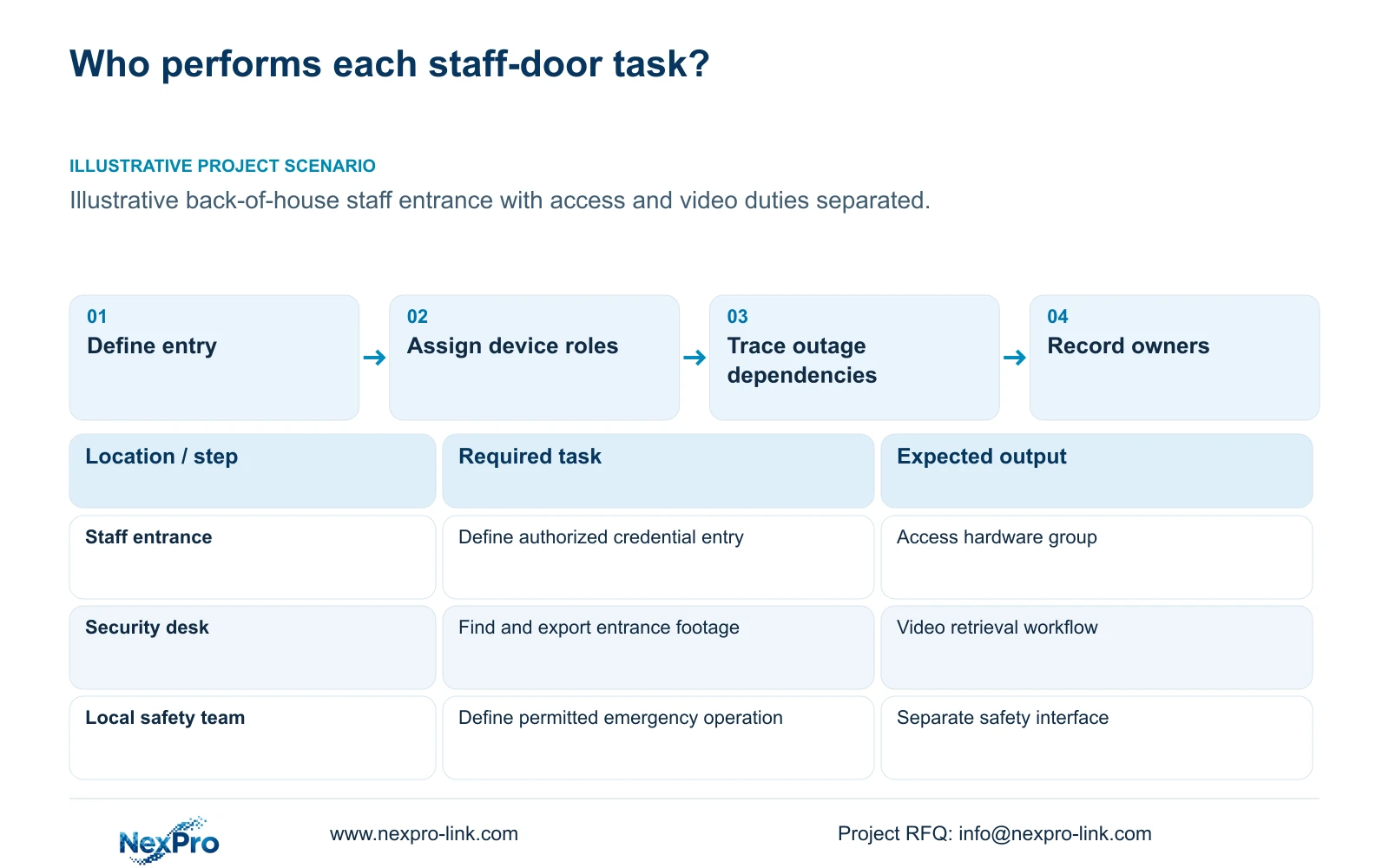
Specify the staff entrance around authorized entry, required door-state information and recorded incident retrieval. Assign emergency operation and safety interfaces to the responsible local designer. Choose a coordinated equipment package only when each function has an identified device, power dependency and delivery owner; an ordinary camera must not determine safe release.
Describe a normal entry from credential presentation through the permitted door operation. Then describe the operator's response to an event: identify the relevant entrance, locate its time window and retrieve the required footage. Record who performs each action. Security operators, hotel IT and installers need different responsibilities and supported permissions.
Include the required outage state and restoration task before selecting hardware. This prevents a quotation from satisfying normal entry while leaving power loss unresolved. The initial task sheet can be short, provided it distinguishes access operation from video observation and names the remaining interface decisions.
| Required task | Given information | Decision still needed |
|---|---|---|
| Authorized staff entry | Controlled staff entrance | Credential method and access decision owner |
| Incident retrieval | Entrance video required | View, retention and authorized export workflow |
| Outage operation | Continuity requested | Required door state and protected dependencies |
Section 02
List reader, controller, lock and video roles
Use the door construction, handing and lock-body requirements to establish the hardware group. Identify the reader's credential role, the controller's access role and the locking device's operating role. Include required door-status equipment where the project task calls for it. A camera supplies visual context and recording; its inclusion does not prove an access-control interface.
For video, NexPro-BL2812M55-5MP-DIC-AI is a documented 5MP-series motorized-varifocal candidate in the supplied BL2812M PDF. The listed focal range is 2.8 to 12 mm, with PoE and IP66. Its suitability still follows the entrance view and environment. The PDF does not provide maximum power, so a verified PoE peak cannot be inferred.
Keep guest-room lock arrangements separate. NX-HL-DQ's hotel lock description does not establish suitability for every staff entrance or an interface with the proposed controller. A unified order can preserve consistent equipment records while retaining distinct access and video configurations.
| Item | Incomplete bundle | Defined package | Effect on the task |
|---|---|---|---|
| Access hardware | Lock named alone | Reader, controller and lock roles specified | Entry dependencies become visible |
| Video | Camera added to the list | Required view connected to recording | Incident retrieval has an operating path |
| Interfaces | Integration presumed | Actual supported connection identified | Unsupported functions stay outside the offer |
Section 03
Map power dependencies
Draw the access supply chain separately from the camera-to-recorder data path. On the video side, the required PoE access node and intermediate network equipment must remain powered if recording is expected to continue. On the access side, establish the supplies serving the actual controller and door equipment. A powered NVR cannot compensate for an unpowered remote node.
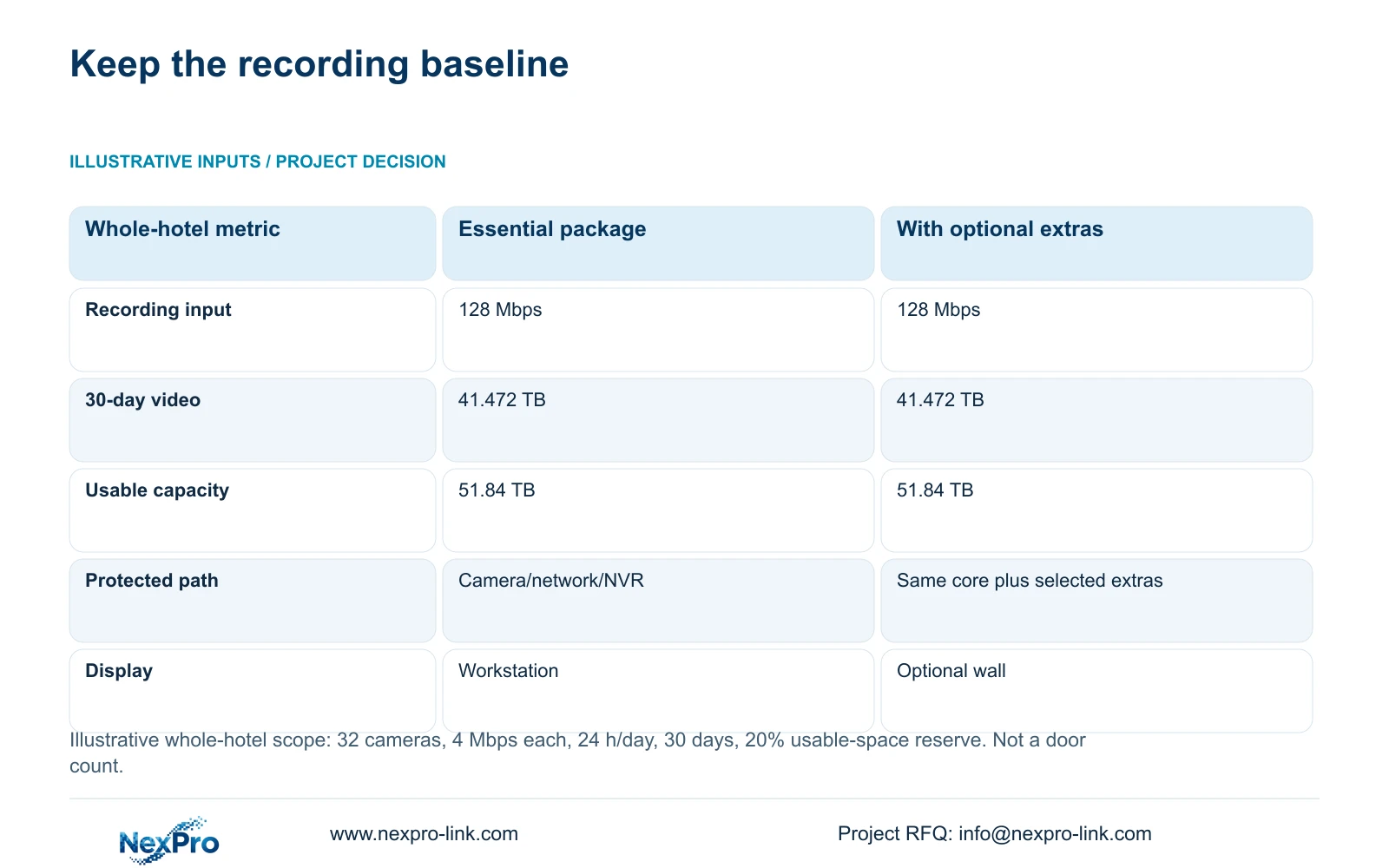
The illustrative whole-hotel recording reference assumes 32 cameras at an average 4 Mbps each, recording 24 hours daily for 30 days. Input is n × 4 Mbps. Decimal video TB equals 0.0108 × n × 4 × 30; reserving 20% of usable space gives video TB divided by 0.80. These are planning inputs, not camera specifications or door counts.
Power needs separate W and VA calculations for each protection zone. Where measured switch AC input already includes camera power, do not add those cameras again. NexPro SW-POE1618G remains an inquiry candidate: its source has conflicting access-port speed descriptions and no numerical total PoE budget. It cannot be declared adequate from its port count.
Section 04
Separate local safety interfaces
Identify the party responsible for safe door operation and the project-specific release interfaces. Record the intended power-loss response and recovery behavior in that party's design. CCTV footage, a viewing application or a supply package does not establish a life-safety controller. Procurement must retain the required access-safety scope independently of optional video features.
Specify the staff-door behavior and responsibility records below before treating a combined package as complete. The local door-safety designer must approve the intended failure and release states for the actual site. A CCTV event, recorded image or app command is not a substitute for that approved design, and this article supplies no wiring or bypass instructions.
Retain the independent video recording calculation in the power-dependency section: its 32 cameras describe a whole-hotel teaching example, not 32 staff doors or an access-control load. For each door, request the actual controller, supply and supported interfaces separately. Acceptance must retain the responsible professional's criteria and observations; neither a supply list nor the illustration is a completed safety test.
| Required behavior | Evidence or approval to request | Responsible scope |
|---|---|---|
| Staff entry | Approved credential task and actual controller/lock interface | Hotel access owner and access integrator |
| Door-status reporting if required | Supported sensor/controller connection and observed event | Access-system configurator |
| Supply loss and required release behavior | Site-specific approved design and acceptance criteria | Appointed local door-safety professional |
| Video incident review | Independent camera/recording path and authorized retrieval | CCTV integrator and hotel security |
| Restoration and handover | Approved recovery sequence, observations and named contact | Relevant system owners; no assumed universal sequence |
Section 05
Compare complete equipment packages
Compare proposals against the same authorized entry and retrieval tasks. Separate door hardware, access supplies and installation from video equipment and storage. Add credentials, required software interfaces and support where applicable. Missing items must stay visible in the evaluated scope; a lower equipment subtotal does not establish a complete entrance package.
NexPro-NVR4449-4K lists 49 channels, 320 Mbps input and four SATA positions with an 18 TB per-drive field. Its summary lists 49 × 5MP / 9 × 4K, so channel count alone does not establish an arbitrary recording mode. Disk layout and playback tasks need their own confirmation. The illustrative 51.84 TB requirement is usable capacity, not a raw disk total.
Start with an ordinary authorized workstation where incident retrieval is the main operating task. Add a wall only when a defined continuous observation duty warrants it. NX-VP-5535 is a 55-inch Full HD LCD candidate; its display role remains outside the essential recording path.
| Retained outcome | Extra scope | When useful | Counter-condition |
|---|---|---|---|
| Authorized entry and recorded context | Supported event interface | Operator needs an established linked workflow | Actual platform connection unresolved |
| Incident retrieval | Larger observation display | Continuous multi-user viewing is required | Occasional search and export are sufficient |
Section 06
Issue a door-specific responsibility sheet
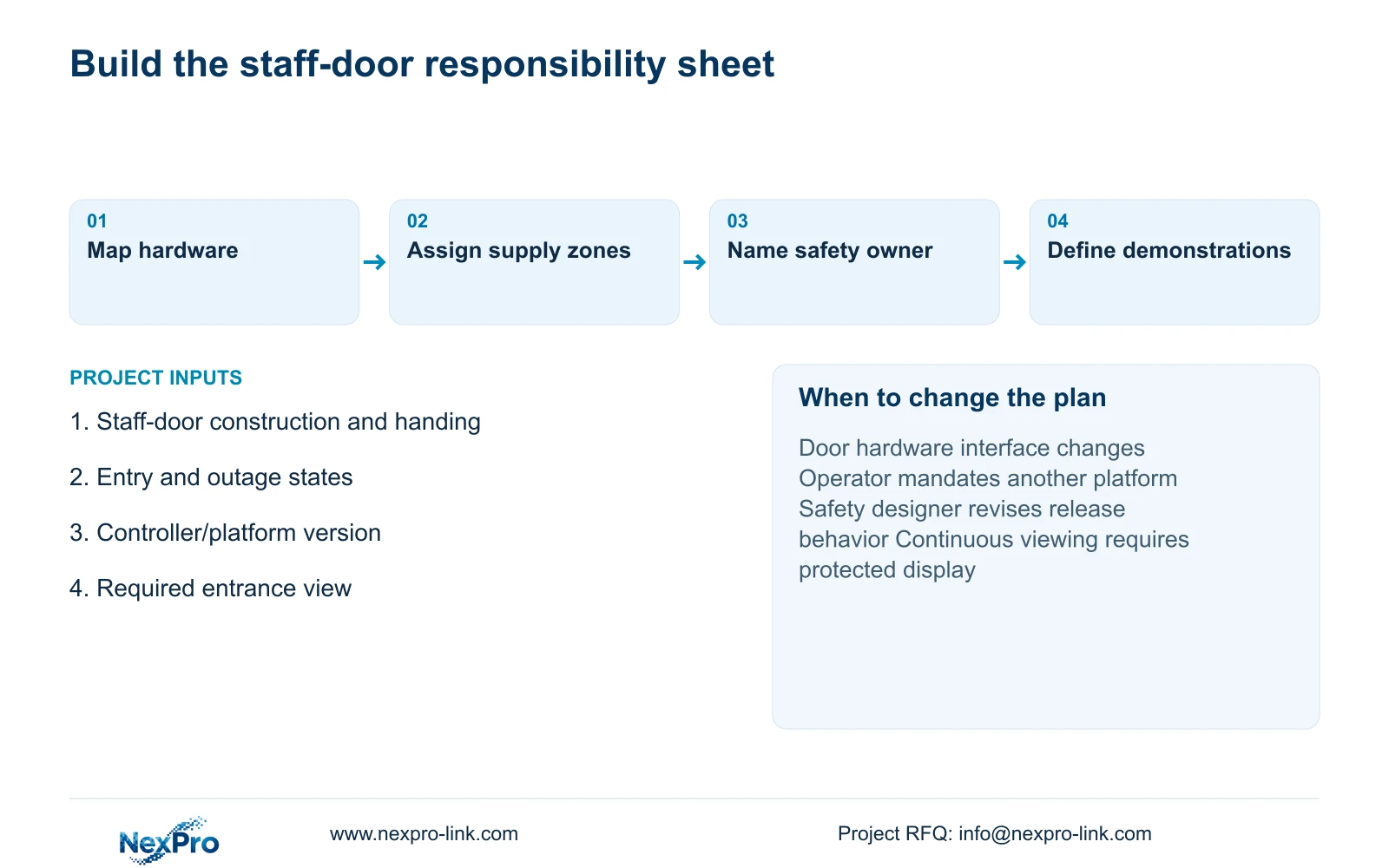
For each staff entrance, issue a record connecting its hardware group to access administration, video position and power supply. Name the installer, interface implementer and hotel operating owner. Include the approved task that each party must demonstrate, with configuration and version references where relevant.
Recommend a defined access package with an independently complete recording path. Change the package when the operator mandates a platform, the door interface changes or the safety designer revises the required operating state. Expand display or recovery scope only for an explicit duty. NexPro-Link can coordinate model matching and BOQ documentation; local installation and final safety responsibilities remain contractual.
Send the staff-door schedule, required entry and outage behavior, camera task and existing controller or platform version to info@nexpro-link.com. Include destination and project stage for a scoped supply response. Applicable main equipment follows the supplied policy's receipt-based 24-month limited hardware baseline, with accessories and site-service terms separately defined.
Section 07
Buyer questions
Does buying the controller and camera together provide linked events? Only a supported interface and actual software configuration can establish that workflow. Request the specific event, receiving system, version and demonstration condition in the proposal.
Must the control-room display remain powered for recording? It is not an essential recording dependency in the illustrated arrangement. Protect it separately if operators must continue viewing during the agreed outage.
Can NexPro-Link supply the package without taking over local safety design? A coordinated supply scope can include equipment matching and technical records while assigning door installation, electrical work and safety interfaces to the responsible local specialists.
Engineering references
These sources support the general planning principles. Always use the selected product's current datasheet and applicable project standards for final design.