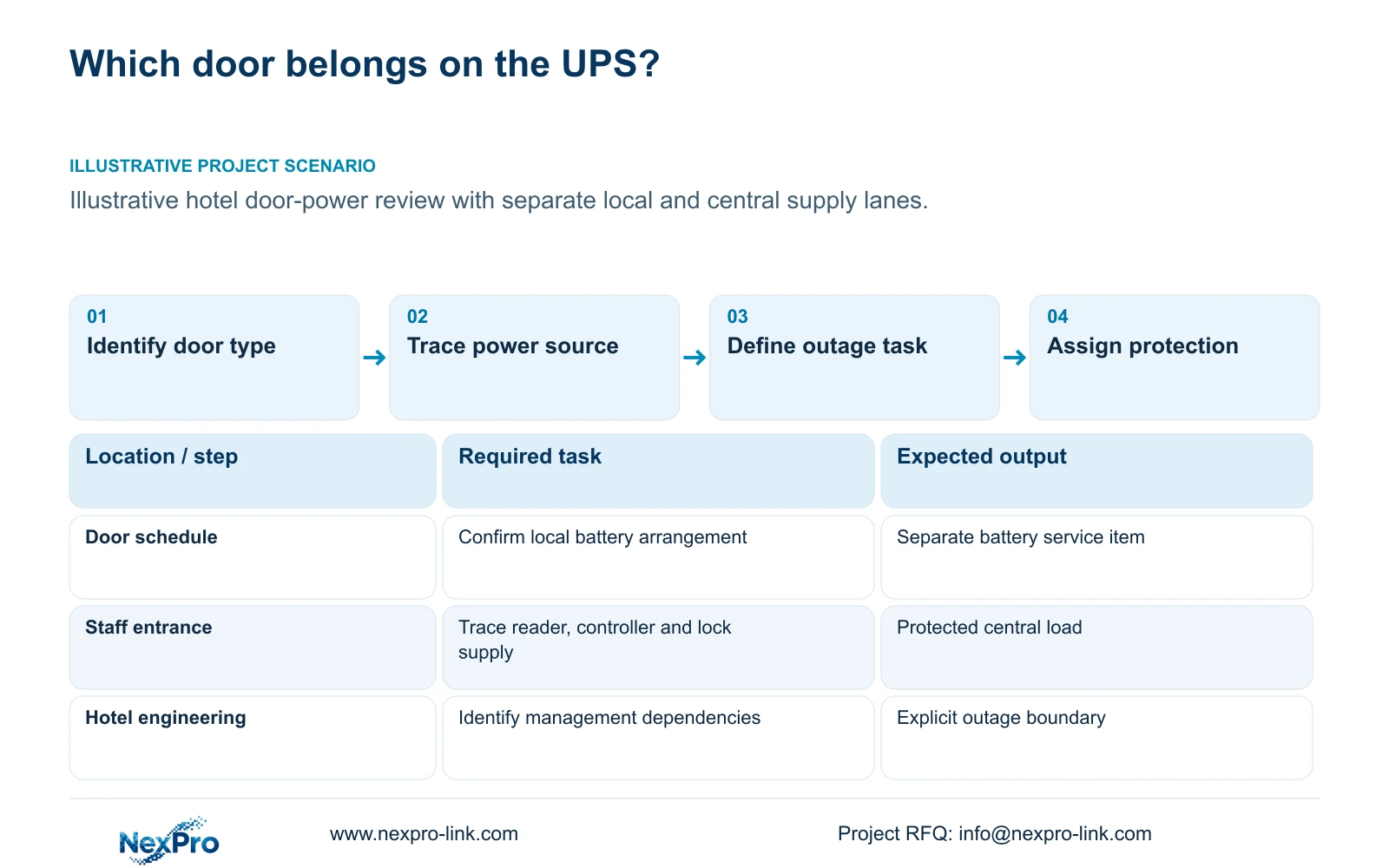
Battery-operated room locks do not automatically belong in the hotel UPS load. Identify each door's power source and emergency operation before specifying protected access equipment.
Section 01
Identify each lock's power source
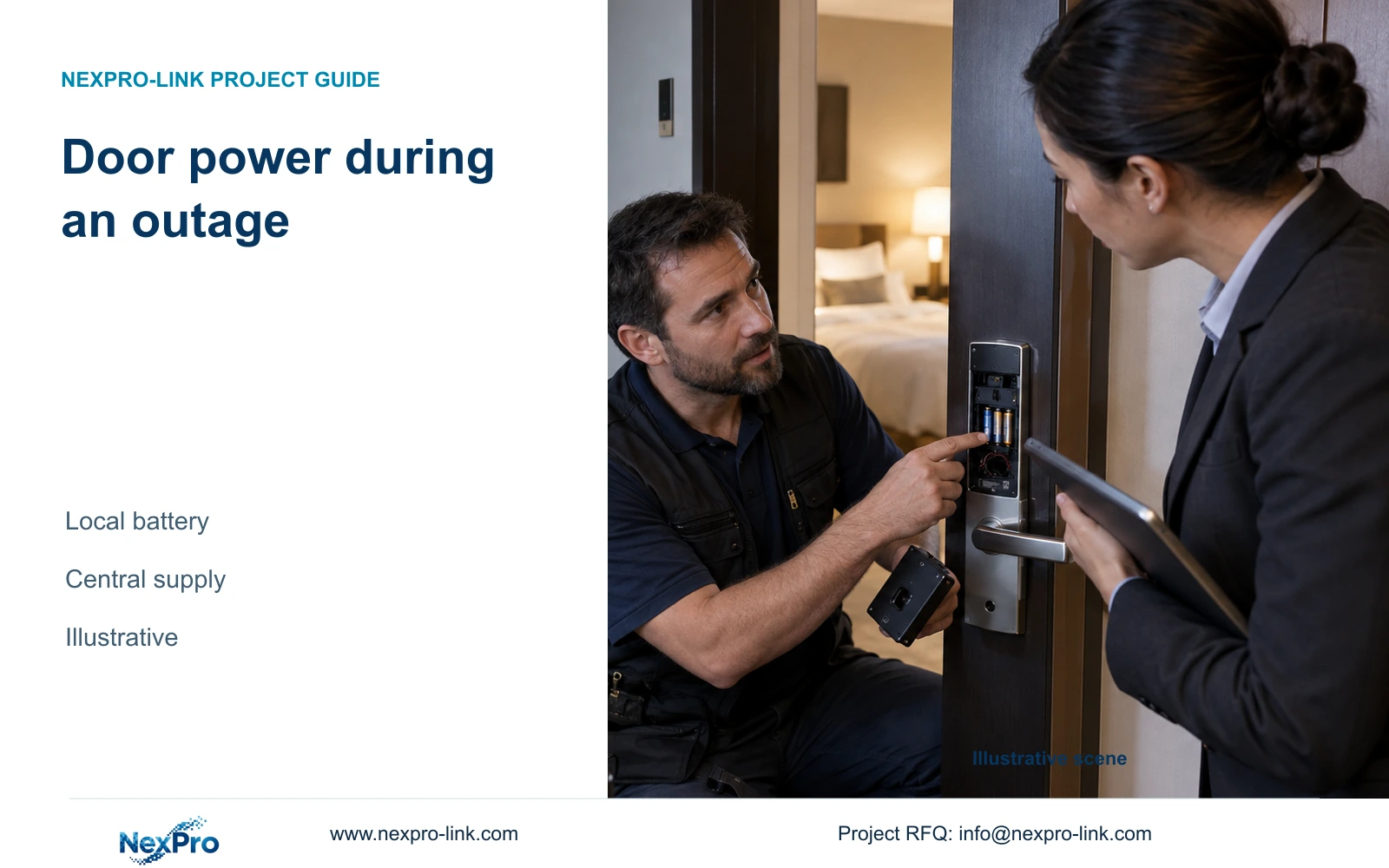
Exclude a locally battery-operated guest-room lock from the cabinet UPS load unless its selected configuration has a documented connection to that supply. For centrally powered access doors, protect the actual equipment chain needed for the agreed outage operation. The first purchase decision is therefore the power arrangement of each door type, followed by its permitted emergency operation.
Start with a door schedule that records use, handing, door construction, lock body and power method. Separate guest-room doors from staff entrances and other controlled openings. A room count cannot establish how many controllers, power supplies or protected circuits the hotel needs. Those quantities follow the selected hardware and its distribution.
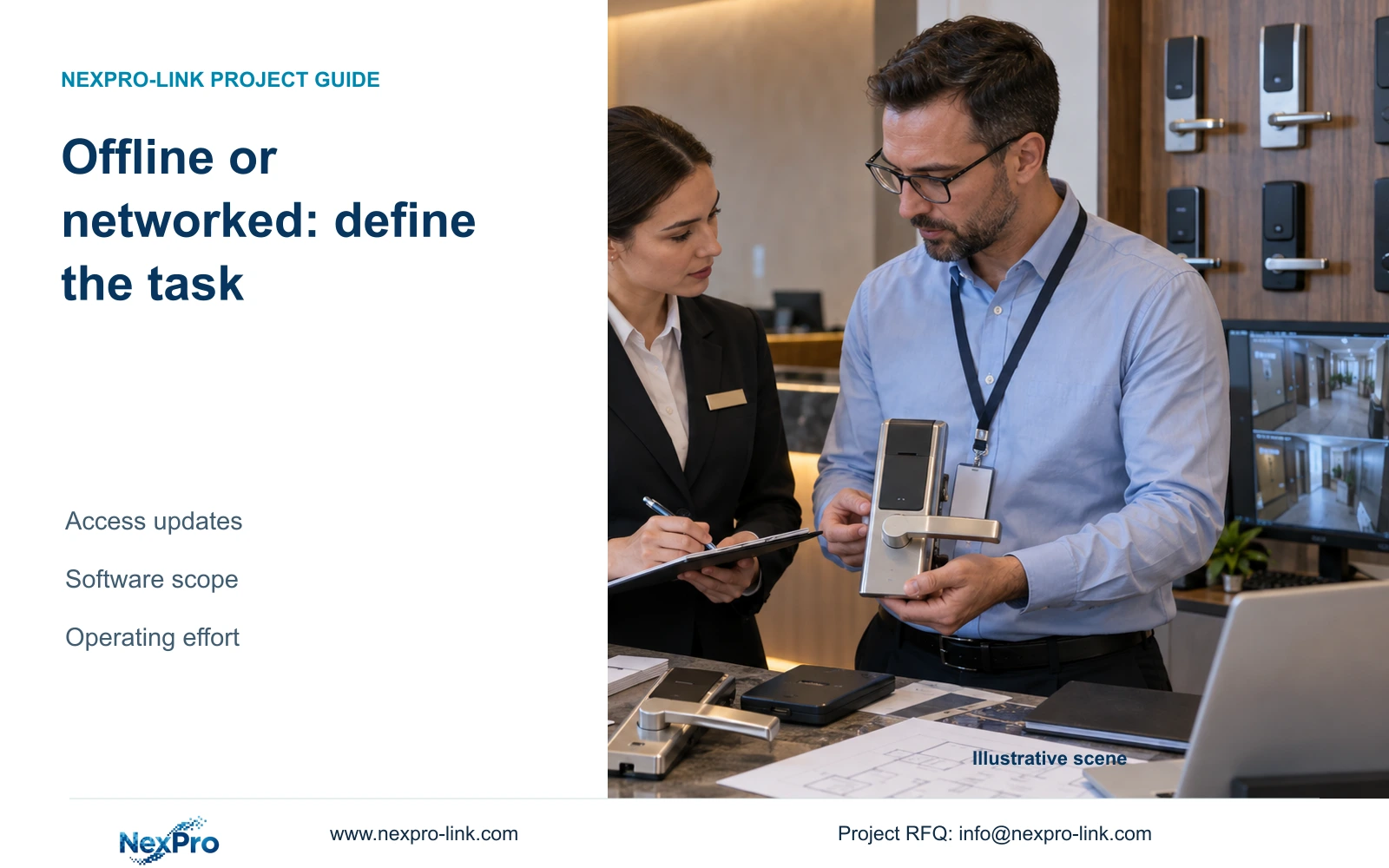
NX-HL-DQ is a hotel IC card lock candidate described in the hotel project source, including mechanical-key support. Its battery details, door thickness requirements and PMS interface must be established for the actual configuration. That description does not establish PoE or central power. Keep unresolved power fields visible in the equipment schedule.
| Required task | Given information | Decision still needed |
|---|---|---|
| Room entry during outage | NX-HL-DQ mechanical-key support described | Actual battery arrangement and authorized fallback |
| Staff-door access continuity | Central access equipment proposed | Connected devices, supply location and outage state |
Section 02
Separate local battery and central supply
A local lock battery and a cabinet UPS serve different equipment boundaries. The lock battery supports the functions assigned to that lock. A central supply may serve a controller, reader and electrically operated locking device. Draw those connections individually before combining their loads into a backup-power schedule.
Separate electrical operation from credential administration. A lock may have local power while a requested issuing or management workflow depends on another device. Establish which tasks must continue during an outage: existing credential use, authorized fallback entry or credential administration. Their dependencies can differ, and the selected system must confirm the actual behavior.
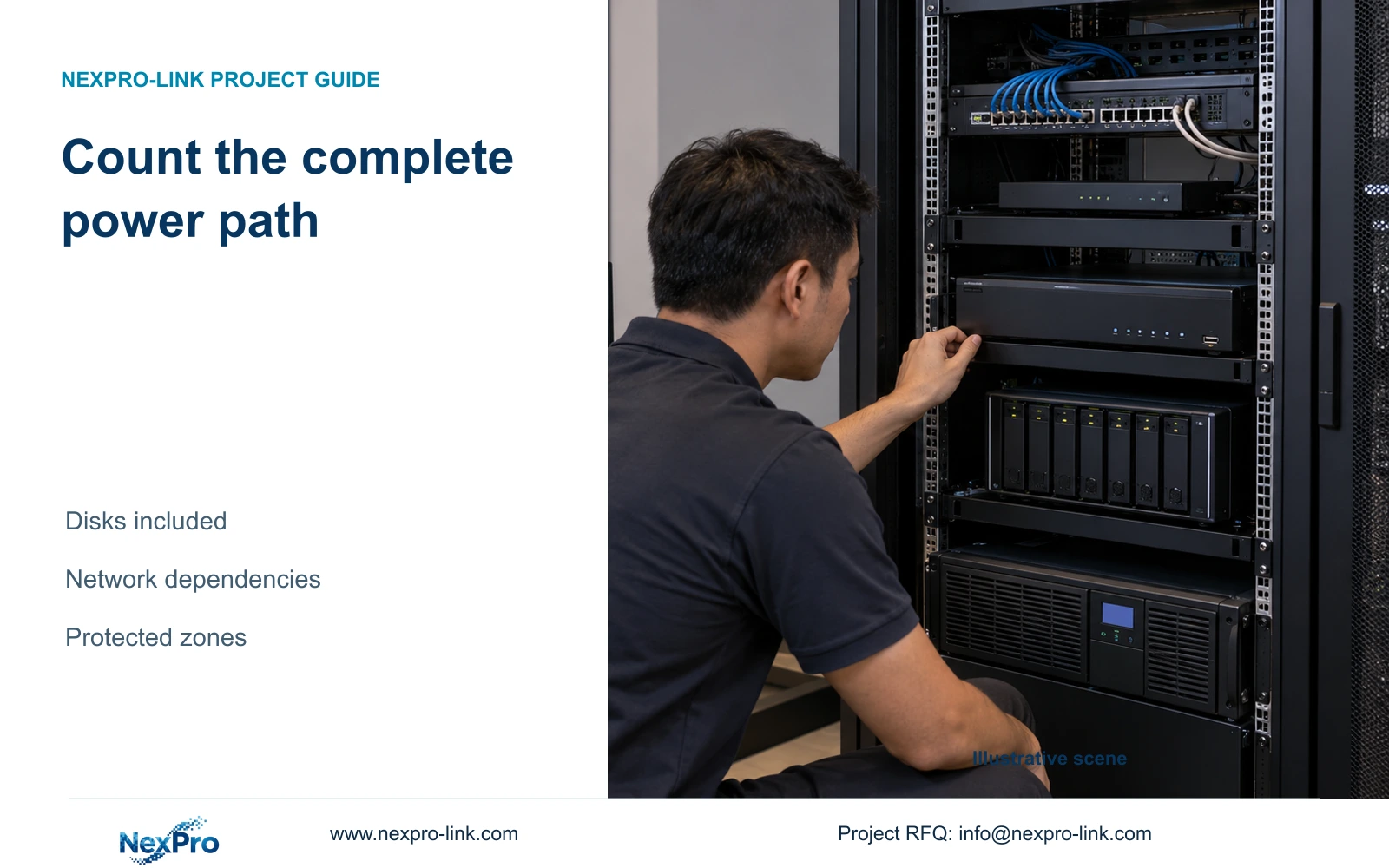
For centrally supplied equipment, output energy equals load watts multiplied by hours. This establishes the energy required by the connected load, not an exact battery size. Any efficiency or usable-energy factor must be identified as a planning assumption. Local lock batteries remain a separate maintenance item unless the design explicitly connects them to the protected central supply.
| Item | Local battery arrangement | Central supply arrangement | Hotel consequence |
|---|---|---|---|
| Lock power | Confirmed at the selected lock | Confirmed through its supply chain | Different outage and maintenance tasks |
| UPS accounting | Exclude without a connected dependency | Include actual protected AC input | Avoid an inflated cabinet load |
| Management equipment | Check independently | Check independently | Powered hardware does not establish every workflow |
Section 03
Map permitted emergency operation
Write an operating-state record for mains loss, loss of a local battery or supply, and recovery. For each state, identify the authorized action and responsible person. Mechanical-key support is a product feature; key custody and permitted use are hotel operating decisions. Do not assume every door should respond identically when power disappears.
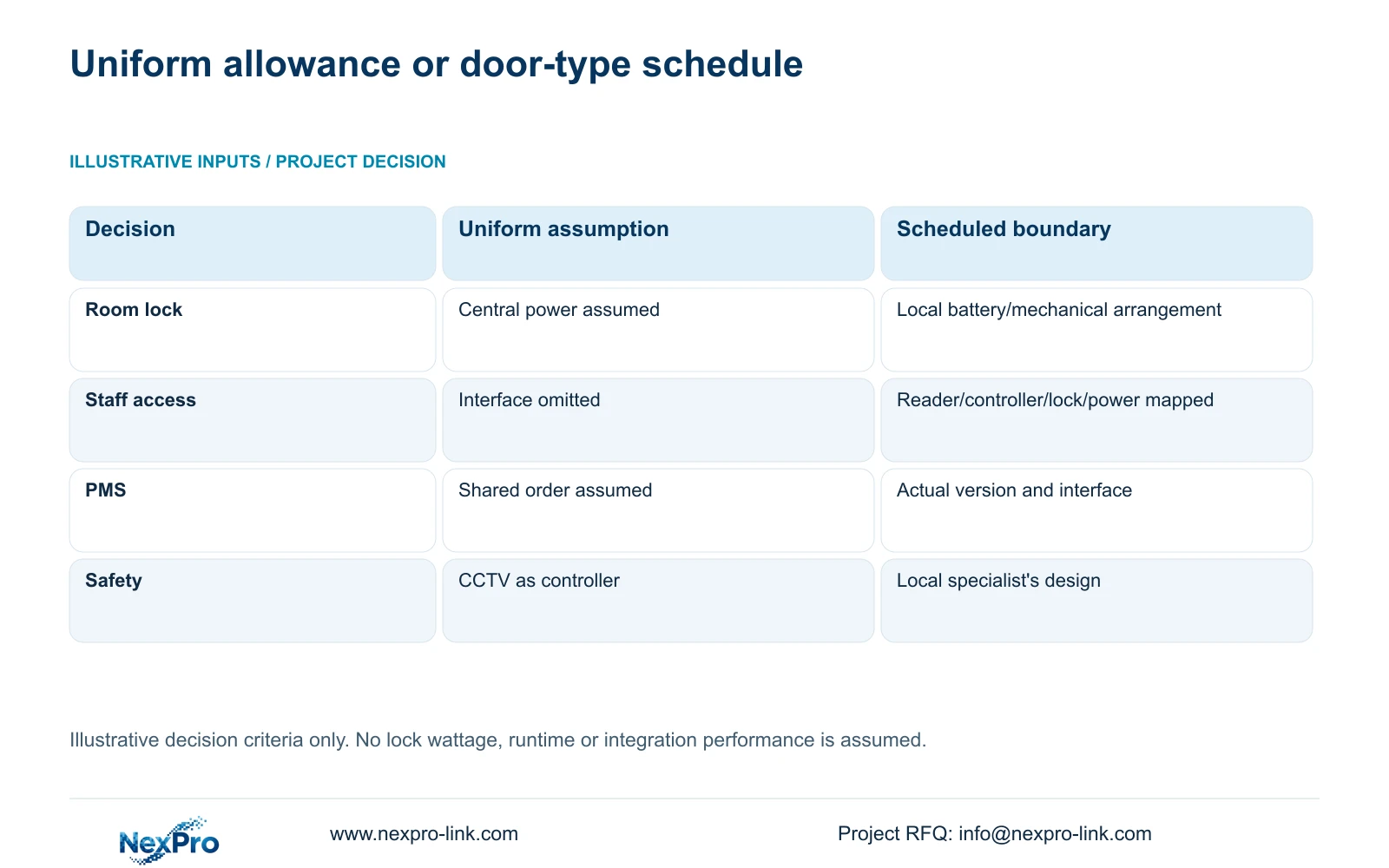
The following illustrative comparison contains decision criteria, not measured performance. It changes the recommendation from a uniform UPS allowance to a door-type schedule. Room locks require their own battery and mechanical arrangements; staff doors require a defined controller and power chain. PMS integration and safety operation need separate evidence.
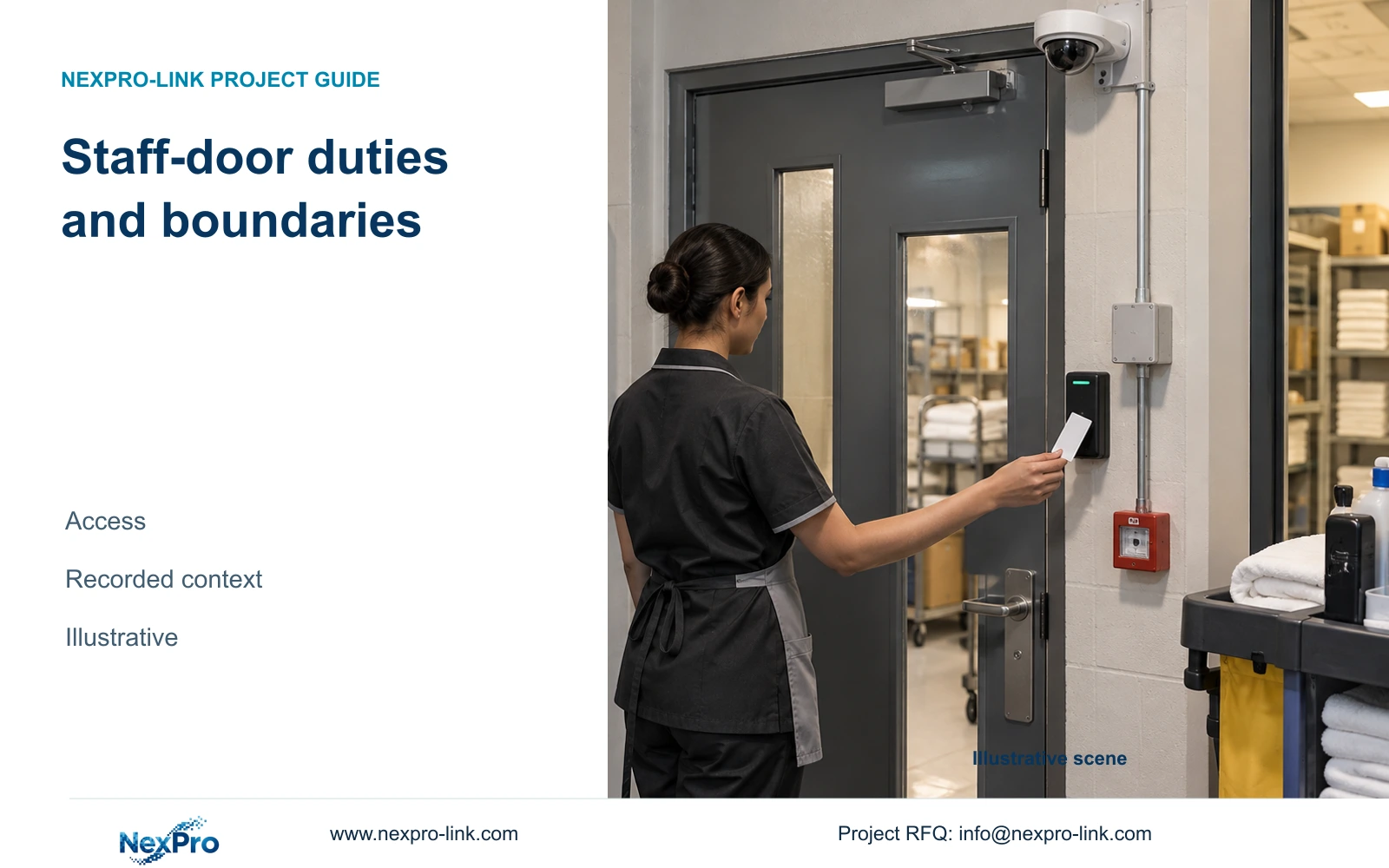
Ordinary CCTV supplies observation and recorded context. It must not be assigned responsibility for emergency release or safe egress. The responsible local specialist defines those interfaces for the project. Buying access equipment and cameras together does not establish an approved opening command, supported PMS connection or safe release sequence.
| Metric / condition | All hotel doors treated alike | Door-type and task schedule |
|---|---|---|
| Room lock | Assumed centrally powered | Identify local battery/mechanical arrangements |
| Staff access | Included without interface detail | Reader, controller, lock and power roles mapped |
| PMS | Assumed from shared order | Actual version and supported integration |
| Safety | Ordinary CCTV treated as controller | Responsible local specialist defines safe operation |
Section 04
Calculate only relevant UPS loads
Build the UPS load schedule at a consistent AC boundary. Where a central power supply's input includes downstream access devices, do not add those devices again. Record maximum, typical and measured values separately. Assign each load to its actual protection zone; a hotel-wide total cannot establish that one cabinet UPS powers every remote opening.
Check both watts and volt-amperes. Published rack ratings distinguish SP1KR(S), at 1 kVA / 900 W, from SP2KR(S), at 2 kVA / 1800 W. These ratings qualify capacity candidates only. Required minutes depend on the supported battery configuration and its load curve, including the relevant discharge conditions.
The separate CASE01 teaching reference budgets CCTV and network loads under its own assumptions. Its totals do not include a verified door-access package and should not be extended by an invented watts-per-room allowance. Add centrally powered access equipment only after obtaining actual supply inputs. If a changed door arrangement adds protected equipment or another location, recalculate capacity and runtime for the affected zone.
Section 05
Compare service and battery tasks
Compare the work needed to maintain the approved operating outcome. Local lock batteries need a model-specific replacement procedure and an assigned hotel service role. Central backup equipment needs its supported battery arrangement and a clear restoration path. A larger UPS cannot resolve an unspecified local lock-battery maintenance task.
Temperature, battery condition and discharge behavior affect actual runtime. External battery selection also requires supported voltage, charging and battery-management compatibility. A watt-hour estimate does not authorize improvised battery connections. Obtain the selected configuration's information before pricing a longer continuity target.
The supplied policy record states a 24-month limited hardware baseline from receipt for applicable main equipment. Batteries, OEM scope and other accessories follow their specific written terms. Keep local labor, replacement stock and return transport visible when comparing service proposals; technical support does not establish free onsite attendance.
| Retained outcome | Extra scope | Purchase condition | Counter-condition |
|---|---|---|---|
| Local lock operation | Supported replacement batteries and procedure | Hotel staff can perform the assigned task | Battery identity or procedure unresolved |
| Central access continuity | Supported backup configuration | Required door state and duration are defined | Only a general UPS rating is offered |
Section 06
Coordinate local access-safety requirements
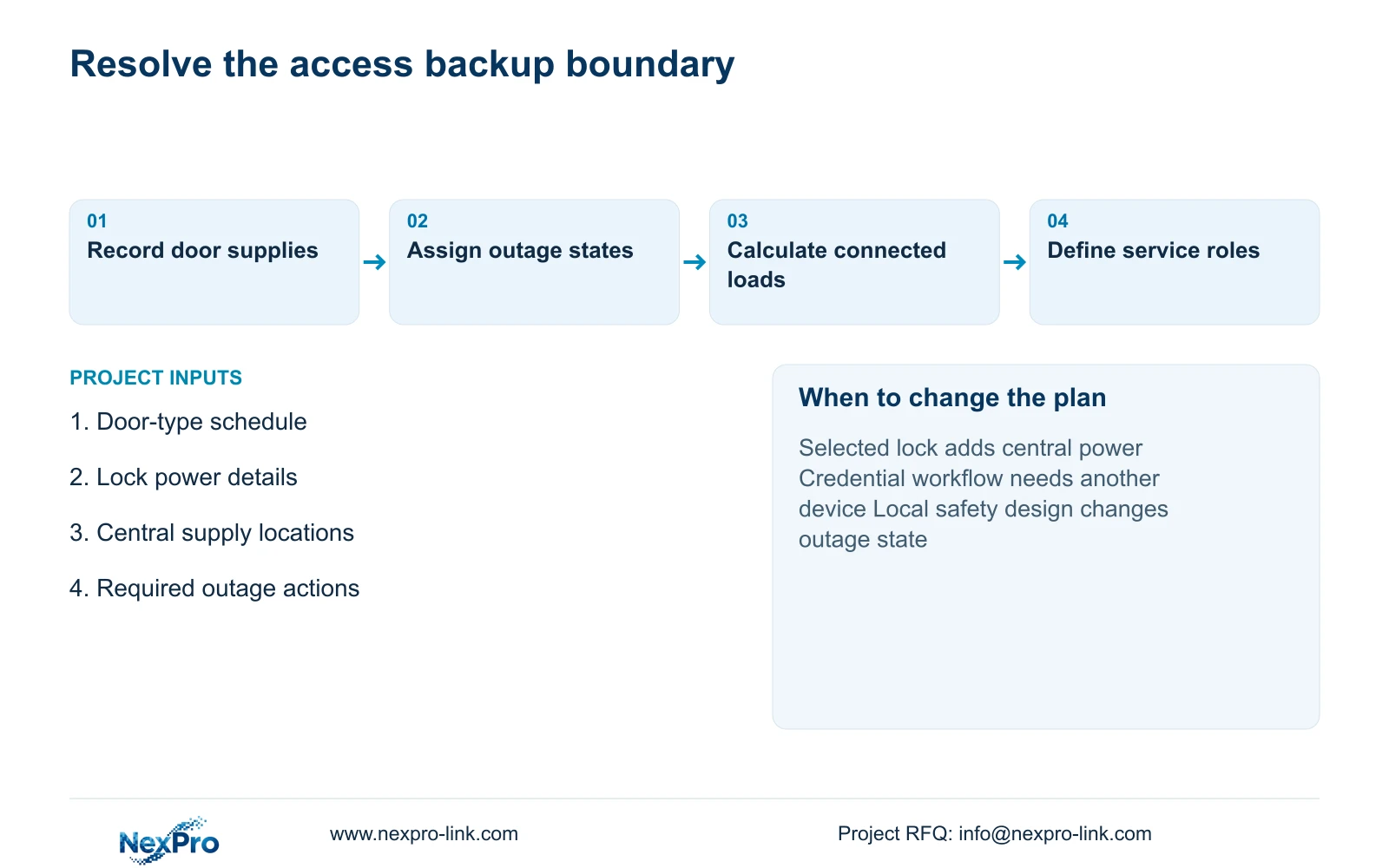
Use a door-type schedule as the purchasing baseline. Keep confirmed local battery locks outside cabinet UPS calculations, and design central access backup around its documented supply chain. Change this recommendation when the selected lock or required management workflow introduces a central dependency, or when the local safety design changes the required outage state.
Assign door fit and installation to the appropriate local party, electrical protection to the electrical designer, and operating permissions to the hotel. NexPro-Link can coordinate equipment matching, BOQ records and supply documentation within an agreed scope. Its CCTV manufacturing core and coordination of supporting categories do not establish that all equipment shares one manufacturer or software platform.
Send the affected door schedule, selected lock power details and required outage actions to info@nexpro-link.com. Include the central supply locations and any required PMS interface version. Hotel project equipment support and BOQ and tender support provide the relevant inquiry routes. Passwords, guest footage and personal credentials are unnecessary for this initial decision.
Section 07
Buyer questions
Does mechanical-key support prove the lock works throughout a power cut? It establishes a described fallback feature, not the full electronic outage behavior. Confirm the selected lock's battery arrangement and the hotel's authorized key procedure separately.
Can one UPS quotation cover room locks and staff doors? It can coordinate the procurement scope, but the load schedule must identify actual connected central supplies. Local lock batteries need their own model-specific service scope.
Can the access and CCTV schedules share one equipment quantity? No. Door hardware quantities follow door types and interfaces. Camera quantities follow permitted observation tasks; neither schedule determines the other.
Engineering references
These sources support the general planning principles. Always use the selected product's current datasheet and applicable project standards for final design.