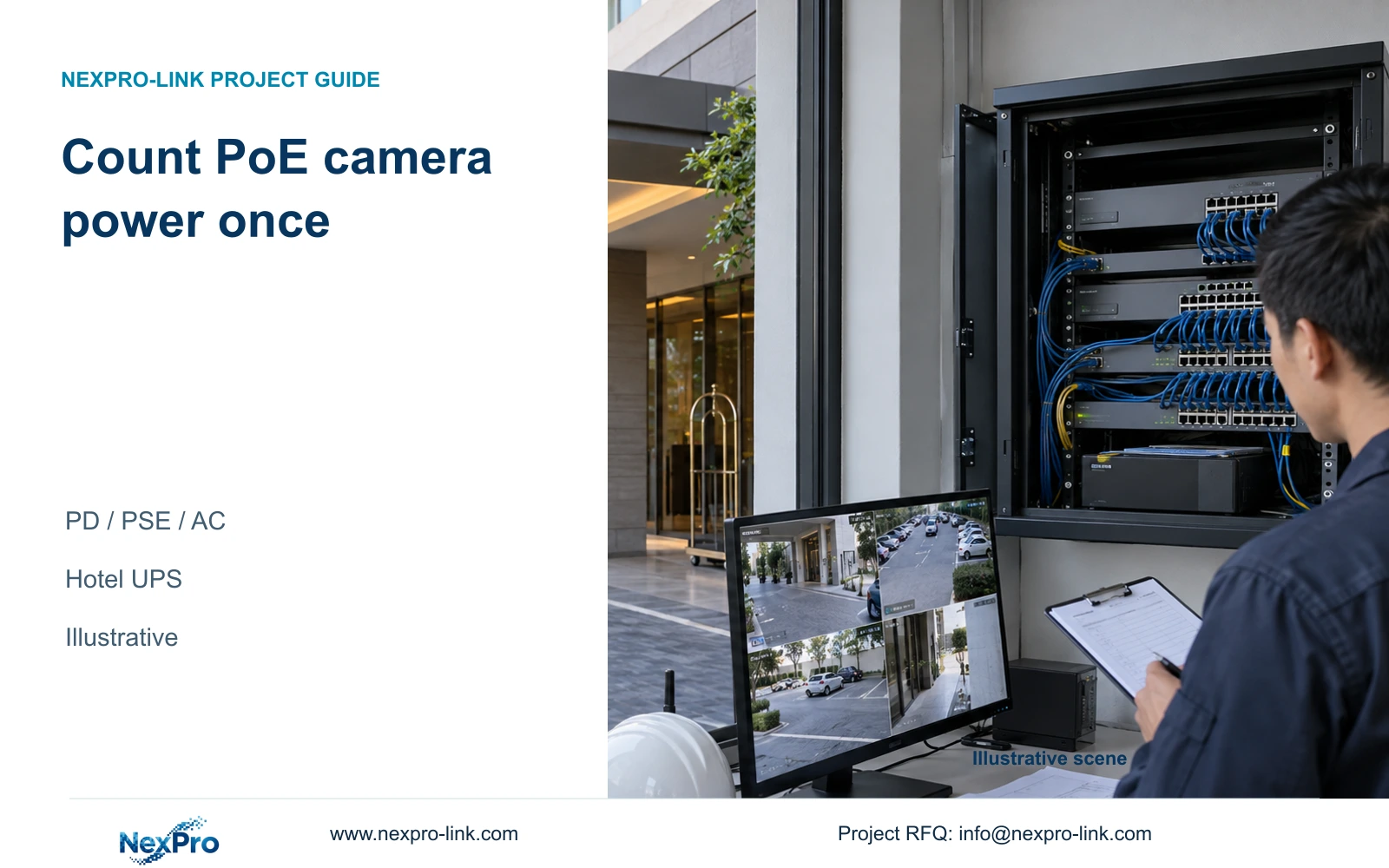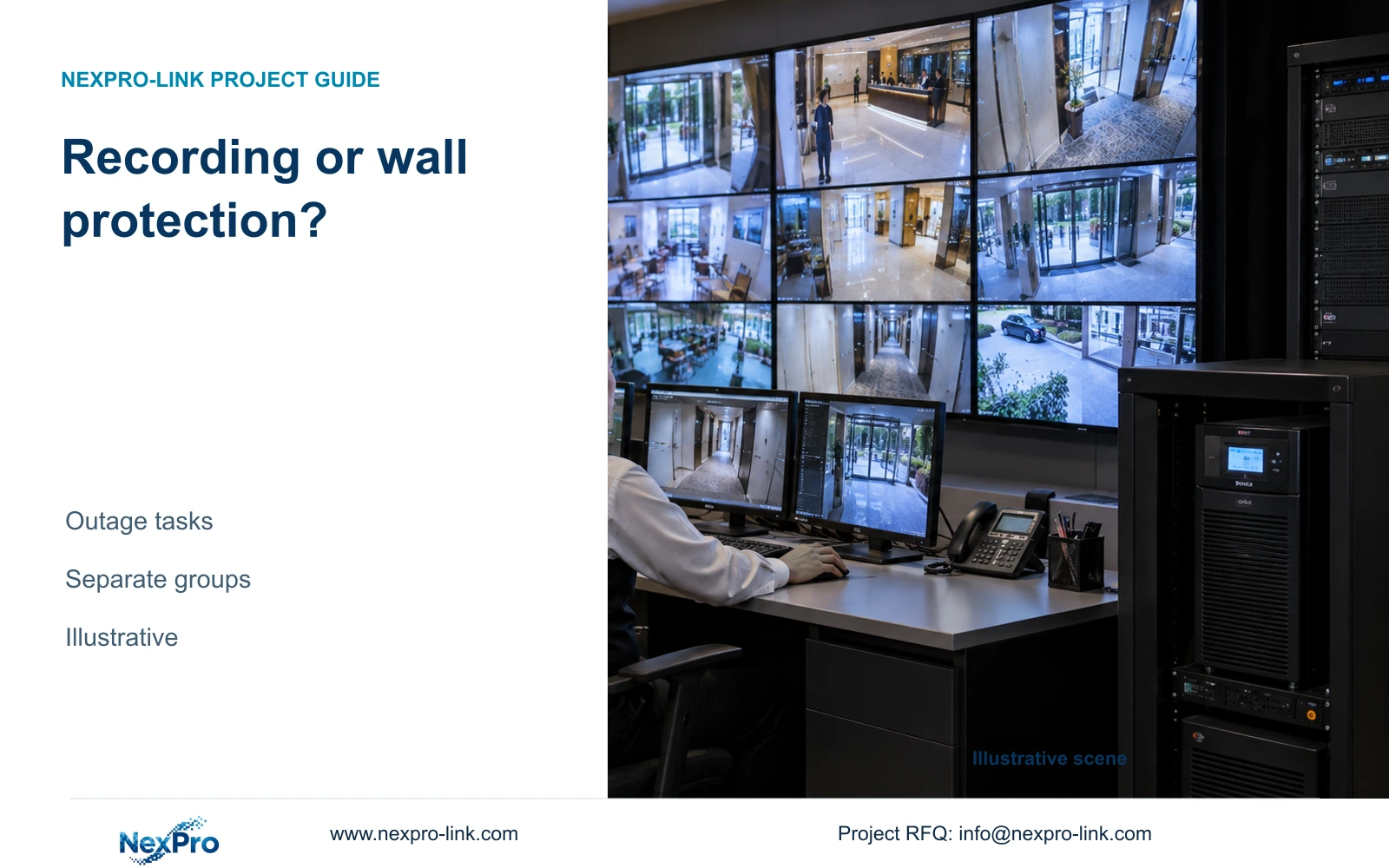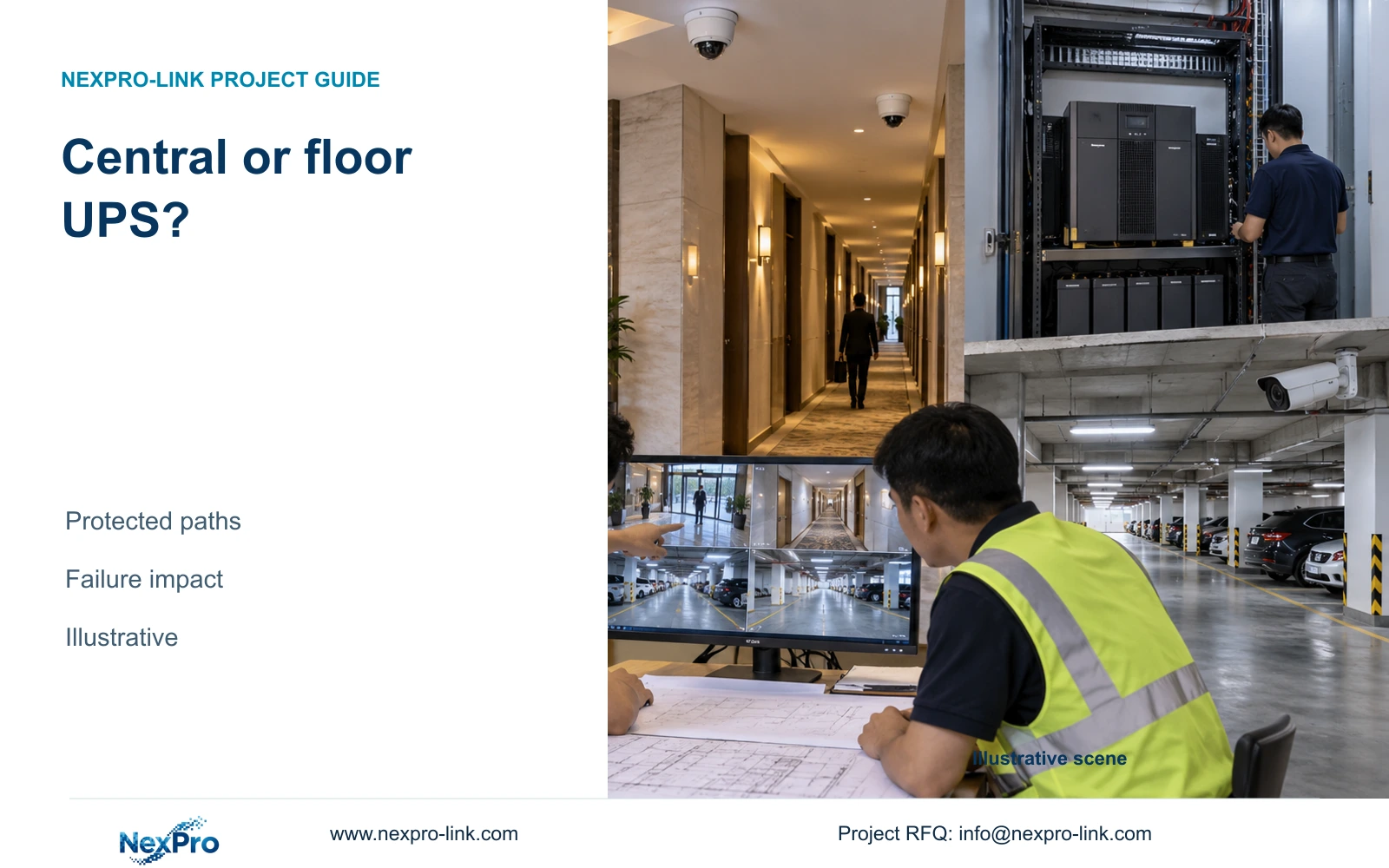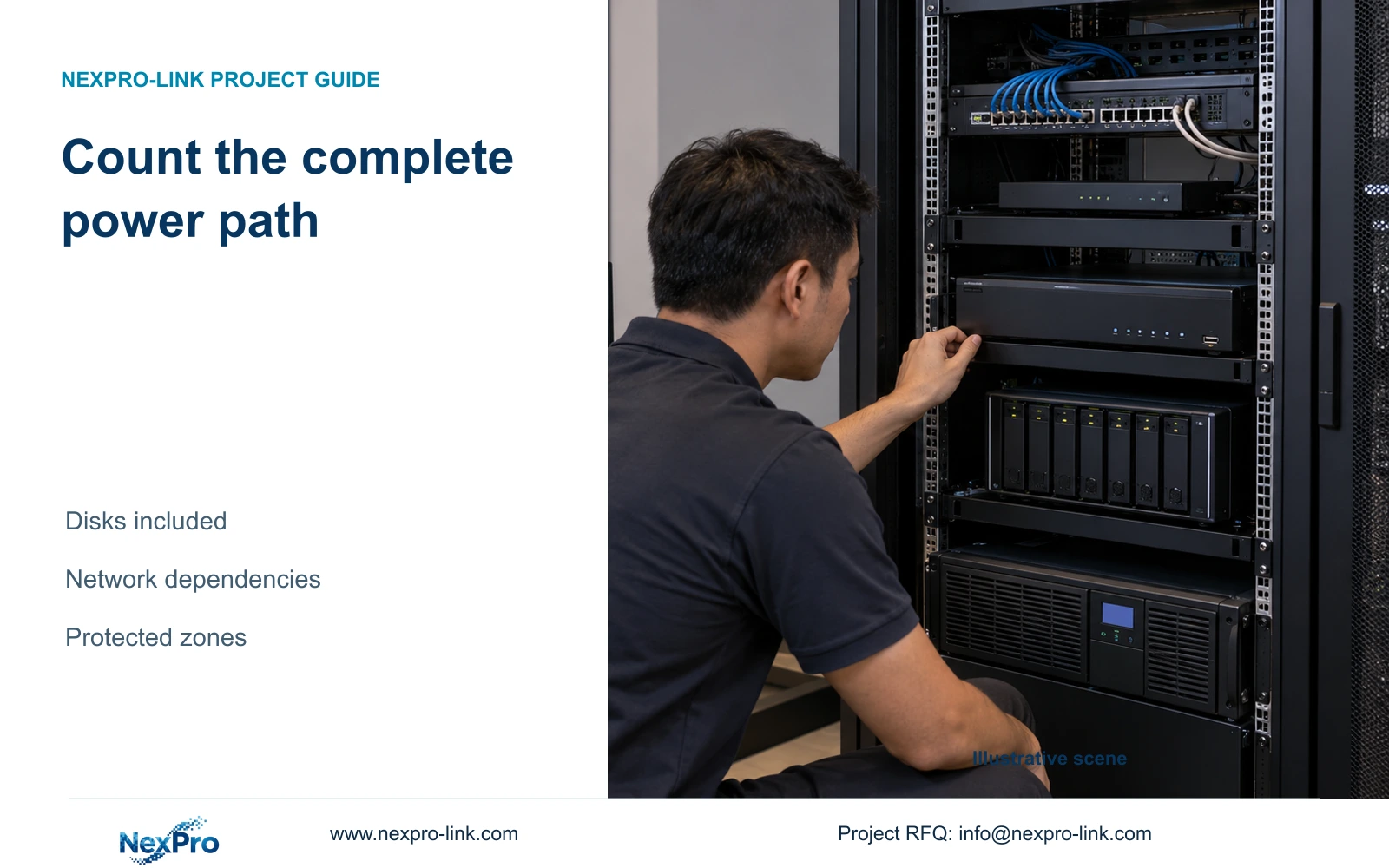
A complete rack load list follows the functions that must survive an outage, counts installed disks correctly and identifies remote network power dependencies.
Section 01
Decide which operating paths must survive an outage
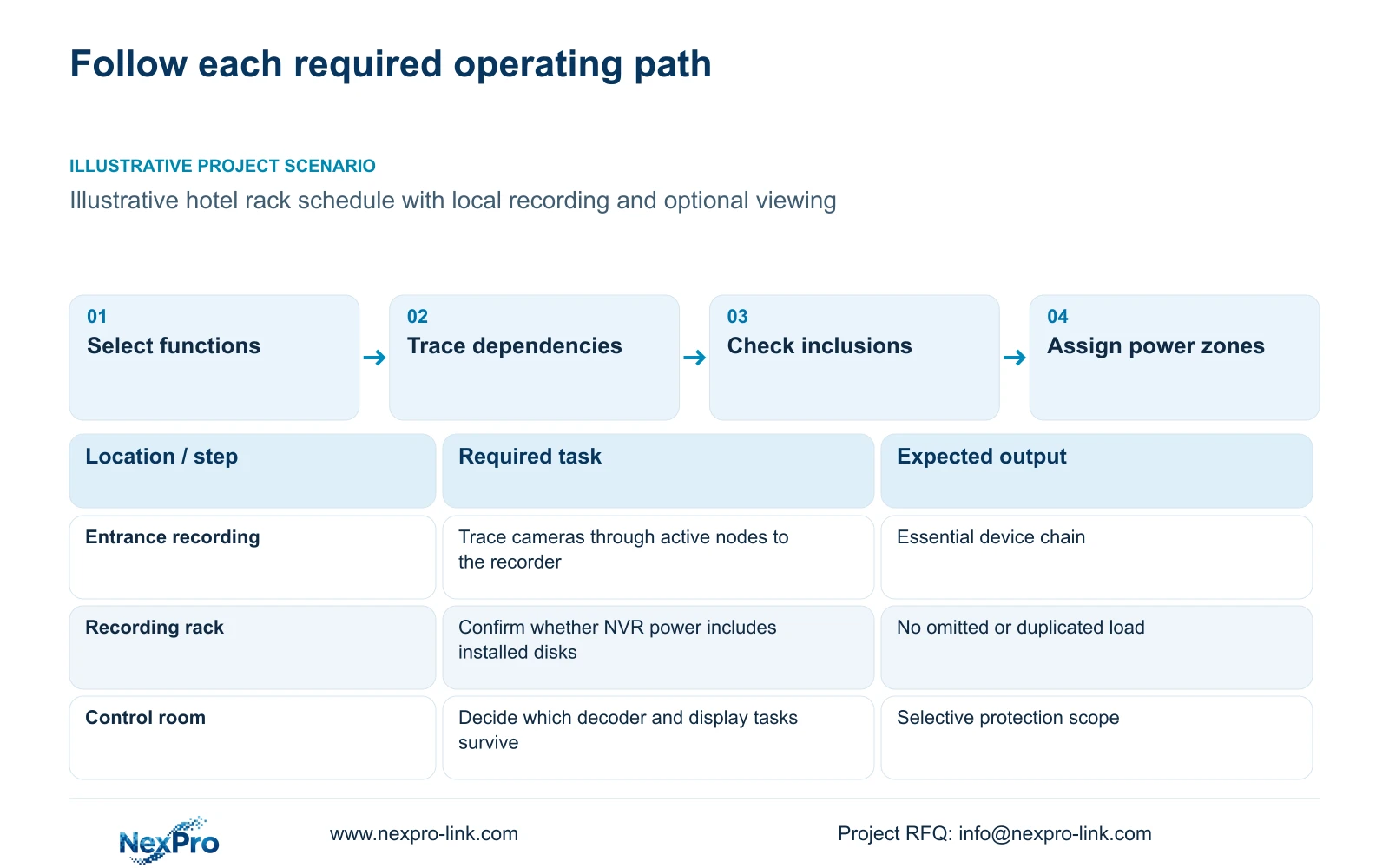
Build the UPS load list by tracing the hotel functions that must remain available. Include installed recorder disks and every required network device, then add clients, decoders or displays only when their outage tasks require protection. A list containing only an NVR and PoE switches is complete only if the approved service has no other powered dependencies.
For entrance recording, follow the camera connection through the access network to the recorder. For authorized remote viewing, extend that trace through the network devices needed to reach the viewing service. A router belongs in the protected list when that task depends on it; its presence in the cabinet alone does not determine priority.
Keep the video path and power path in separate records. The display receives video from a client or decoder, while the recorder can remain a separate recording destination. This distinction lets the owner approve recording continuity without automatically buying backup power for the entire control-room display arrangement.
| Required task | Given information | Decision still needed |
|---|---|---|
| Public-zone recording | Cameras, access network and recorder are dependencies | Identify every intervening active node |
| Authorized remote viewing | Network access may require a router | Whether remote viewing must continue during the outage |
| Control-room live display | Client or decoder and screen require power | Which viewing equipment is essential |
Section 02
Identify what each device power figure includes
Record the recorder chassis and its installed drive configuration together. Mark whether the stated AC consumption includes those disks. If it does, retain one combined load entry. If it does not, obtain a configuration-specific figure or a clearly separated estimate. An unexplained allowance for disks can cause either an omission or duplicate counting.
Use the same rule for PoE. A complete switch AC input figure includes its downstream camera contribution. Do not add the camera PD loads again to that measured total. When estimating from separate components, distinguish camera demand, delivery losses and switch conversion from the switch's own consumption so the resulting AC boundary is clear.
Check accessory adapters and the actual display signal chain. NX-VP-5535 is a 55-inch Full HD LCD panel, and NX-VD-4K16 is a decoder candidate. Their names do not supply the required power figures or establish every decoding workload. Request values for the selected equipment configuration; the complete hotel reference's display loads are teaching assumptions, not readings for these SKUs.
| Item | If already included | If outside the boundary |
|---|---|---|
| Installed NVR disks | Keep the configured recorder AC figure once | Obtain or estimate their contribution explicitly |
| PoE cameras | Do not add to measured complete switch input | Convert the separate power budget to the AC boundary |
| Decoder and screen | Confirm what a quoted display package includes | List each required powered device |
Section 03
Assign every load to its actual power source
Add a location and protection-zone identifier to each device entry. A central recorder, a floor access switch and an exterior-service network node may have different AC sources. A total that fits one UPS rating does not establish a distribution design between those locations. The schedule must show where each protected supply reaches its load.
For each zone, retain the required input conditions, device connections and intended outage duration. Remote active equipment needs a resolved local power arrangement or an explicitly designed protected supply. A fiber backbone carries data; it does not automatically power a remote switch or its cameras.
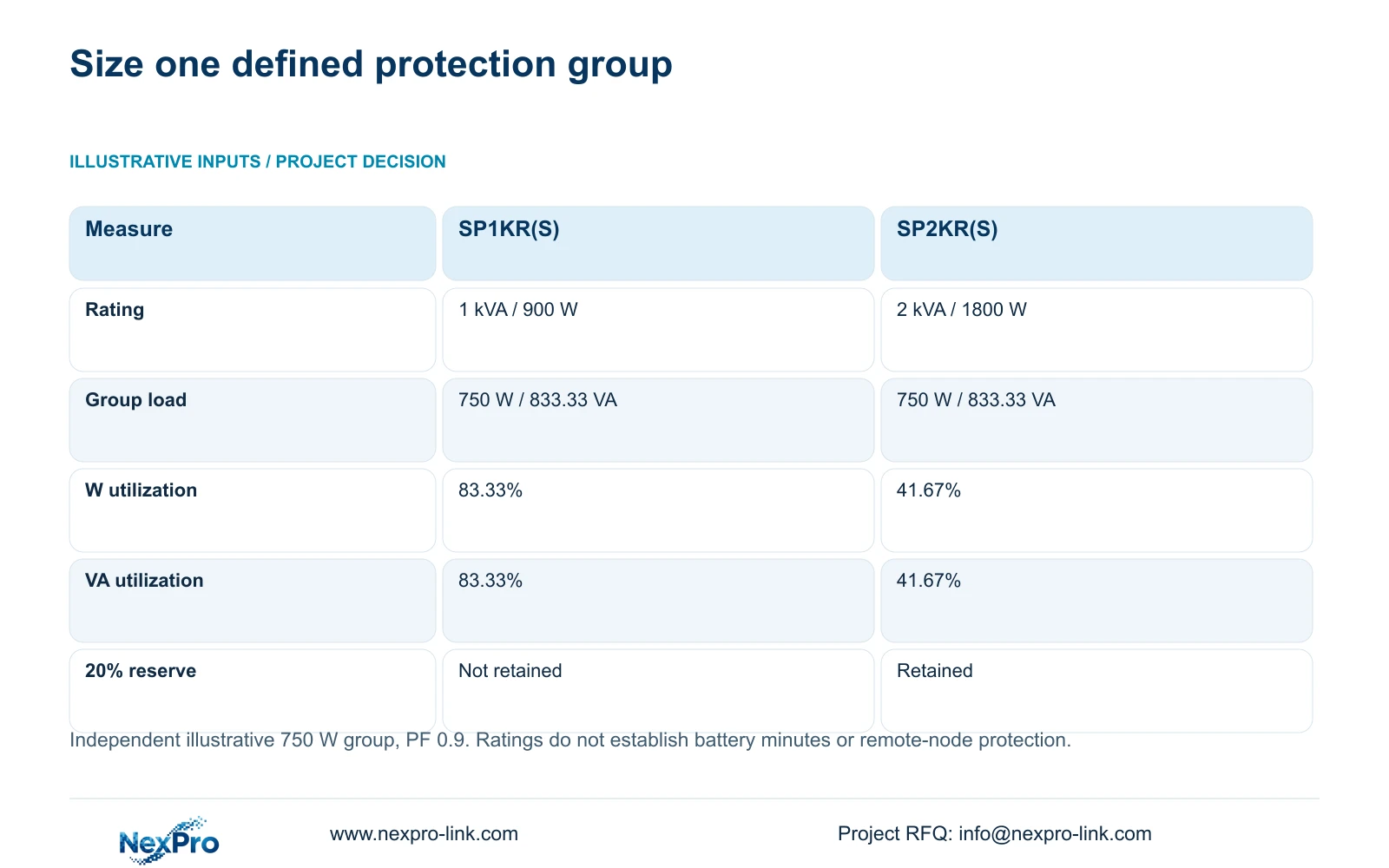
The following capacity calculation applies to one illustrative protected AC group of 750 W. Its assumed aggregate power factor is 0.9, giving 833.33 VA through load VA = W / PF. Calculate utilization as load divided by the corresponding UPS rating. Use actual group values in a project schedule instead of copying this total into every floor cabinet.
Section 04
Calculate grouped W and VA totals before pricing
Sum the devices assigned to each protected group, preserving their evidence labels and operating modes. Where the inputs describe different tasks, resolve the intended simultaneous state before using the total for sizing. Record optional equipment outside the essential subtotal so a lower quotation cannot conceal an omitted dependency.
In the independent example, SP1KR(S) is rated 1 kVA / 900 W and SP2KR(S) is rated 2 kVA / 1800 W. Both exceed 750 W / 833.33 VA, but only SP2KR(S) meets the stated requirement to retain 20% of both ratings. It is therefore the capacity candidate for this group, with runtime still unresolved.
Keep commercial grouping separate from electrical grouping. Quote the UPS, supported battery arrangement and necessary connection scope without charging twice for accessories already included in a package. Separate installation and later service costs. No teaching cost or load figure establishes a supplier price, and the 750 W group is not the complete reference hotel's load.
| Metric / condition | SP1KR(S) | SP2KR(S) |
|---|---|---|
| Published model rating | 1 kVA / 900 W | 2 kVA / 1800 W |
| Protected load | 750 W / 833.33 VA | 750 W / 833.33 VA |
| W utilization | 83.33% | 41.67% |
| VA utilization | 83.33% | 41.67% |
| 20% W and VA reserve target | Does not retain target reserve | Retains capacity reserve |
| Battery runtime | Needs configured load curve | Needs configured load curve |
Section 05
Compare full and selective protection by retained function
Selective protection is suitable when the hotel approves a defined set of functions during an outage. Protect the complete recording path first, then assess whether live viewing, remote access or a larger display must also continue. Removing a required network node is not a valid saving within that same approved recording service.
The complete illustrative 32-camera reference shows why this decision matters. Its basic package and enhanced display package retain the recording task, while the enhanced option adds an assumed wall and decoder load. Those independent case totals should not be substituted for this article's 750 W comparison. In a real project, the selected display equipment supplies the revised power inputs.
Evaluate extra protection through its actual benefit and added scope. Continuous staffed viewing can justify protecting the needed client and screen. If the owner accepts temporary loss of the wall while recording continues, keep that wall outside the essential battery load. Recalculate capacity and request a revised runtime curve whenever the protected task changes.
| Retained outcome | Extra scope | Purchase condition |
|---|---|---|
| Recording remains available | Complete required camera and network power path | Essential whenever outage recording is required |
| Live event viewing remains available | Required client or decoder and display | Include when staffed outage response depends on viewing |
| Remote viewing remains available | Required network access devices | Include when approved remote operation must continue |
Section 06
Mark excluded functions and commercial boundaries
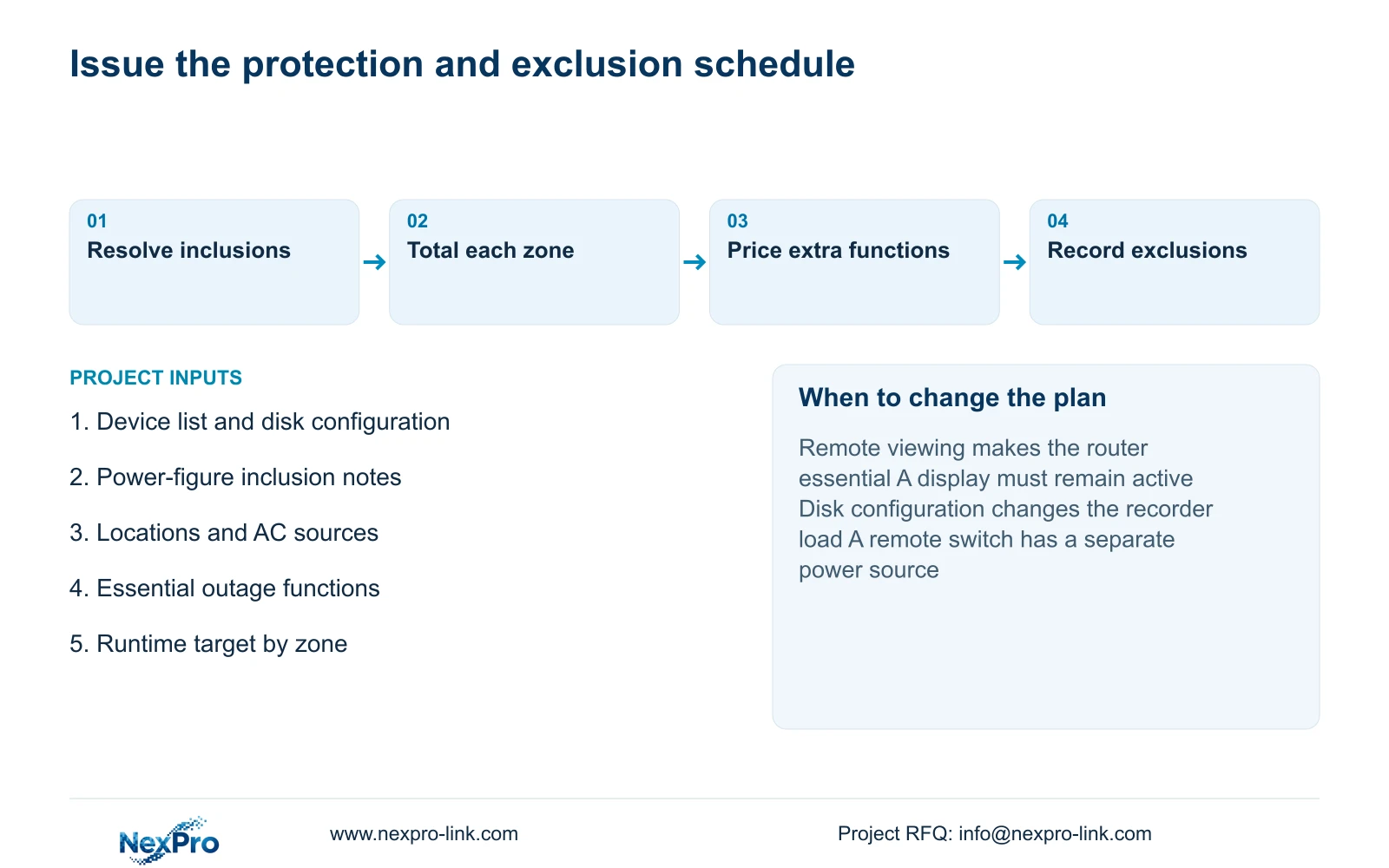
State exclusions in operational language. An unprotected display means the local live picture may be unavailable while recording remains active. An unprotected remote-access dependency means local recording protection does not establish remote availability. Make these consequences visible beside the equipment scope so the owner can accept or revise them.
Recommend a task-based selective package when it preserves every required outage function. For the illustrated group, carry SP2KR(S) forward as the capacity candidate. Change the grouping or model if a router, decoder, additional disk configuration or remote closet becomes necessary. Battery minutes must follow the supported configuration and relevant load curve.
Before the PO, separate equipment support from local installation, replacement labor and transport responsibilities. The supplied policy record states a 24-month limited hardware baseline for applicable main equipment from receipt; batteries, drives and other scope follow model and written order terms. Send info@nexpro-link.com the device list with disk inclusions, locations, power sources and required outage functions for a scoped hotel proposal.
Section 07
Buyer questions
Must the router always be on the CCTV UPS? Include it when an approved outage task depends on it. If only local recording is required, establish whether the actual recording path uses that router before adding it to the essential group.
Can a single hotel-wide watt total support the first quotation? It can show preliminary scale, but supply device locations and power zones as well. The supplier needs those boundaries to distinguish a central package from several locally protected groups.
What information resolves a missing disk-power allowance? Provide the recorder model, installed disk arrangement and the source of its power figure. Ask whether that figure covers the complete configured recorder, including drives, before adding a separate disk estimate.
Engineering references
These sources support the general planning principles. Always use the selected product's current datasheet and applicable project standards for final design.