Choose centralized backup where protected distribution can reach every required CCTV node. Use floor-level UPS units where local power boundaries and service access justify them.
Section 01
Decide which complete power paths must survive
Choose a centralized UPS when an approved protected distribution system can supply every required camera access node and the recording equipment. Choose floor-level protection when those nodes depend on separate local supplies and extending central protected power is impractical. Compare both arrangements against the same outage objective before comparing equipment capacity.
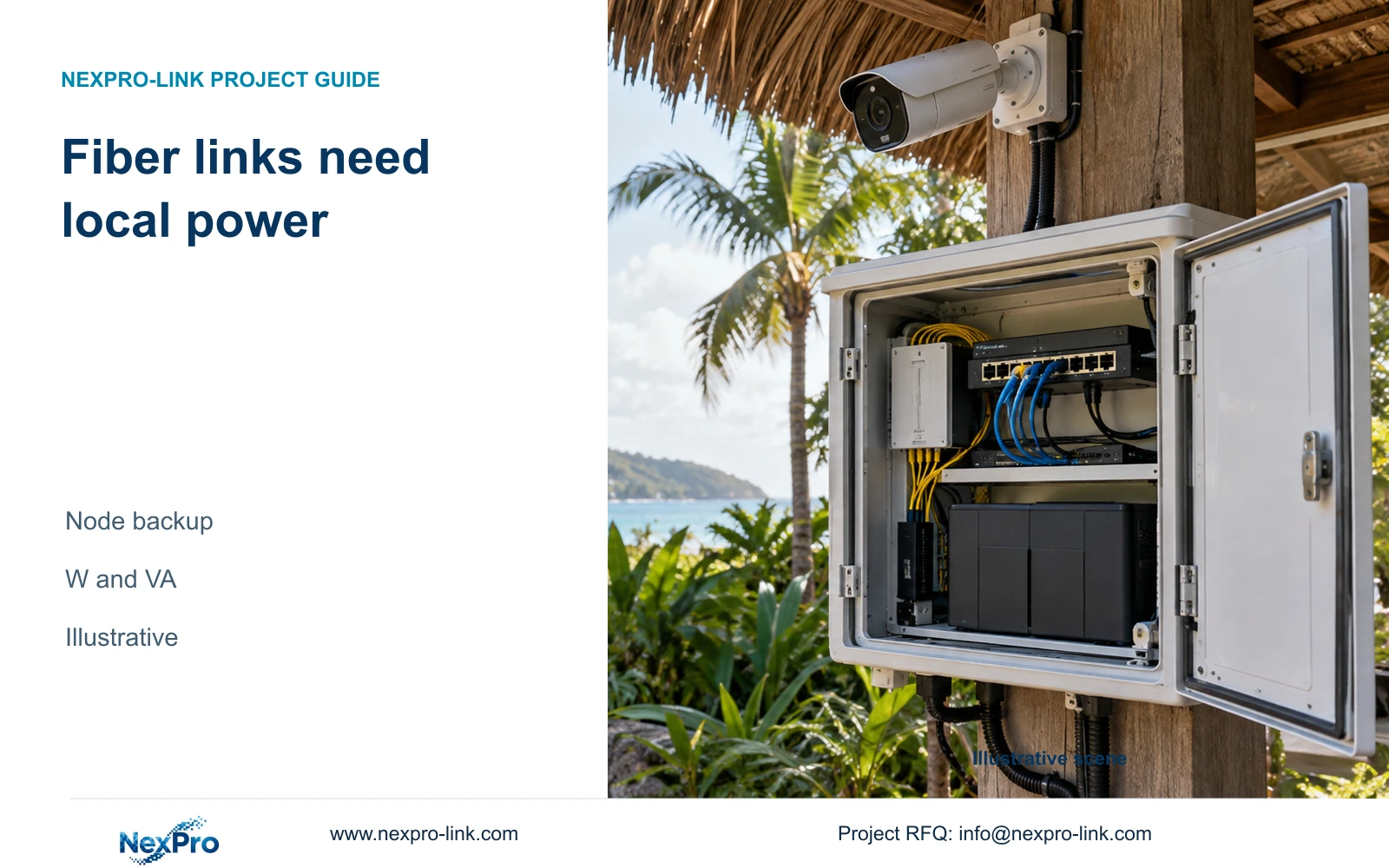
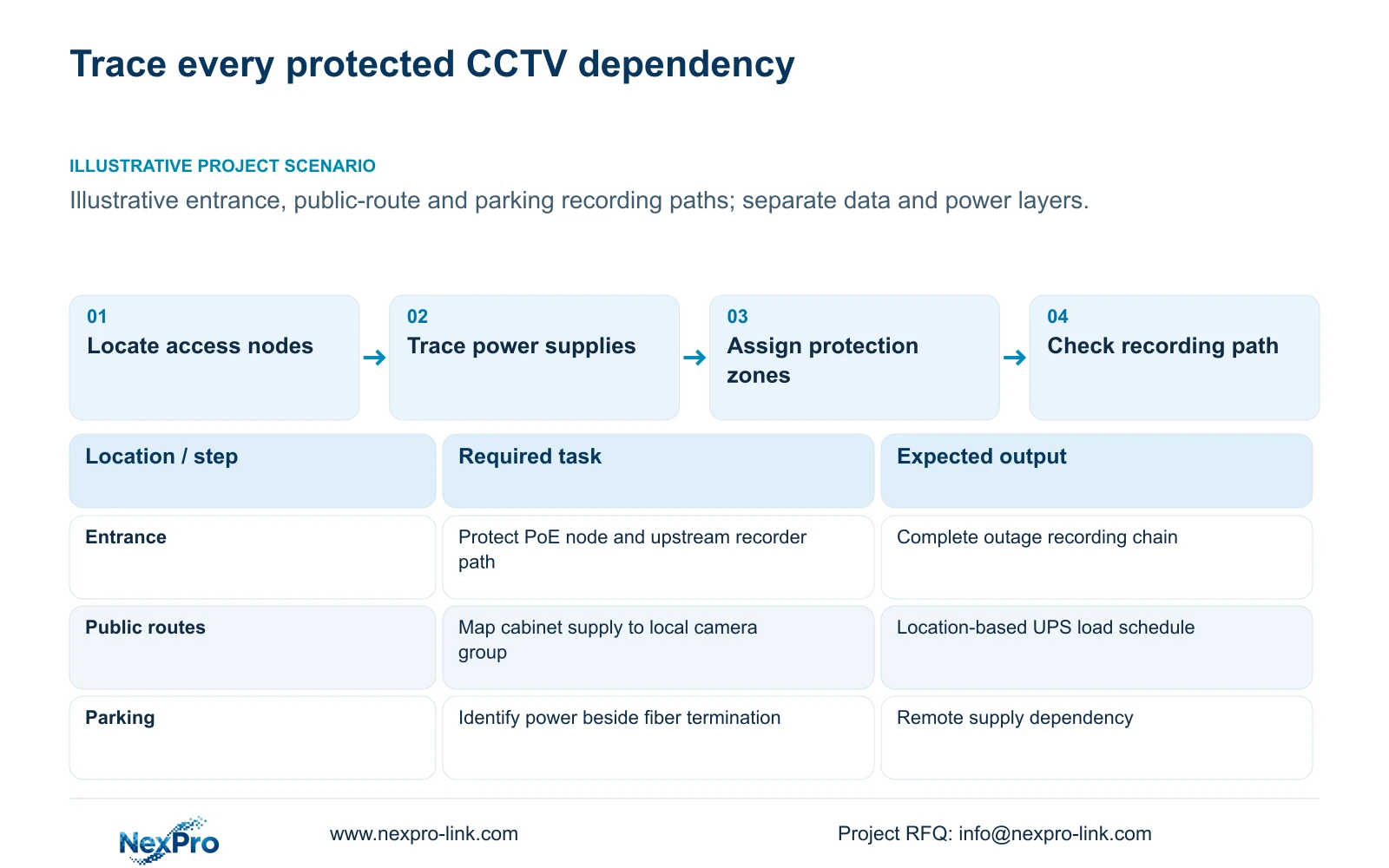
Draw power and data separately. The data path runs from public-area cameras through access switches and the backbone to the recorder. The power path must identify the source serving each active device. A fiber backbone carries data; it does not supply the remote switch or its PoE cameras. Protecting the recorder alone leaves recording dependent on those remote supplies.
Define continued recording, local retrieval and any required remote viewing as separate tasks. An operator monitor can be optional during an outage if recording remains available without it. Ordinary CCTV backup also has a defined scope: it does not automatically include fire systems, lifts or other life-safety circuits.
| Required task | Given information | Decision still needed |
|---|---|---|
| Record entrance activity | Camera uses a local PoE access node | Protect that node and every required upstream device |
| Retrieve recorded incidents | Recorder is in the control room | Define whether the authorized client also needs backup |
| Keep parking views available | Backbone may use fiber | Identify the remote node's actual protected supply |
Section 02
Group critical functions by their supply location
Build the UPS schedule around actual electrical locations. A camera-zone schedule identifies observation tasks, while a protection-zone schedule identifies equipment sharing a supply and maintenance boundary. These schedules may differ. Cameras on several public routes can use one access cabinet, and a parking node can sit outside the control-room power boundary.
The supplied illustrative 32-camera reference uses four access nodes with eight cameras each. This describes a planning arrangement, not a rule that every hotel needs four floor UPS units. Locate those nodes on the drawings, identify their upstream dependencies and assign responsibility for the supply at each location.
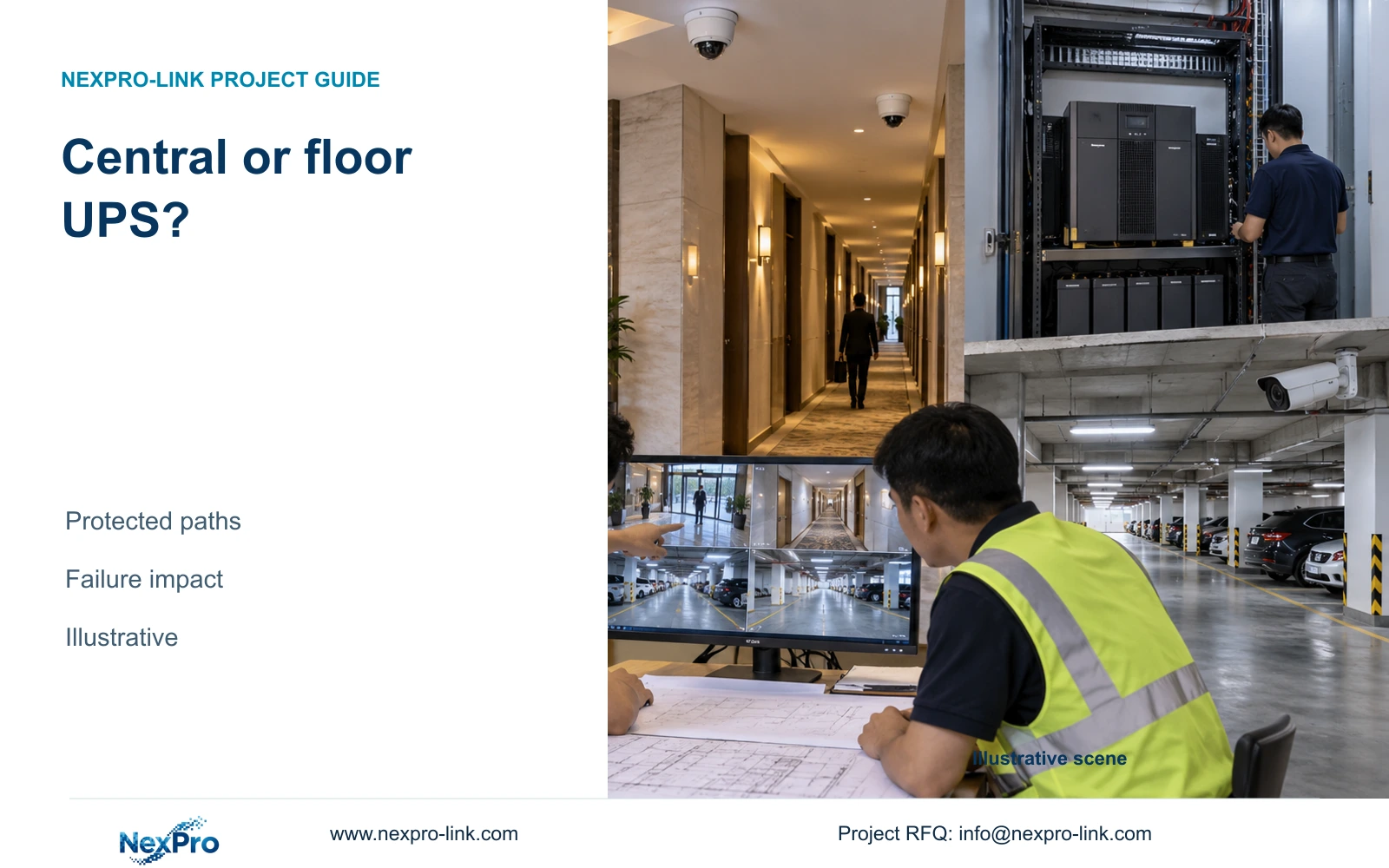
Central protection can consolidate battery servicing but requires suitable distribution to the remote loads. Local protection places backup beside the access equipment and creates additional service locations. A hybrid arrangement can protect the recorder and core centrally while protecting separate access nodes locally, provided the complete required path remains covered.
| Item | Centralized protection | Local protection | Effect on hotel operation |
|---|---|---|---|
| Remote access node | Protected distribution must reach it | UPS serves its local supply | An unprotected node interrupts its camera group |
| Battery service | Concentrated service location | Several service locations | Access and staffing requirements change |
| Core and recorder | Included in central load schedule | Still need their own protection | Floor units alone do not preserve central recording |
Section 03
Calculate loads at each protection boundary
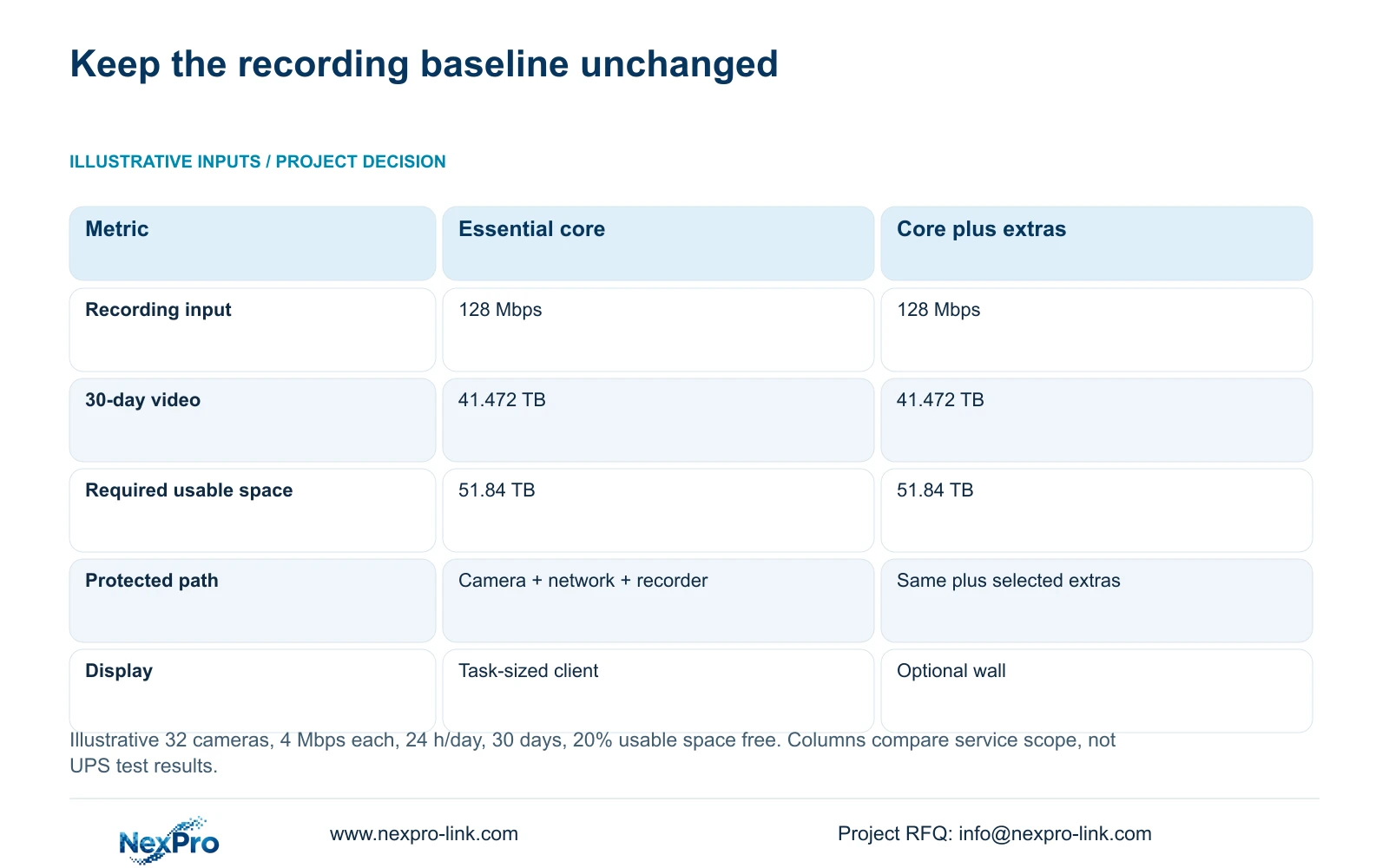
Keep the recording requirement constant while comparing power architecture. The topic example assumes 32 cameras averaging 4 Mbps, recording continuously for 30 days. Input traffic is 32 × 4 = 128 Mbps. Video volume is 0.0108 × 32 × 4 × 30 = 41.472 decimal TB. Retaining 20% of usable storage free requires 41.472 ÷ 0.80 = 51.84 TB.
These figures establish the service that either architecture must preserve. They do not calculate UPS watts. The table compares an essential package with the same core plus optional display or recovery scope; its A and B columns are not measured central and distributed UPS results.
For power, total each UPS zone in W and VA using consistent AC input boundaries. A complete PoE switch AC measurement already includes its camera contribution, so adding the same camera watts again would double-count them. Separate measured values from label maxima and teaching assumptions. Check both UPS ratings and obtain runtime information for the actual battery configuration.
| Metric / condition | Essential recording-first package | Same core plus optional scope |
|---|---|---|
| Recording input (Mbps) | 128 | 128 |
| 30-day video data (TB) | 41.472 | 41.472 |
| Required usable capacity (TB) | 51.84 | 51.84 |
| Protected path | Cameras + network + recording | Same plus explicitly selected extras |
| Operator display | Task-sized monitor/workstation | Optional wall; independent recording |
| Cost comparison | Complete scope quotation required | Add only documented incremental scope |
Section 04
Compare failure impact and service boundaries
Review a failed central UPS, an unavailable local UPS and an interrupted backbone as different events. A central supply fault can affect all loads depending on that supply. A local supply fault can affect its access group, although shared core or recorder failures can still interrupt the wider service. Several UPS units therefore do not establish system redundancy by themselves.
For each event, name the views lost, the recording destination remaining and the person responsible for restoration. Include planned maintenance in this comparison. A supply arrangement that limits electrical impact can still be difficult to service if the cabinet is inaccessible or the hotel cannot release the work area.
Optional display protection should have its own justification. Losing a wall display may affect continuous observation without stopping recording. Preserve the table's 128 Mbps recording task and 51.84 TB usable-capacity requirement in both proposals, then describe any additional viewing benefit and its power cost separately.
Section 05
Include battery maintenance and replacement effort
Compare the number of battery locations, access arrangements and supported replacement configurations. Distributed protection requires records for each unit and its local operating conditions. Central protection concentrates servicing but can place more of the hotel's recording service within one maintenance boundary. Neither arrangement removes the need for a defined service procedure.
SP1KR(S) is a rack online double-conversion candidate rated 1 kVA / 900 W; SP2KR(S) is rated 2 kVA / 1800 W. These published ratings support capacity screening. They do not establish installed battery energy or runtime. External batteries must match the supported voltage, charging and battery-management arrangement.
Price battery servicing, local labor and replacement logistics separately from equipment purchase. The supplied policy record gives applicable main equipment a 24-month limited hardware baseline from receipt, subject to controlling written terms. Battery coverage has its own scope. Technical support does not automatically include local attendance, replacement labor or every transport expense.
| Retained outcome | Extra scope | When justified | Condition against it |
|---|---|---|---|
| Accessible battery service | Central protected distribution | Remote loads can be supplied safely and maintainably | Distribution work is impractical |
| Local access-node continuity | Local UPS and battery records | Separate supplies require local protection | Service locations cannot be supported |
Section 06
Select architecture from distribution and service constraints
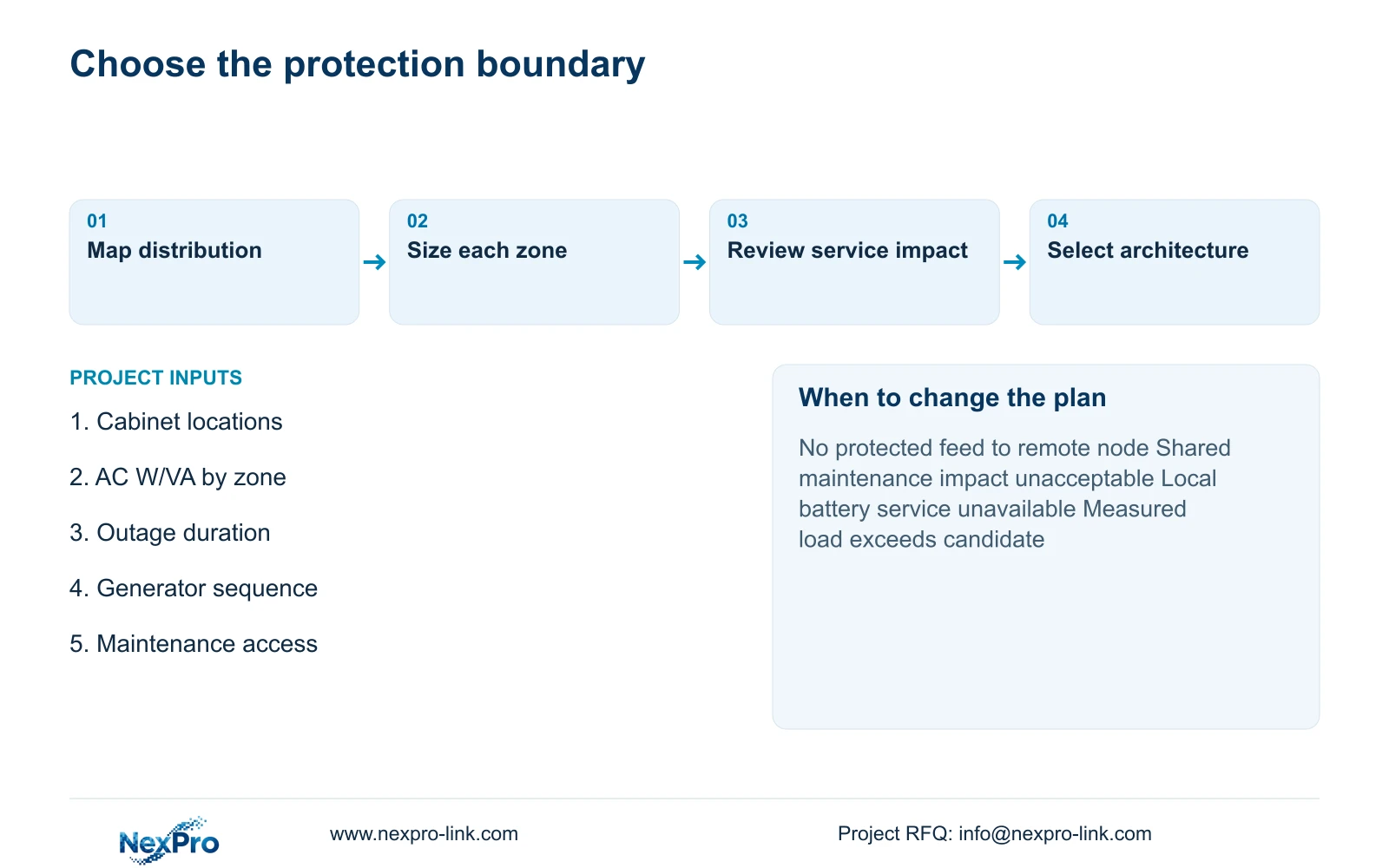
Use centralized protection where the hotel already has suitable protected distribution and a service plan acceptable for the resulting shared failure boundary. Use local units where access cabinets have independent supplies and local maintenance is practical. Select a hybrid when the recorder and core share one protected area while remote nodes require their own backup.
Change the proposal when a remote node cannot receive protected power, a maintenance event would remove unacceptable coverage, or actual local loads and runtime curves exceed the selected configuration. Adding nominal kVA across several units cannot resolve any of these conditions. Each unit must meet its own load and service requirement.
Send info@nexpro-link.com a marked cabinet-location plan, protected AC loads by location, target outage duration and generator sequence. Include the destination and any mandatory equipment requirements. NexPro-Link can discuss model matching, BOQ support and coordinated equipment supply. Its CCTV manufacturing core and supporting supply categories have separate responsibilities; local electrical design and installation must remain explicitly assigned.
Section 07
Buyer questions
Can floor UPS units replace protection for the central recorder? Only if the recorder and required core equipment already have a suitable protected supply. Floor units preserve local camera groups, but their footage still depends on the complete network and recording path.
Should existing access cabinets be replaced when changing UPS architecture? Review their load, supply, environmental conditions and service access first. Retain suitable equipment where the revised protection boundary supports it; coordinated procurement does not require replacing every cabinet or device.
What should the first architecture quotation separate? Separate UPS and batteries by location, protected distribution work, optional displays and local service responsibilities. This makes a lower equipment price comparable with the installation and maintenance scope needed to achieve the same recording outcome.
Engineering references
These sources support the general planning principles. Always use the selected product's current datasheet and applicable project standards for final design.