A usable hotel CCTV UPS tender defines the service to retain, its configured load and runtime conditions, then maps each offered model to those requirements.
Section 01
Define the recording service that the tender must preserve
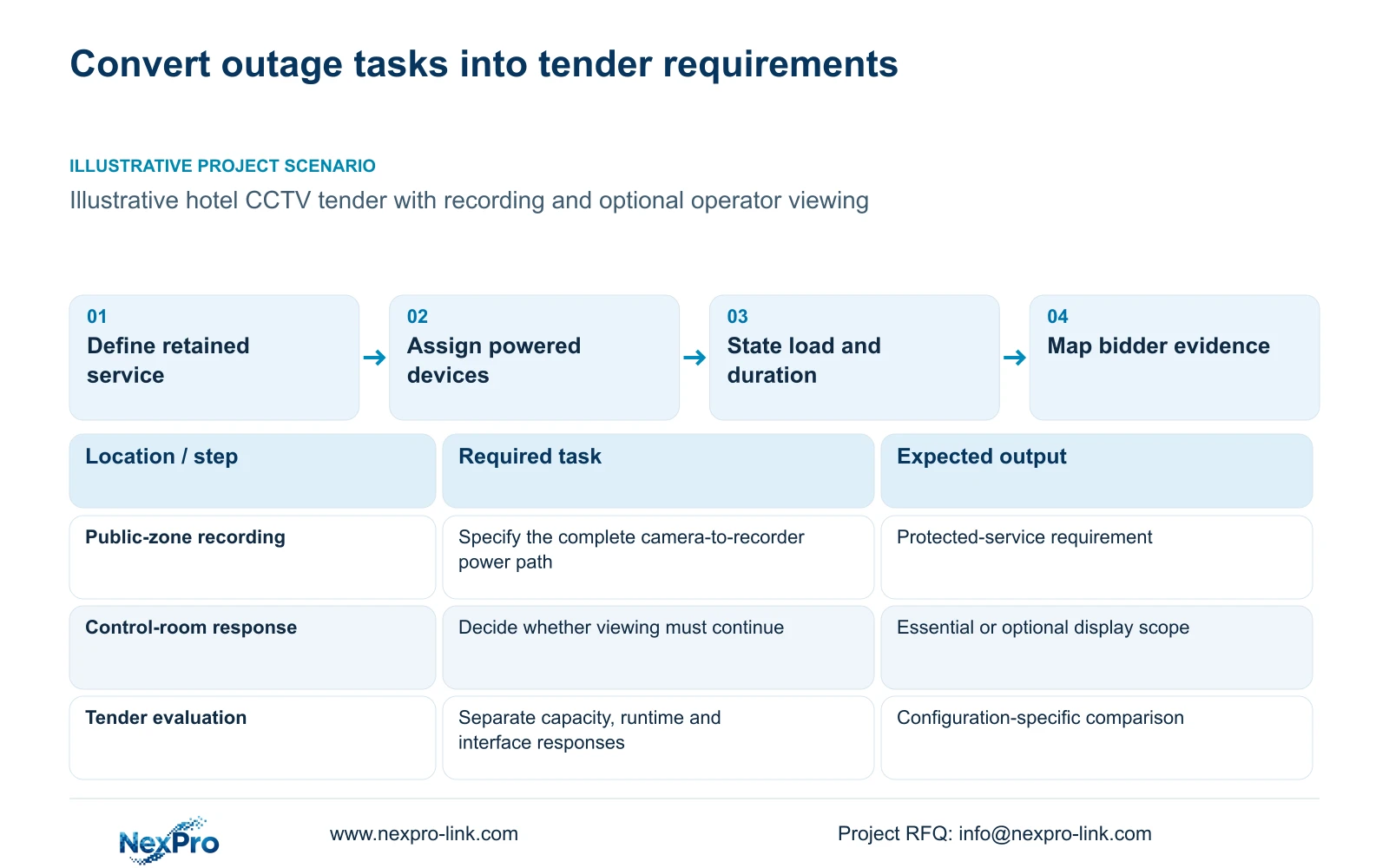
Replace an isolated 2 kVA description with a protected-service requirement that states W, VA, target duration, environment and connection interfaces. Retain a proposed model only when its exact configuration addresses those conditions. A kVA rating alone leaves bidders free to offer different batteries, connections and protection boundaries while appearing to quote the same item.
Describe the required outage state in operational terms. Identify the public-zone cameras whose recording must continue, the network nodes carrying their streams and the configured recorder. State separately whether authorized remote access or control-room viewing must remain available. Each required function needs its complete active power path.
Use the service description to define the acceptance objective. The relevant result is that the agreed camera streams remain recorded and the required operator functions remain available through the specified state. An illuminated UPS or recorder is insufficient evidence of that outcome. Keep optional enhancements separate so bidders can price them without weakening the essential task.
| Required task | Given information | Decision still needed |
|---|---|---|
| Public-zone outage recording | Approved camera and recorder scope | All required active network nodes and protection zones |
| Outage event response | Operator viewing workflow | Whether client, decoder and display are essential |
| Continued remote access | Approved access requirement | Required network dependencies and availability boundary |
Section 02
List configured steady loads and relevant peak conditions
Attach a load schedule by power zone. Identify equipment ratings, configured estimates and measured observations as different evidence types. Give the recorder's installed disk arrangement and state whether its power figure includes the drives. For PoE, count the camera contribution once at the chosen boundary; a complete switch AC reading already includes its downstream contribution.
Require bidders to identify the load basis they use. A daytime operating figure may not represent the selected nighttime illumination or other required operating states. Startup and recovery conditions should be recorded separately when they affect capacity or transient assessment. Do not accept an unexplained average as the sole basis for an upper-load requirement.
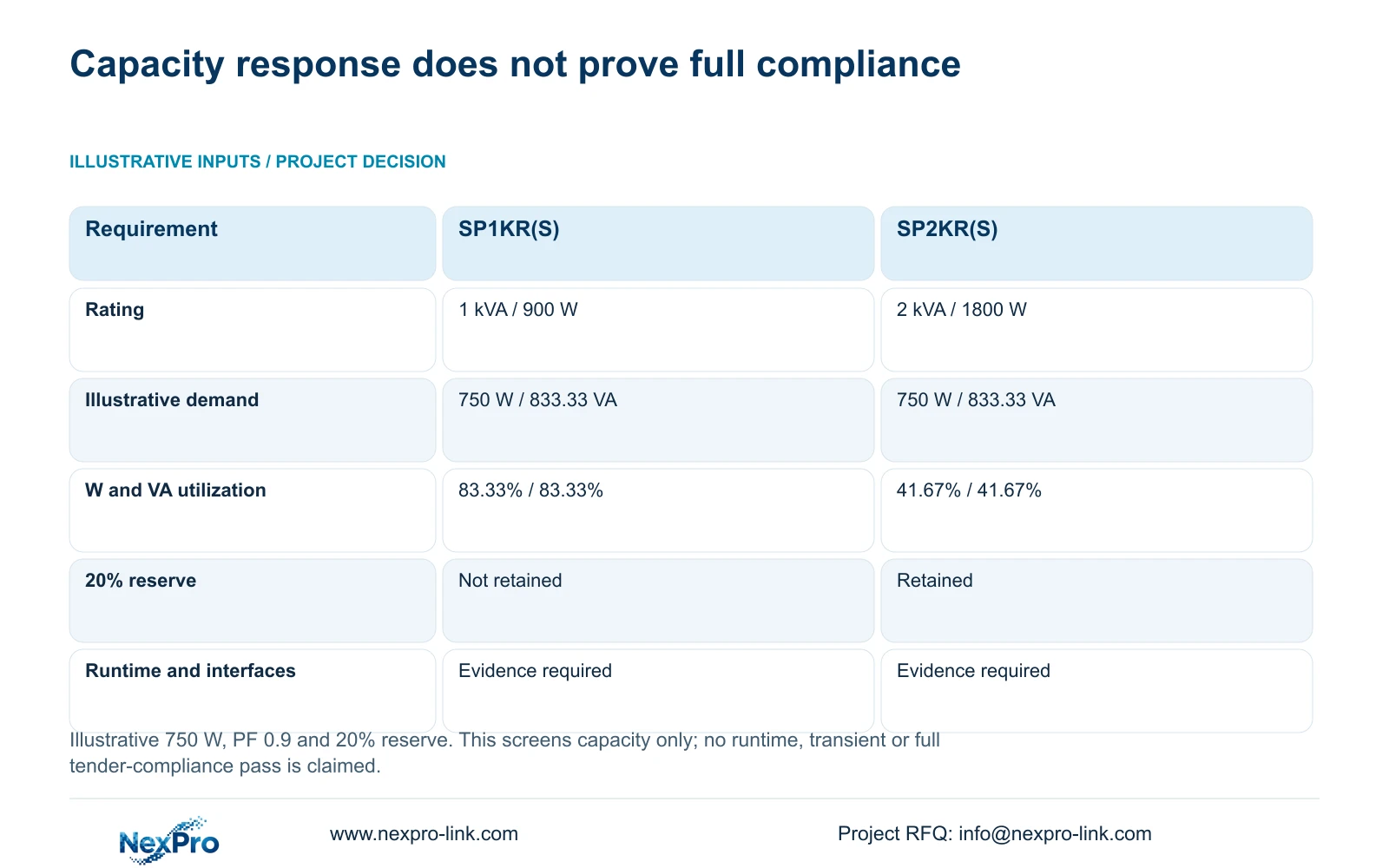
The independent example uses 750 W of protected AC load and assumed aggregate power factor 0.9. Load VA = W / PF gives 833.33 VA. W utilization and VA utilization are each the relevant load divided by its corresponding UPS rating. The chosen 20% reserve convention leaves at least that share of each rating available; it is an illustrative project requirement, not a universal rule.
Section 03
Specify runtime at the required operating load
Write the target duration beside the operating load and required functions. Identify whether the objective is to bridge an approved generator sequence or retain the service for a defined outage period. Do not substitute a general duration from another hotel or infer battery minutes from the UPS conversion-unit rating.
Ask for the supported battery configuration and runtime information corresponding to the offered load and conditions. Battery temperature, condition, discharge behavior and protective thresholds affect duration. A teaching energy calculation can illustrate the requirement, but it cannot establish the minutes delivered by an unspecified configuration.
The capacity comparison below therefore leaves runtime unresolved for both candidates. Any default battery Wh shown for one model must not be transferred to another. The complete 32-camera reference has its own load and energy assumptions; its battery budget is independent of this article's 750 W example.
Require the proposed verification to demonstrate the selected service through the agreed outage and recovery state. Local electrical professionals should supervise safe changeover work. Record observations after the test rather than filling the tender response with assumed passes.
Section 04
Specify the interfaces and environment that affect the offer
Add the actual supply requirements and required output connections to the tender. Count connected loads from the equipment schedule and identify the proposed distribution boundary. Require the bidder to state the supplied connection accessories and unresolved local interfaces; the series name alone does not establish a destination-ready variant.
State the planned location, relevant environmental conditions and available maintenance access. Rack and tower arrangements need their own physical information. For distributed closets, resolve each protection zone instead of assuming a single central UPS reaches every active node. A fiber connection does not supply backup power to remote equipment.
Use the published ratings as a capacity screen within this wider specification. SP1KR(S) is rated 1 kVA / 900 W and SP2KR(S) 2 kVA / 1800 W. Both exceed the example's steady demand, but SP2KR(S) alone retains the specified 20% W and VA reserve. That qualifies it as a capacity candidate, not as a fully compliant tender offer.
| Metric / condition | SP1KR(S) | SP2KR(S) |
|---|---|---|
| Published model rating | 1 kVA / 900 W | 2 kVA / 1800 W |
| Illustrative protected load | 750 W / 833.33 VA | 750 W / 833.33 VA |
| W utilization | 83.33% | 41.67% |
| VA utilization | 83.33% | 41.67% |
| 20% W and VA reserve target | Does not retain target reserve | Retains capacity reserve |
| Battery runtime | Needs configured load curve | Needs configured load curve |
Section 05
Compare complete offered configurations
Create a response matrix that maps each requirement to the offered configuration and supporting information. Keep capacity, battery duration and connection scope as separate entries. A bidder can satisfy the W and VA requirement while leaving the runtime or local installation interface unresolved; the matrix should show that distinction.
Compare cost only after required functions and exclusions are visible. List the UPS, battery scope, distribution accessories and local work without duplicating included items. Price optional viewing protection separately. Removing an essential access switch or required battery scope is a reduction in service, not an equivalent lower-cost configuration.
For the 750 W illustration, carry SP2KR(S) forward if its exact electrical configuration, battery evidence and transient behavior meet the project requirements. SP2K(S) is a distinct tower alternative rated 2 kVA / 2000 W. Evaluate it with its own configuration details. A mandatory operator specification or site condition can require a different candidate even when this capacity calculation passes.
| Retained outcome | Additional scope | Purchase condition |
|---|---|---|
| Required recording continuity | Supported battery and complete network protection | Mandatory within the approved outage service |
| Continuous operator viewing | Required client or decoder and display power | Buy when outage response requires that viewing task |
| Appropriate installation | Connections, placement and local electrical work | Resolve wherever the equipment offer excludes site work |
Section 06
Keep the chosen model and configuration traceable
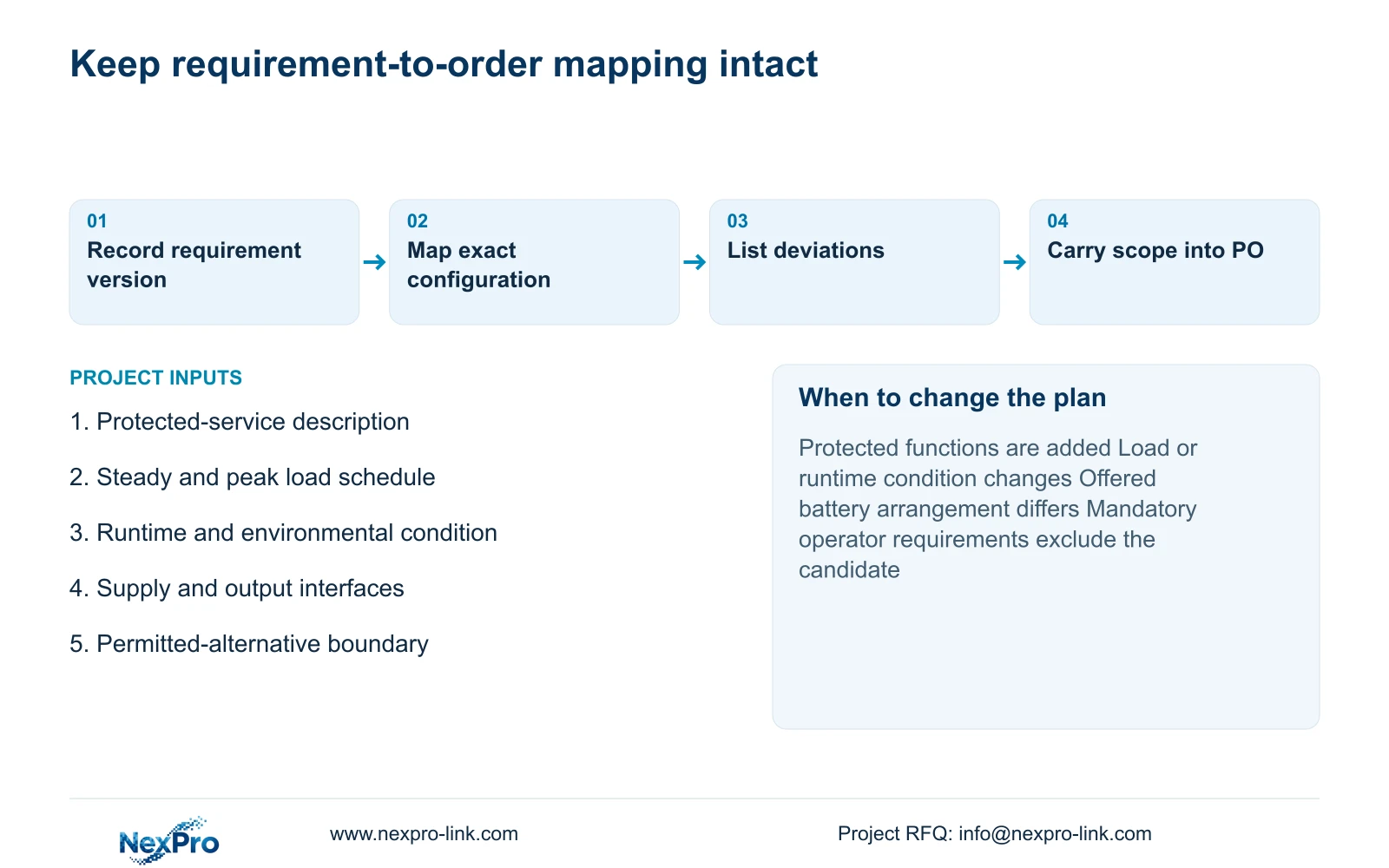
Preserve the tender requirement version, offered model and battery arrangement together. Record deviations and clarifications beside the affected requirement. When a model, load schedule or protected function changes, revise the comparison so the purchase order refers to the configuration actually evaluated.
Recommend a performance-defined specification with model mapping, using SP2KR(S) only as the capacity candidate for the stated example. Change that recommendation if actual W or VA demand, runtime conditions, connection requirements or mandatory standards differ. Avoid silently replacing the required service with a smaller scope to keep a preferred model in the bid.
Separate support and warranty terms from technical compliance. The supplied policy record states a 24-month limited hardware baseline from receipt for applicable main equipment; batteries and other categories follow their scoped model and written order terms. Local labor and transport responsibilities need explicit treatment. These terms do not establish a successful outage test.
Send info@nexpro-link.com the protected-service description, load schedule by zone, runtime condition and destination connection requirements. Include the relevant tender clause and permitted-alternative boundary. NexPro-Link can discuss model matching, BOQ support and coordinated supply, with CCTV manufacturing and supporting-equipment coordination distinguished from local installation and buyer approval.
Section 07
Buyer questions
Can a bidder claim compliance by offering a larger kVA rating? Only the capacity-related requirement may be addressed. Require evidence for the actual battery duration, electrical interfaces and protected-service boundary before treating the complete configuration as compliant.
What should accompany an alternative-model submission? Provide a mapping to the same load, runtime and interface requirements, with explicit deviations and included battery scope. If alternatives are prohibited, preserve the specified brand or model requirement rather than substituting silently.
Can we send only the relevant tender clause for a first review? Yes. Add the protected load and required outage behavior, marking provisional fields. A focused package can support an initial response without disclosing unrelated confidential tender material or access credentials.
Engineering references
These sources support the general planning principles. Always use the selected product's current datasheet and applicable project standards for final design.