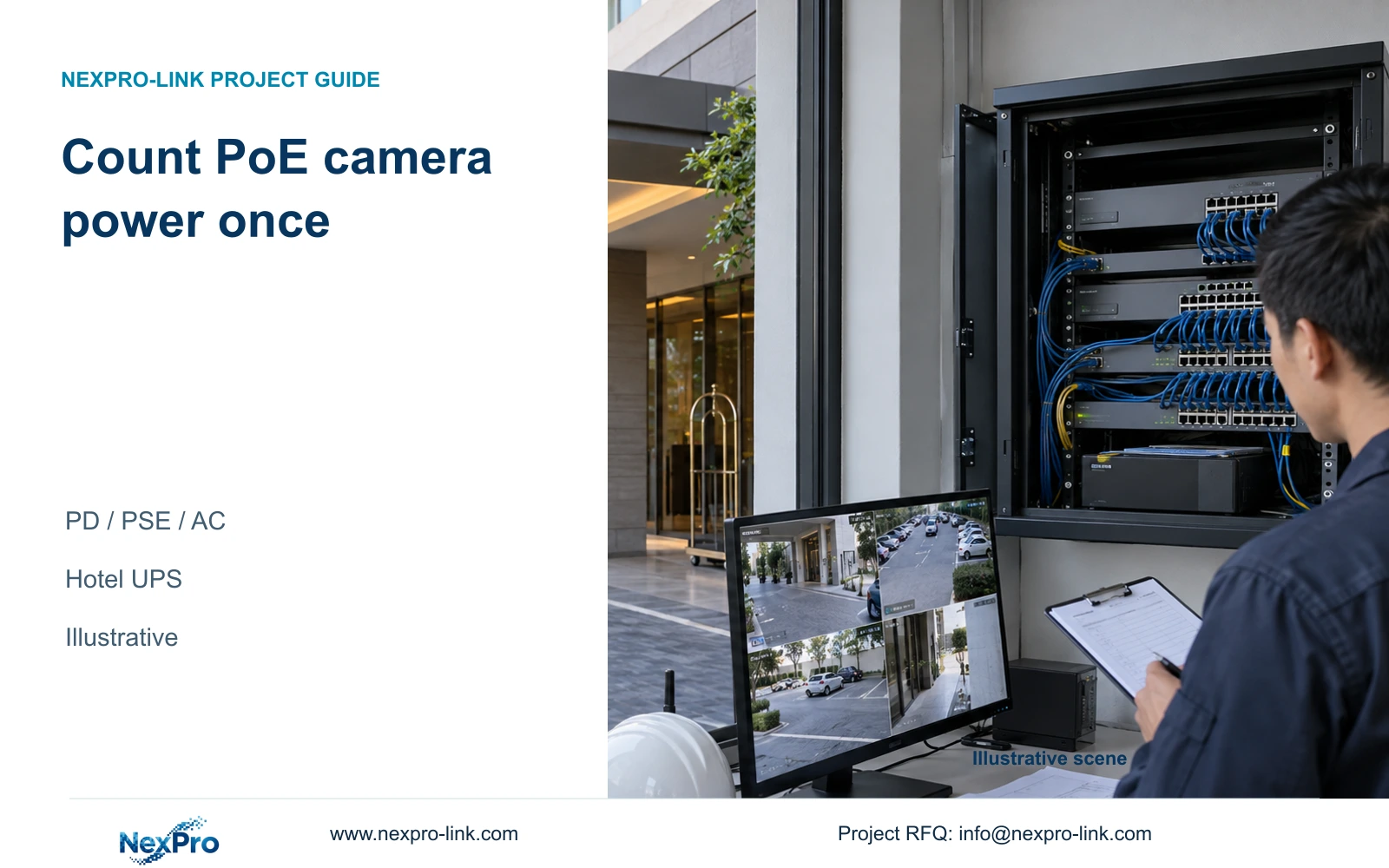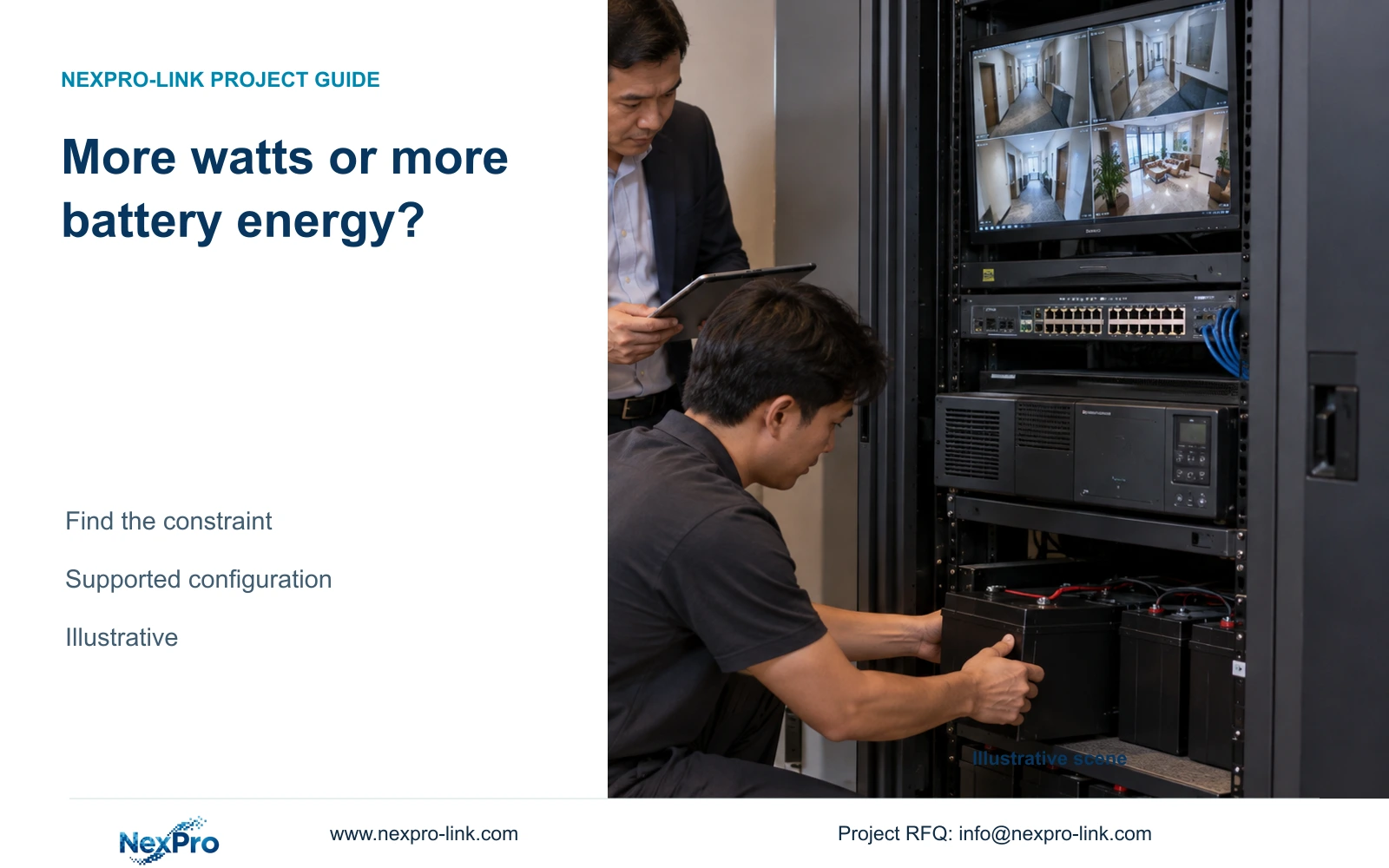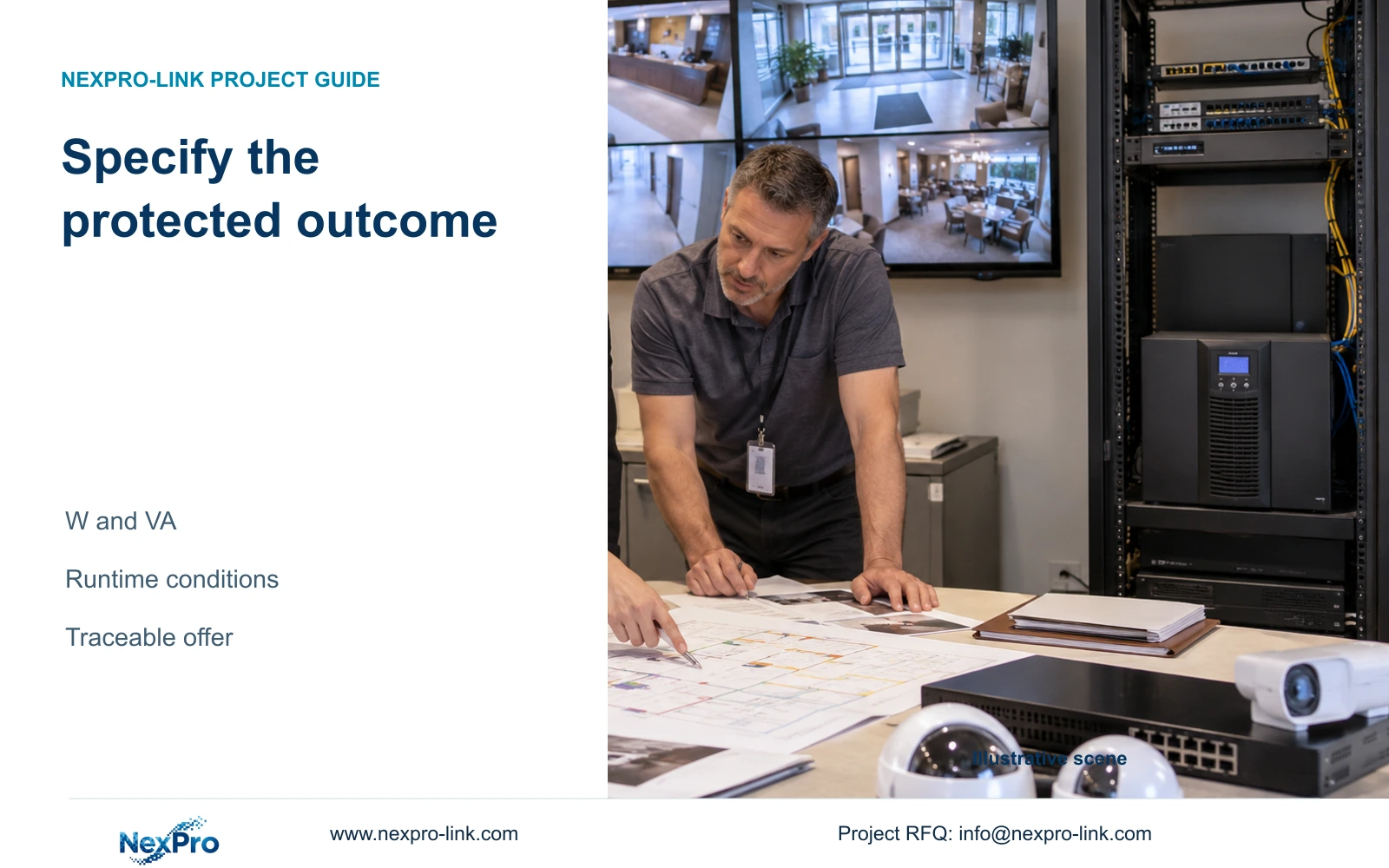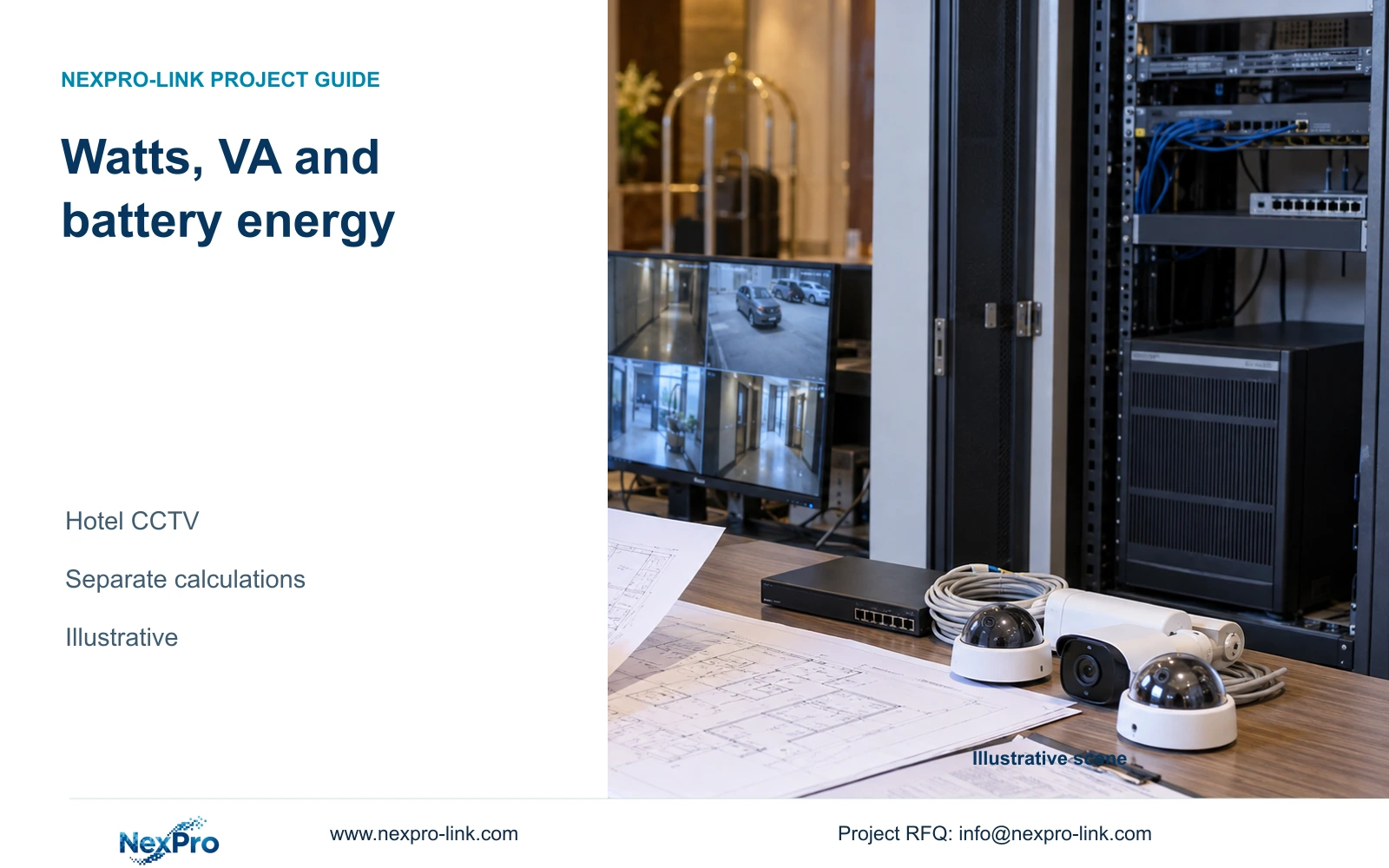
A 2 kVA rating does not establish one hour of hotel CCTV backup. Define the protected equipment, check watts and VA, then select a supported battery configuration.
Section 01
Decide which equipment must survive the outage
Select the UPS against the protected load in both watts and VA, then select its battery configuration against the required minutes. A 2 kVA unit does not establish one hour of backup. For the illustrative 750 W load examined here, SP2KR(S) retains the specified 20% capacity reserve; the battery duration remains a separate configuration decision.
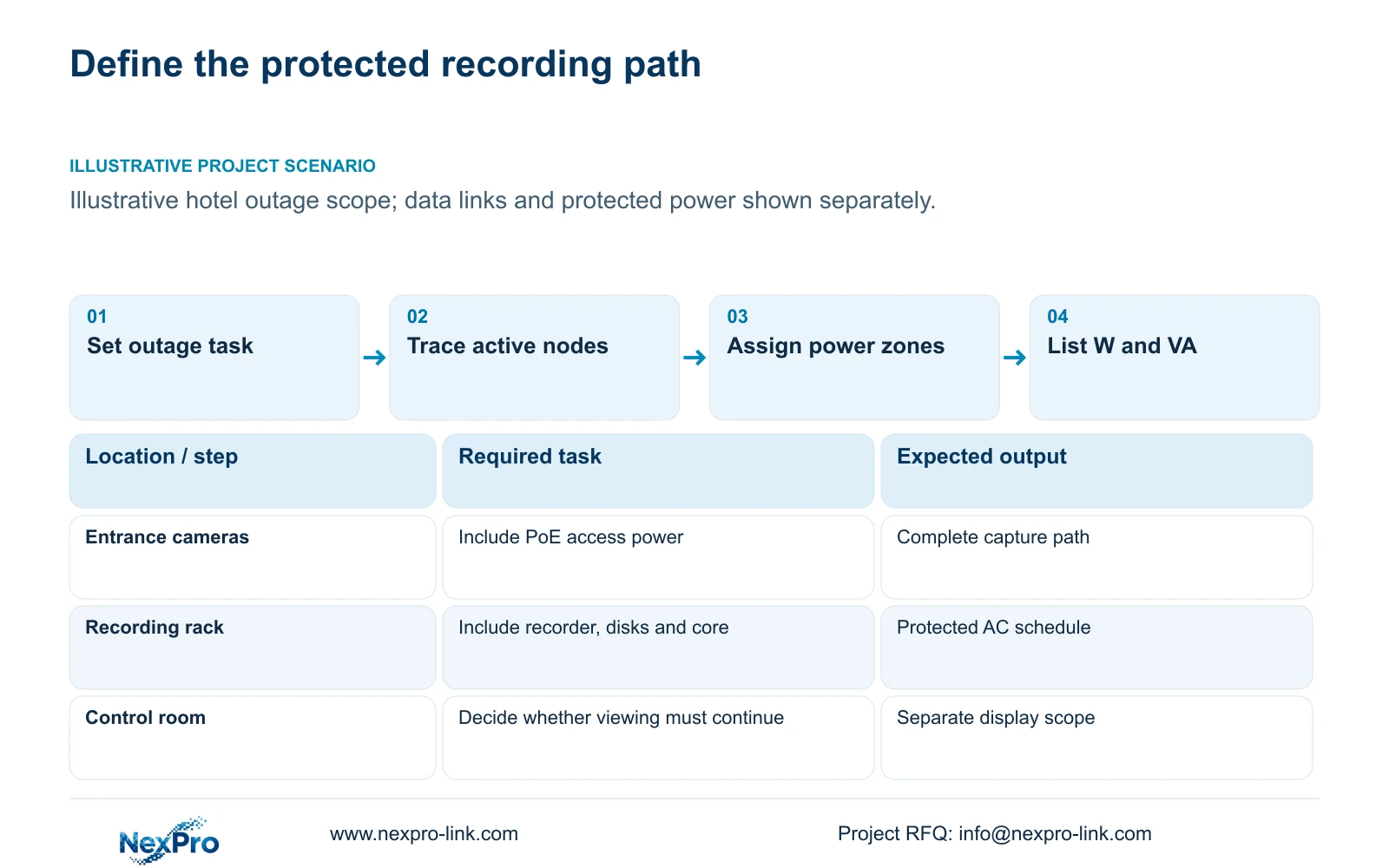
Begin with the service the hotel needs during an outage. Continued recording requires the cameras, their PoE access switches, the necessary network connections and the recorder with its disks. A powered recorder cannot collect images from an access node that has lost power. Mark every active dependency on the camera-to-recorder path, including remote closets.
The supplied 32-camera hotel reference includes ordinary operator display equipment and treats a larger wall as additional scope. If the owner requires recording alone, list optional displays separately. If staff must continue viewing entrances during an outage, include the selected viewing equipment. Assign each item to its actual protection zone before calculating a hotel-wide total.
| Required task | Given information | Decision still needed |
|---|---|---|
| Continue public-zone recording | Cameras depend on PoE and network nodes | Identify every protected power zone |
| Continue operator viewing | Display protection is separate scope | Choose the outage viewing equipment |
Section 02
Use one AC power boundary for each load
A complete PoE switch AC input already represents the switch and the cameras it supplies under the measured operating condition. Adding those cameras again overstates the UPS load. When complete AC measurements are unavailable, estimate the camera load through cable delivery and switch conversion losses, then include the switch's own consumption once.
The supplied hotel reference assumes eight cameras per node at 12 W each, 90% cable delivery efficiency, 92% PoE conversion efficiency and 20 W switch consumption. These inputs produce 96 W at the cameras, approximately 106.67 W required at the PSE output and approximately 135.94 W at the switch AC input. None is a measured rating for NexPro SW-POE1618G.
Record whether each schedule entry is measured consumption, an equipment maximum or a planning assumption. Keep recorder consumption inclusive of its selected disks. The reference's 60 W recorder figure is hypothetical. Its complete base load is independent of this article's 750 W capacity example and must not be added to it.
Section 03
Check watts and VA against separate limits
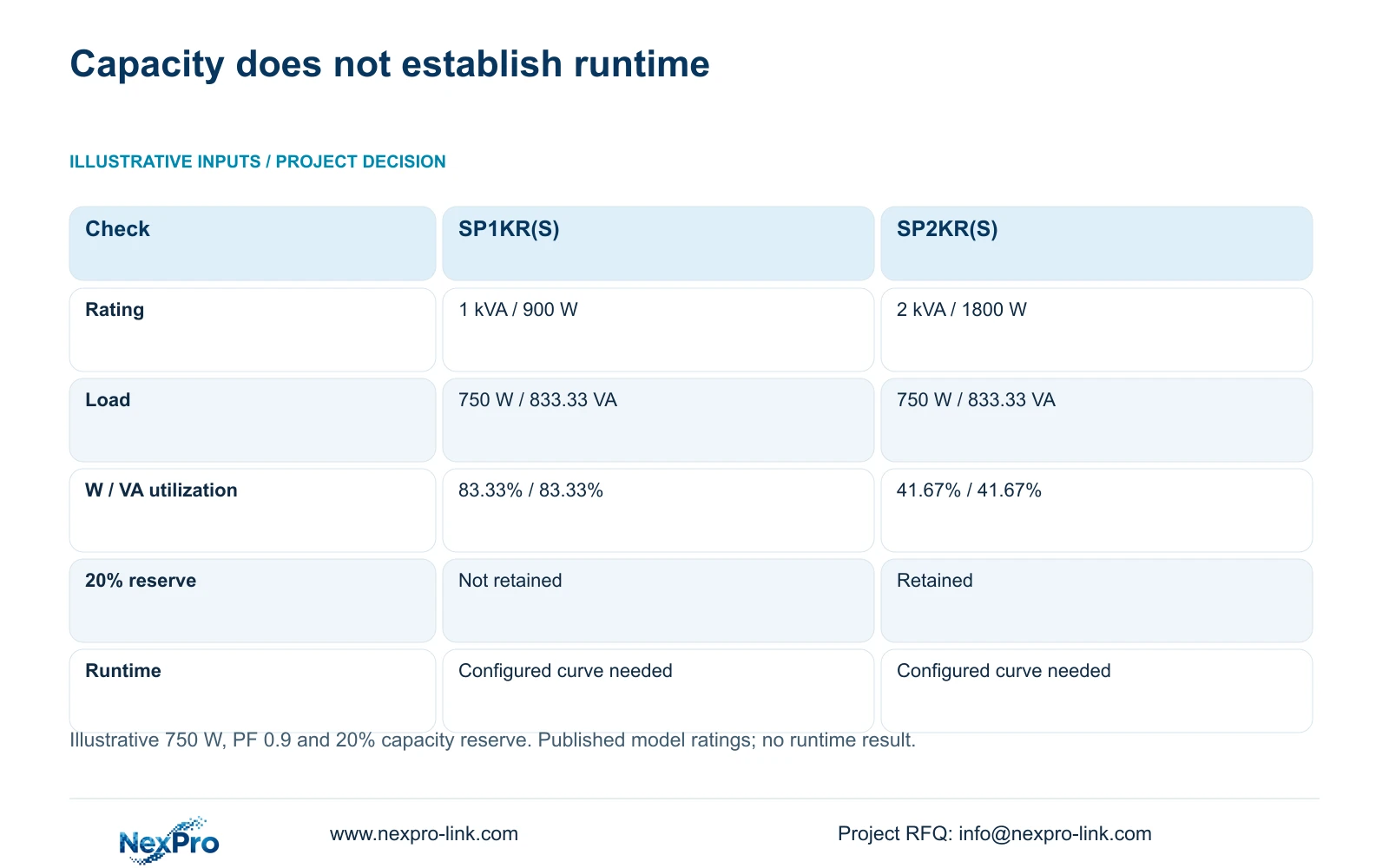
Watts describe real power; VA describe apparent power. For the illustrative aggregate load, VA = W / power factor = 750 / 0.9 = 833.33 VA. The assumed aggregate power factor is a planning input. An actual equipment schedule should retain supported or measured apparent-power information where available.
Calculate utilization independently: load W / rated W and load VA / rated VA. The published rack ratings are 1 kVA / 900 W for SP1KR(S) and 2 kVA / 1800 W for SP2KR(S). Both exceed the example's steady load, but SP1KR(S) uses 83.33% of each rating, leaving less than the stated 20% reserve.
The reserve means keeping utilization at or below 80%, not adding 20% to the load and treating that as equivalent. SP2KR(S) meets this capacity condition at 41.67% utilization. This recommendation changes if the actual load, power factor or required reserve changes; it does not establish runtime or all operating behavior.
| Metric / condition | SP1KR(S) | SP2KR(S) |
|---|---|---|
| Published rating | 1 kVA / 900 W | 2 kVA / 1800 W |
| Illustrative protected load | 750 W / 833.33 VA | 750 W / 833.33 VA |
| W utilization | 83.33% | 41.67% |
| VA utilization | 83.33% | 41.67% |
| 20% W and VA reserve | Does not retain target reserve | Retains target reserve |
| Battery runtime | Configured load curve required | Configured load curve required |
Section 04
Calculate battery energy from the time target
Use a separate energy calculation after establishing the protected operating state. In the supplied energy example, 600 W for 30 minutes requires 600 × 0.5 = 300 Wh at the output. With assumed 90% inverter efficiency and an 80% usable-energy factor, the nominal planning budget is 300 / (0.90 × 0.80) = 416.67 Wh.
The 600 W input is independent of the 750 W capacity comparison. Its result explains the method without claiming that 416.67 Wh is a battery fitted to either rack model. A larger power conversion unit can carry a larger load while still lacking the battery arrangement needed for the requested duration.
Actual runtime depends on the supported battery configuration and its load curve, including temperature, battery condition and protective cutoffs. Use the planning estimate to identify the energy requirement, then obtain configuration-specific runtime information. External battery voltage, charging and protection cannot be designed from Wh alone.
Section 05
Compare candidates without transferring family specifications
Keep the exact model identity visible through procurement. SP1KR(S) and SP2KR(S) belong to the NX-UP-RM-002 rack online double-conversion LiFePO4 series. SP2K(S) is a tower model rated 2 kVA / 2000 W, while SP2KR(S) is rated 2 kVA / 1800 W. Their shared kVA value does not make their watt limits identical.
Select rack or tower placement using the actual installation and maintenance arrangement. Confirm equipment dimensions, support requirements and access before assigning cabinet space. A series page's default battery energy must not be transferred to another selected model, and a nominal efficiency figure cannot establish efficiency across every load condition.
Compare quotations using the same protected task and duration. Identify the battery configuration, installation boundary and support scope separately. The smaller unit remains a candidate when the actual W and VA loads satisfy the agreed reserve and its supported battery arrangement meets runtime; otherwise retain the larger candidate or revise the protection zones.
Section 06
Request a battery configuration tied to the load
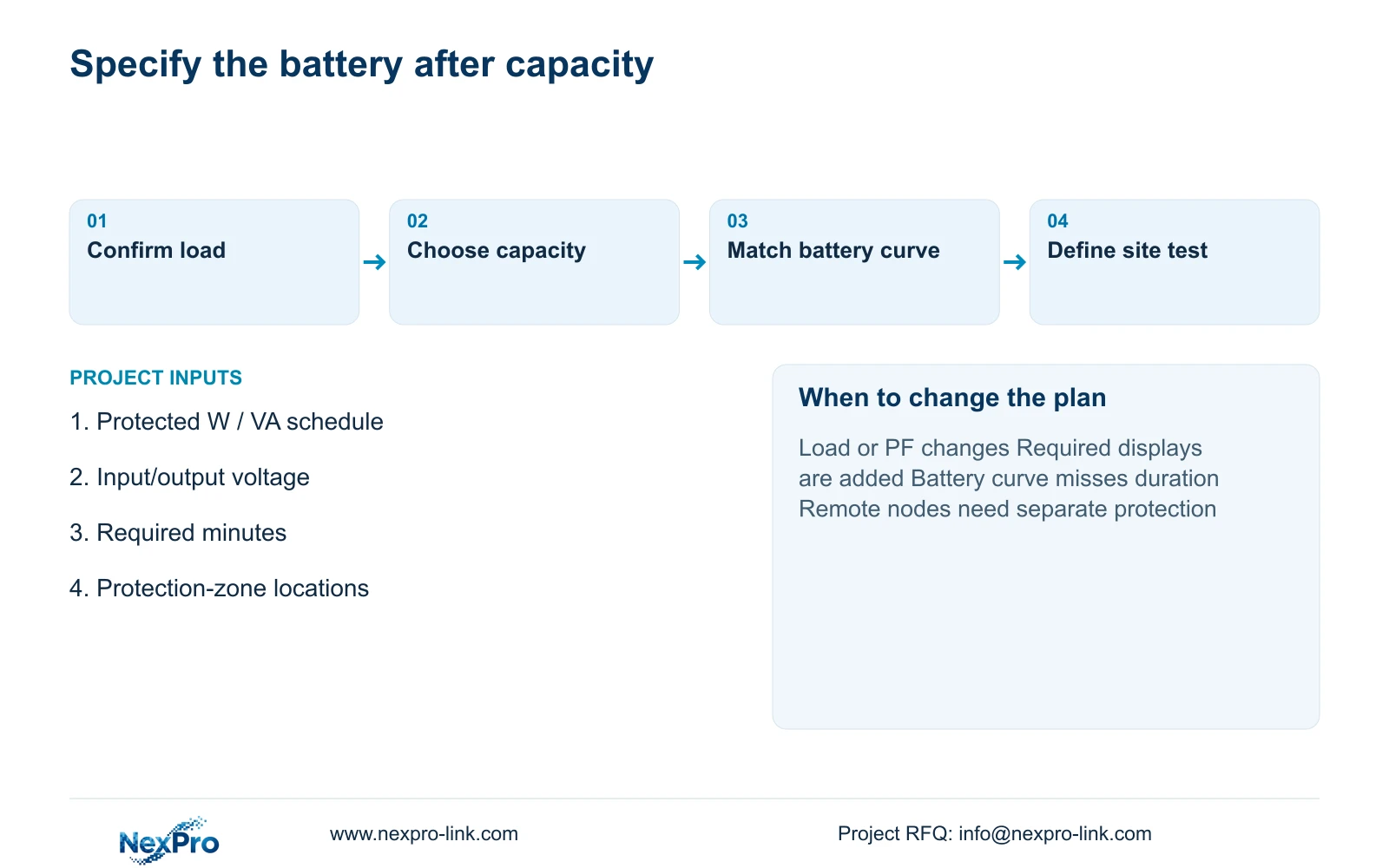
For the stated 750 W, PF 0.9 and 20% reserve assumptions, request SP2KR(S) as a capacity candidate with a separately specified battery arrangement. Change the proposal if a revised load exceeds either reserve limit, the voltage configuration differs or the supported battery curve cannot meet the required minutes.
Send info@nexpro-link.com the protected equipment schedule with W and VA information, input/output voltage, target minutes and the location of each protection zone. State whether switch entries include cameras and whether a generator participates in recovery. Hotel project equipment support and BOQ support can coordinate model matching and supply documentation; local electrical installation and safe switching tests remain within the agreed professional scope.
The supplied warranty policy gives applicable main equipment a 24-month limited hardware baseline from receipt. Battery terms and project-specific arrangements require their own written scope. Remote technical support does not automatically include site labor, replacement batteries or unlimited free repair.
Section 07
Buyer questions
What must an alternative UPS quotation include? Require the same W and VA load, voltage, operating topology, runtime target and battery configuration. Include bypass and local-service scope where required. An unspecified competing package cannot be ranked by kVA or initial price alone.
Can one central UPS cover remote PoE closets? Only when the actual protected distribution supplies them as designed. A hotel-wide power total does not establish a physical supply path, and fiber carries data without automatically supplying remote power.
What should the outage test demonstrate? Under appropriate professional supervision, verify the agreed camera and network path, recording continuity and any required viewing state. Record the configuration and conditions; an illuminated UPS or recorder alone does not demonstrate the complete service.
Engineering references
These sources support the general planning principles. Always use the selected product's current datasheet and applicable project standards for final design.