When a hotel UPS carries the load but misses the required minutes, investigate the battery configuration and operating conditions before choosing a larger kVA unit.
Section 01
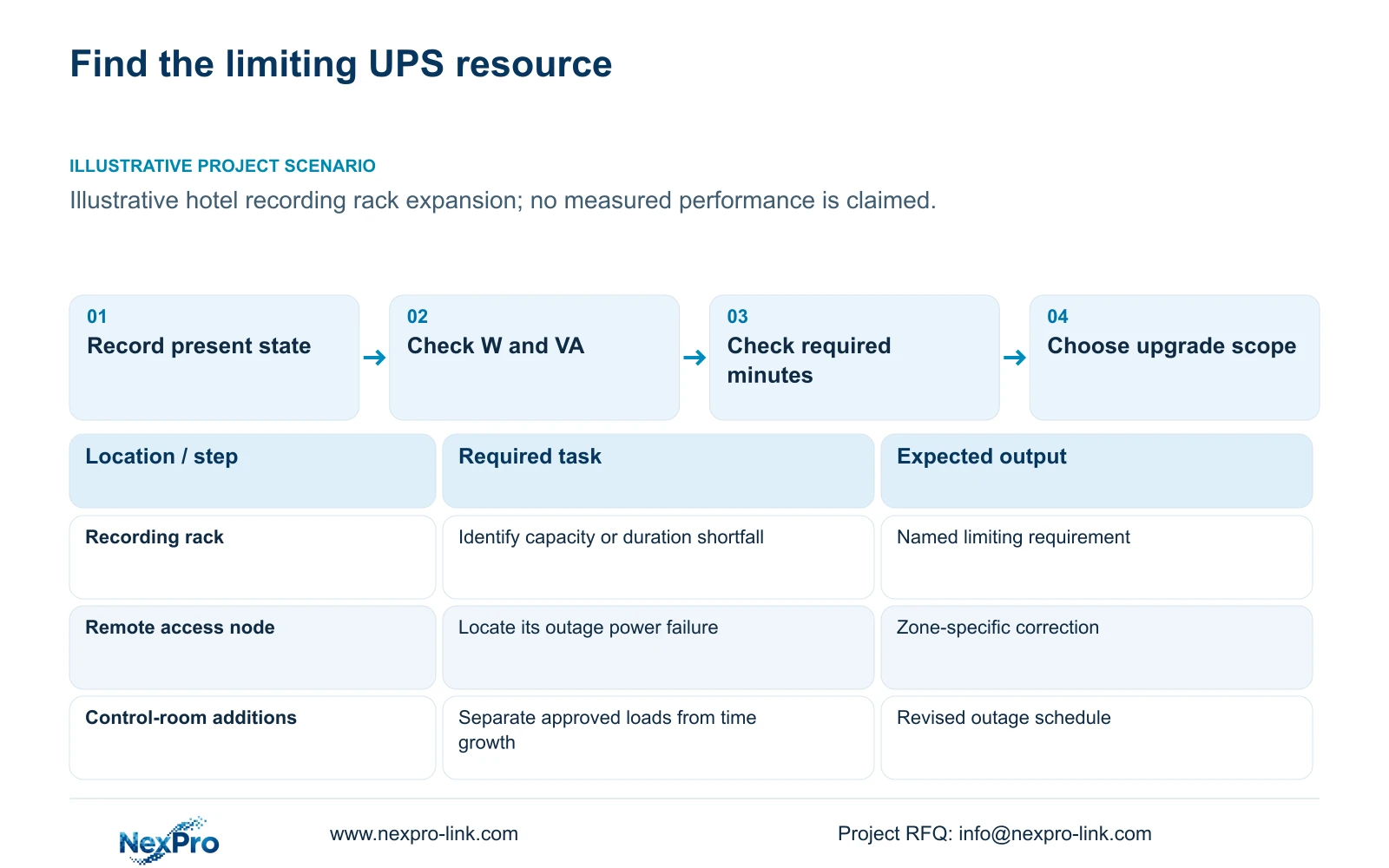
Measure the present load and define the missing minutes
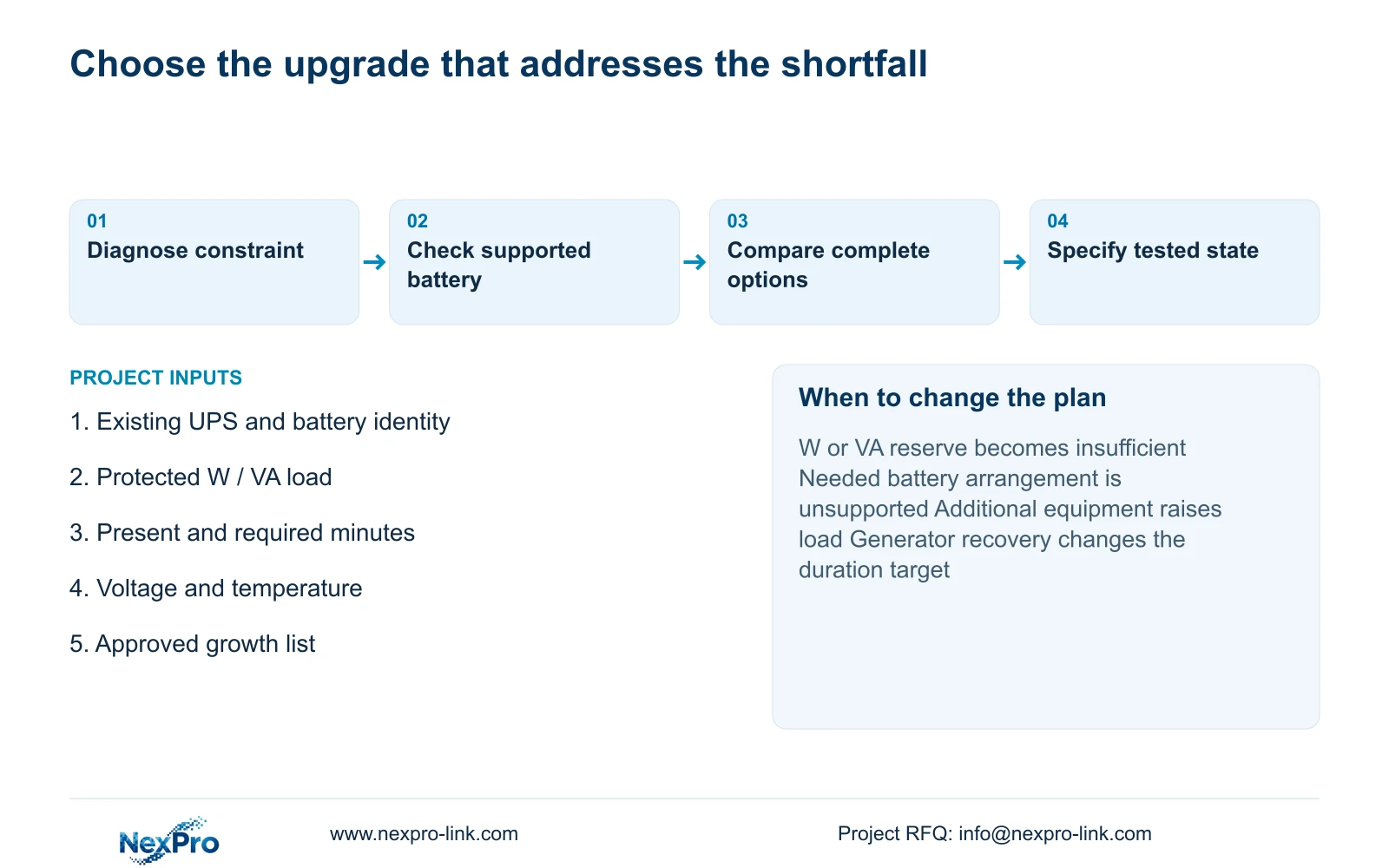
Request a supported battery or runtime correction when the existing UPS satisfies the protected W and VA load but cannot meet the approved duration. Request higher conversion capacity when either load limit or the agreed reserve is insufficient. Choose an upgrade addressing both constraints when documented growth increases power and energy requirements.
Start with the actual outage state. List the equipment that must keep working and how long it must operate. Record the UPS model, installed battery configuration and load measurement conditions. Keep a claimed runtime, a planning estimate and an observed test duration in separate fields so procurement can see what the evidence establishes.
Use one AC-load boundary. Complete PoE switch consumption already includes its connected cameras in the represented state. Recorder disks, required core equipment and independently supplied viewing devices need their own entries. Check night illumination and other relevant peak conditions before treating a daytime average as the complete design load.
Review the location of every active node. Additional battery energy in the central rack cannot restore a remote switch whose local supply is unprotected. A runtime shortfall must be traced to the equipment and protection zone where the required service stops.
Section 02
Identify whether capacity or energy is limiting
Compare measured or supported W and VA figures with the exact conversion unit ratings and the project's reserve policy. A load below the absolute rating may still miss an agreed growth allowance. Conversely, low utilization does not establish adequate battery duration.
Use the supported runtime information to examine the installed battery arrangement at the required load and conditions. Temperature, battery condition, discharge behavior and protective thresholds can affect duration. A short observed result does not establish that the remedy is simply another battery pack; first confirm the configuration and operating state.
The supplied rack series lists SP1KR(S) at 1 kVA / 900 W and SP2KR(S) at 2 kVA / 1800 W. Those figures identify conversion capacity. Their battery configuration must be obtained independently. SP2K(S), the tower model, has a different 2 kVA / 2000 W rating and must not be substituted silently.
| Observed requirement | First option to examine | Condition changing the choice |
|---|---|---|
| W or VA reserve is insufficient | Higher supported conversion capacity | Revised load also needs more battery energy |
| Capacity passes but duration is short | Battery configuration and operating conditions | Existing unit cannot support the needed arrangement |
| Remote node loses power | Protection at that node | A designed protected distribution already supplies it |
Section 03
Model growth in operating time separately from added equipment
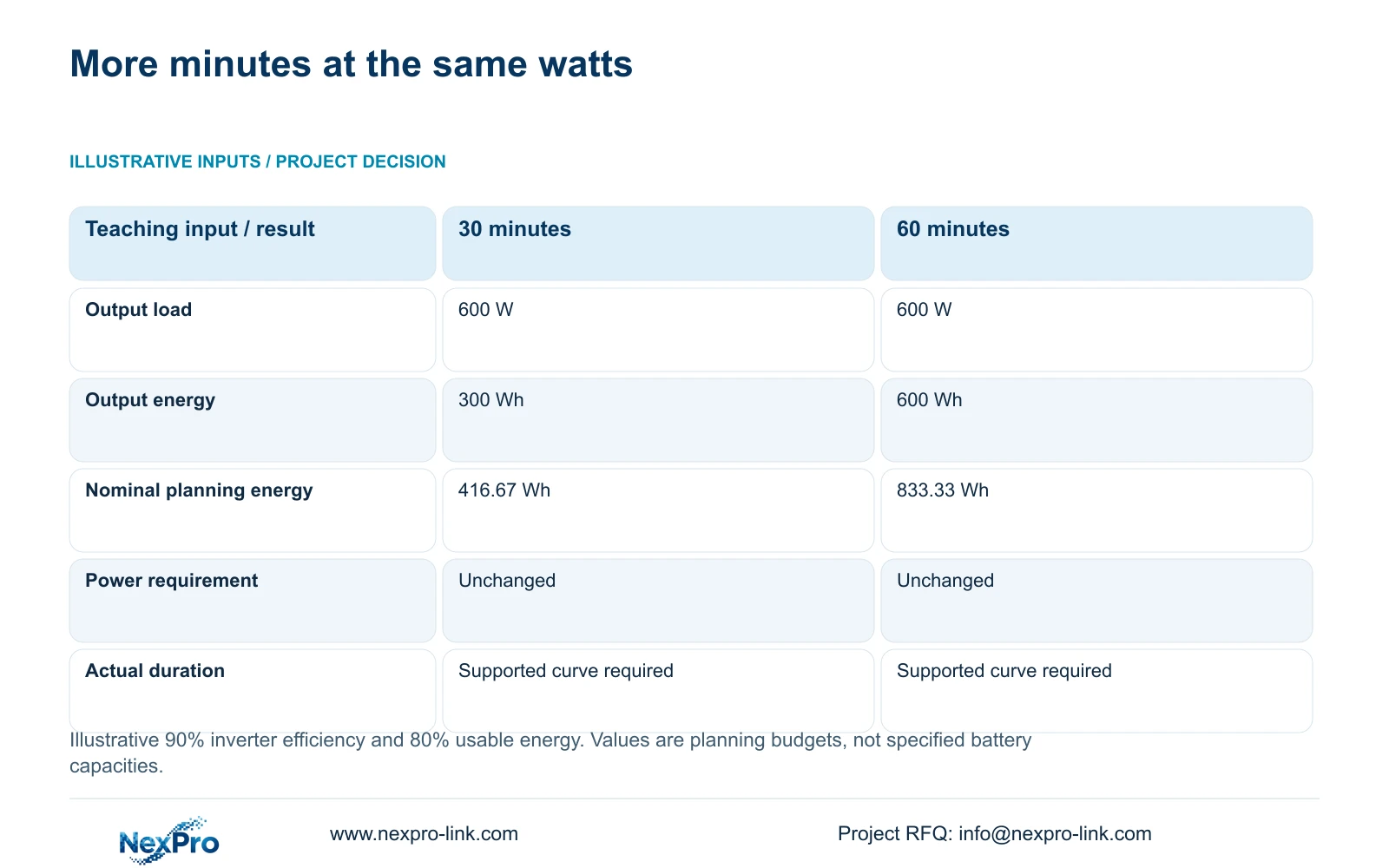
The supplied time-growth example keeps output load at 600 W and extends its target from 30 to 60 minutes. Output energy equals W × minutes / 60. Nominal planning energy equals output Wh / (0.90 × 0.80), with assumed 90% inverter efficiency and an 80% usable-energy factor.
The result increases from 300 to 600 Wh at the output and from 416.67 to 833.33 Wh in the simplified nominal budget. The power requirement remains 600 W. This isolates a duration change that does not, by itself, require a higher W rating. It does require a supported arrangement capable of delivering the new duration.
Equipment growth is a separate scenario. Add the approved devices to the AC schedule and recheck both W and VA, then calculate energy at that revised load. The complete hotel reference's base 663.77 W and wall-protected 1243.77 W arrangements are independent of this 600 W example. They illustrate load growth and cannot be inserted into its table without recalculation.
Keep the proposed additions identifiable. Another PoE group, recorder or required display has a specific power consequence. Unallocated reserve and named future equipment should not be counted twice as the same growth requirement.
| Metric / condition | Current time target | Extended time target |
|---|---|---|
| Output load | 600 W | 600 W |
| Time target | 30 minutes | 60 minutes |
| Output energy | 300 Wh | 600 Wh |
| Nominal planning energy | 416.67 Wh | 833.33 Wh |
| Actual runtime and switching | Configured system validation required | Configured system validation required |
Section 04
Compare capacity and energy upgrades on equal scope
A conversion-unit upgrade addresses the W and VA envelope. A supported battery change addresses energy and duration within its operating limits. Some projects need both, but a quotation should explain which requirement each component solves. A larger kVA label without a load-matched battery configuration leaves the runtime question unanswered.
Compare alternatives using the same required outage service. Retaining the existing unit with a supported battery arrangement may be a candidate when capacity remains sufficient. Replacing the complete package becomes relevant when the necessary battery arrangement is unsupported or the revised load exceeds the existing unit's capacity conditions.
Include the associated installation and recovery scope. Battery placement, charging demand and maintenance access may affect the proposal. Obtain actual prices for each complete alternative. The supplied evidence has no model-specific upgrade costs or failure rates, so it cannot establish a financial winner.
If the owner accepts shorter operation for optional displays, evaluate that approved change separately. Removing display duty changes the service being purchased; it should not appear as a battery improvement while concealing a reduced operating requirement.
Section 05
Confirm charger and battery compatibility before expansion
Specify the exact UPS and supported battery arrangement before ordering. Voltage, battery management, charging behavior and protective functions need to match. A watt-hour total expresses an energy budget and provides no instruction for connecting batteries in series or parallel.
Ask for runtime information tied to the selected combination and the stated load. Do not move a default battery value from one model on a series page to another. The supplied 416.67 Wh and 833.33 Wh values are teaching budgets, not battery capacities promised for SP1KR(S) or SP2KR(S).
Where a generator participates, identify the required bridge and recovery behavior. Charging and other loads also enter the generator's scope. This simplified energy calculation does not design generator coordination, external battery wiring or electrical protection.
Local professionals should confirm installation and safely test the intended service. Record the tested equipment identities and conditions. A successful limited test supports the observed arrangement; it does not establish every temperature, battery age or future expansion state.
Section 06
Issue an RFQ that names the constraint and configuration
For unchanged 600 W demand with a duration increase from 30 to 60 minutes, request a supported configuration demonstrating the longer runtime first. Change to a combined capacity-and-battery proposal if the existing unit lacks the required reserve, cannot support that battery arrangement or must carry approved additional equipment.
Send info@nexpro-link.com the existing UPS and battery identities, protected W and VA schedule, present and required minutes, voltage and operating temperature. Include any planned equipment additions. Hotel project equipment support and BOQ support can coordinate candidate matching and supply documentation without requiring guest footage or passwords.
Ask the response to distinguish retained equipment, added components and local installation responsibilities. NexPro-Link's CCTV manufacturing core and supporting equipment coordination do not imply that every component is self-manufactured or that local work is included.
The supplied policy gives applicable main equipment a 24-month limited hardware baseline from receipt. Battery and upgrade-order terms remain separately defined. An extension of the time requirement does not automatically extend warranty coverage or make battery replacement and site labor free.
Section 07
Buyer questions
Will doubling nominal battery Wh double actual runtime? The simplified fixed-load budget doubles when duration doubles. Actual runtime still requires the supported configuration's curve because discharge behavior, protective limits and operating conditions affect usable energy.
Can the existing battery be reused with a larger UPS? Only when that exact arrangement is supported for the selected unit. Confirm voltage, BMS, charging and protection requirements; matching a nominal energy figure is insufficient.
What should be compared if the current runtime is unexpectedly short? Compare the actual load and operating state with the installed battery configuration's supported runtime information. Check conditions and device identities before treating the shortfall as proof that a larger conversion unit or more battery energy is required.
Engineering references
These sources support the general planning principles. Always use the selected product's current datasheet and applicable project standards for final design.