A low average power reading can support a battery estimate, but UPS capacity also needs representative peak loads, apparent power and startup conditions.
Section 01
Choose the operating modes that must remain protected
Use measured average consumption for energy planning only when it represents the required outage operation. Select UPS capacity against representative upper loads in both W and VA, then review startup behavior separately. A quiet daytime reading below the equipment nameplate is insufficient grounds for reducing the UPS size if night lighting, disk activity or additional operating tasks were absent during measurement.
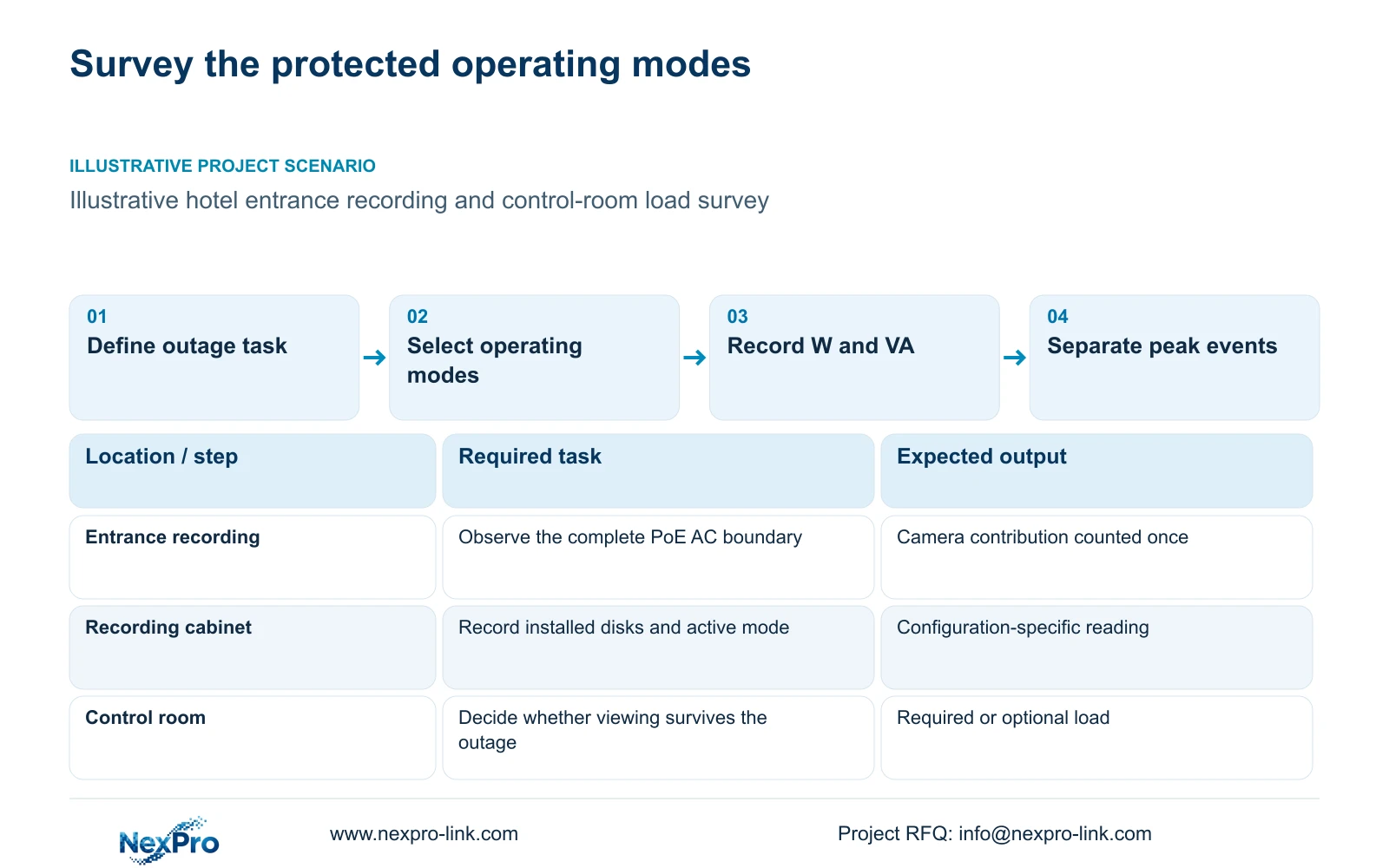
Begin with the recording service that the hotel expects to retain. Trace public entrance cameras through their PoE switches and required network nodes to the recorder. If an intermediate switch loses power, an illuminated NVR cannot preserve the missing camera streams. Record live viewing and remote access as separate tasks because their power dependencies may extend beyond the recording path.
Build a mode list before collecting readings. Include normal recording, the selected nighttime camera mode and the agreed outage state. Add startup or recovery observations where those states affect the proposal. For each mode, identify which equipment operates together. Optional displays should appear explicitly so the engineer can evaluate their inclusion without silently changing the protected service.
| Required task | Given information | Decision still needed |
|---|---|---|
| Entrance recording during an outage | Camera, access switch and recorder form the path | Which network nodes and power zones must remain active |
| Control-room event viewing | Client, decoder and display may add loads | Whether viewing is essential throughout the outage |
| Nighttime recording | Selected illumination mode can change the load | Which representative night state the survey must capture |
Section 02
Keep equipment ratings separate from observed consumption
Give each load value an evidence label: equipment rating, configured estimate or measured observation. A rating describes a stated equipment limit or condition. A measurement describes the configuration and activity present during the observation. Neither should replace the other without explaining what changed. Keep the original rating alongside the reading so later additions remain visible.
Use a consistent AC boundary. A measured PoE switch input includes the power drawn to supply its connected cameras. Adding those cameras again would duplicate part of the protected load. If the engineer instead builds an estimate from camera demand, cable losses and switch conversion, identify those assumptions and retain the switch's own consumption separately.
Apply the same discipline to recorder disks and external accessories. A recorder reading with its installed drives differs from an unloaded chassis figure. Record the drive configuration and whether external adapters were inside the measurement boundary. For UPS selection, compare W with rated W and VA with rated VA; a shared kVA label does not make different output watt ratings interchangeable.
| Evidence | Useful application | Limit |
|---|---|---|
| Equipment nameplate | Retain the stated rating and configuration boundary | Does not describe average hotel consumption |
| Measured operating load | Estimate the observed duty and corresponding energy | Does not cover unobserved modes |
| Representative upper load | Check steady capacity against W and VA limits | Does not establish transient capability or runtime |
Section 03
Measure the conditions that could control capacity
Plan observations around the equipment behavior that could change selection. Include the installed disk arrangement, required camera illumination and any viewing workload that must continue during the outage. Record the active configuration, measurement location and observation period. A maximum value without this context cannot show whether it belongs to the approved protected task.
Where startup or restoration matters, identify it as a separate observation rather than folding it into an unexplained average. Ask the UPS supplier which transient information is needed for the proposed configuration. The measurement method must suit the event being assessed; an ordinary operating reading should not be presented as proof that a brief startup demand is acceptable.
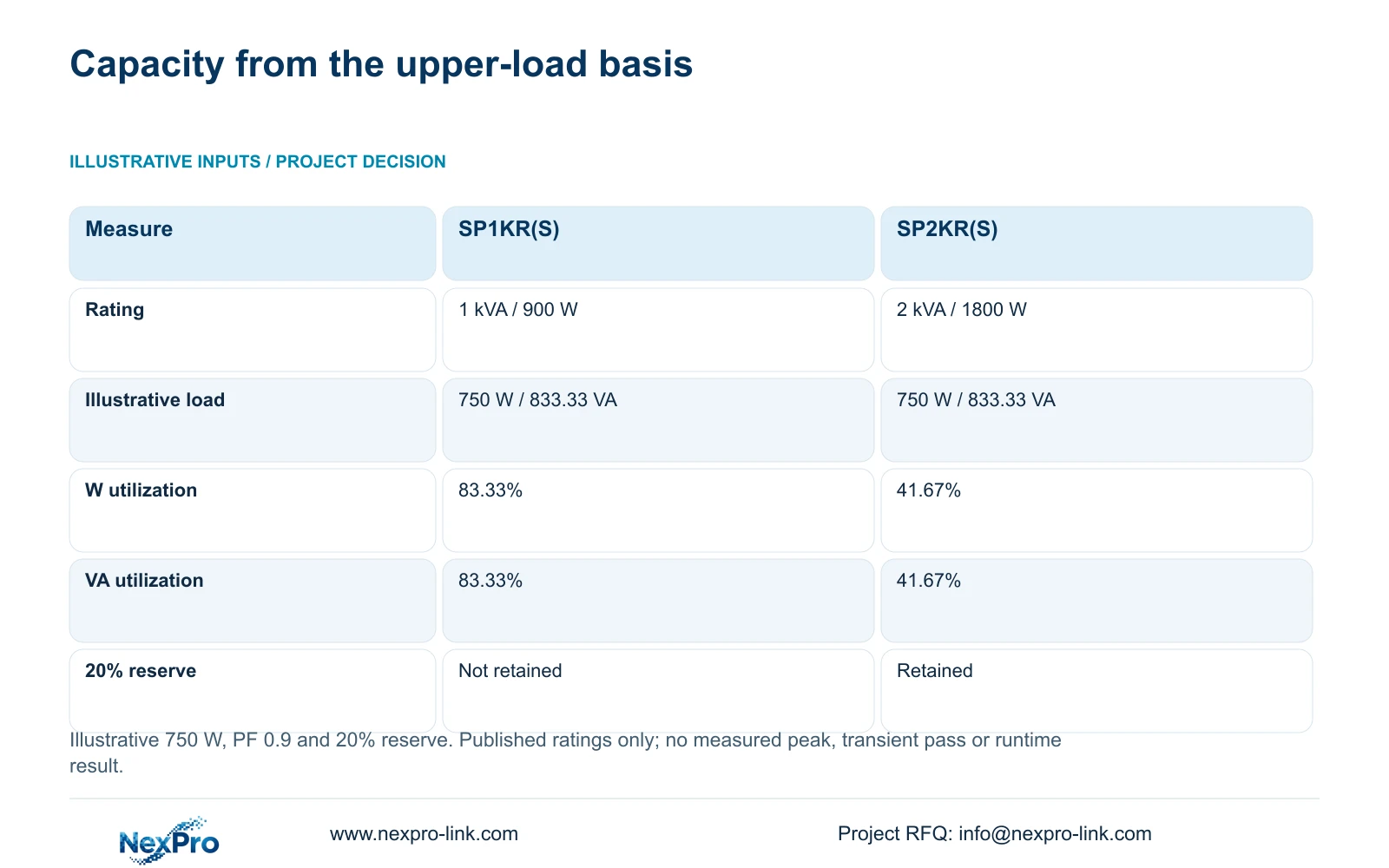
The independent teaching comparison below uses a protected AC load of 750 W and an assumed aggregate power factor of 0.9. It is not a hotel survey result. Apparent load is W divided by power factor, so 750 divided by 0.9 gives 833.33 VA. W utilization is load W divided by rated W; VA utilization uses the corresponding VA values.
Section 04
Compare the sizing load with both UPS limits
SP1KR(S) and SP2KR(S) are published rack online double-conversion UPS models in the NX-UP-RM-002 series, with ratings of 1 kVA / 900 W and 2 kVA / 1800 W respectively. Those ratings are product facts. The 750 W load, power factor and reserve target are illustrative project inputs.
Both models exceed the stated steady load. SP1KR(S), however, uses 83.33% of each rating and therefore fails the chosen requirement to keep 20% of rated capacity available. SP2KR(S) retains that reserve. For this sizing basis, it is the capacity candidate to take forward, subject to the voltage, connection and transient checks.
A lower measured average could reduce the energy used in a runtime assessment without changing this capacity conclusion. Reconsider SP1KR(S) only when the approved upper-load basis satisfies both reserve limits and its transient requirements are supported. This example remains independent of the complete 32-camera hotel reference, whose load totals use different equipment assumptions.
| Metric / condition | SP1KR(S) | SP2KR(S) |
|---|---|---|
| Published model rating | 1 kVA / 900 W | 2 kVA / 1800 W |
| Illustrative protected load | 750 W / 833.33 VA | 750 W / 833.33 VA |
| W utilization | 83.33% | 41.67% |
| VA utilization | 83.33% | 41.67% |
| 20% W and VA reserve target | Does not retain target reserve | Retains capacity reserve |
| Battery runtime | Needs configured load curve | Needs configured load curve |
Section 05
Review apparent power, recovery and runtime separately
When actual VA readings are available, preserve them in the schedule rather than applying the teaching power factor to every device. Different operating modes may produce different W and VA relationships. Review the selected UPS against the approved simultaneous load and the recovery sequence, including any equipment that restarts together.
Capacity headroom does not establish battery minutes. Runtime needs the supported battery configuration and information for the relevant load and conditions. Do not transfer a battery energy value shown for a default model to SP2KR(S). If the hotel adds a decoder or display to outage operation, revise both the capacity calculation and the runtime request.
For distributed access closets, repeat the assessment by protection zone. A hotel-wide total can support coordination, but it does not demonstrate that each remote node has a suitable power source. Local electrical installation and safe changeover testing belong to the appropriate professionals, with the required recording outcome retained as the test objective.
Section 06
Record a sizing basis that procurement can use
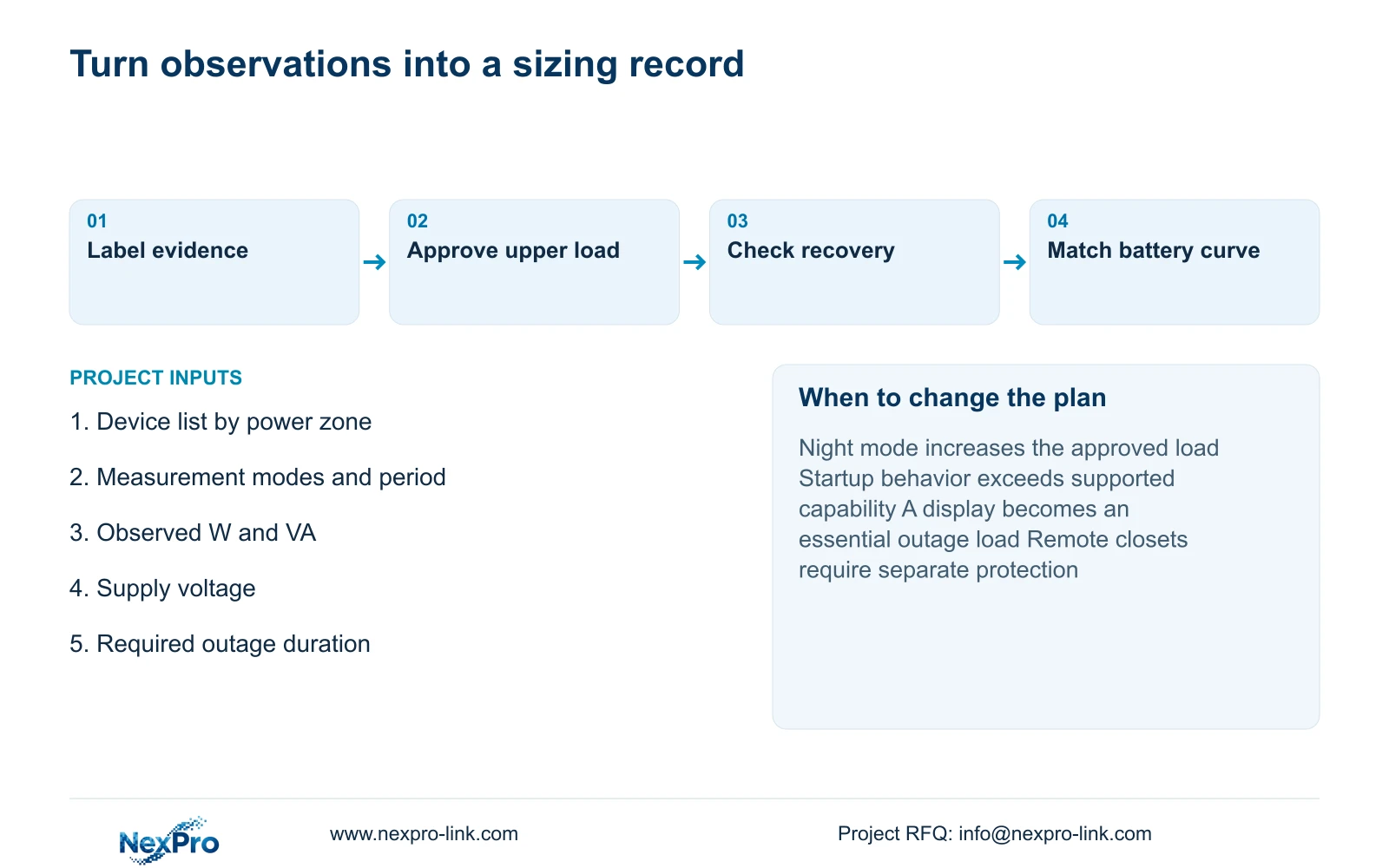
Issue the load schedule with the protected task, device configuration and power zone beside each value. Preserve the distinction between measured averages, representative upper loads and unresolved startup conditions. State the reserve convention and the battery runtime target independently. This allows a revised quote to be checked against the same service requirement.
For the illustrated 750 W / 833.33 VA basis, request SP2KR(S) as a capacity candidate with a load-matched battery proposal. Change the candidate if actual upper loads, power factor, location or supported recovery behavior invalidate that basis. Avoid choosing a larger unit solely to obtain longer runtime when the required change may be a supported battery arrangement.
Send info@nexpro-link.com the protected AC device list, measurement modes and W/VA readings, supply voltage and required outage behavior. Identify which readings remain provisional. NexPro-Link's hotel project equipment support and BOQ support can help map the schedule to a coordinated proposal; the written scope should identify supplied equipment and local installation responsibilities.
Section 07
Buyer questions
Can we request an initial proposal before the survey is complete? Yes. Send the known equipment ratings and configured load estimates, marking missing measurements. Request a provisional capacity basis and list the operating observations that could change it before ordering.
Does moving from SP1KR(S) to SP2KR(S) guarantee more backup minutes? No. Their output ratings establish capacity differences. Compare the actual battery arrangements and load-matched runtime information before accepting a duration.
What should the supplier return with a survey-based quotation? Request the proposed model, W and VA sizing basis, supported battery configuration and unresolved load conditions. The response should also identify which protection zones and operating functions it covers.
Engineering references
These sources support the general planning principles. Always use the selected product's current datasheet and applicable project standards for final design.