An online UPS is justified where the required recording path needs its supported power behavior. A line-interactive alternative needs documented load tolerance and an equal runtime comparison.
Section 01
Set the allowable interruption before choosing topology
Select an online UPS where the required CCTV load cannot tolerate the proposed alternative's transfer behavior or where power conditions require the selected online operating mode. Consider a line-interactive UPS when its documented output and transfer characteristics satisfy the complete recording path. Hotel star rating does not determine this choice, and a restricted budget does not establish load tolerance.
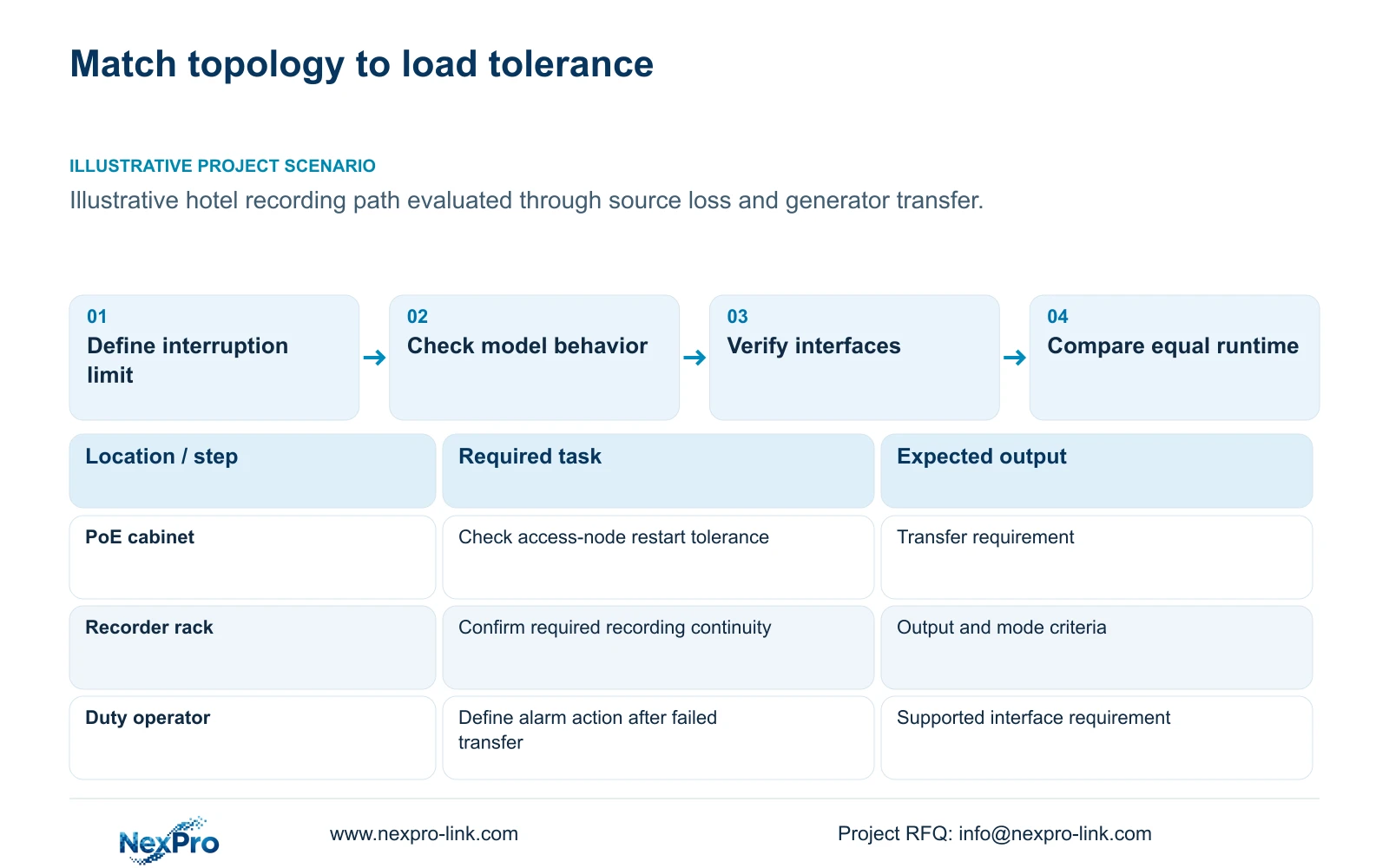
Identify what must continue: camera capture, network transport, recording and any essential operator access. A recorder remaining powered is insufficient if an access switch restarts. Establish the permitted interruption for every dependency, then compare that requirement with the exact UPS configuration and connected equipment.
Describe the site sequence from loss of mains through generator starting, acceptable supply and transfer. Include the accepted slow-start or failed-start case. A stated generator start time does not establish when the UPS can accept its supply or whether subsequent disturbances will extend battery operation.
| Required task | Given information | Decision still needed |
|---|---|---|
| Continuous recording | Recorder and PoE network are required | Permitted interruption for each dependency |
| Generator bridging | A generator sequence exists | Latest acceptable supply and fallback duration |
| Operator response | Local staff manage incidents | Required alarms and supported management path |
Section 02
Compare behavior in the intended operating mode
Compare how each candidate supplies the load during normal service, source loss and recovery. The supplied NexPro-Link rack and tower candidates are identified as online double-conversion products. A line-interactive alternative needs its own model documentation; the evidence package does not identify a verified NexPro-Link line-interactive SKU. Eaton's topology explanation distinguishes the normal power paths: line-interactive equipment regulates incoming AC and switches to battery operation when required, while double-conversion operation converts AC to DC and back to AC. Use that distinction to request the exact transfer and output behavior at the intended mode. It does not prove a particular NVR or PoE switch will tolerate the candidate, and ECO or bypass operation needs its own assessment.
Use the declared operating mode in the proposal. A topology name alone cannot establish behavior during bypass, overload or a selected alternative mode. Ask for those conditions separately where they affect recording continuity. Compare successful generator transfer with a failed transfer so that the hotel understands the battery fallback state.
If the cheaper alternative meets the interruption and output requirements, retain it in the evaluation. If its supported behavior causes an unacceptable restart or recording gap, change the candidate or architecture. Battery energy cannot compensate for an incompatible transfer characteristic, and an online label cannot establish every maintenance outcome.
| Item | Online candidate | Line-interactive alternative | Hotel consequence |
|---|---|---|---|
| Normal mode | Confirm selected double-conversion configuration | Obtain exact model behavior | Compare the supply reaching the load |
| Source transfer | Confirm supported behavior and limits | Confirm transfer characteristics | Avoid unacceptable device restarts |
| Fallback control | Verify actual interfaces | Verify actual interfaces | Management actions require device support |
Section 03
Check output requirements and management interfaces
Request the exact output waveform specification and supported voltage configuration for normal and battery operation. Match them to the connected power supplies. Do not assume that products sharing a kVA rating provide identical output characteristics, input acceptance or connection arrangements. Any unresolved field belongs in the technical comparison before procurement.
Management needs also affect selection. The hotel may need a battery-status alarm, a local notification or a supported shutdown action. Confirm the interface at both ends: the UPS must provide the relevant signal and the receiving equipment or software must use it. A connector or a general software description does not prove automatic NVR shutdown.
Record who receives the alarm and what action follows when generator transfer fails. Where no supported automatic action exists, use an agreed staffed procedure or change the equipment requirement. Electrical protection, grounding and generator dynamic assessment remain separate professional tasks; neither waveform documentation nor a short energy calculation completes them.
Section 04
Compare capacity and runtime on equal terms
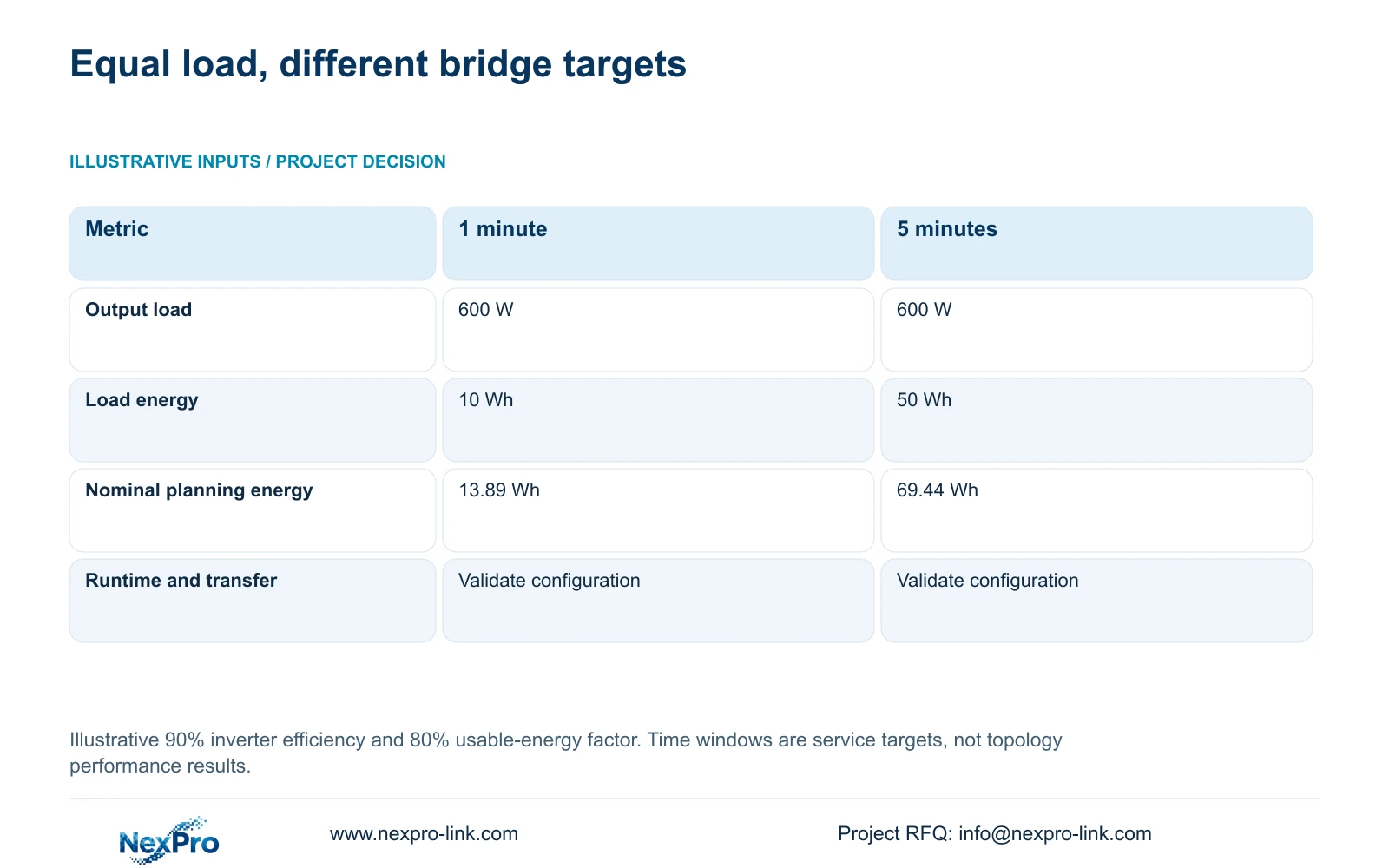
Use the same protected load, duration and operating conditions for both topology quotations. This teaching example assumes 600 W output, 90% inverter efficiency and an 80% usable-energy factor. Output energy in Wh equals W × minutes ÷ 60. Nominal planning energy equals output Wh ÷ (0.90 × 0.80).
The one-minute window needs 10 Wh at the load and 13.89 Wh in the simplified nominal budget. Five minutes needs 50 Wh and 69.44 Wh respectively. These windows describe different service requirements, not intrinsic runtime differences between online and line-interactive products. Comparing one topology for one minute with another for five minutes would conceal a scope difference.
Check W and VA independently before runtime. SP1KR(S) is rated 1 kVA / 900 W, SP2KR(S) 2 kVA / 1800 W, and tower SP2K(S) 2 kVA / 2000 W. These are actual published ratings. Battery temperature, condition, discharge behavior and cutoff affect achieved minutes, so obtain the supported configuration's load-matched curve. The 600 W example is independent of CASE01's complete hotel loads.
| Metric / condition | 1-minute energy window | 5-minute energy window |
|---|---|---|
| Load (W) | 600 | 600 |
| Time target (minutes) | 1 | 5 |
| Output energy (Wh) | 10 | 50 |
| Nominal planning energy (Wh) | 13.89 | 69.44 |
| Actual runtime / switching | Requires configured system validation | Requires configured system validation |
Section 05
Price the complete configuration and service scope
Request quotations with the same protected functions and approved runtime target. Separate the UPS, supported battery arrangement, necessary interfaces and installation scope. Add local servicing and replacement logistics where required. A lower UPS chassis price is incomplete if the offer omits a battery pack or management component needed for the hotel task.
Keep costs for optional displays outside the essential recording comparison. Also identify whether an existing distribution system can be retained. If the economic advantage depends on an unknown installation or service charge, show that item as unresolved and evaluate how its actual value would change the ranking. No brand price advantage is established by this example.
The supplied warranty record states a 24-month limited hardware baseline from receipt for applicable main equipment, with controlling written terms governing exceptions. Batteries and other categories need their own scope. Include return transport and site labor boundaries explicitly; ongoing technical assistance does not imply unlimited free repairs or local attendance.
| Retained outcome | Extra scope | When worth buying | Counter-condition |
|---|---|---|---|
| Required recording continuity | Online configuration | Alternative transfer behavior is unacceptable | Alternative meets the documented task |
| Required operator action | Supported management interface | Hotel needs an actionable alarm or shutdown path | Feature has no supported receiving workflow |
Section 06
Choose the option that passes the hotel task
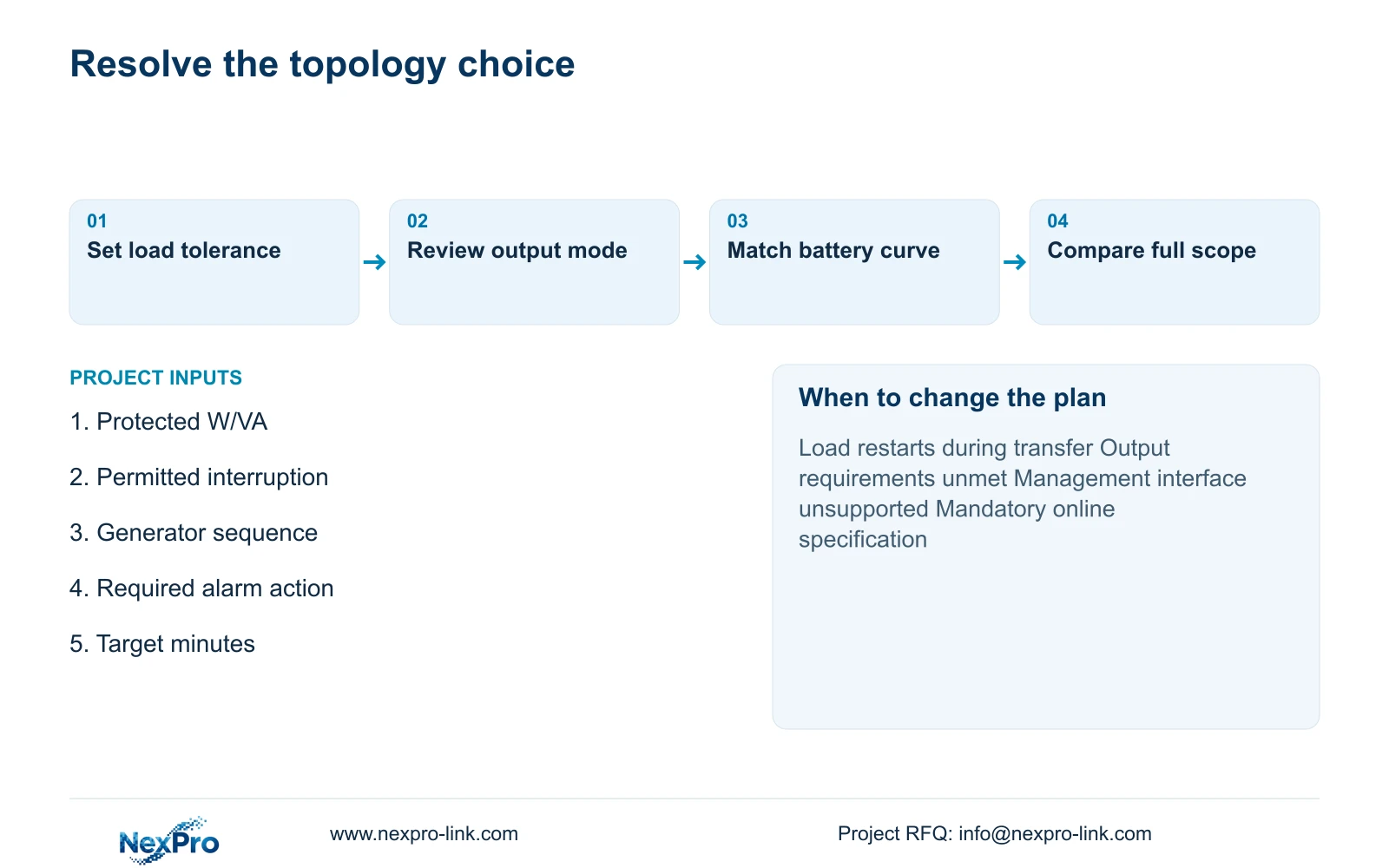
Choose the economical line-interactive option only when its exact model satisfies load tolerance, output requirements and the agreed generator sequence, with the required battery configuration included. Choose an online double-conversion candidate when those conditions require it. An operator's mandatory specification can also control selection even where another configuration appears technically sufficient.
Change the recommendation if a representative load restarts during the approved transfer scenario, input conditions fall outside the candidate's supported range, required management is unavailable or runtime evidence fails the chosen target. Test the complete camera-to-recorder path under a procedure coordinated with the appropriate electrical and operating personnel.
For a scoped comparison, send info@nexpro-link.com the protected W/VA load schedule, permitted interruption, generator sequence and desired battery duration. Add the delivery destination and mandatory operator requirements. NexPro-Link can discuss equipment matching and BOQ support; local testing and electrical work need named responsibilities in the proposal.
Section 07
Buyer questions
Can a mixed UPS package be evaluated for one hotel? Yes, if each protected zone has explicit requirements and the combined path passes the agreed outage task. Do not place a tolerant optional display and a critical recording node under the same assumed requirement without reviewing their roles.
Does a larger online UPS automatically provide longer runtime? No. A higher W/VA rating changes capacity. Longer runtime requires evidence for the supported battery configuration at the actual load, including relevant operating conditions.
Can NexPro-Link quote a verified line-interactive model from this article? This evidence package identifies online rack and tower models only. A line-interactive proposal must identify its exact candidate and documentation before its characteristics or price can be compared.
Engineering references
These sources support the general planning principles. Always use the selected product's current datasheet and applicable project standards for final design.