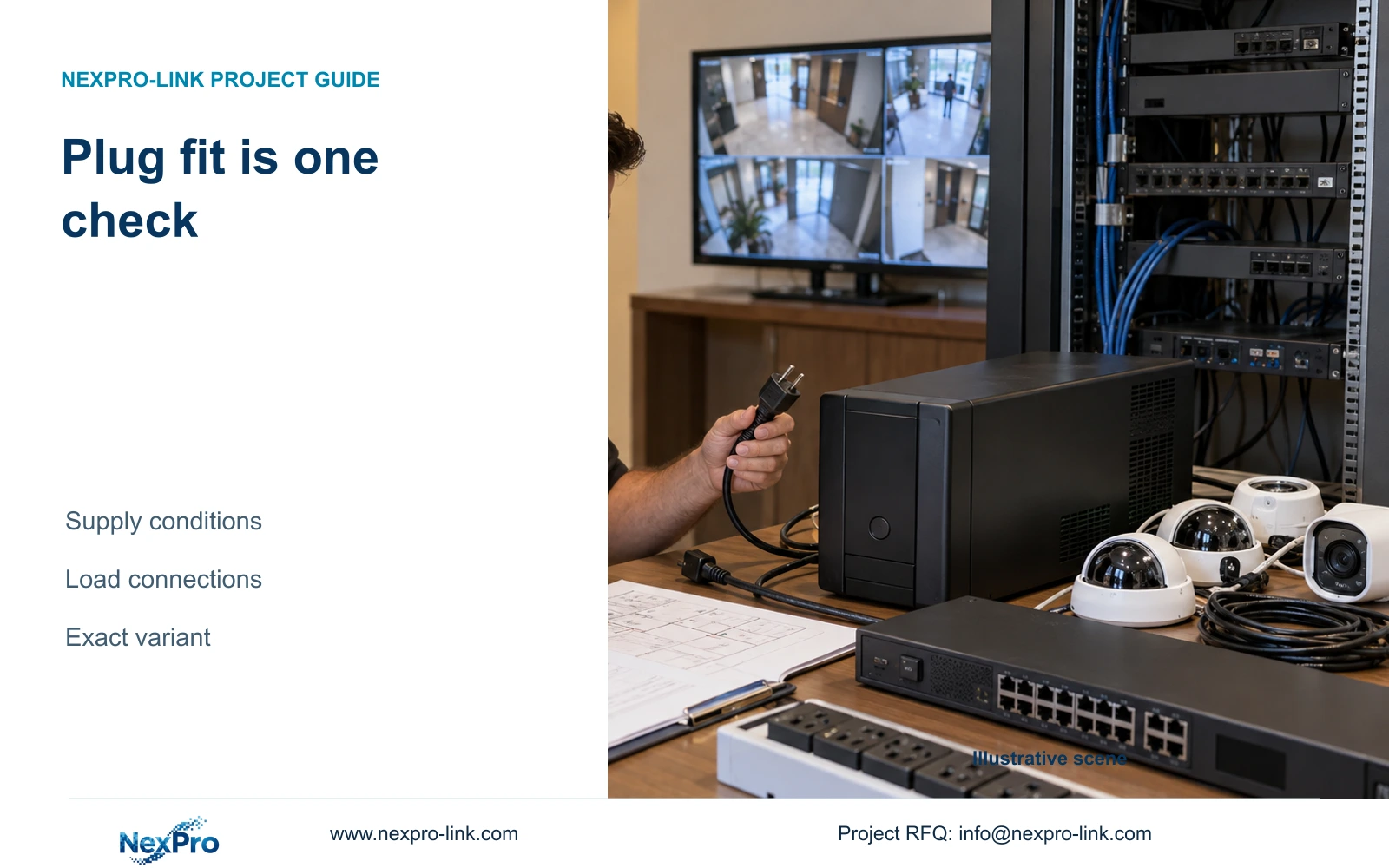
A matching plug does not establish a suitable hotel UPS configuration. Specify the supply, load connections, capacity and local installation interfaces together.
Section 01
Confirm the supply and load requirements before choosing connectors
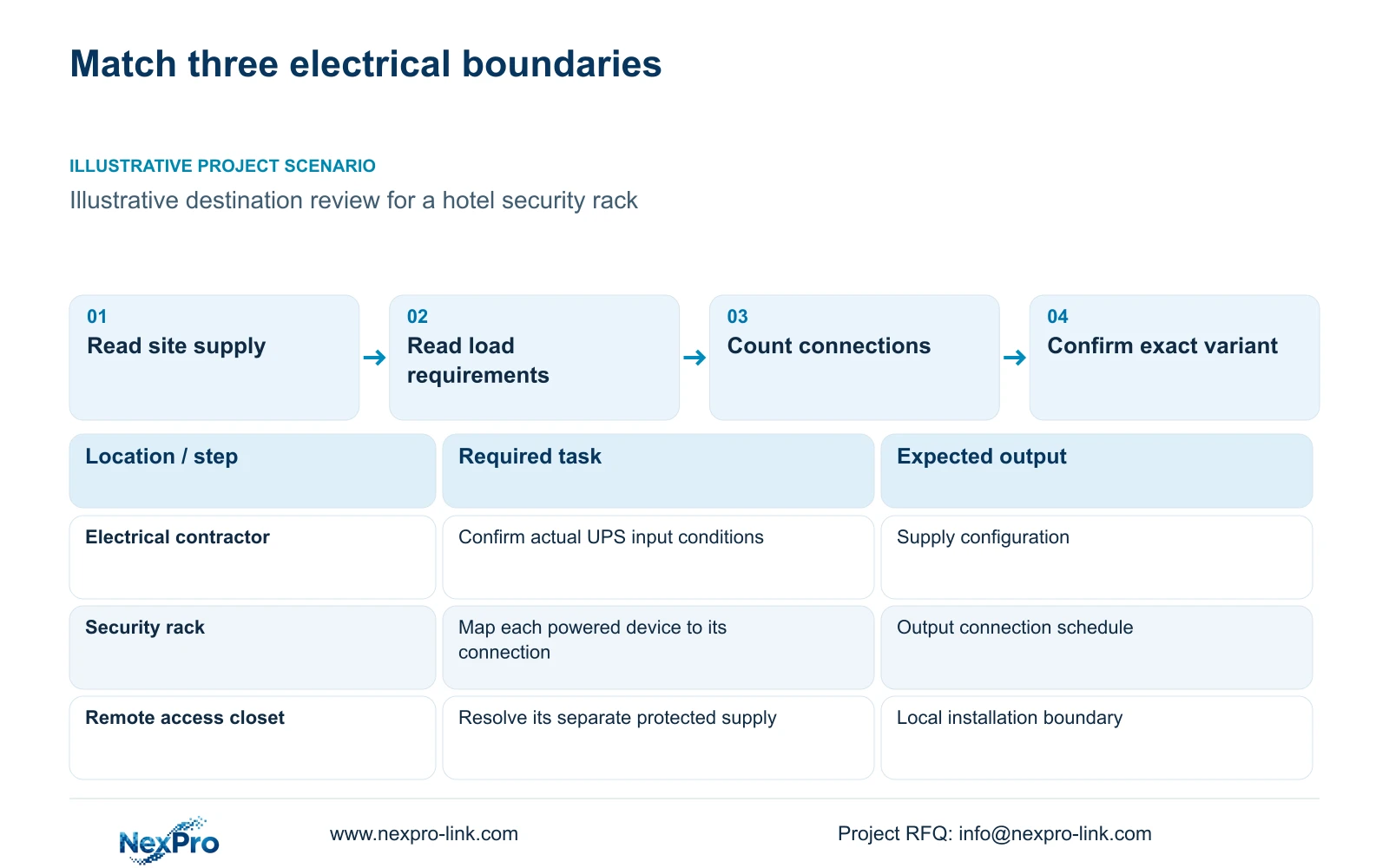
Choose the UPS configuration against the hotel's actual input supply and required output conditions, then match its connections. Changing a plug alone does not establish electrical suitability. Proceed with a candidate only when voltage, frequency, W and VA capacity, connection method and the supported battery arrangement fit the intended installation; qualified local personnel must resolve installation requirements.
Collect input and output requirements as separate fields. The supply-side record describes what reaches the UPS. The load-side record describes what the recorder, network equipment and selected operator devices require. A country name can identify the destination, but it cannot replace the actual circuit and equipment information needed for configuration.
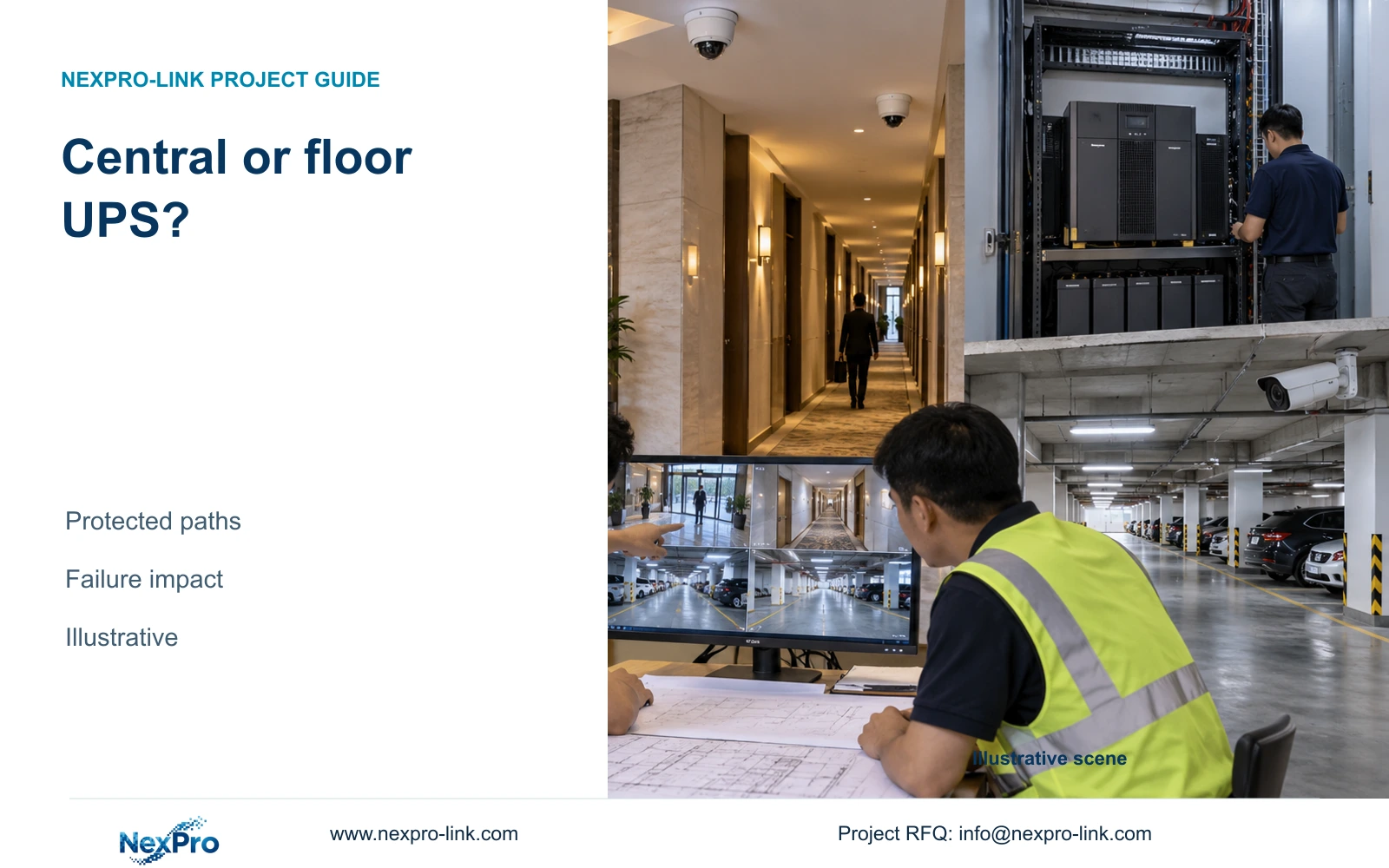
Trace the service across all protected locations. A central security rack and a remote access closet may need different connection arrangements even within one hotel. Preserve the required recording function while resolving those interfaces. If remote switches are essential, their supply conditions belong in the proposal instead of being assumed to follow the central rack.
| Required task | Given information | Decision still needed |
|---|---|---|
| Supply the central UPS | Destination and intended circuit | Actual voltage, frequency and connection method |
| Power the recording rack | Configured recorder and network equipment | Required output conditions and load connections |
| Retain remote camera streams | Remote active nodes are recording dependencies | Their local supply and protected-power arrangements |
Section 02
Separate connector fit from electrical rating
A connector decision should identify both the physical connection and its applicable electrical rating. Record the approved cable or connection arrangement between the UPS and distribution equipment, then between distribution and each load. Do not let a connector photograph become the only basis for the destination configuration.
Keep W and VA limits visible while reviewing connections. A UPS output capacity cannot be inferred from the number or appearance of its outlets. Similarly, fitting the load plugs does not resolve the capacity of the distribution arrangement. Ask for the exact configuration details rather than assuming every unit in a series has identical connections.
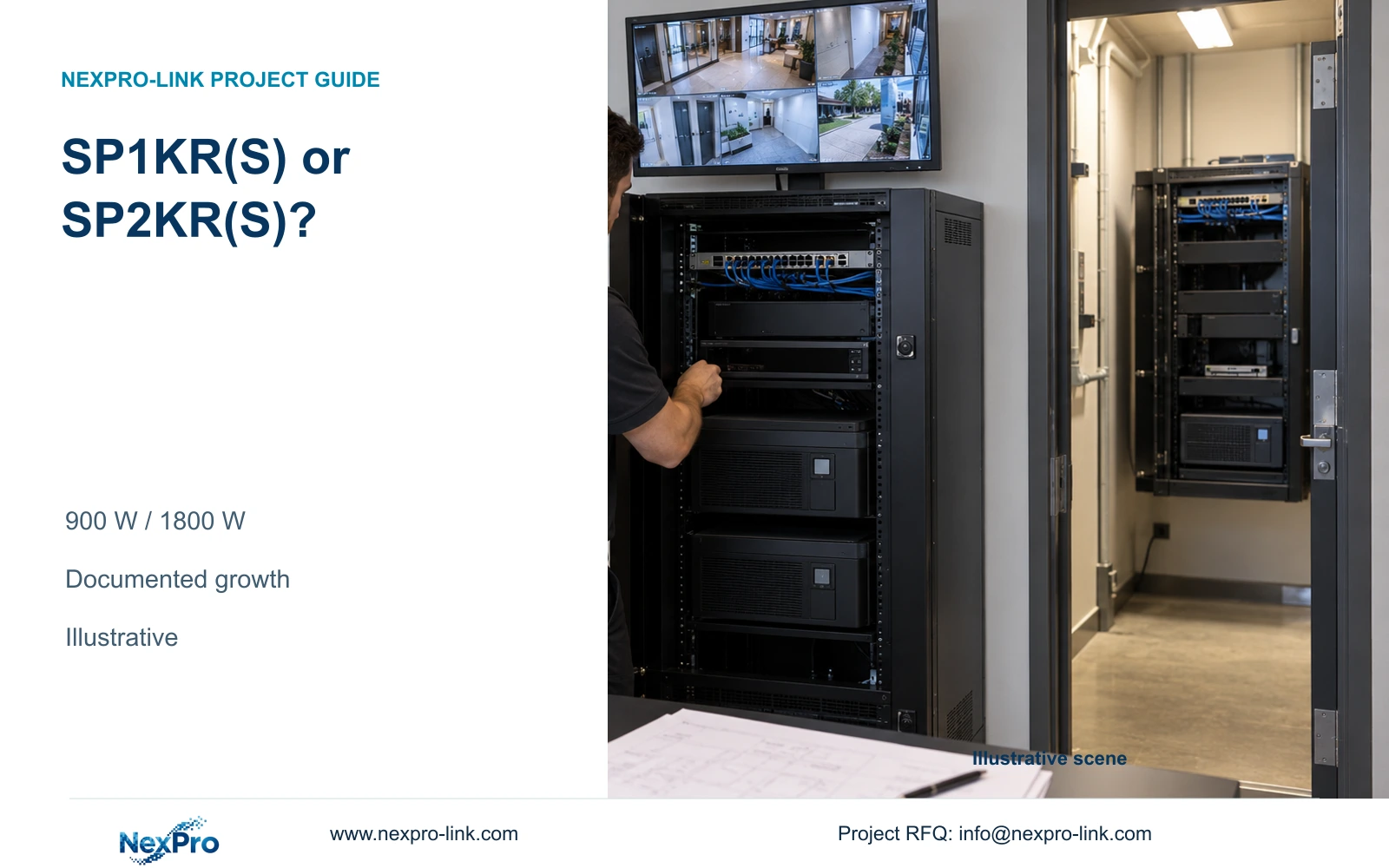
The supplied rack-series records establish SP1KR(S) at 1 kVA / 900 W and SP2KR(S) at 2 kVA / 1800 W. They do not establish the outlet count or destination-specific electrical configuration for this article. Preserve those gaps in the quotation request so a capacity-qualified model is not mistakenly described as installation-ready.
| Information | Decision supported | Further requirement |
|---|---|---|
| Physical connector match | Whether the planned connection fits | Electrical rating and approved connection scope |
| UPS W and VA ratings | Whether the unit has sufficient stated capacity | Supply, output and transient conditions |
| Destination configuration | Which exact variant to request | Local installation and changeover responsibility |
Section 03
Count the connections in the protected load schedule
List each powered device and its connection destination. Include the configured recorder, required network nodes and any essential client or decoder. Mark whether an accessory uses its own adapter or is already covered by a complete device power figure. The schedule should allow the supplier to identify required leads and distribution scope without inventing an outlet count.
Keep optional displays in a separate group. Adding a screen may change the connection arrangement and the battery load even if the core recording equipment remains unchanged. Confirm that the same functions are retained when comparing a direct connection arrangement with a proposed distribution package.
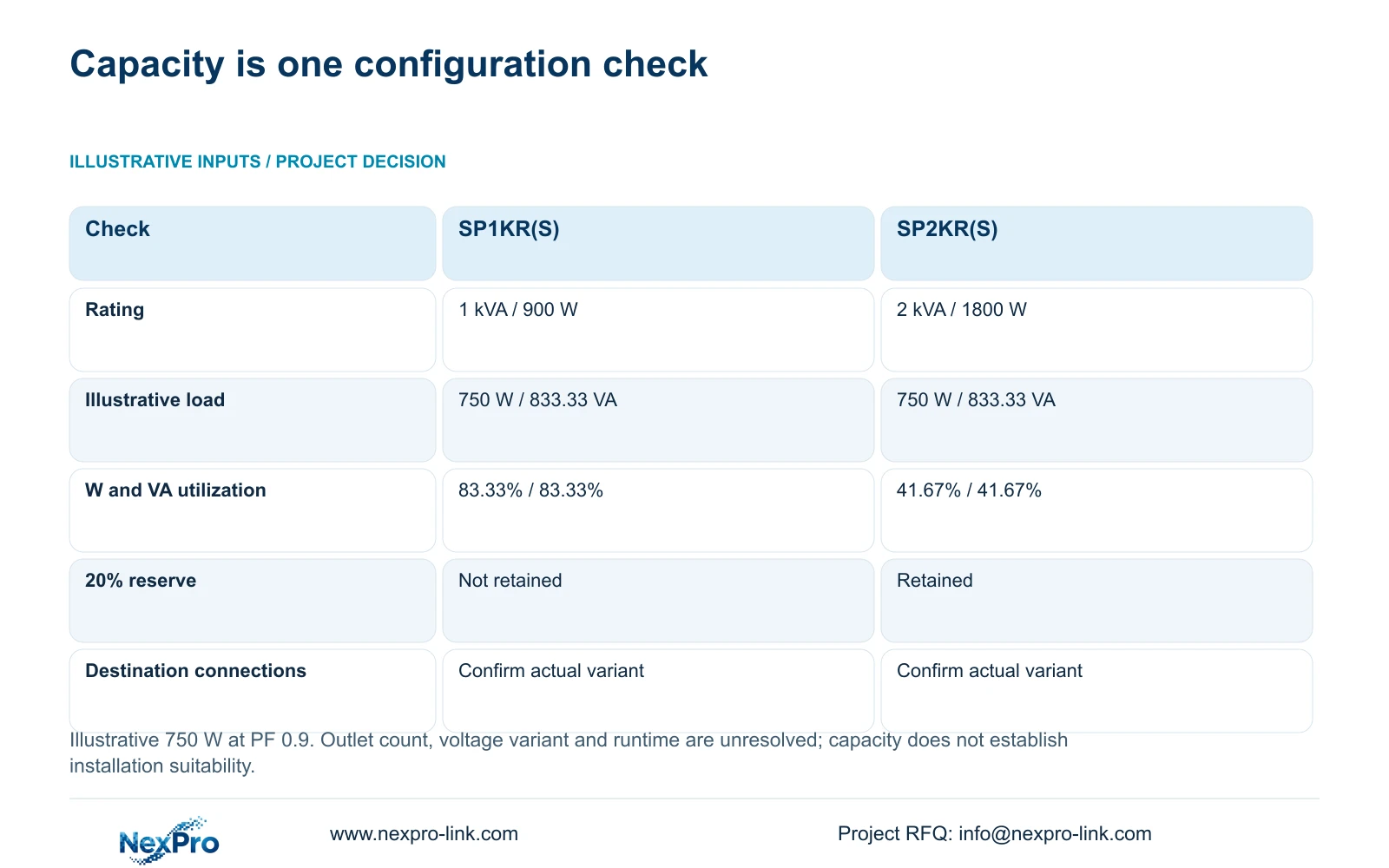
For the capacity illustration, the protected AC group is assumed to draw 750 W at aggregate power factor 0.9. Load VA = W / PF gives 833.33 VA. Divide 750 W and 833.33 VA by each candidate's respective ratings to calculate utilization. These teaching inputs describe neither a measured rack nor its connection count.
Section 04
Compare tower and rack arrangements after checking capacity
The capacity table compares two rack candidates because their exact ratings are supplied. At the assumed load, both exceed the steady W and VA demand, but SP1KR(S) fails the chosen 20% reserve target. SP2KR(S) retains that reserve and can proceed to the destination and connection review. This result does not establish runtime or the suitability of its unconfirmed outlet configuration.
A tower alternative must be evaluated as its own model. SP2K(S), in the NX-UP-HF-002 series, is rated 2 kVA / 2000 W. SP2KR(S) is a rack model rated 2 kVA / 1800 W. Both are described as online double-conversion LiFePO4 products, but the shared 2 kVA rating does not make their watt ratings, battery arrangements or installation requirements identical.
Choose the physical arrangement around the available location and maintenance access. A rack proposal needs actual equipment dimensions and cabinet loading information; a tower proposal needs suitable placement and connection routing. Obtain those configuration details before selecting on form alone. The separate complete hotel reference cannot supply missing dimensions or destination ratings.
| Metric / condition | SP1KR(S) | SP2KR(S) |
|---|---|---|
| Published model rating | 1 kVA / 900 W | 2 kVA / 1800 W |
| Illustrative protected load | 750 W / 833.33 VA | 750 W / 833.33 VA |
| W utilization | 83.33% | 41.67% |
| VA utilization | 83.33% | 41.67% |
| 20% W and VA reserve target | Does not retain target reserve | Retains capacity reserve |
| Battery runtime | Needs configured load curve | Needs configured load curve |
Section 05
Assign the local installation interfaces
Identify who supplies the UPS connection accessories and who completes the site electrical work. The proposal should distinguish delivered equipment from circuit preparation, protection, grounding and safe changeover testing. These interfaces require project-specific professional coordination; a general hotel equipment package does not establish a universal installation method.
Keep the equipment outcome unchanged when pricing alternative arrangements. A rack-mounted option may require a different cabinet or connection scope from a tower unit. Request the complete installed-scope comparison, with missing local work visible, rather than comparing only UPS chassis prices. No real installation prices are supplied here.
The contractor and hotel team should also agree how the protected recording state will be demonstrated after installation. Verification must address the actual camera and network path, including remote dependencies. If the hotel adds protected viewing or changes the site connection method, revise the proposal and runtime assessment before relying on the previous configuration.
| Retained outcome | Extra scope | Change condition |
|---|---|---|
| Configured rack loads remain protected | Confirmed distribution and connection accessories | The selected outlet arrangement differs from the load schedule |
| Remote recording remains available | Protected supply at the remote active node | The remote closet has an independent AC source |
| Equipment can be maintained | Suitable placement or cabinet arrangement | Actual dimensions or access prevent the preferred form |
Section 06
Write the exact destination configuration into the request
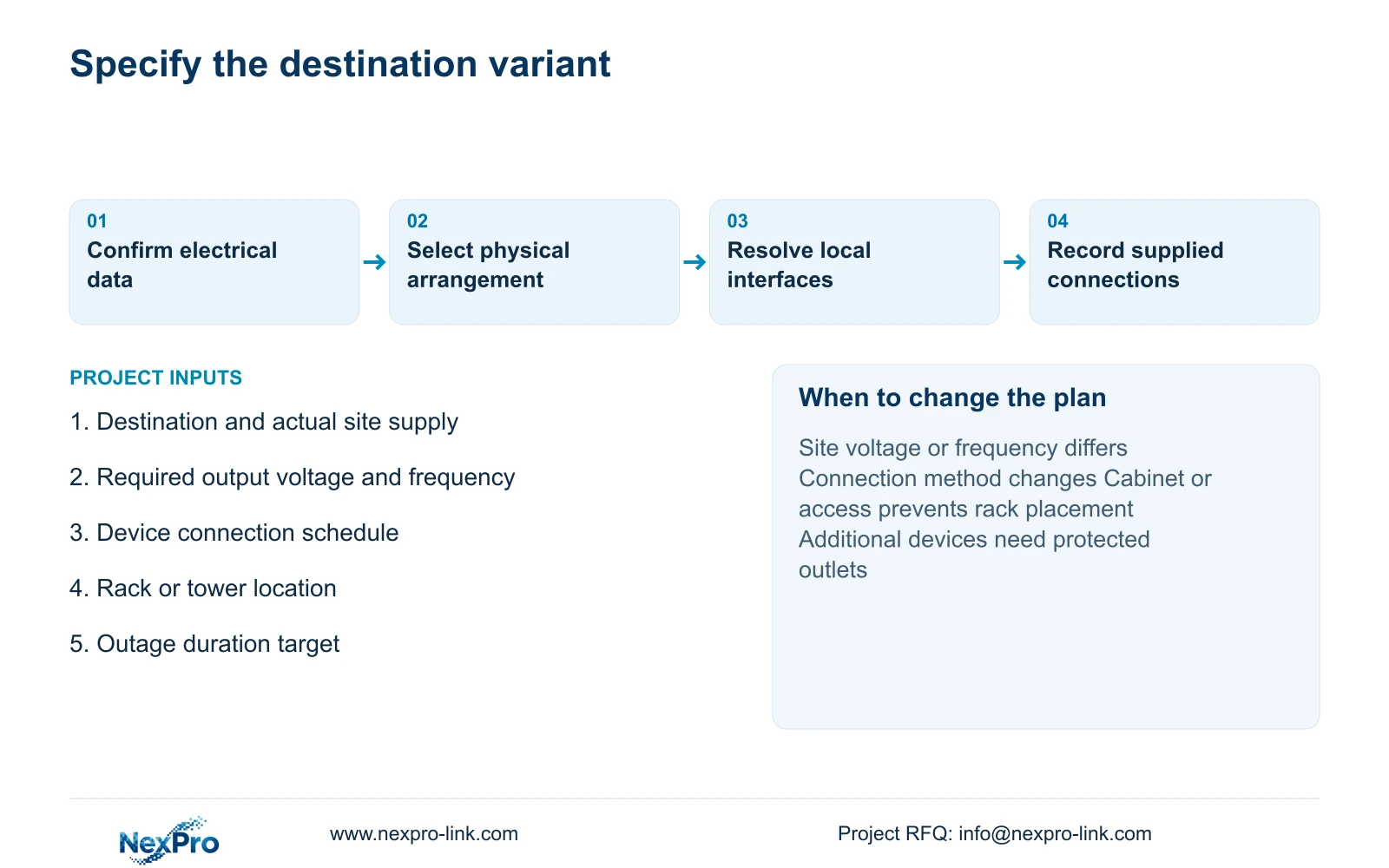
Request one identifiable configuration with its input and output requirements, connection scope and battery arrangement. Avoid an order description that names only a series and destination. Attach the load connection schedule so the supplier can respond to the actual rack and remote-node interfaces.
For the illustrated load and reserve target, SP2KR(S) is the rack capacity candidate. Retain it only if the supplied variant fits the confirmed voltage, frequency and installation arrangement. Consider SP2K(S) where tower placement suits the site, using its own 2 kVA / 2000 W rating and configuration information. Change either choice if the actual load or connection requirements differ.
Send info@nexpro-link.com the destination, confirmed supply voltage and frequency, protected device connection list, preferred rack or tower location and required outage duration. NexPro-Link can discuss model matching and coordinated equipment supply through its hotel project and BOQ support routes. The written response should state unresolved interfaces and the locally executed installation scope.
Section 07
Buyer questions
Is the destination country enough for a first UPS quotation? It is useful context, but add the actual site supply and load connection requirements. If they are still provisional, ask for a conditional quotation that identifies which configuration fields must be resolved.
Can we substitute SP2K(S) for SP2KR(S) because both are 2 kVA? Treat it as a model change. The supplied watt ratings are 2000 W for SP2K(S) and 1800 W for SP2KR(S). Confirm physical placement, connections and the supported battery configuration before accepting the substitute.
What should a destination-specific quotation include? Ask for the exact UPS configuration, stated electrical conditions, supplied connection accessories and battery scope. Keep circuit work and local installation responsibilities separately identified.
Engineering references
These sources support the general planning principles. Always use the selected product's current datasheet and applicable project standards for final design.