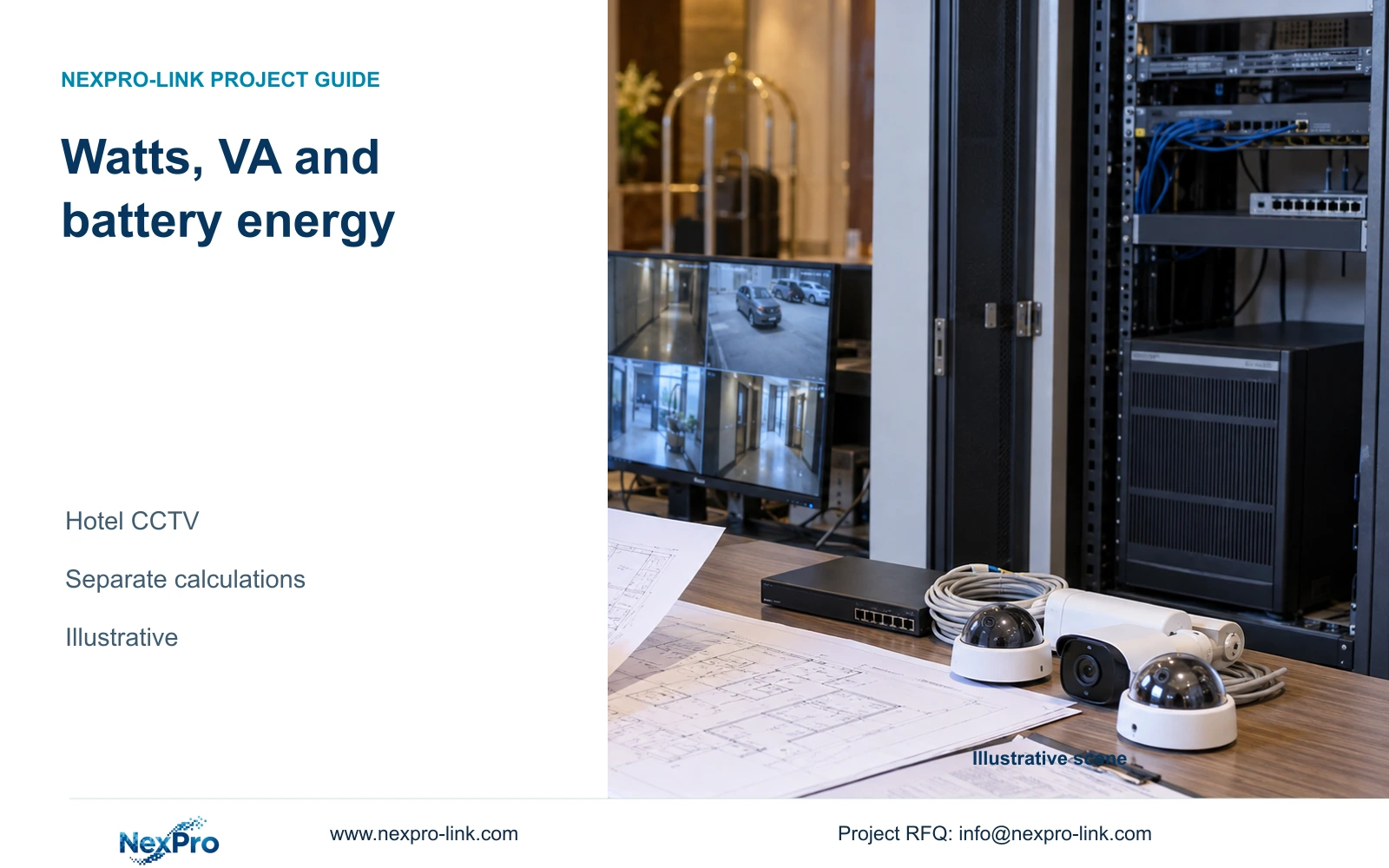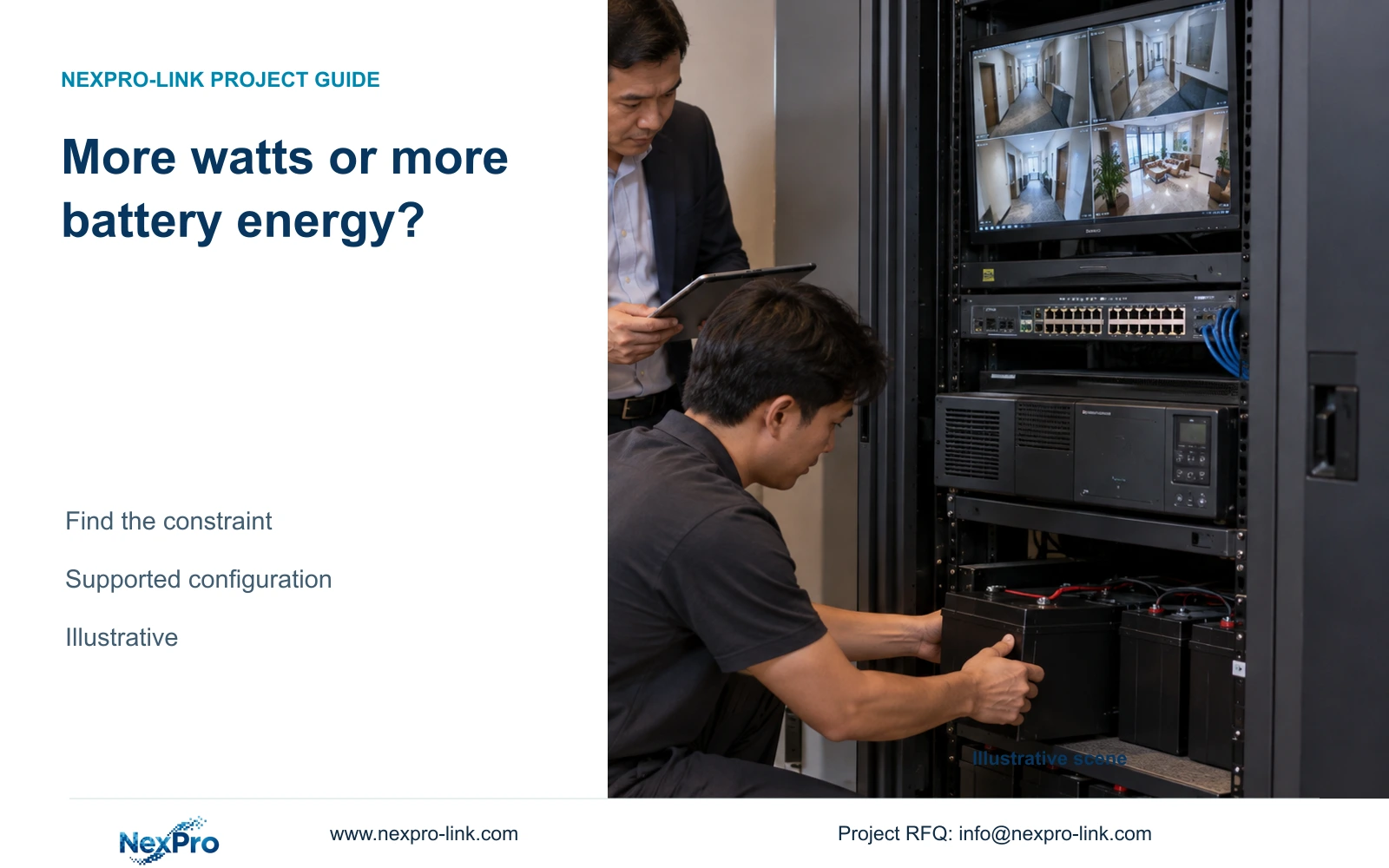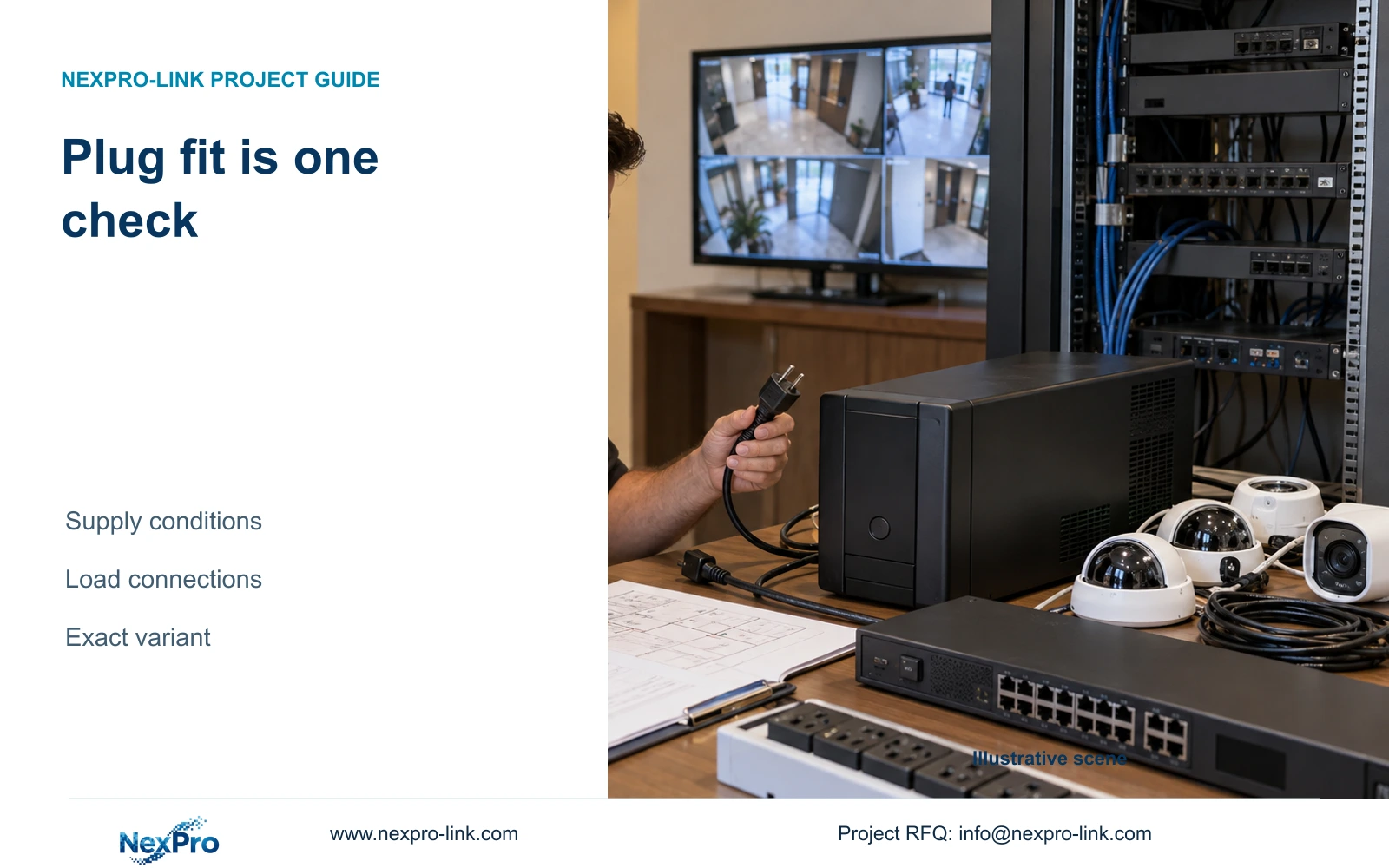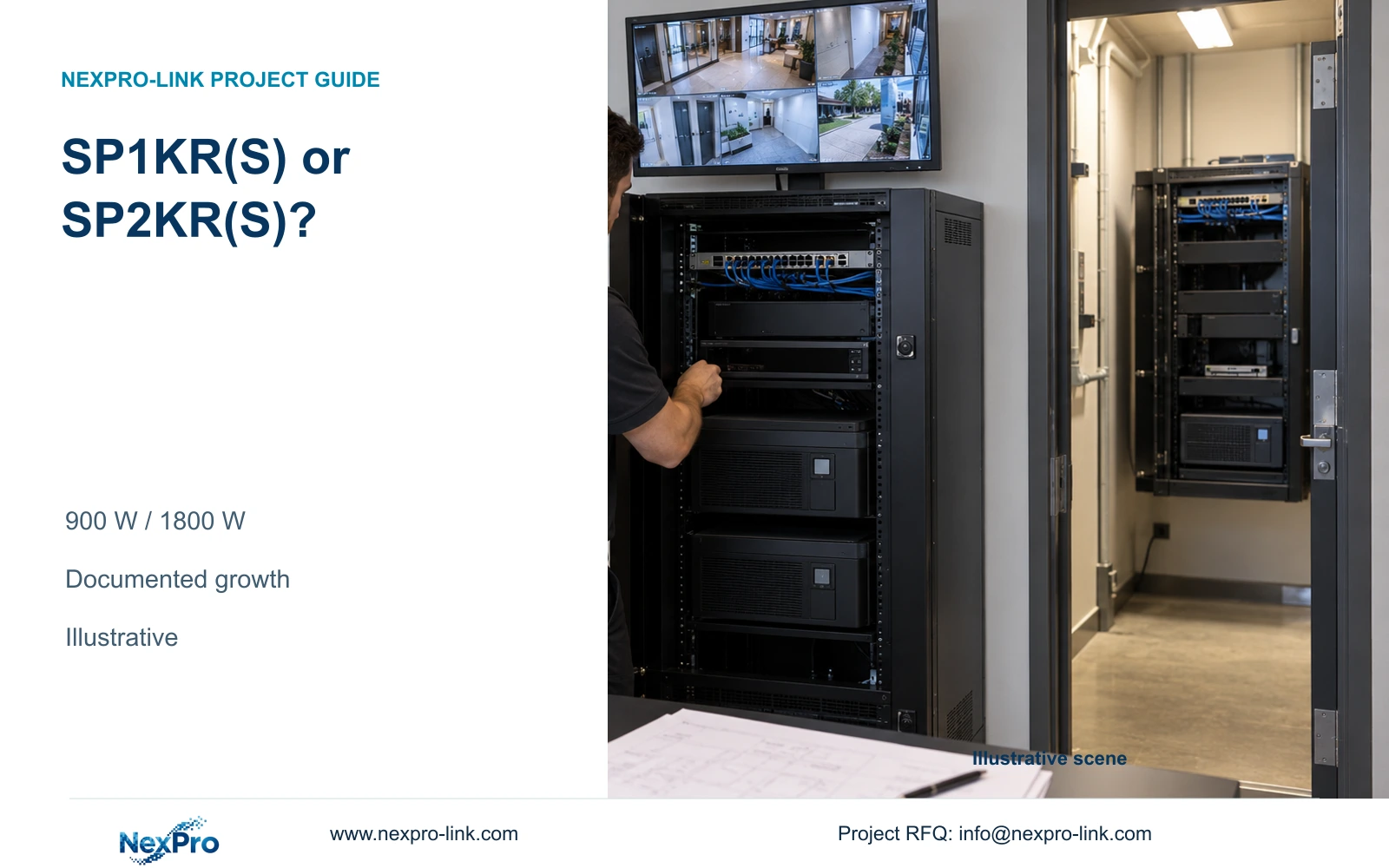
For a proposed rack addition, update the protected W and VA demand using its actual source basis, then compare both models under the same agreed reserve. Keep the battery-duration check separate.
Section 01
Select the exact rack model before comparing capacity
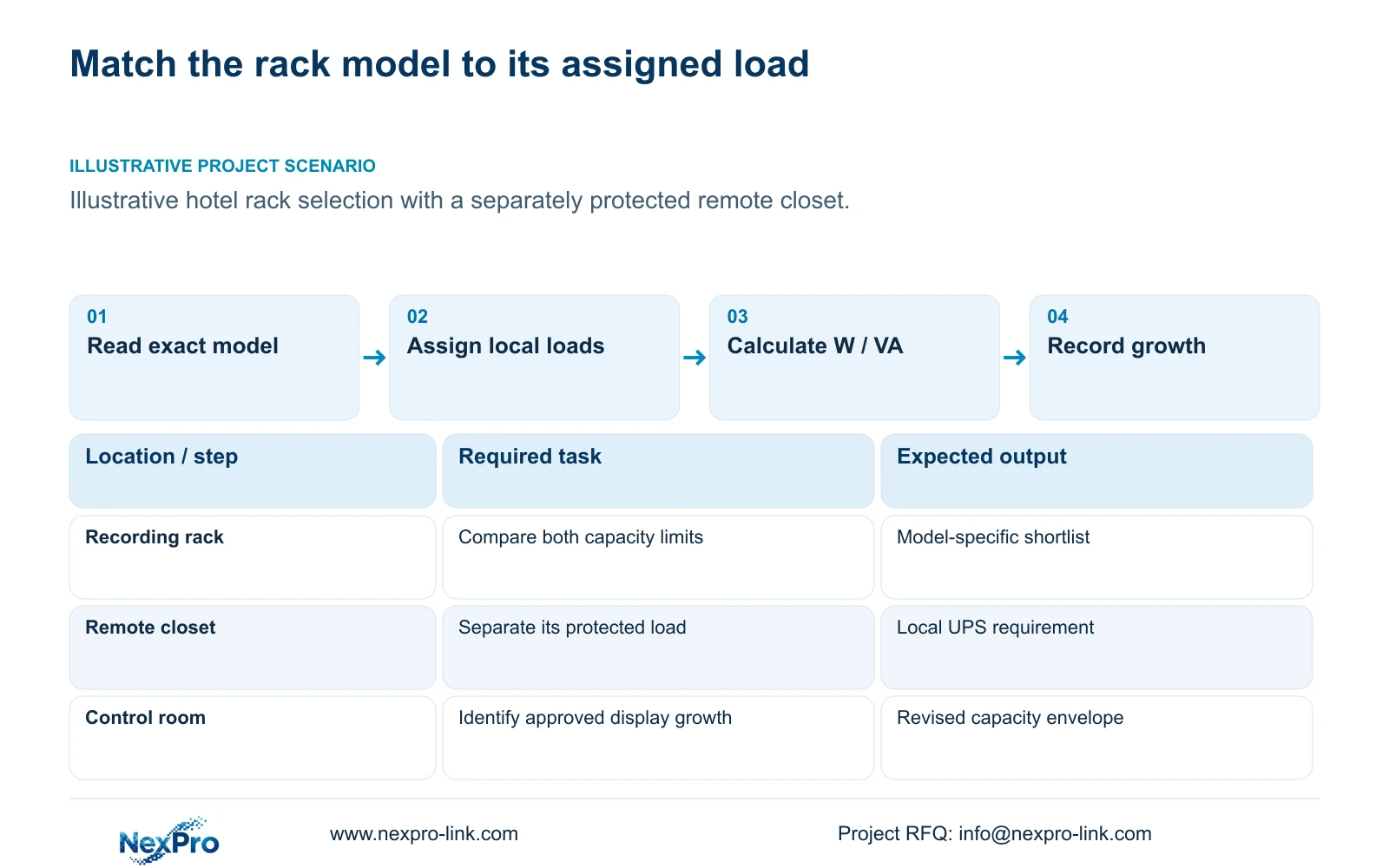
For a proposed rack addition, update the protected W and VA demand using its actual source basis, then compare both models under the same agreed reserve. Keep the battery-duration check separate. If a larger model is needed only after the addition, preserve that trigger instead of describing every current rack as needing the upgrade.
Choose SP2KR(S) for the illustrative 750 W, PF 0.9 load when the hotel requires 20% unused capacity in both W and VA. SP1KR(S) exceeds that steady load but misses the reserve target. Retain SP1KR(S) as an option when the verified load fits its agreed reserve and its separate battery configuration meets the duration requirement.
The supplied NX-UP-RM-002 record lists SP1KR(S) at 1 kVA / 900 W and SP2KR(S) at 2 kVA / 1800 W. Both are rack online double-conversion LiFePO4 candidates. Keep the exact spelling on the BOQ and quotation so the watt limit, configuration and supporting documents refer to the same equipment.
Do not substitute the tower model SP2K(S), rated 2 kVA / 2000 W, into a comparison labeled SP2KR(S). Before allocating rack space, obtain the selected equipment's actual installation dimensions and support requirements. The source establishes capacity ratings, but it does not establish a common battery arrangement or identical runtime for these models.
| Required task | Known field | Selection still needed |
|---|---|---|
| Carry protected rack load | SP1KR(S): 1 kVA / 900 W | Load, reserve and battery arrangement |
| Carry higher protected load | SP2KR(S): 2 kVA / 1800 W | Voltage, placement and runtime curve |
| Consider tower placement | SP2K(S): 2 kVA / 2000 W | Separate tower installation scope |
Section 02
Calculate the load assigned to this protection zone
Trace the equipment needed to retain the hotel's agreed outage service. The list normally includes the required PoE access nodes, network connections and recorder with disks. Add operator equipment only when viewing is part of the protected task. An NVR that remains powered cannot record new images from an unpowered camera path.
Use complete switch AC input or a bottom-up camera estimate with losses, never both for the same group. Label each value as measured, maximum or assumed. Record which operating condition it represents, especially where illumination changes camera demand. The load assigned to the rack must reflect the actual protected supply arrangement.
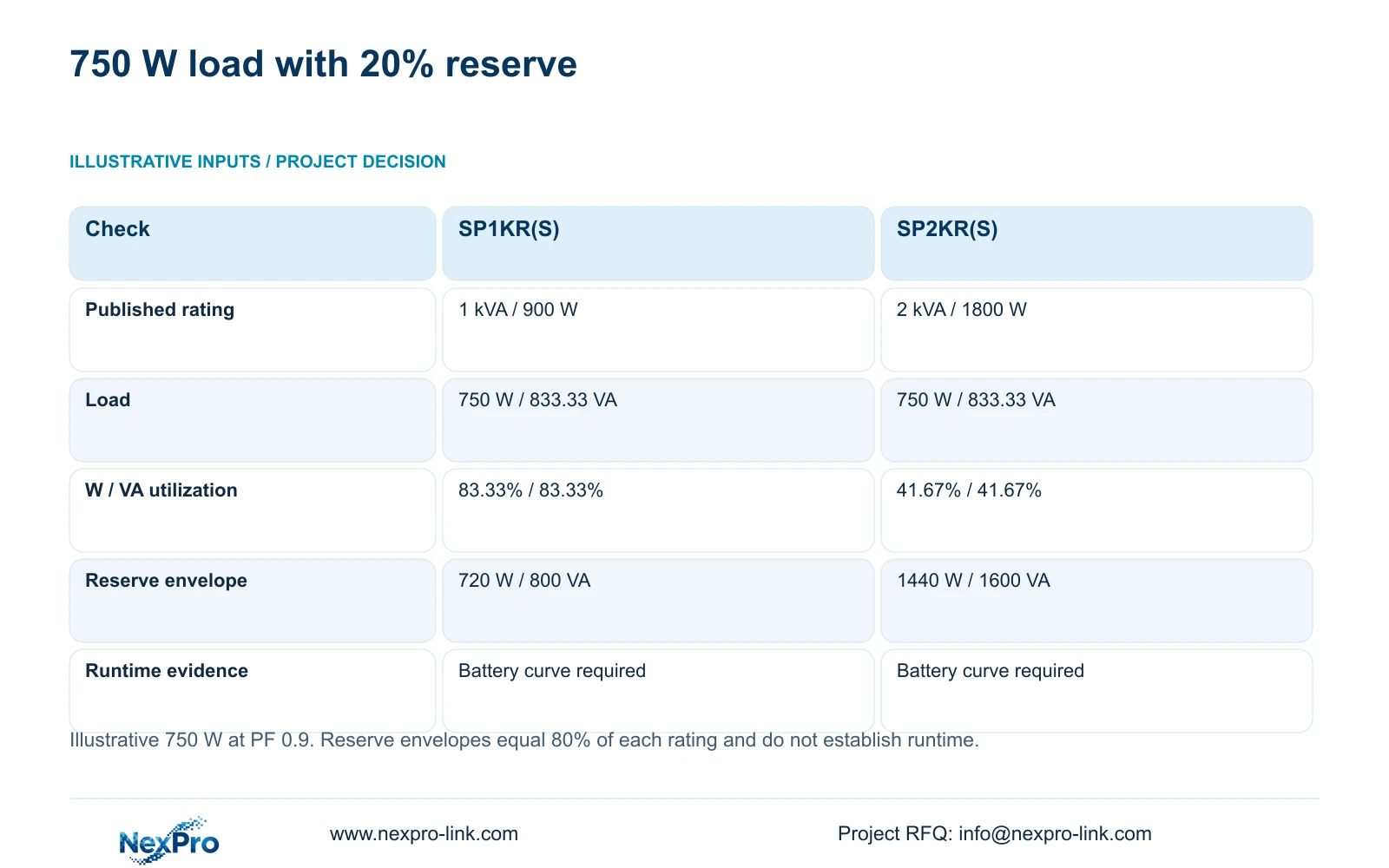
For the independent comparison here, assume 750 W AC and aggregate PF 0.9. Apparent power is 750 / 0.9 = 833.33 VA. The 32-camera reference has a different complete load schedule and distributed-node considerations. Its totals provide context, not additional equipment watts to append to this example.
| Situation | Required record | Decision boundary |
|---|---|---|
| Existing load remains unchanged | Approved W and VA basis | Retain its current model decision |
| New rack item is proposed | Incremental demand and reserve rule | Recheck both capacity limits |
| Capacity passes, duration unproved | Supported battery/load evidence | Request runtime separately from model size |
Section 03
Compare utilization and the specified reserve
Divide load W by rated W and load VA by rated VA. SP1KR(S) uses 750 / 900 = 83.33% of its watt rating and 833.33 / 1000 = 83.33% of its VA rating. SP2KR(S) uses 41.67% of each. Both steady loads are below the published ratings.
A 20% reserve target permits at most 80% utilization. At that target, the smaller candidate's capacity envelope is 720 W and 800 VA; the larger candidate's is 1440 W and 1600 VA. These are derived planning limits for this reserve policy, not additional product ratings.
The 750 W example crosses the smaller candidate's reserve envelope, so SP2KR(S) is the capacity recommendation. This does not mean SP1KR(S) cannot carry 750 W at all. It means the proposed load and specified allowance do not fit together. If the owner changes the reserve policy, document that decision instead of concealing it in model selection.
| Metric / condition | SP1KR(S) | SP2KR(S) |
|---|---|---|
| Model rating | 1 kVA / 900 W | 2 kVA / 1800 W |
| Protected load | 750 W / 833.33 VA | 750 W / 833.33 VA |
| W utilization | 83.33% | 41.67% |
| VA utilization | 83.33% | 41.67% |
| 20% W and VA reserve | Does not retain target reserve | Retains capacity reserve |
| Battery runtime | Configured load curve required | Configured load curve required |
Section 04
Select batteries independently of the capacity result
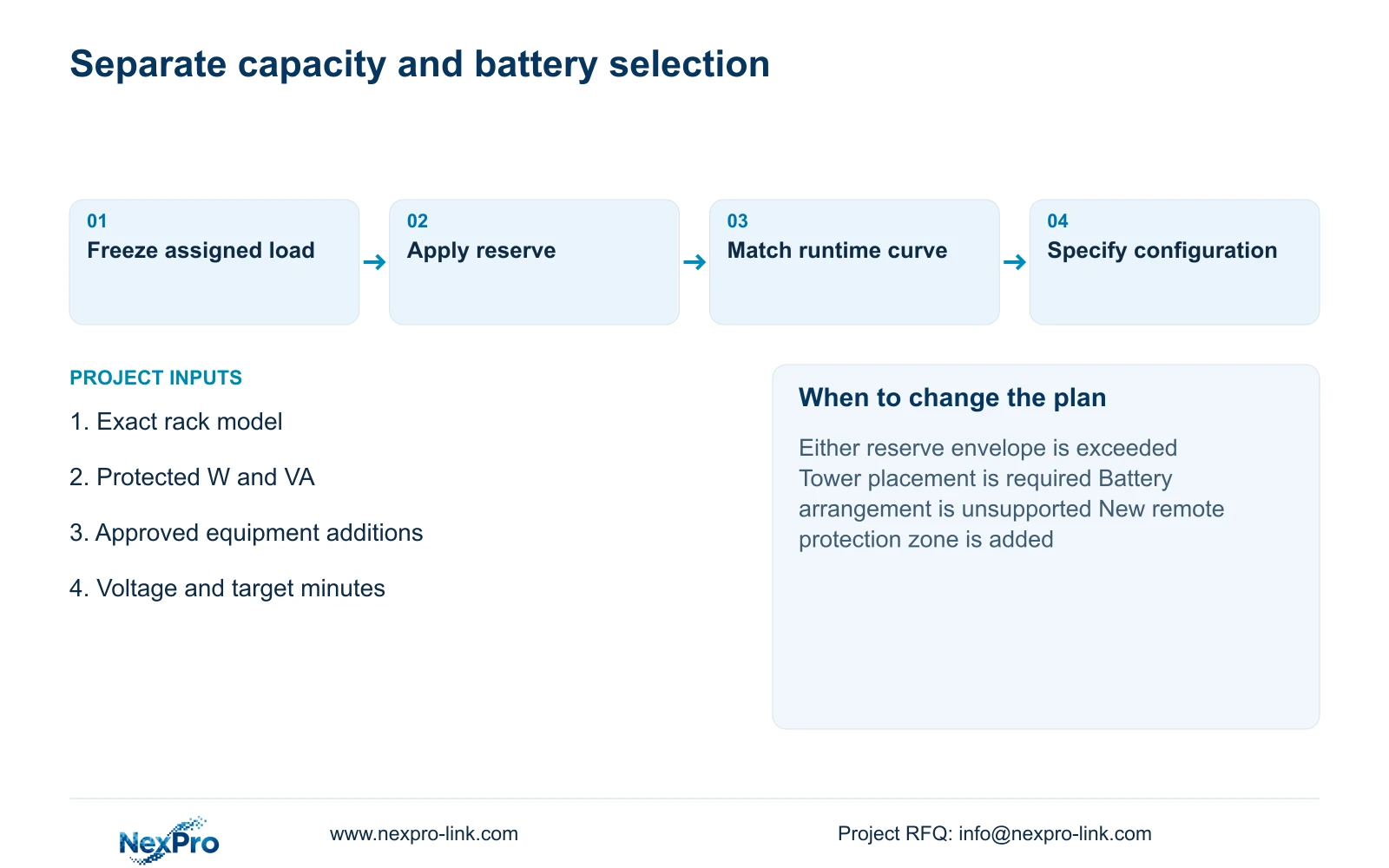
The lower loading percentage of SP2KR(S) does not prove a longer backup duration. Obtain a supported battery configuration and runtime information at the actual protected load. The series page's default battery energy for another selected model cannot be transferred to SP2KR(S), including a displayed 960 Wh value.
Compare duration using the same outage task, operating temperature and battery conditions. Temperature, condition, discharge behavior and protective limits affect achievable minutes. A simple W × hours calculation describes output energy; conversion losses and usable energy affect the required nominal budget.
External battery selection also involves voltage, BMS, charging and the manufacturer's supported arrangement. Do not combine packs from a Wh total or assume that a higher kVA model accepts an existing battery assembly. A technically complete comparison names the conversion unit and battery configuration separately, with runtime evidence tied to their combination.
Section 05
Reserve capacity for documented additions
List approved growth by equipment and protection zone. Additional entrance cameras change the PoE load; another recorder adds its own AC demand. A new wall display changes the load only if the owner requires it to remain active during the outage. Avoid a general growth percentage that duplicates additions already included in the schedule.
The supplied hotel reference illustrates the effect of protecting optional display equipment. Its base arrangement totals 663.77 W, while the arrangement with an additional assumed 580 W wall and decoder totals 1243.77 W. Those independent case figures lead to different capacity candidates under the stated reserve, but they do not alter this article's 750 W comparison.
Evaluate the battery curve again after approved additions. Capacity reserve accommodates load growth without establishing energy for the same minutes. If new equipment sits in a separately powered closet, allocate protection there instead of treating unused central capacity as a completed solution. Quote the added battery, installation and distribution scope alongside the conversion unit.
| Retained outcome | Additional scope | Change condition |
|---|---|---|
| Recording with agreed reserve | Higher-capacity conversion unit | Revised W or VA exceeds smaller envelope |
| Recording for longer | Supported battery configuration | Capacity passes but runtime misses target |
| Outage wall viewing | Display load and battery allowance | Owner requires sustained wall operation |
Section 06
Specify the selected capacity and its conditions
Use SP2KR(S) as the capacity candidate for the stated 750 W example with 20% reserve. Reconsider SP1KR(S) when both verified load figures fit its reserve envelope and no approved addition pushes them beyond it. Reconsider either model when the voltage, environment, physical installation or required battery arrangement cannot be supported.
For a useful comparison, send info@nexpro-link.com the protected W and VA schedule, required minutes, voltage and approved growth list. Include rack location and whether remote nodes have separate power protection. NexPro-Link can coordinate a model-specific equipment proposal and BOQ response. Its supporting supply scope does not automatically include local installation or every third-party interface.
Keep service terms alongside the chosen configuration. The supplied policy gives applicable main equipment a 24-month limited hardware baseline from receipt; battery and project-order terms are separately scoped. A quoted capacity upgrade does not create a longer warranty or include site attendance unless the controlling order says so.
Section 07
Buyer questions
Can a lower power factor change the model choice? Yes. For the same watts, a lower power factor increases VA. Check the revised apparent-power utilization against its own limit and reserve; satisfying the watt condition alone is insufficient.
Must all hotel UPS units use the larger model? No. Select each actual protection zone from its assigned load and required service. A larger central model cannot compensate for an unprotected remote switch, and a lightly loaded zone may qualify for the smaller candidate.
What makes the two quotations comparable? Keep load, reserve, voltage, duration and outage tasks identical. Require a named battery arrangement and identify installation, support and replacement boundaries. Without those fields, the comparison covers only part of the required system.
Engineering references
These sources support the general planning principles. Always use the selected product's current datasheet and applicable project standards for final design.