Use one qualified recorder when centralized operation and its failure boundary are acceptable. Split recording only when the hotel needs defined groups to remain available independently.
Section 01
Choose the recording groups and their survival requirements
Choose one qualified 49-channel NVR when it meets the hotel stream, storage and replay requirements and the owner accepts its recorder-wide failure boundary. Choose two smaller recorders when dividing recording into defined groups provides a required operational benefit. Two units do not automatically provide hot standby, duplicate footage or recovery of recordings assigned to the failed unit.
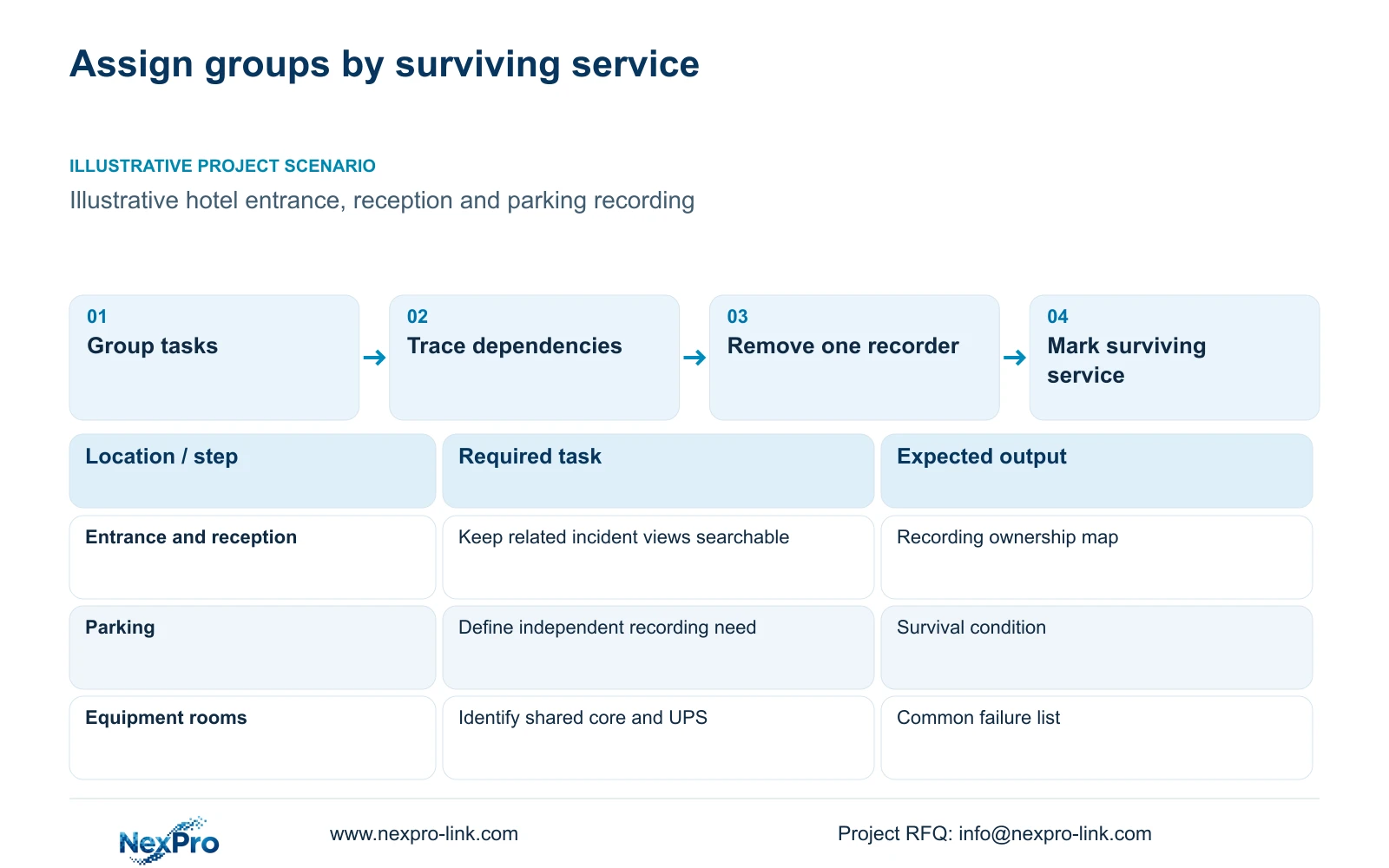
Group cameras by the service that must remain available. Entrance and reception footage may be reviewed together, while parking and exterior-service routes may have a different network or equipment-room boundary. A floor-based split is useful only when it supports those operating and fault requirements.
Trace the camera-to-recorder path for each group, including PoE access, backbone and protected power. A recorder in a separate room still depends on any shared network device needed to reach its cameras. Define the surviving service before choosing equipment quantities, and keep sensitive private spaces outside the coverage schedule.
| Required task | Given information | Decision still needed |
|---|---|---|
| Entrance and reception review | Related public-area event views | Keep together or use supported cross-recorder search |
| Parking recording during another recorder fault | Separate recording group proposed | Identify shared network and power dependencies |
| Outage recording | NVR protection requested | Include essential PoE and backbone nodes |
Section 02
Calculate each recorder load without changing the service
Use the same camera schedule and retention policy for both architectures. For each proposed recorder, sum only its assigned recording streams. Keep local replay, client retrieval and exports visible as separate operating tasks. Dividing channels changes where work occurs; it does not reduce the total amount of footage required by an unchanged policy.
The supplied illustrative calculation compares 32 streams averaging 4 or 6 Mbps each. Input equals cameras×average Mbps. The totals are 128 and 192 Mbps, against a stated 256 Mbps planning ceiling calculated as 320×0.80. This table compares bitrate profiles, not one recorder against two.
A split design requires a new row for each actual recording group and its selected recorder limit. Do not copy the 320 Mbps product rating to an unspecified smaller recorder. Evaluate usable storage for each group independently because free capacity elsewhere is not automatically available to a full recorder.
| Metric / condition | 4 Mbps per camera | 6 Mbps per camera |
|---|---|---|
| Cameras | 32 | 32 |
| Aggregate video input | 128 Mbps | 192 Mbps |
| Illustrative 256 Mbps planning ceiling | Within | Within |
| 30-day video data | 41.472 TB | 62.208 TB |
| Recording modes / decoding / disks | Separate model checks | Separate model checks |
Section 03
Compare failures at the service boundary
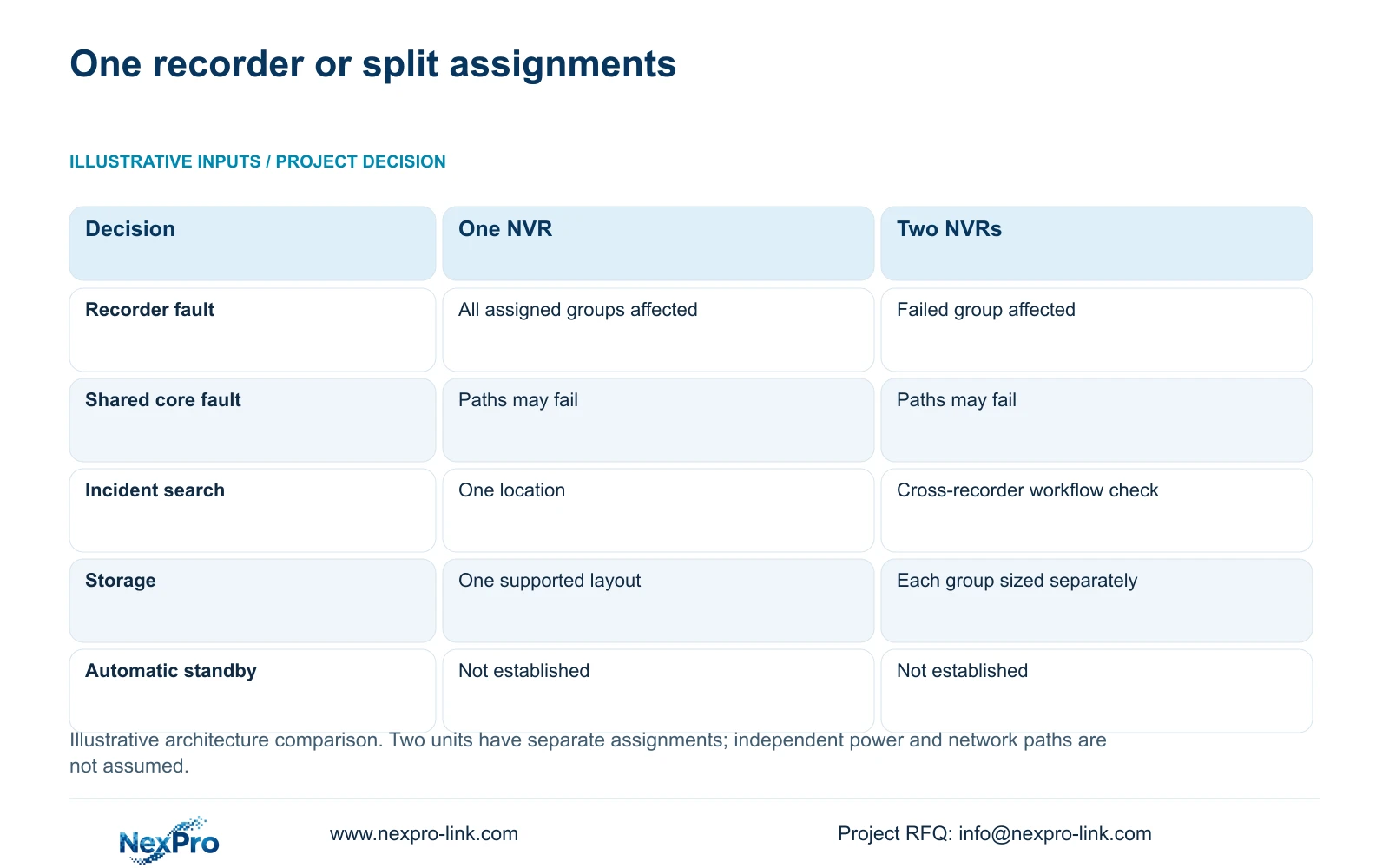
With centralized recording, a recorder outage affects its assigned recording service across the hotel. With split recording, a failed recorder affects its own group, provided the other group retains its required cameras, network and power. Existing footage and new recording must be assessed separately during a failure.
A shared core switch or UPS can remain a common failure dependency in either design. Draw the failed component explicitly and mark which cameras can still reach a working recorder. A drawing with two recorder icons is insufficient to establish independent operation.
If the owner requires continued recording of the same critical cameras after recorder failure, define a supported duplication or recovery architecture separately. Dividing camera assignments does not provide that outcome. Record the accepted limitation in the proposal so operators do not discover it during an incident.
| Condition | One recorder | Two assigned recorders | Hotel consequence |
|---|---|---|---|
| Recorder unavailable | Assigned system affected | Failed group affected | Other group survives only with working dependencies |
| Shared core unavailable | Required paths may fail | Required paths may fail | Recorder count does not remove the shared dependency |
| Maintenance | One recording boundary | Group-specific boundaries | Search and service procedures must identify the affected group |
| Hot standby | Not established | Not established | Needs separate supported design |
Section 04
Review the incident search across recording groups
An incident may start at the entrance, continue through reception and appear later on a public route. With one recorder, operators search one recording location. With multiple recorders, the client may provide a suitable combined workflow, or the operator may need to select each location. Verify the actual software behavior before counting this as equivalent service.
Define a representative investigation with named camera identities and an approved time interval. Check selection, time alignment, simultaneous replay and export on the intended client version. Repeat the task with one recorder unavailable to establish what can still be retrieved. Do not claim a time saving without recorded observations.
Handover should identify which recorder owns each camera and where its footage is found. Permissions, account ownership and escalation contacts need the same clarity. ONVIF support does not establish every retrieval, event or account function across the proposed equipment.
Section 05
Include the disks, power and equipment-room consequences
Compare full disk arrangements, occupied rack space, protected AC loads and maintenance access. Two smaller recorders may change the number and distribution of disks even when total retention remains identical. Disk capacity allocated to one group should not be treated as spare capacity for another unless the supported system actually provides that arrangement.
NexPro-NVR4449-4K lists four SATA bays and 18 TB per drive. Its 49-channel summary lists 49×5MP and 9×4K, so supported recording modes remain a qualification step. NexPro-NVR2232-4K lists two SATA bays, but its 2×8 TB versus 2×18 TB capacity information and playback fields conflict. These cannot support a finished two-recorder disk proposal without clarification.
CASE01 is an independent single-recorder reference with an assumed 60 W recorder-and-disk load. That value is not a product rating and cannot establish the power difference for a two-recorder design. Use actual proposed AC-load information, and avoid adding camera power again when a complete PoE-switch AC input already includes it.
Section 06
State the chosen architecture and its accepted limitation
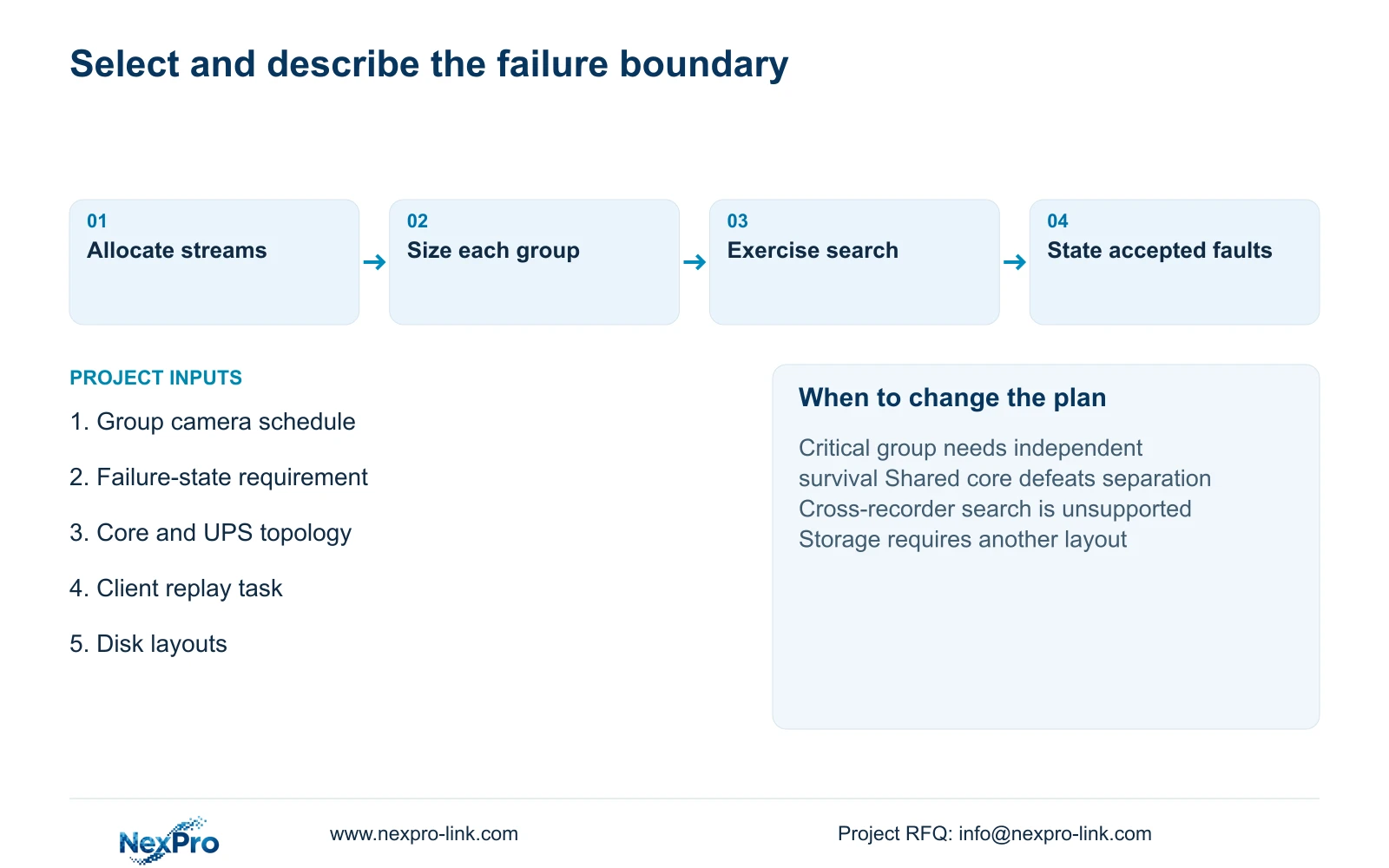
For a single hotel with a workable central recording path and accepted common recorder exposure, start with one fully qualified recorder. Change to split recording when a named group must remain operational through another recorder's maintenance or failure, and the supporting network, power and operator workflow preserve that benefit.
If the requirement is continuity for every critical camera, review a separately supported recovery design. If the problem is disk space alone, compare a suitable larger storage arrangement before adding another search location. NexPro-NVR8864-4K offers eight listed SATA bays but retains a 320 Mbps listed input ceiling; it changes some resources without resolving every constraint.
Send the group schedule, topology, required failure states and cross-group replay task to info@nexpro-link.com. NexPro-Link can compare model matching and coordinated equipment scope through hotel project and BOQ support. The response should distinguish CCTV manufacturing, ancillary supply coordination and local installation responsibilities, with the selected limitation written into the scope.
Section 07
Buyer questions
Will the second recorder take over cameras automatically? Only a specifically supported and configured recovery arrangement can establish that behavior. Two recorders with separate camera assignments continue their own work; they do not automatically inherit the failed recorder's tasks.
Can one client search both recorders? Check the exact client edition and version with the proposed devices. Request a demonstration of camera selection, synchronized replay and approved export across both locations. A device appearing online does not prove the complete investigation workflow.
Must both options have the same number of disks? No. They must meet the same retention outcome for each camera group. Supported bay layouts, formatting allowances and any explicitly supported array arrangement determine disk quantities. Compare complete configurations and their installation scope.
Engineering references
These sources support the general planning principles. Always use the selected product's current datasheet and applicable project standards for final design.