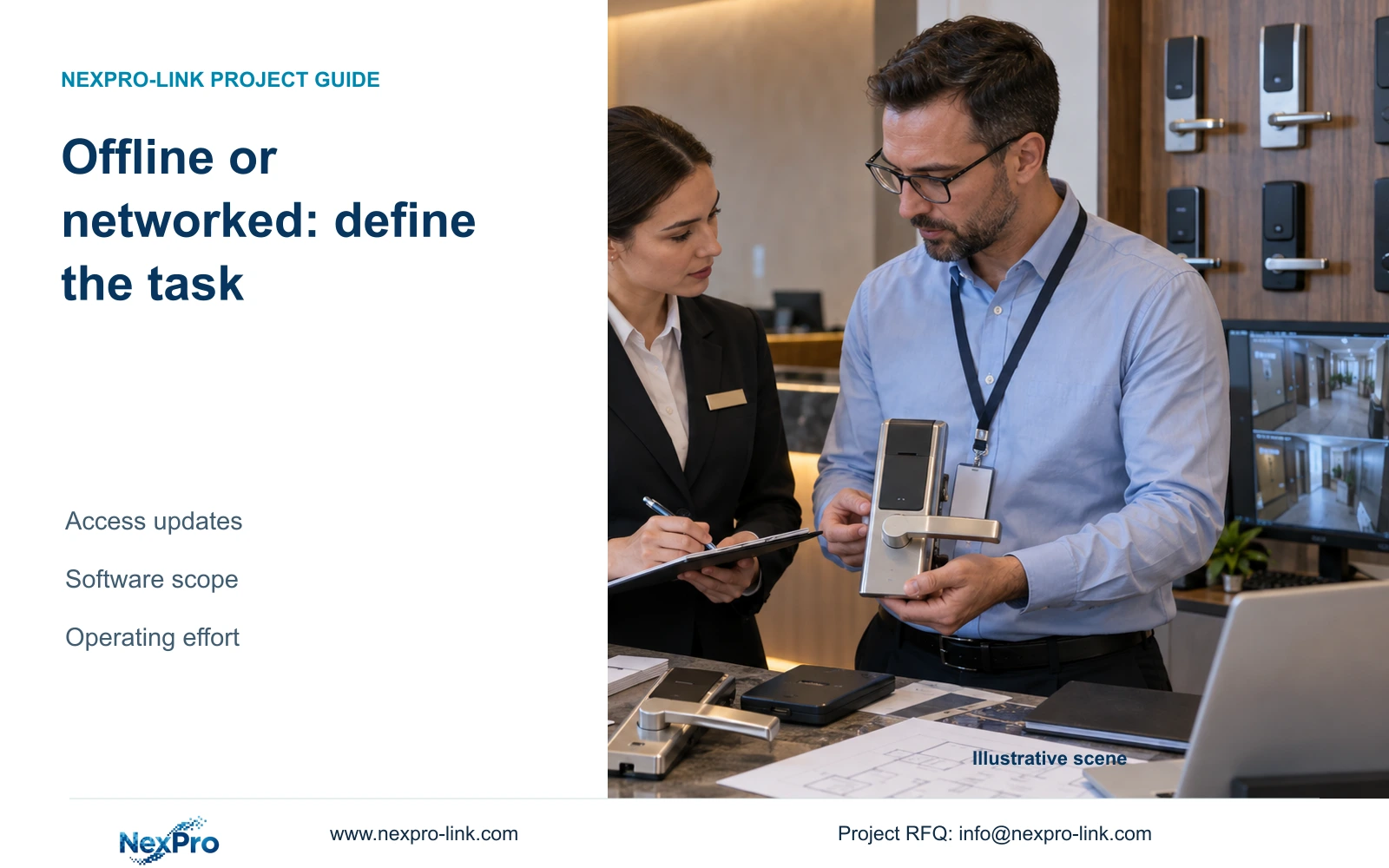
Choose offline or networked access according to the hotel's credential tasks. Include the supported update method, outage behavior and software scope before comparing cost.
Section 01
Describe the guest access workflow
Retain an offline room-lock arrangement when its supported issuance, access-update and log-retrieval methods meet the hotel's operating requirements. Choose networked access where a defined management task needs a supported remote workflow and the hotel can maintain its infrastructure. Neither architecture is inherently the safer purchase without examining permissions, fallback operation and responsibility.
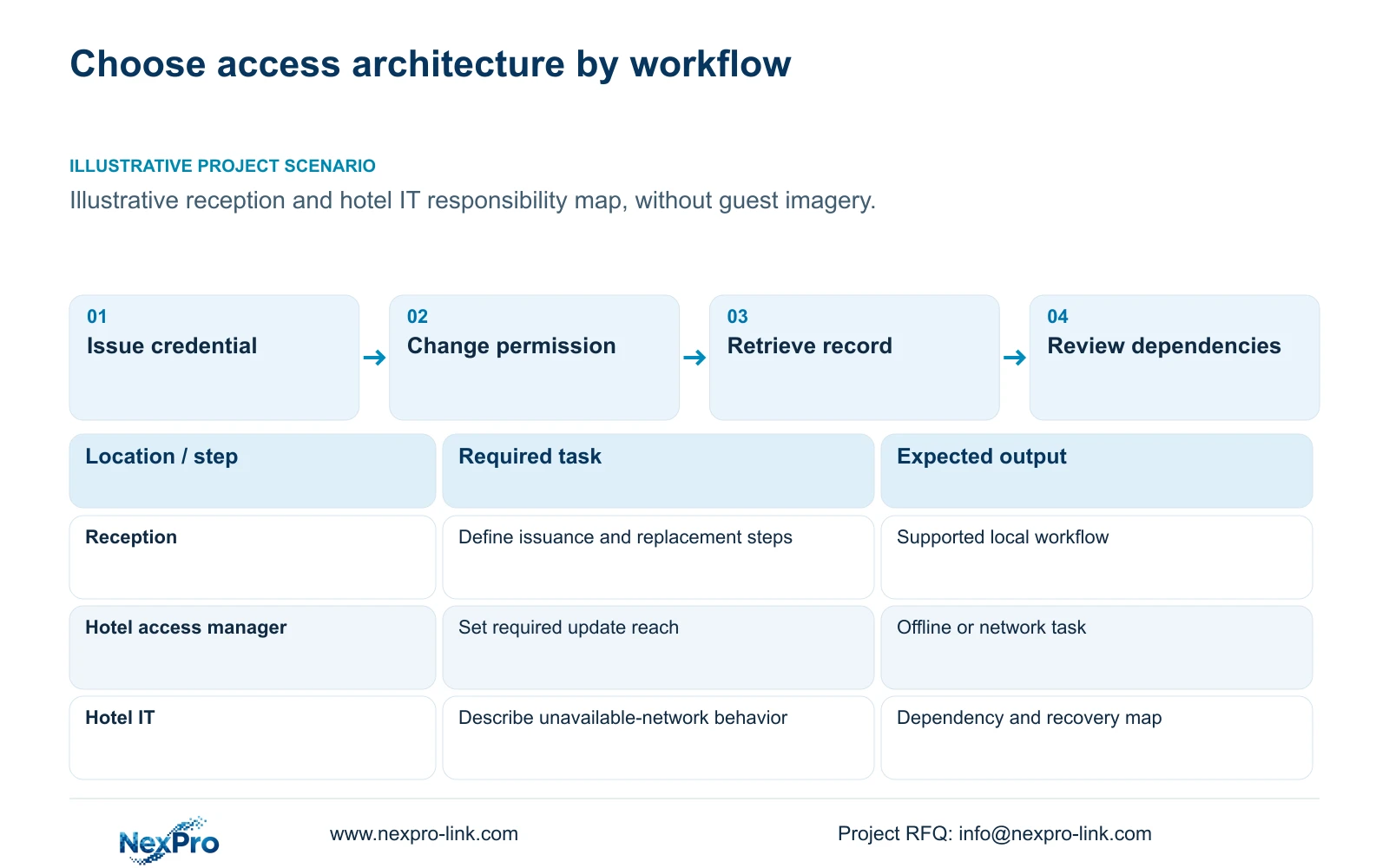
Describe the guest journey through observable actions. Reception issues a credential, an authorized person changes the permitted access when necessary, and the hotel handles loss or an exception through an agreed procedure. For each step, identify the operator, device and expected outcome. Avoid using a feature name as a substitute for the actual sequence.
A useful comparison identifies the decision that cannot be completed under the simpler arrangement. If the hotel requires a permission change to reach specified doors remotely, document that requirement and verify the proposed method. If local procedures meet the required timing, networking every room may add scope without addressing an unmet task.
| Required task | Given information | Decision still needed |
|---|---|---|
| Issue a guest credential | Reception operating workflow | Supported encoder and software combination |
| Withdraw access | Required response and affected doors | How the change reaches each lock |
| Retrieve an access record | Authorized investigation task | Supported retrieval method and data location |
Section 02
Separate room locks from staff access
Evaluate room access and staff access as separate groups. Their operating duties, power arrangements and management responsibilities may justify different architectures. A hotel can retain an appropriate room-lock workflow while specifying centrally managed staff-door access, provided the supported interfaces and handover boundaries are explicit.
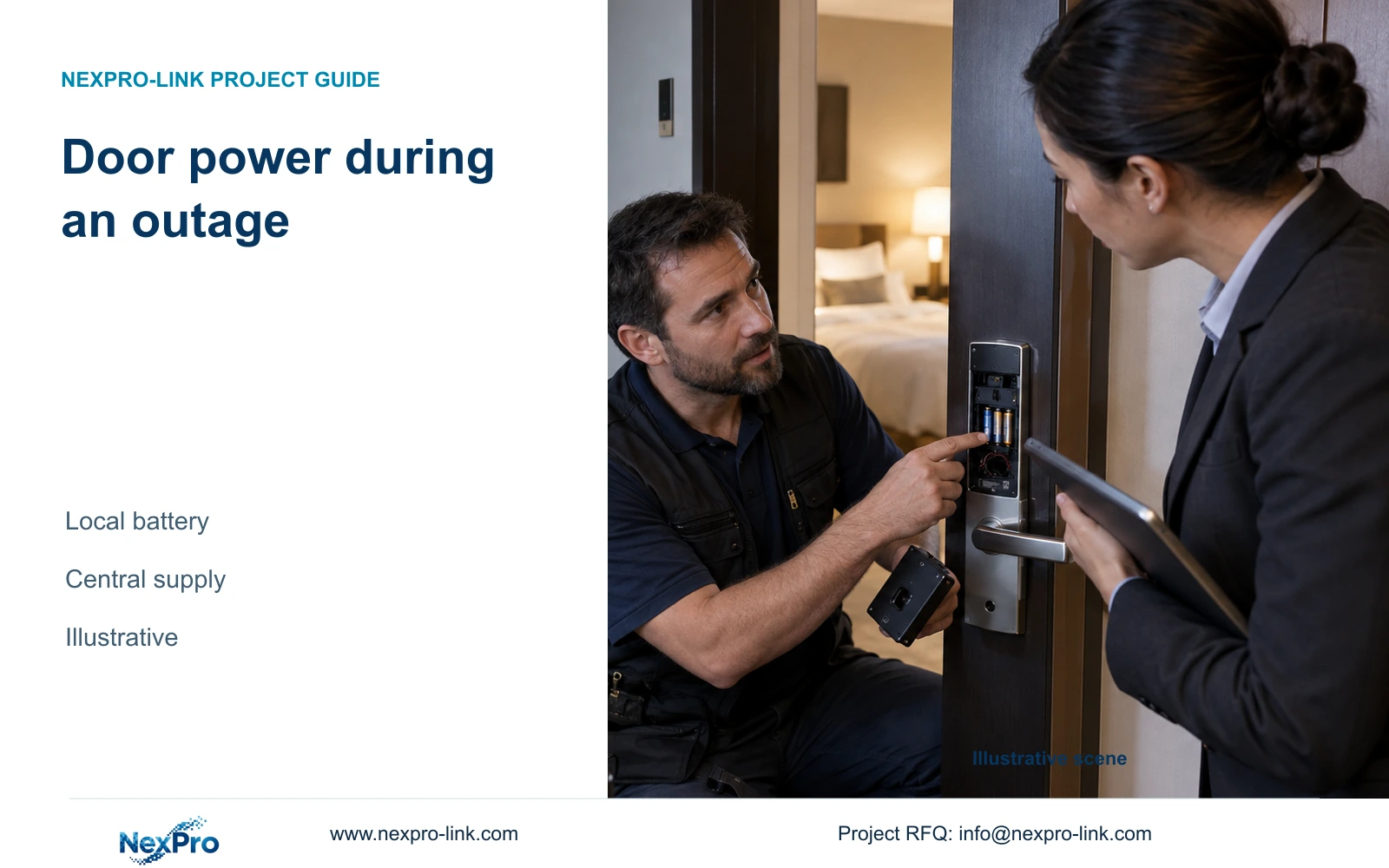
Record the actual power method for every active component. A battery-operated room lock cannot be counted as a load on the CCTV UPS simply because both systems share a procurement package. A powered controller, gateway or staff-door component may create a separate supply dependency. Determine what remains operational when that dependency is unavailable.
The supplied illustrative hotel case defines a CCTV recording path independently of its door scope. Its camera power and storage totals provide no capacity allowance for lock-network infrastructure. Emergency egress and safe release also remain with the responsible local specialist. Camera observation does not replace access authorization or safety control.
Section 03
Compare data and network requirements
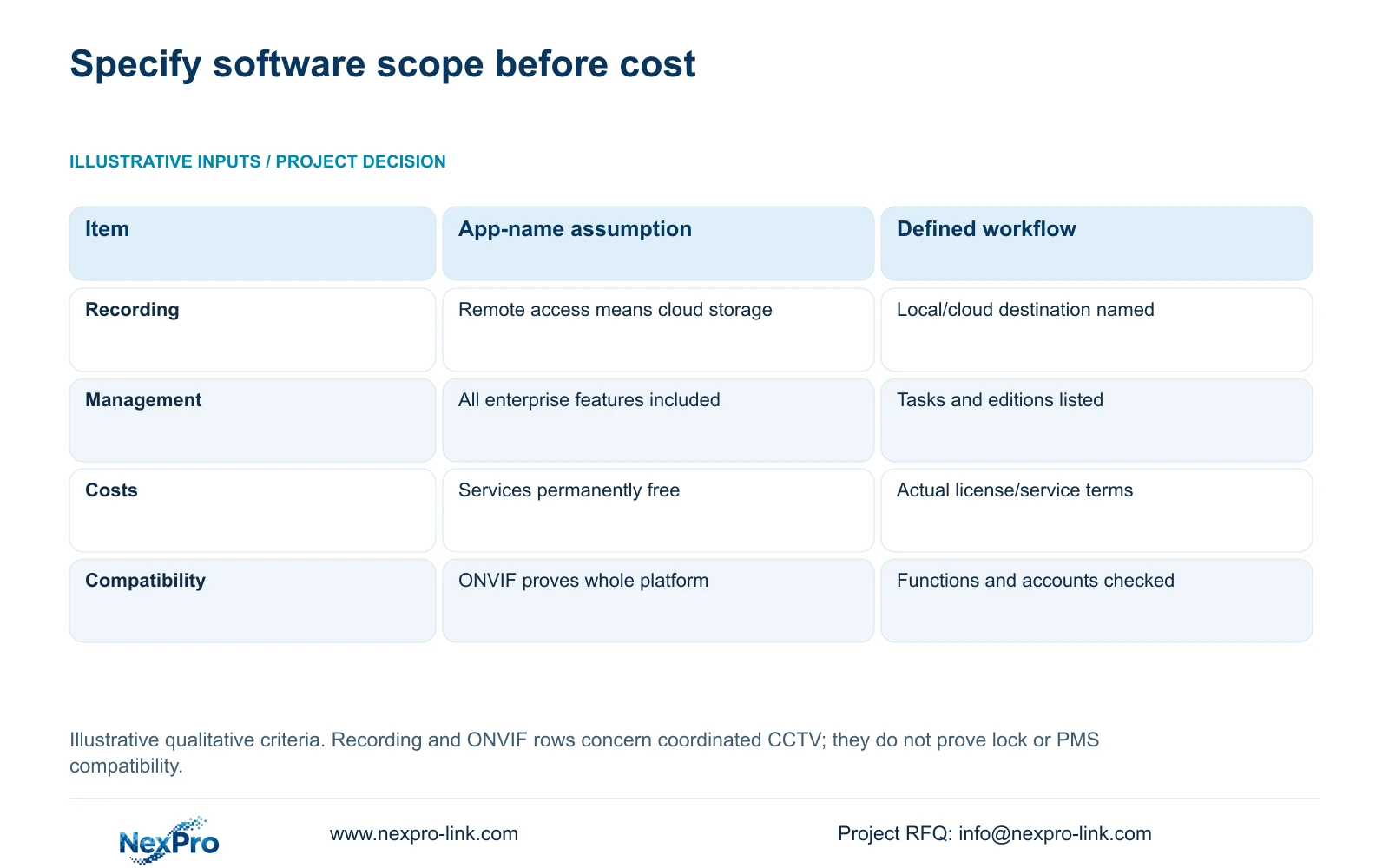
Name where access information is held and how operators reach it. Local management, remote access and enterprise administration are different service layers. Where CCTV forms part of the wider hotel package, local recording, cloud access and cloud storage must also remain separately identified. Remote viewing provides no evidence of an included cloud recording service.
Compare the lock architectures against the transactions below, using the actual lock, encoder and software editions. The original software illustration also appears in this coordinated hotel series, but its recording and ONVIF rows apply only to CCTV; they cannot prove a lock or PMS interface. The lock comparison must instead identify how credentials change, how records are retrieved and what becomes unavailable during an outage.
ONVIF profiles concern relevant video-device and client functions. They do not establish compatibility between a hotel lock, PMS and cloud account. Even for the CCTV portion, check the required functions and account behavior. A shared application label or coordinated supply order cannot establish the credential-management interface.
| Operating requirement | Evidence to request for each proposed architecture | Procurement consequence |
|---|---|---|
| Change access at a door | Supported update route and how the change reaches the lock | Include the necessary visit, device or network service |
| Issue or replace credentials | Exact software/encoder editions and supported transaction | Do not infer workflow from an app name |
| Retrieve access records | Supported record, retrieval method and authorized export | Quote only the records actually available |
| License and service scope | Actual license unit, edition and term | No assumption that all management remains free |
| Unavailable dependency | Behavior when the relevant host, encoder or connection fails | Document the permitted fallback and restoration owner |
Section 04
Count supporting equipment
Build the supporting-equipment list from the selected workflow. Depending on the actual supported architecture, it may involve encoders, controllers, gateways, network equipment or a management host. These are procurement roles to resolve, not a claim that every system needs all of them. Include the equipment that is necessary for the required transaction.
Describe ordinary operation and failure states before calculating quantities. An unavailable WAN connection, failed management workstation or inaccessible issuance device can affect different tasks. Ask the system provider to explain whether existing credentials remain usable and which updates or records become unavailable. Keep unconfirmed behavior out of the proposal's guaranteed scope.
Apply the software matrix's result to the BOM: request the relevant licensing unit and supporting service for each required task. Licensing may be defined by users, devices, sites, servers or functions. An unquoted item is an open input, not a zero-cost inclusion. Count shared equipment once and identify the subsystem that depends on it.
Section 05
Evaluate operating effort
Compare the work the hotel must perform during routine use, access changes and fault recovery. An offline proposal should explain its supported local procedures. A networked proposal should explain the management task it centralizes and the equipment or service required to keep that task available. Use the same operating outcome for both options.
Include migration, operator training and version support in the commercial evaluation. A feature with the same name can involve a different sequence in another edition. Handover should demonstrate the actual operator task using the delivered configuration. Without recorded trials, do not claim minutes saved, fewer failures or a quantified reduction in staff effort.
Account ownership and service exit also affect operating effort. Identify how the hotel retains administration and retrieves required records when a service provider changes. Hardware branding does not confer ownership of a third-party application. Review upgrade and support terms alongside the initial equipment price, particularly when a required workflow depends on continuing services.
| Retained outcome | Extra scope | Worth buying when | Counter-condition |
|---|---|---|---|
| Authorized access updates | Supported network management | Remote changes are a required task | Supported local updates meet the requirement |
| Required record retrieval | Management platform and service | The defined retrieval task needs that platform | Existing supported retrieval is sufficient |
| Hotel administration | Training and ongoing support | Hotel staff can maintain the chosen workflow | Responsibility or service continuity is unresolved |
Section 06
Choose by the actual management task
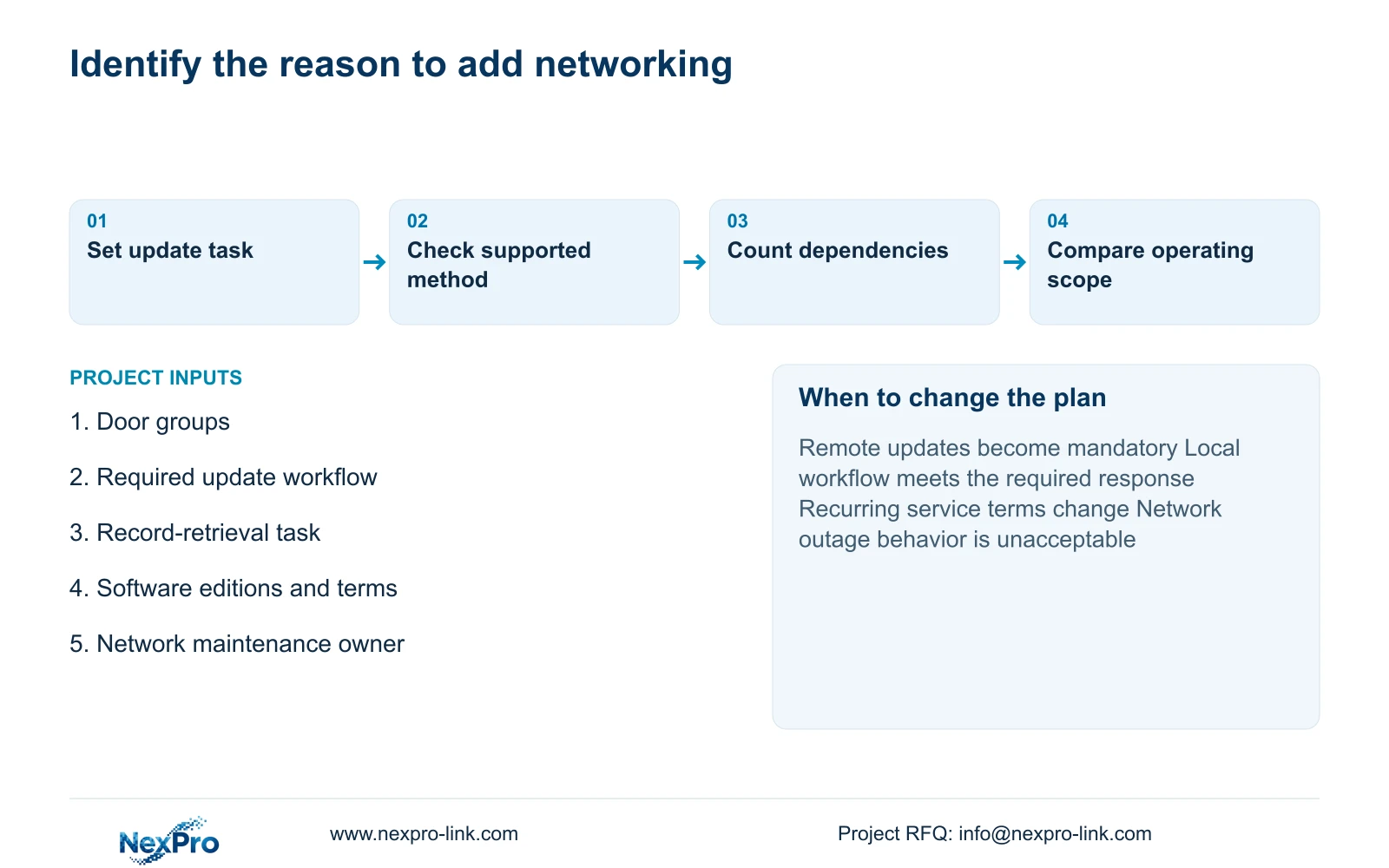
Select the simplest supported arrangement that meets issuance, revocation and record-retrieval requirements. Move to a networked option when a documented task cannot be met through the approved local workflow. Reconsider that choice if network maintenance, account ownership or recurring service terms remain unresolved. A mandatory operator platform may determine the acceptable architecture.
NexPro-Link can discuss model matching and coordinated hotel supply using the door schedule and operating requirements. The written scope should separate equipment, software interfaces and local installation. Its CCTV manufacturing and supporting-equipment coordination do not establish native integration across every proposed product.
Send info@nexpro-link.com a grouped door schedule, the required update and retrieval workflows, existing software versions and applicable licensing terms. State who will maintain the network and whether alternatives to the operator's platform are permitted. The proposal can then identify confirmed scope and the specific condition that justifies networked management, without attaching hypothetical costs or capabilities to a named lock.
Section 07
Buyer questions
Does an offline lock prevent PMS-assisted card issuance? The lock's network arrangement alone does not answer that question. Confirm the PMS, encoder, credential protocol and lock-management combination. Do not infer either compatibility or incompatibility from the word offline.
Can a free app replace a paid management platform? Only if its supported edition performs the required tasks under acceptable terms. A viewing client, credential workflow and enterprise management platform may have different scope. Request the actual license and service basis.
What should we demonstrate during a network outage? Demonstrate the agreed access task, issuance or update task, and record-retrieval task separately. Record what remains available and what requires recovery, using the selected equipment and software versions.
Engineering references
These sources support the general planning principles. Always use the selected product's current datasheet and applicable project standards for final design.