Unified hotel viewing does not automatically require replacement recorders. Define the cross-building tasks, verify the existing interfaces and add only the management scope those tasks need.
Section 01
Define the cross-building tasks before replacing recorders
Retain existing hotel recorders when they meet the approved recording requirements and expose supported interfaces for the required management tasks. Add a client or VMS only to cover a defined operational gap. Replace recording hardware when a required interface, recording mode or operator-platform rule prevents a supported integration.
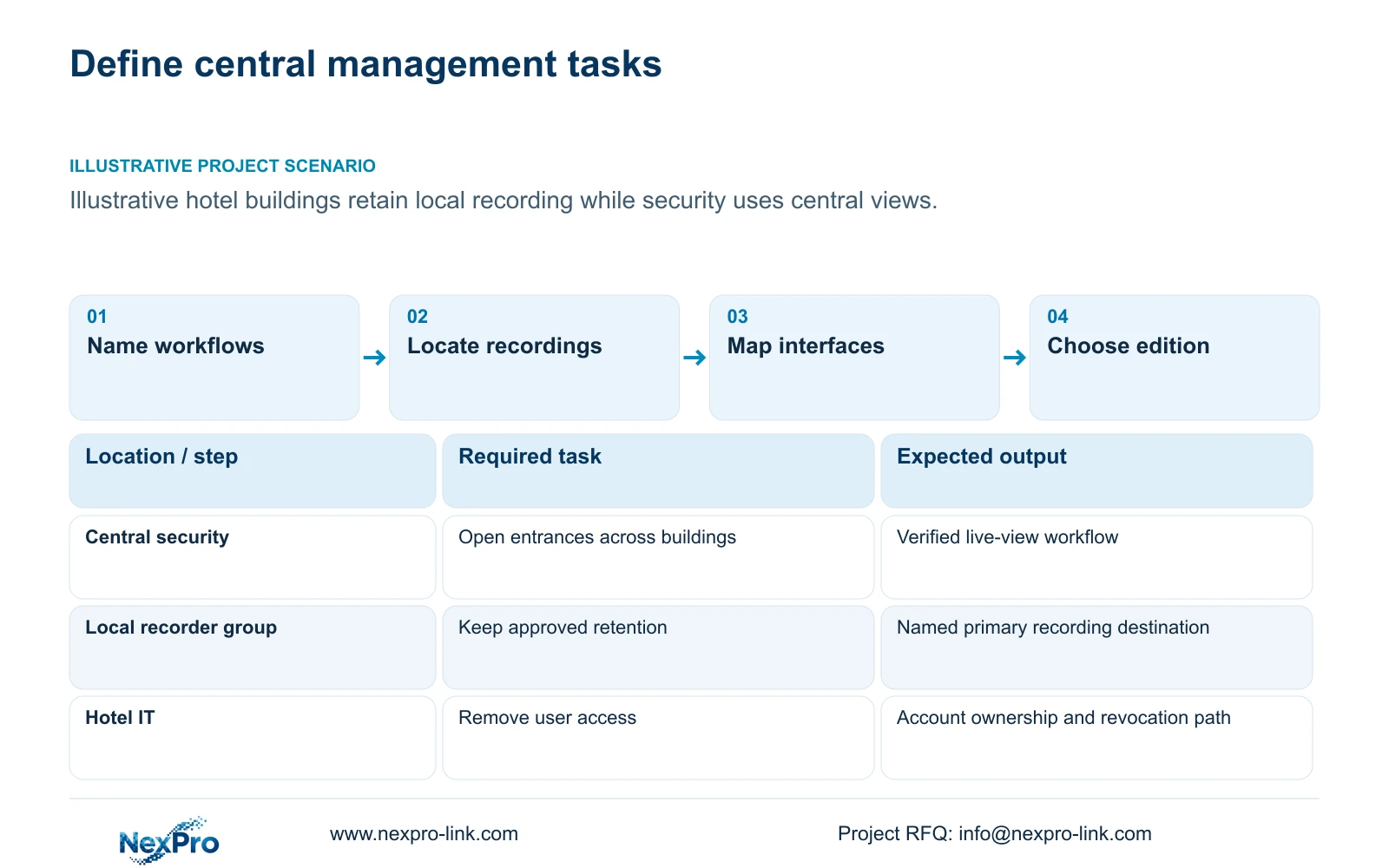
Unified viewing can mean a receptionist opening an entrance view from another building, or a security team searching incidents across several recorder groups. Those tasks have different software and permission requirements. A shared live grid does not establish unified event search, synchronized playback or centrally managed user roles.
Describe each task as an action with a responsible person and an observable result. An illustrative security operator might need to find a parking event and retrieve the related entrance clip without changing either building's local recording policy. IT needs a separate task for managing authorized access and approved software changes.
The task schedule should include the exception state. State what must remain possible when the inter-building link or remote-access path is unavailable. This lets the buyer distinguish a local recording requirement from a central viewing requirement before comparing platforms.
| Required task | Given information | Decision still needed |
|---|---|---|
| View public entrances | Authorized central security seat | Supported multi-recorder live layout |
| Retrieve related incident clips | Recordings remain in local groups | Search and export workflow |
| Remove a departing user's access | Hotel owns access decisions | Supported account and binding procedure |
Section 02
Locate the primary recordings and retention controls
Mark the actual recording destination for each camera group. It may be a local recorder or a separately specified storage service. Remote access describes a way to reach video; it does not establish that video is stored in the cloud. The proposal should name where routine recordings and authorized incident exports reside.
If a management layer reads recordings from local NVRs, preserve their channel allocation, bitrate and retention settings unless a documented change is required. A central server that also records creates additional storage and network scope. Its capacity cannot be assumed to exist because the existing local system already meets retention.
Compare the normal and disconnected states. Local recording should have a defined dependency on the local camera, network and power path. Central visibility can fail while local recording continues, but that behavior must be checked in the actual design. Operators need to know where to retrieve footage after connectivity returns.
The separate 32-camera hotel reference illustrates a complete local recording package; it is not evidence that its recorder supports a particular VMS. Its power and storage totals are not inputs to this software decision unless the project adopts those same assumptions and configuration.
Section 03
Map supported functions across each interface
Build an interface record using exact camera and recorder models, firmware, client or VMS edition, and the functions needed. Check live streaming, playback retrieval, export and required events separately. A connection that displays a live picture supplies evidence for that function only.
ONVIF Profiles provide a basis for checking device and client support. A general ONVIF statement does not prove every event, audio function, recording search or cloud-account behavior. Record the relevant profile and function requirements, then verify them with the selected equipment and software combination.
NexPro-Link's Seetong System record describes related app and PC-client workflows. It does not establish that every compatible device shares a manufacturer or that every third-party feature works. Hardware branding also does not give the buyer rights to rename a third-party app.
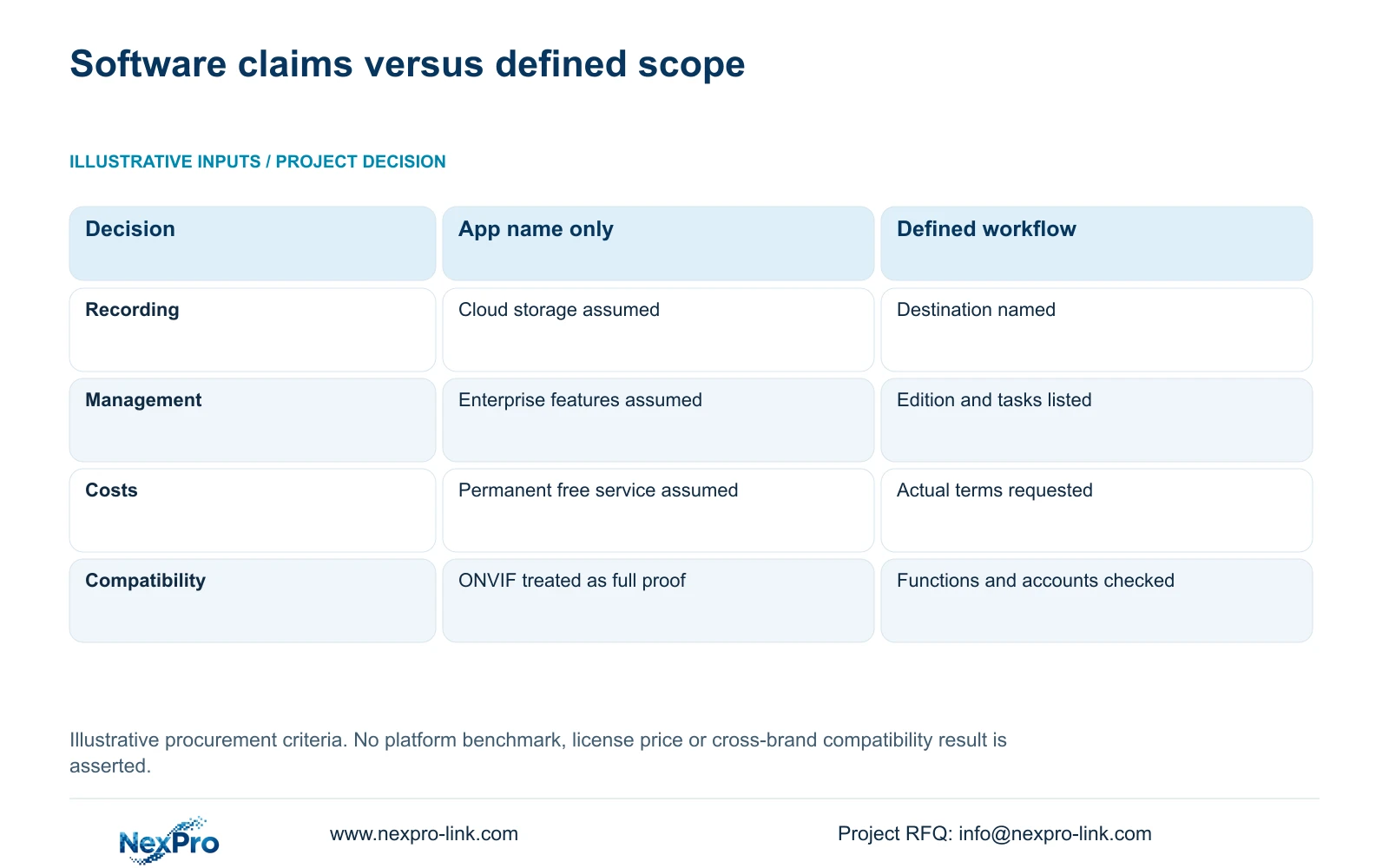
Use the following illustrative comparison to turn broad software claims into procurement requirements. It contains decision criteria, not test results or license prices. An edition-defined response gives the buyer enough information to decide whether existing recorders can remain and which missing functions need additional scope.
| Metric / condition | App name used as a complete system | Workflow and edition-defined system |
|---|---|---|
| Recording | Remote access confused with cloud storage | Actual local/cloud destination named |
| Management | All enterprise features assumed | Tasks and supported editions listed |
| Costs | Every service assumed permanently free | Actual license and service inputs requested |
| Compatibility | ONVIF used as full-platform proof | Relevant functions and account behavior checked |
Section 04
Compare client and server requirements
Start with a supported PC client when the required task is straightforward multi-recorder viewing and the actual workflow is sufficient. Consider an enterprise management platform when the hotel needs functions the client cannot provide, such as a specified central role structure or an operator-mandated integration. Those functions remain requirements until the selected edition confirms support.
Size the viewing workstation from simultaneous streams, resolution and frame rate. The number of displayed windows alone does not describe decoding demand. A substream overview with main-stream event enlargement can reduce viewing load where supported, while leaving recording profiles unchanged.
For a server-based proposal, identify the server's role. Management, recording and other services can create different hardware, network and protected-power requirements. Include required storage only where that server actually stores video. Avoid adding local recorder capacity and server storage as though they were automatically one interchangeable pool.
Assign responsibility for software updates, account ownership and configuration recovery. The hotel IT team and security operator may need different access. If the proposed platform depends on a connection unavailable during an outage, describe the remaining local functions and the procedure for restoring central operation.
Section 05
Price licensing and maintenance as separate scope
Obtain actual terms for the selected edition and purchasing unit. Licensing may be described by channels, devices, users, sites, servers or functions. Do not substitute an assumed free service for a missing quotation. Remote viewing without a stated charge does not establish unlimited cloud storage or permanently free enterprise features.
Separate initial software and hardware costs from recurring services. Include integration work, migration, operator training and any quoted update or support arrangement. A platform with the required features can still leave the hotel with an incomplete proposal if its server preparation or maintenance responsibility is excluded.
Compare a basic client option and a server-platform option using the same required outcomes. The server option is worth buying when it supplies a needed function the verified client cannot deliver. Keep the client option when it meets the current task and offers an explainable expansion path. Unquoted costs remain open inputs in both alternatives.
NexPro-Link can assist with equipment matching and BOQ coordination, but a coordinated order does not establish native integration or included local implementation. The written proposal should distinguish the CCTV manufacturing core, coordinated supply categories and the party responsible for the software integration.
Section 06
Keep a phased integration path with defined stop conditions
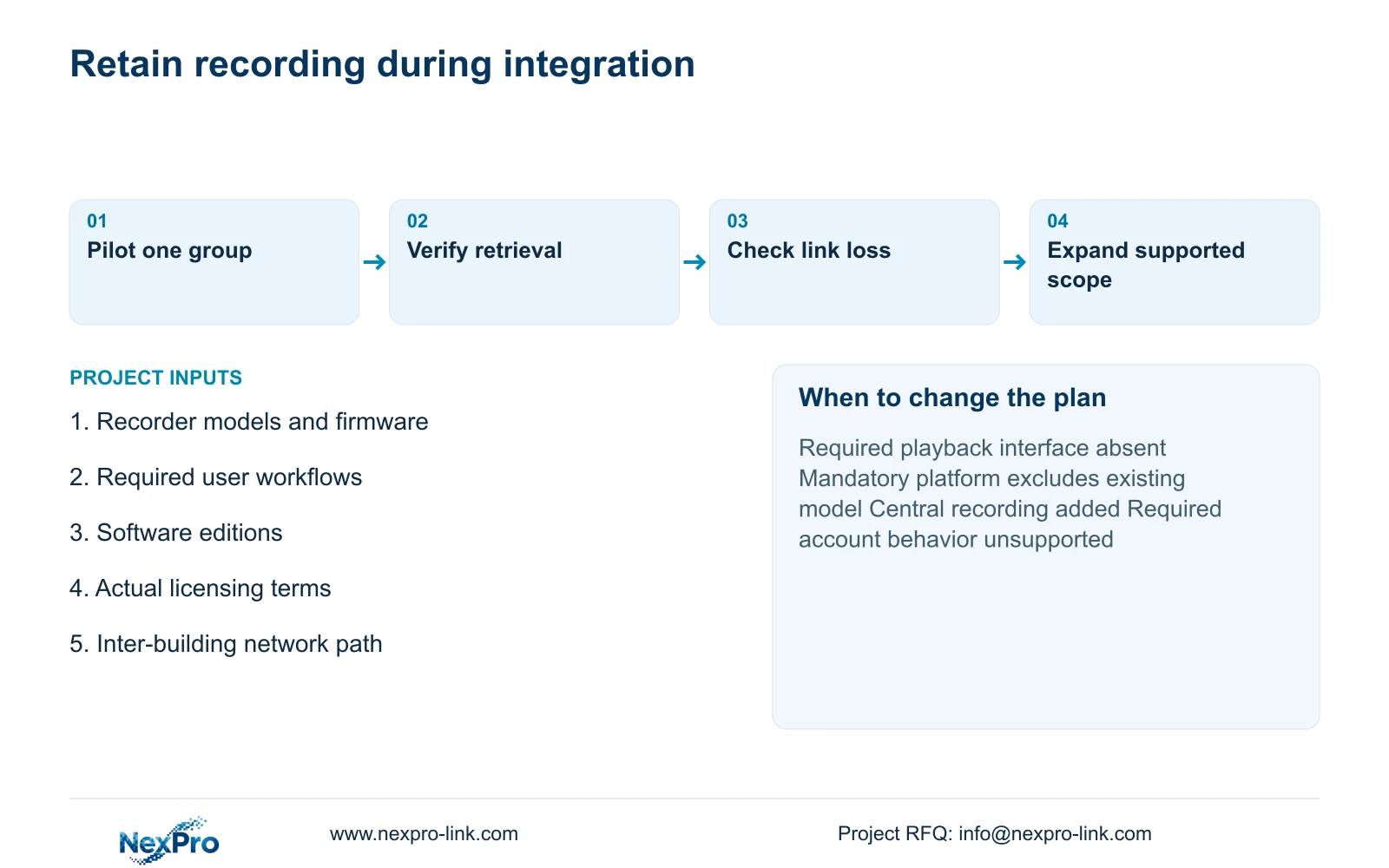
Begin with a representative recorder group and the actual authorized client workflow. Verify live viewing, incident retrieval and export before adding other buildings. Include a controlled connectivity-loss observation so the hotel understands which functions remain available locally. Record actual results without assigning an invented efficiency improvement.
Proceed with the existing recorders when the pilot meets required tasks and retention remains intact. Stop expansion if required events, playback or account behavior are unsupported. At that point, compare a supported adapter or platform change, targeted recorder replacement, and any mandatory operator requirement.
Phase the work by operational dependency rather than by a promise to replace everything at once. Preserve access to existing recordings during migration and establish who approves changes to retention or recording destinations. A passed pilot supports its observed configuration; a different firmware or device family needs its own relevant checks.
Send the existing model and firmware list, required cross-building workflows, selected software editions and known licensing terms to info@nexpro-link.com. Include the inter-building network arrangement and any mandatory platform. The hotel project and BOQ support routes can then support a scoped equipment and integration discussion.
Section 07
Buyer questions
Must all buildings use the same recorder model? Uniform models are not established as a requirement here. Each proposed combination must support the required functions in the selected client or VMS edition. A mandatory operator platform may narrow the acceptable equipment.
Does free remote viewing include cloud recording? No such inclusion follows from remote access. Ask for the actual storage destination, retention service, license unit and applicable service terms.
What should a first integration quotation include? It should identify retained hardware, new software or servers, the exact supported workflows, license terms and implementation responsibilities. Missing integration or maintenance costs should remain visible.
Engineering references
These sources support the general planning principles. Always use the selected product's current datasheet and applicable project standards for final design.