At release, compare the operator document with the actual approved local interface and client identity. Mark any unsupported branding request outside the delivered scope.
Section 01
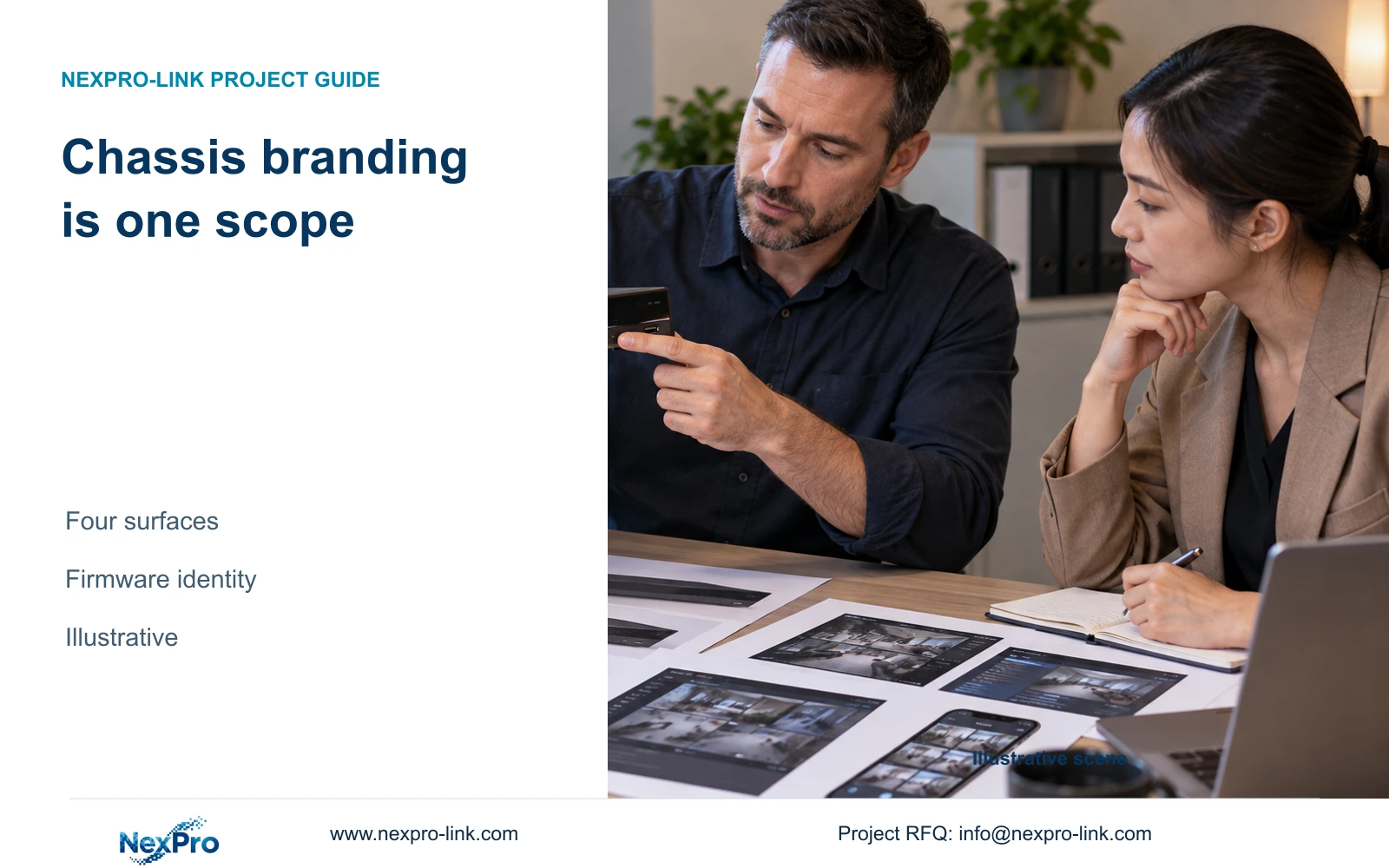
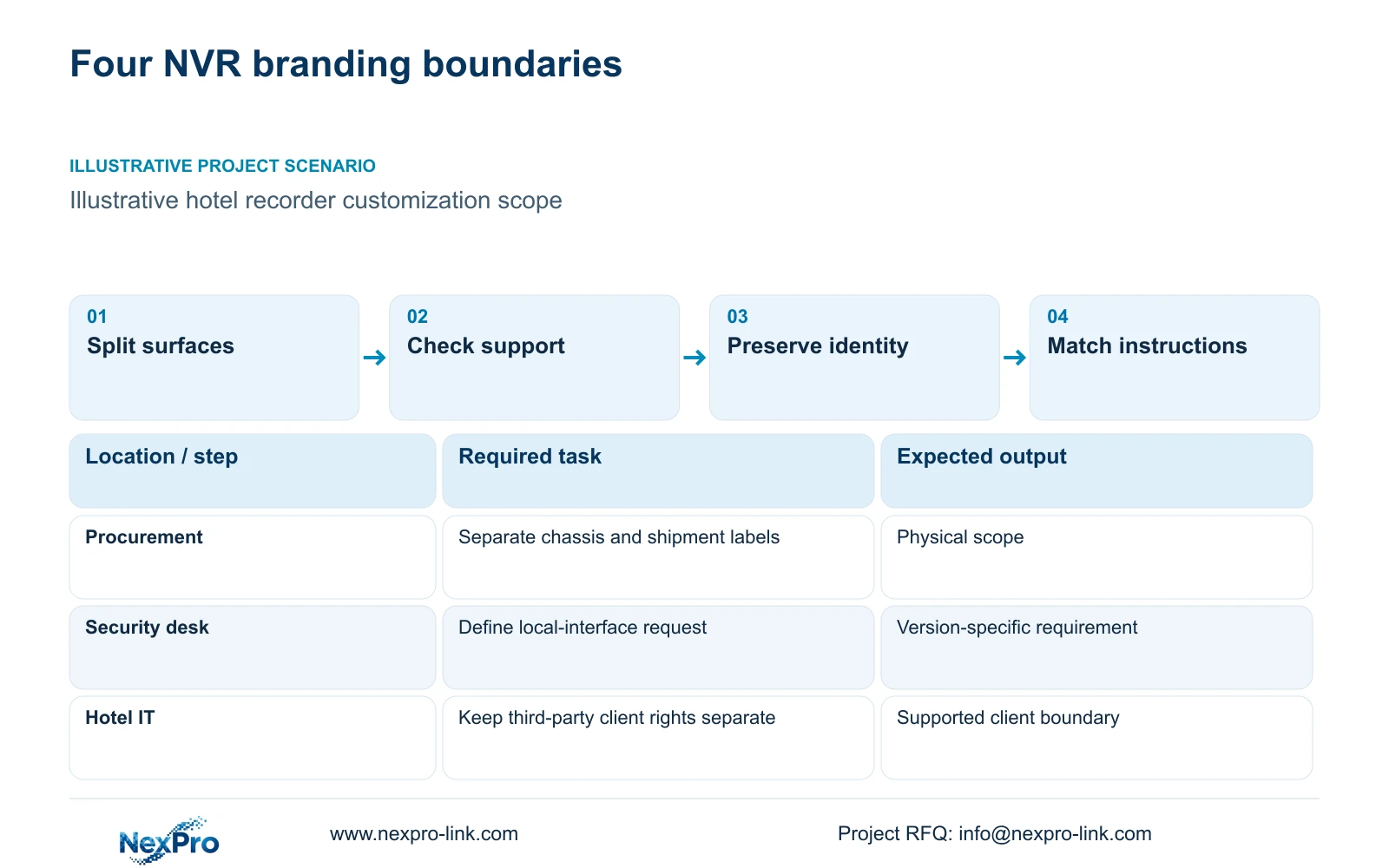
Separate the four requested branding surfaces
At release, compare the operator document with the actual approved local interface and client identity. Mark any unsupported branding request outside the delivered scope. If firmware changes the displayed treatment, revise the document and sample reference separately. A correct chassis logo cannot validate instructions written for another interface or device version.
Order chassis branding and shipment labels as defined hardware work. Treat local-interface changes and third-party client branding as separate requests, included only when the exact model and software support them. A custom NVR logo does not mean every menu, PC client or mobile app can be renamed.
Identify the four surfaces in the quotation: physical chassis, shipment labels, recorder-local interface and external client software. Each has a different production or support boundary. An artwork approval for the front panel can establish the physical mark while leaving all software identity unchanged.
The supplied NexPro-Link OEM/ODM record supports logo, label, manual and packaging scope. The Seetong system record concerns App and PC-client workflows; it does not prove a right to rename those clients. Keep unresolved software requests visible so the buyer can decide whether hardware-only branding satisfies the hotel requirement before committing to that scope.
| Required task | Given information | Decision still needed |
|---|---|---|
| Brand the chassis | Authorized logo can be supplied | Process, surface and sample |
| Label the shipment | Model and destination are known | Project fields and packing revision |
| Change local interface | Exact recorder model is selected | Supported changes for its firmware |
| Rename external client | Client workflow is identified | Rights and actual customization support |
Section 02
Identify supported customization options by task
Describe the requested interface change precisely. A startup image, menu wording and application identity are different requests and should not be grouped under an undefined UI-customization line. Ask the supplier to state what is included for the selected recorder and software version. An unavailable option should remain excluded, even if another product family supports something similar.
Evaluate the effect on hotel operation. An authorized operator must still open the required view, find a time window, replay footage and perform an approved export. Security staff, IT and the installer may need different access. Branding should not imply that these roles have the same permissions or that a shared screen establishes their responsibilities.
A supported option can be reviewed using the intended workflow and observable output. Until that review occurs, record it as a proposed function rather than a completed test. The hotel can proceed with physical branding if unchanged software is acceptable; if a branded application is mandatory, software support becomes a selection condition.
| Item | Hardware-only scope | Requested software scope | Hotel effect |
|---|---|---|---|
| Chassis and labels | Defined production work | Still separately defined | Consistent receiving identity |
| Local interface | Existing identity retained | Exact supported changes listed | Manual must match delivered version |
| External client | Actual client name retained | Support and rights unresolved until confirmed | Operator download path remains accurate |
Section 03
Preserve the model and firmware references
Retain the recorder SKU, serial number and firmware reference in the equipment register and technical handover. A customer-facing product name can appear alongside them, but the service team needs the underlying identity to discuss configuration, updates and replacements. Project location fields should remain separate so a recorder can move without acquiring a different technical identity.
NexPro-NVR4449-4K is the candidate recorder in the independent 24-camera boutique-hotel reference. Its supplied page record lists 49 channels, 320 Mbps input and four SATA positions with an 18 TB per-drive field. The summary also lists 49×5MP/9×4K, so channel count does not establish 49 simultaneous 8MP streams; RAID details remain unspecified.
Branding cannot resolve an equipment-data conflict. If NexPro-NVR2232-4K is proposed instead, retain the supplied discrepancy between the 2×8 TB summary and 2×18 TB detailed disk fields, as well as the differing playback information. Do not use a custom label to present the larger figure as settled procurement capacity. Keep the controlling technical response attached to the selected model.
Section 04
Compare one-time setup with recurring work
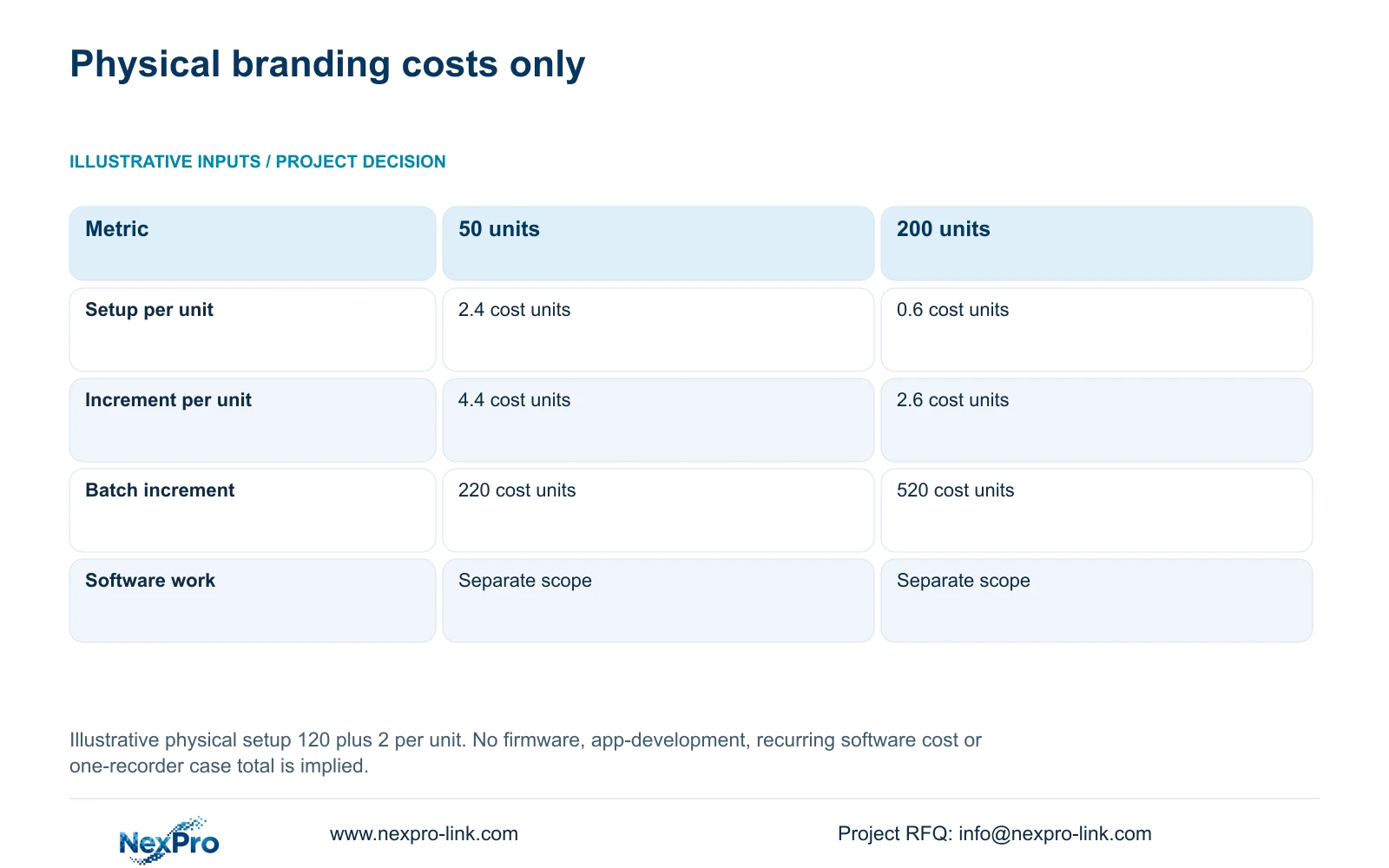
Separate artwork/setup from the work repeated on each recorder. The illustrative calculation uses 120 cost units of setup and 2 cost units per unit for marking, labels or packing. Increment per unit equals 120 divided by quantity, plus 2. Total incremental batch cost equals 120 plus quantity multiplied by 2.
The 50-unit batch produces 4.4 cost units per unit and 220 in total. The 200-unit batch produces 2.6 per unit and 520 in total. These are unpriced teaching batches, independent of the reference hotel's single recorder. They show how shared preparation changes allocation; they do not price firmware development, application maintenance or future software updates.
If software customization is supported, obtain its own setup, version-support and recurring-work lines. A physical mark that remains unchanged may be reusable while documentation needs revision after a software change. Request the cost of each actual change, and avoid treating a lower hardware branding rate as evidence that continuing software work is included.
| Metric / condition | 50-unit teaching batch | 200-unit teaching batch |
|---|---|---|
| Batch quantity | 50 units | 200 units |
| Setup cost per unit | 2.4 cost units | 0.6 cost units |
| Total incremental cost per unit | 4.4 cost units | 2.6 cost units |
| Total incremental batch cost | 220 cost units | 520 cost units |
| Model and required labels | Retain | Retain |
Section 05
Prepare documentation for the delivered interface
Use the actual software name and version in operating instructions. A branded manual cover can coexist with accurate client-download guidance and technical screenshots. Replacing every visible name with the customer's brand can leave users looking for an application that does not exist under that name.
Divide instructions by intended task. Operators need their permitted viewing, playback and export workflow. IT needs the relevant account and configuration responsibilities. The local installer needs the equipment identity and commissioning scope. Keep passwords and personal credentials out of printed project records and publicly shared support material.
State the support route alongside the delivered identity. The supplied policy describes a usual 24-month limited hardware baseline from receipt for applicable main equipment, subject to controlling written order terms. It does not establish unlimited software development, free local attendance or identical coverage for disks and other accessories. A custom manual must preserve those distinctions.
| Situation | Required record | Decision boundary |
|---|---|---|
| Manual ready for issue | Actual interface and version reference | Match visible instructions to delivered device |
| Requested branding unsupported | Exact customization evidence | Keep that request outside accepted delivery |
| Firmware changes appearance | Revised sample and instructions | Recheck branding and operation separately |
Section 06
Confirm the branding scope without hiding exclusions
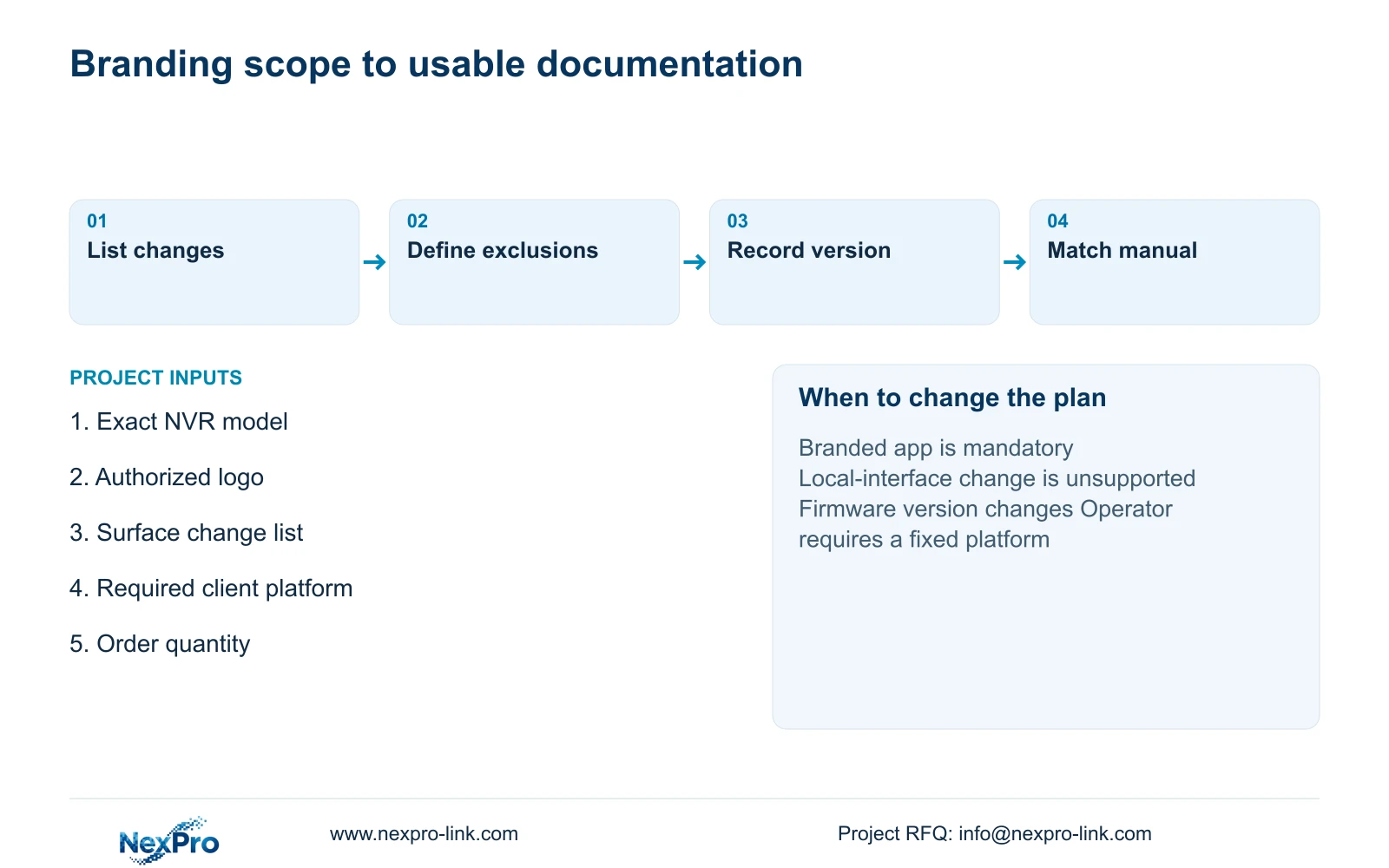
For a hotel that accepts the existing client workflow, choose physical chassis branding, traceable labels and version-matched documentation. Include local-interface changes only where their exact scope is supported. Change the proposal when the operator requires a branded application, a fixed platform or a software function that the candidate cannot provide.
The order should connect each included surface to its artwork or technical reference and state which identities remain unchanged. A broader equipment supply arrangement does not make all supporting products self-manufactured or establish native integration between them. NexPro-Link can discuss CCTV manufacturing and coordinated hotel equipment scope with those responsibilities identified separately.
Send the exact NVR model, authorized logo, requested changes for each surface, quantity and mandatory client platform to info@nexpro-link.com. Include a short description of the intended operator workflow. This provides a useful basis for a scoped branding response without requiring hotel recordings, passwords or unrelated confidential tender material.
Section 07
Buyer questions
Can we buy chassis branding while keeping the existing software? Yes, define the physical mark and labels separately. The manual should retain the real local-interface and client identities so installation and support instructions remain usable.
Does a branded firmware request include future updates? The physical-branding scope cannot establish that. If firmware changes are supported, the written software scope must define version support, updates and any recurring work.
What is enough information for an initial NVR branding quotation? Provide the exact model, quantity, authorized logo and a separate requested-change list for chassis, labels, local interface and client. Identify any platform requirement that cannot change.
Engineering references
These sources support the general planning principles. Always use the selected product's current datasheet and applicable project standards for final design.