A hotel group can share an equipment specification without mixing brand-specific deliveries. Connect each authorized artwork variant to its purchasing entity and cartons.
Section 01
Map each brand to its purchasing entity
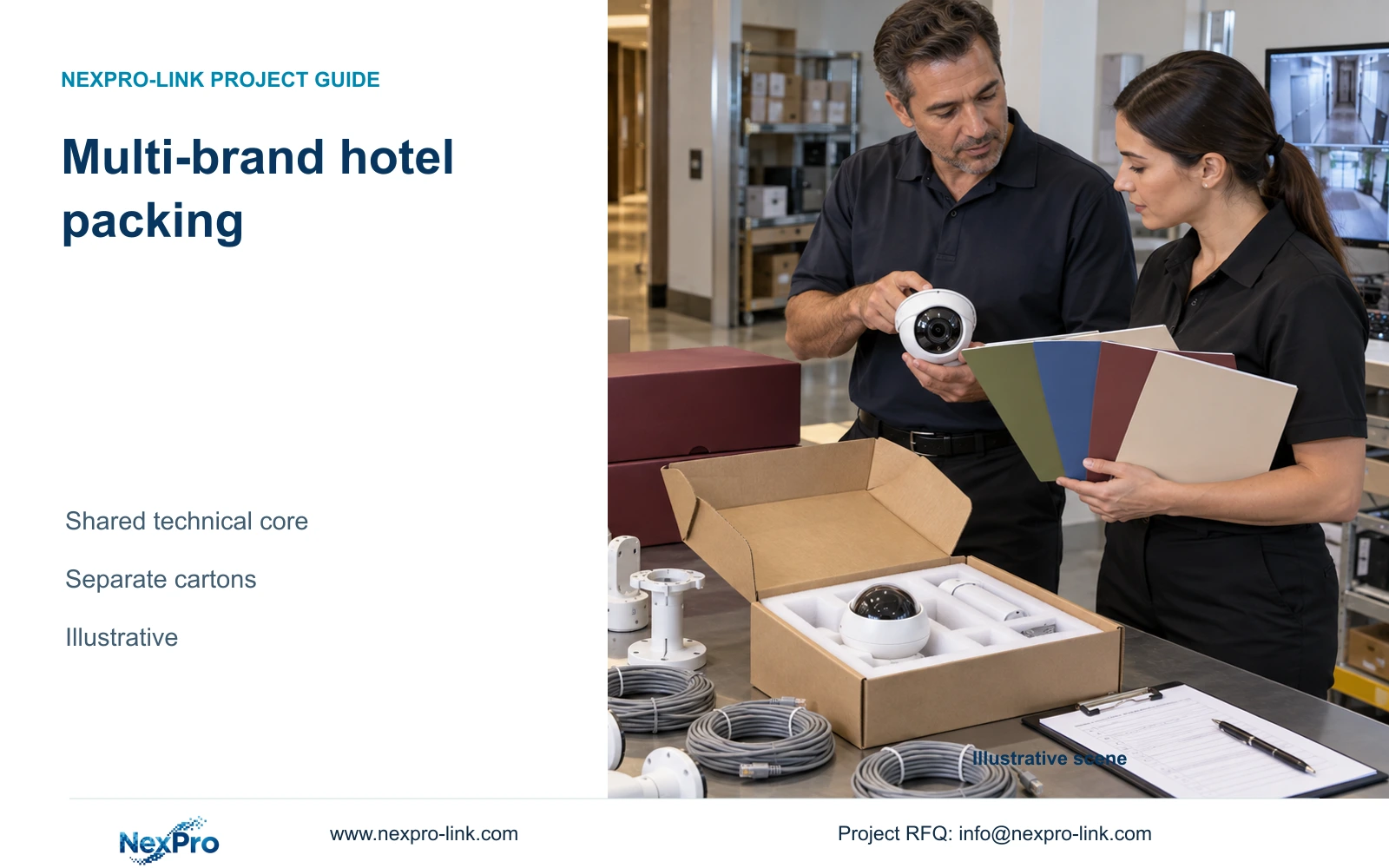
Use a shared technical specification where the hotels genuinely need the same equipment, but keep authorized branding, manuals and receiving allocations separate. Consolidate supply only when those allocations are stable and the delivery arrangement suits each purchasing entity. Split releases when a delayed brand approval or different destination would disrupt another hotel’s required equipment.
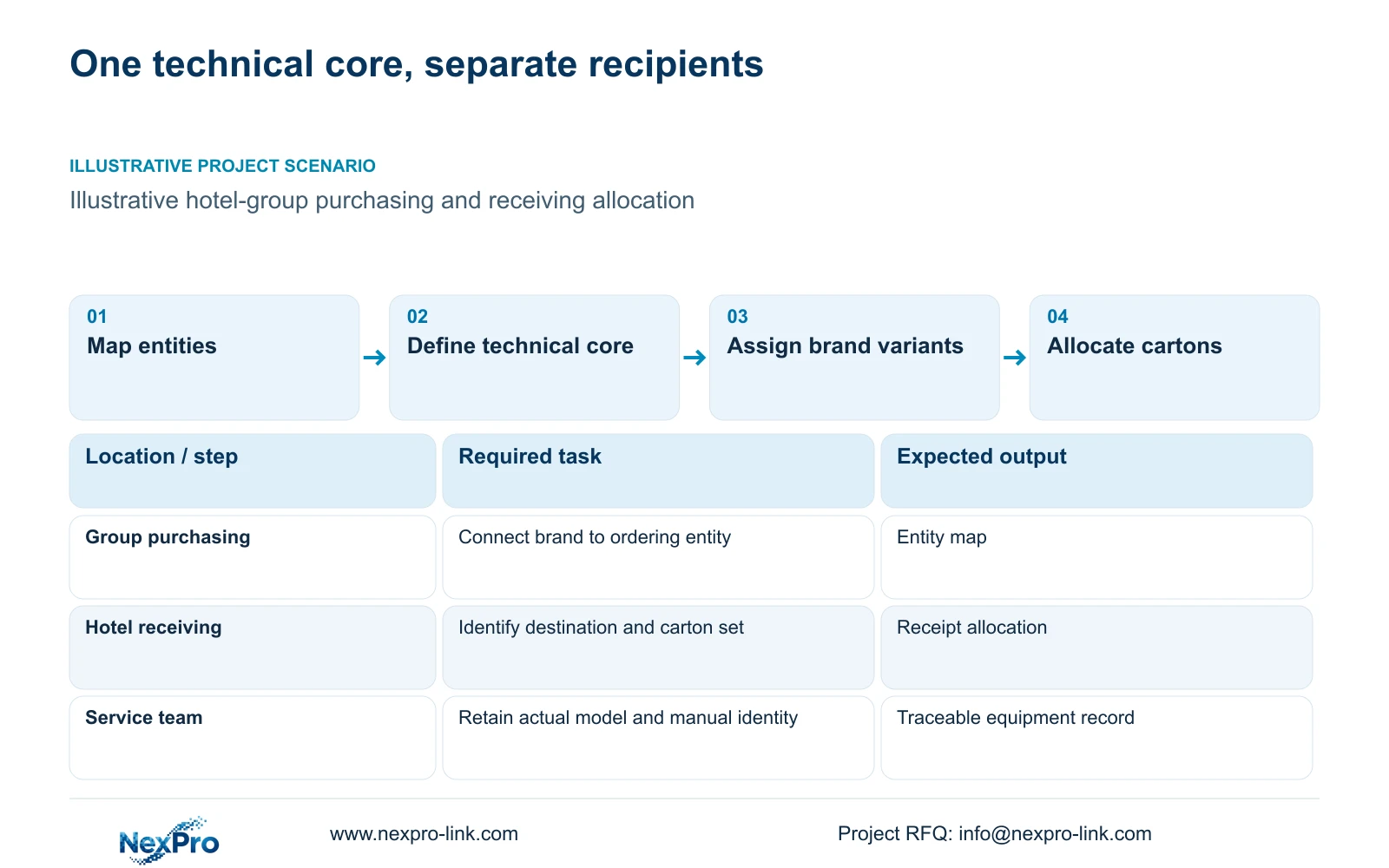
Start by connecting each operating brand to the party buying and receiving its equipment. The name on a carton may differ from the ordering entity or hotel operator. Record those relationships explicitly so the supplier knows which artwork belongs to which delivery, and the receiving team can reconcile the goods to the correct order.
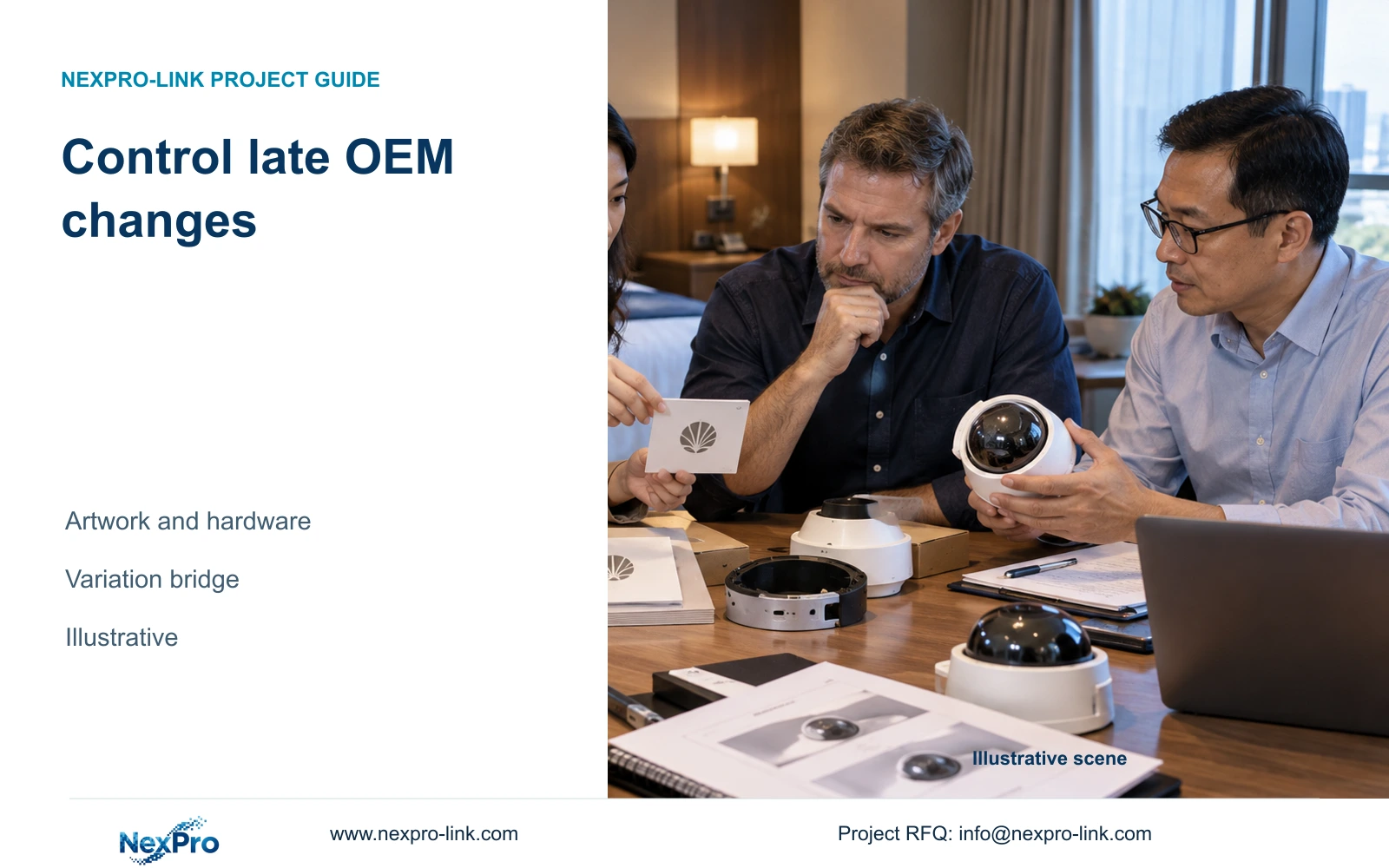
Obtain authorized artwork for each required presentation. Do not assume that a group purchase grants unrestricted use of every group brand. Specify whether the identity appears on equipment, individual packaging or transport cartons. Different surfaces can require different processes even when the same logo file is used.
| Required task | Given information | Decision still needed |
|---|---|---|
| Identify recipient | Hotel and operating brand | Purchasing entity and delivery allocation |
| Apply branding | Proposed presentation | Authorized artwork and marking surface |
| Issue support information | Shared technical equipment | Hotel-specific responsibility and manual variant |
Section 02
Define the shared technical core
Keep the shared core at the equipment and configuration level. Match the observation task, selected camera mode, mounting requirements and system interfaces before declaring units interchangeable across hotels. A common housing or logo treatment does not establish that two installations require the same equipment.
For example, the supplied PDF describes NexPro-BL2812M55-5MP-DIC-AI with a 2.8-12 mm motorized lens, PoE and IP66. That model can be considered against an appropriate task, but its appearance does not determine an exterior installation detail or prove a particular bracket fit. Its maximum power is not supplied, so shared power budgets still require a supported input.
The independent CASE02 illustration contains 24 camera tasks across entrances, lobby, public corridors, service routes and exterior approaches. It is a useful structure for one hotel schedule, not a standard package to multiply by the number of group brands. Each property’s actual schedule should determine what can remain common and what needs a technical variant.
| Record field | Why it matters | Keep separate |
|---|---|---|
| Exact model/firmware and quantity | Preserves the common technical supply baseline | Brand presentation is not technical equivalence |
| Authorized brand/design revision | Controls permitted artwork and surfaces | Separate approval for each operating brand |
| Setup quantity by design | Provides a defensible allocation denominator | Do not amortize every design over the whole order |
| Destination/carton and zone fields | Directs the correct kit to the intended receiving party | Variable locations may change after artwork approval |
| Manual/support reference and sample status | Preserves real equipment identity and correct service route | Approval pending is not released for production |
Section 03
Separate artwork and package variants
Maintain independent records for the technical configuration and each presentation variant. The technical record identifies the actual model and supplied scope. The artwork record defines the authorized brand treatment. The carton allocation connects those two records to a hotel recipient and quantity.
Keep model and serial information readable under every variant. Brand-specific manuals should retain the real equipment and software identities while changing only authorized presentation and relevant project information. Hardware OEM does not grant rights to rename third-party software, and a common supply order does not prove that every hotel uses the same account or client workflow.
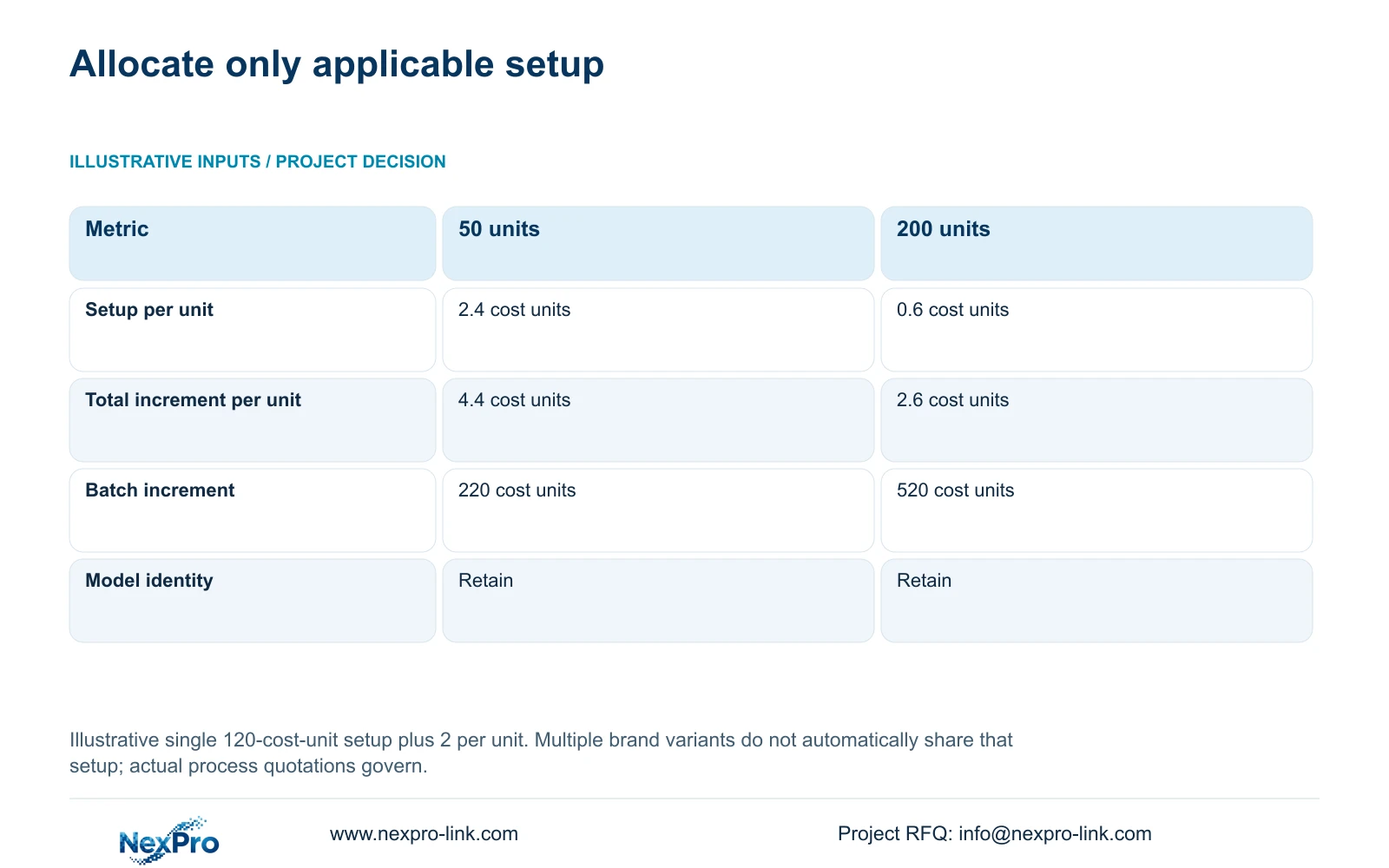
The teaching cost comparison assumes one artwork/setup effort of 120 cost units and a per-unit marking, label and packing increment of 2 cost units. Increment per unit equals setup divided by the applicable batch quantity, plus 2. That single-setup assumption must be checked before using a combined group quantity as the denominator.
Section 04
Calculate batch allocation
For a 50-unit teaching batch, 120 divided by 50 gives a setup allocation of 2.4 cost units per unit. Adding 2 gives 4.4. For 200 units, the corresponding figures are 0.6 and 2.6. Total incremental batch cost remains 120 plus quantity multiplied by 2, producing 220 and 520 cost units.
These values are not MOQ, actual prices or evidence that multiple brand variants share one preparation charge. Request setup and per-unit treatment for the real artwork variants. If separate surfaces or versions need separate preparation, allocate the confirmed setup against its own applicable quantity. Group purchasing alone does not establish the saving.
Use the calculation to compare justified batch treatment after quantities and variant boundaries are known. The larger batch has lower illustrated cost per unit but higher total incremental cost. Retain the required quantities and brand separation; do not add surplus equipment merely to reduce an allocated setup figure.
| Metric / condition | 50-unit teaching batch | 200-unit teaching batch |
|---|---|---|
| Batch quantity | 50 units | 200 units |
| Setup cost per unit | 2.4 cost units | 0.6 cost units |
| Total incremental cost per unit | 4.4 cost units | 2.6 cost units |
| Total incremental batch cost | 220 cost units | 520 cost units |
| Model and required labels | Retain | Retain |
Section 05
Compare consolidated and individual releases
Consolidated preparation can preserve a common technical baseline while the packing process separates hotel allocations. It suits stable quantities and settled presentation where the receiving arrangement can keep cartons assigned correctly. Compare the actual handling and transport scope before choosing it; the setup calculation does not establish a freight saving.
Individual releases give each hotel a clearer boundary when delivery dates, destinations or presentation approval differ. They can introduce additional preparation or shipment activity, which should appear in the quotation. Keep those costs separate from technical equipment so the group can see whether consolidation remains worthwhile.
Recommend consolidated supply with distinct brand-to-carton allocations when all required variants are settled and the shipment arrangement works for the recipients. Change to individual or staged releases if one brand’s unresolved artwork would hold necessary equipment for another hotel. A common purchasing plan should preserve each property’s installation and support responsibilities.
| Retained outcome | Extra scope | When worthwhile | Counter-condition |
|---|---|---|---|
| Common technical baseline | Separated brand carton allocation | Stable variants and compatible delivery arrangement | One unresolved variant blocks other hotels |
| Independent hotel receipt | Separate preparation and shipment scope | Different destinations or required dates | Extra releases add avoidable handling |
Section 06
Verify brand-to-carton traceability
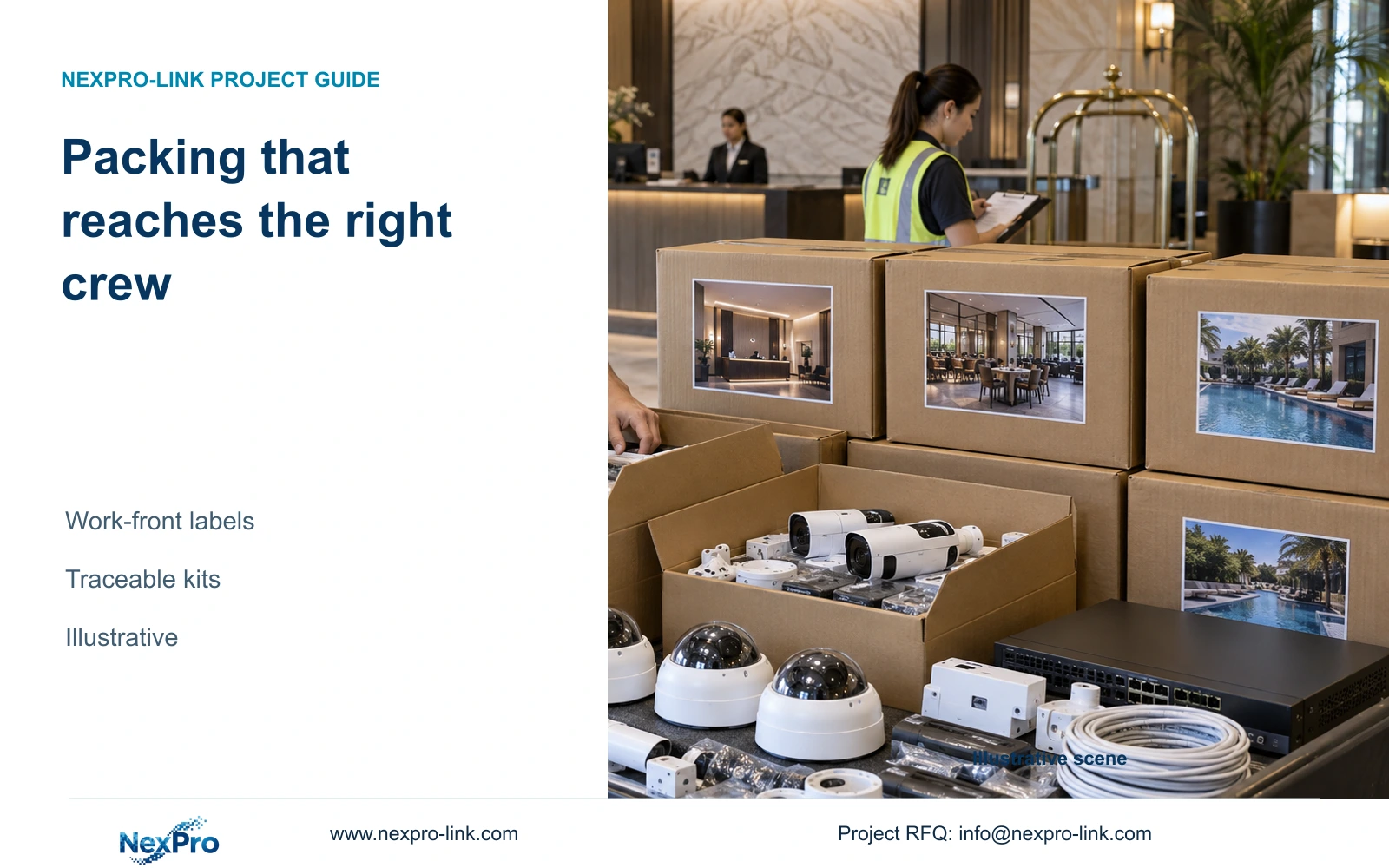
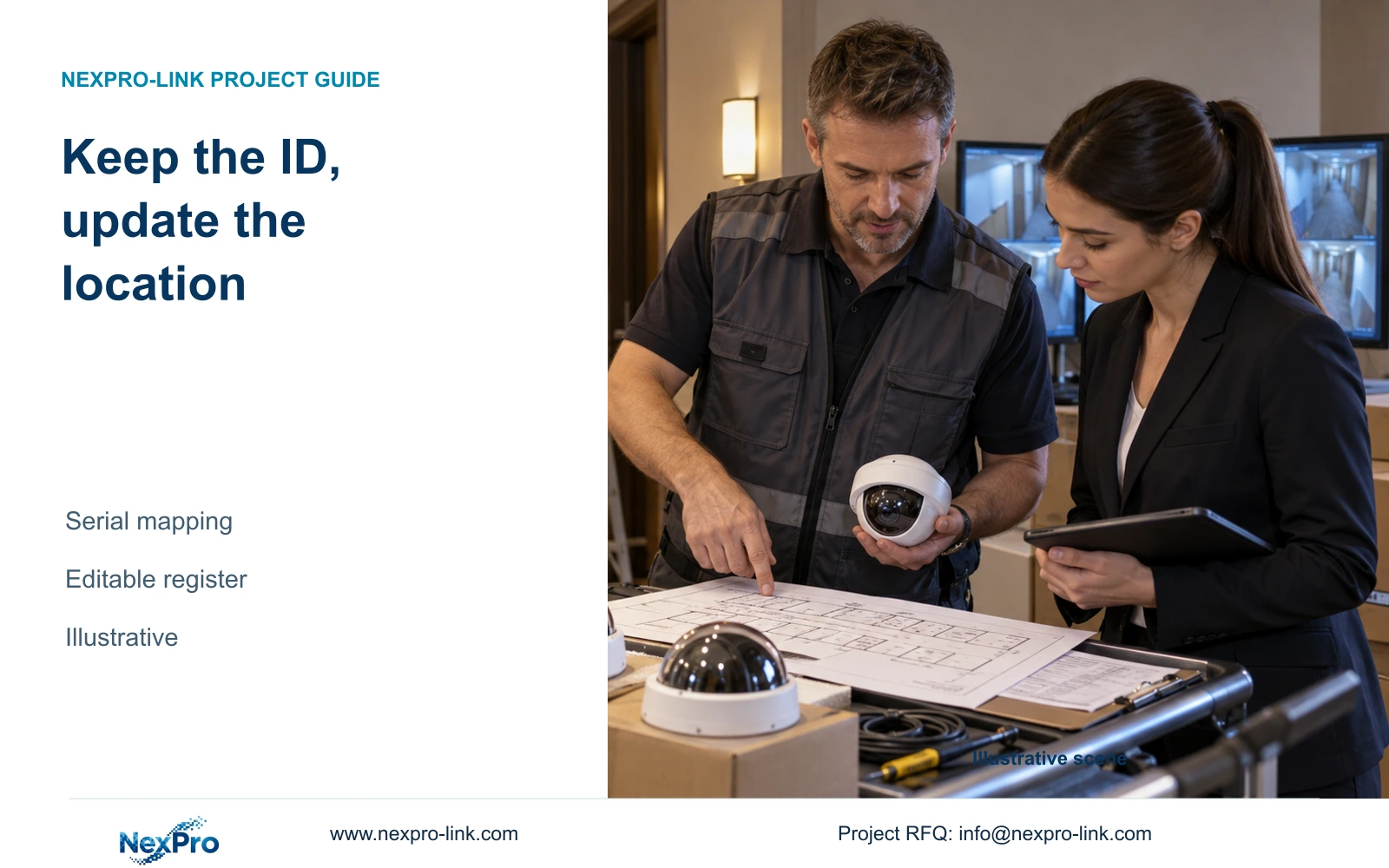
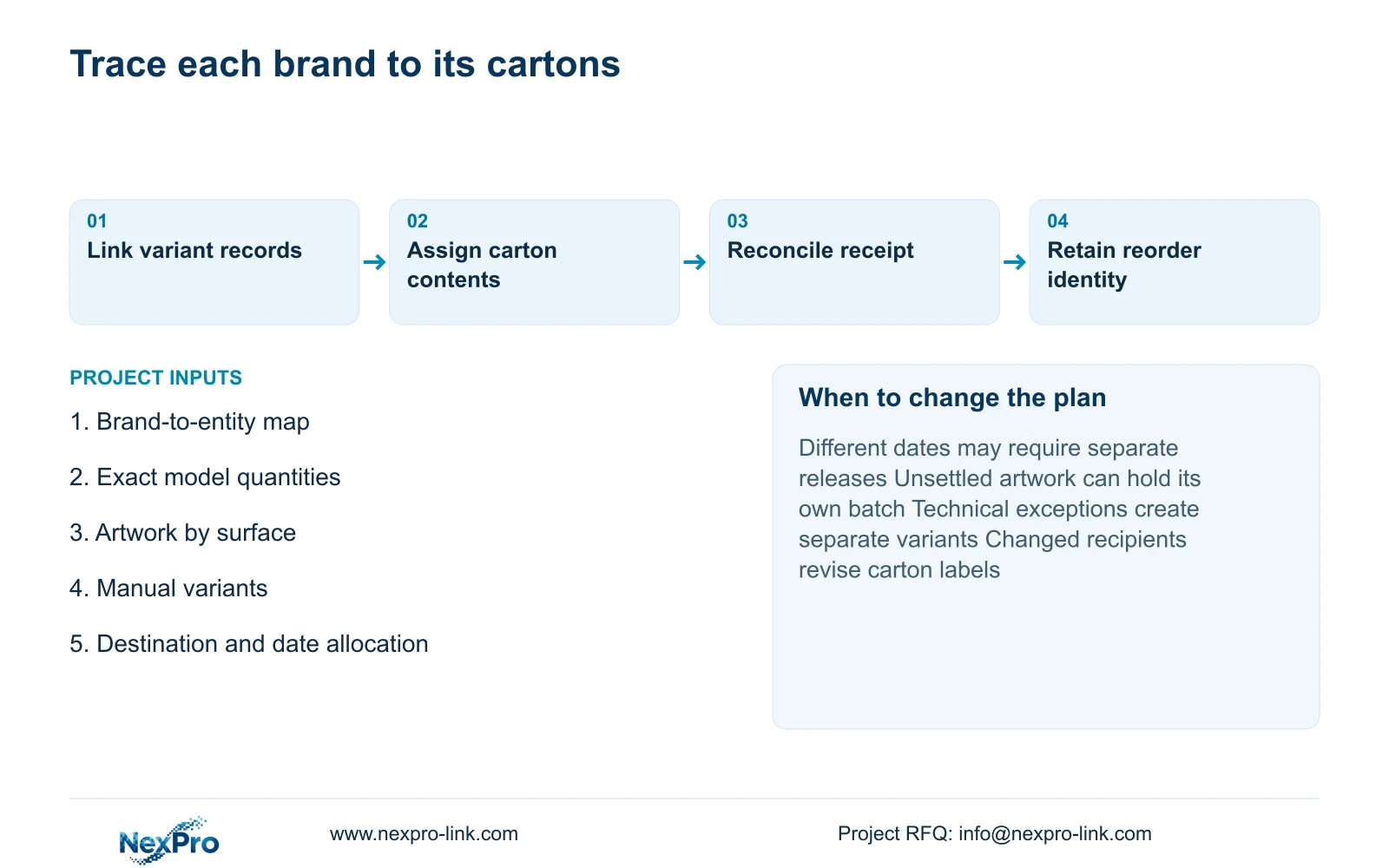
Check the connection from purchasing line to brand variant, carton and equipment identity. A carton list should show its hotel allocation, model quantities and relevant artwork/manual revisions. Keep the actual serial or asset mapping available for service. A correctly branded box can still contain the wrong variant.
At receipt, reconcile the allocated cartons and record discrepancies before distributing them to work fronts. Retain the confirmed technical baseline for later replenishment, while updating changed brand presentation and project location fields separately. This helps a repeat order preserve equipment identity without carrying forward obsolete receiving information.
Send the brand-to-entity map, exact model quantities, authorized artwork by surface and destination/date allocations to info@nexpro-link.com. NexPro-Link can discuss OEM packing and hotel equipment coordination within the agreed scope. Its CCTV manufacturing core and coordinated supporting categories should remain distinguishable; a single order does not make every product self-manufactured or every subsystem integrated.
Section 07
Buyer questions
Can all brand quantities share one setup charge? Only when the actual process and quotation support that allocation. The teaching comparison assumes one setup; different artwork, marking surfaces or package versions may require their own preparation.
Does a different logo create a different technical model? A presentation change alone does not establish a functional difference. Retain the actual technical model and configuration, and describe any genuine hardware variation independently.
What information is needed for a group packing proposal? Provide the brand-to-purchasing-entity map, quantities by exact model, authorized artwork variants and delivery allocations. Identify the hotel-specific manual contacts and any mandatory technical exceptions.
Engineering references
These sources support the general planning principles. Always use the selected product's current datasheet and applicable project standards for final design.