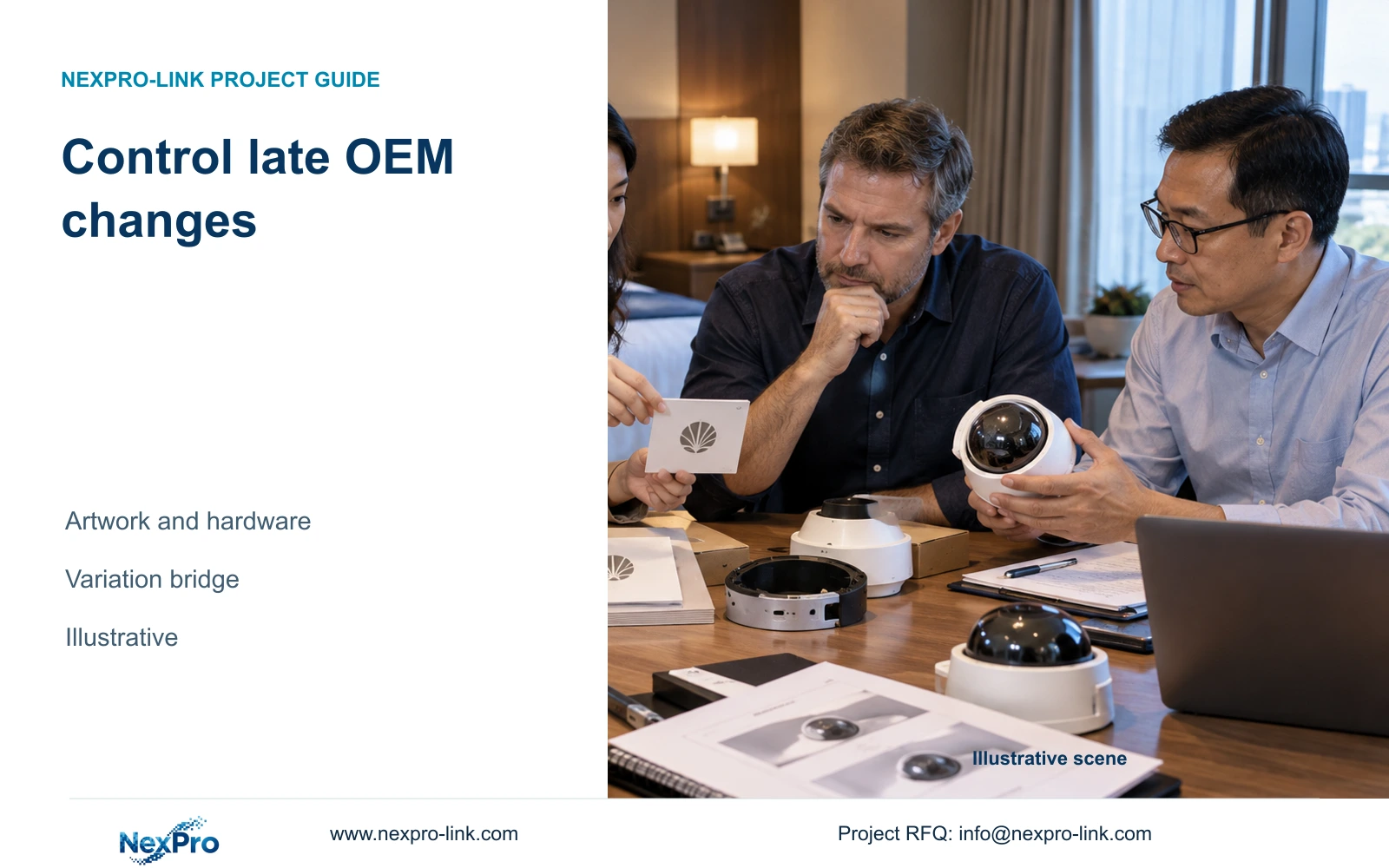
A late logo revision and a camera substitution need separate impact records. Count the affected stock and preparation work before choosing full or staged release.
Section 01
Define the exact change against the baseline
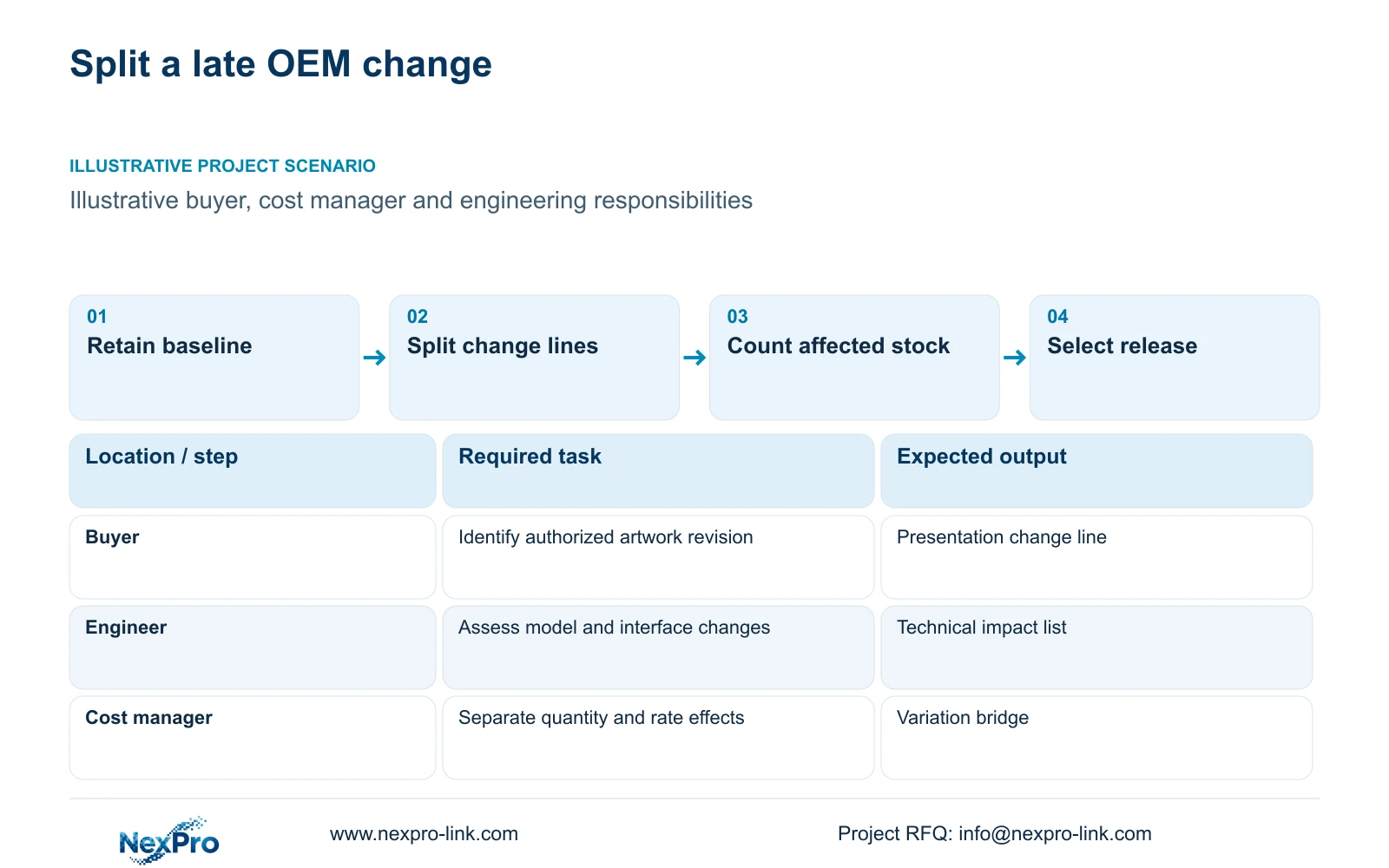
Separate the requested artwork change from any hardware substitution before agreeing a revised price or shipment. Count the affected materials and preparation work against the approved baseline, then choose a release arrangement that preserves the hotel’s required functions. Use staged release only when unchanged equipment remains usable and its interfaces are settled.
A request to change the logo and model shortly before dispatch can affect different parts of the order. Identify the original and proposed artwork revisions, equipment models, quantities and delivery boundary. State whether the revised requirement applies to every unit, a particular hotel work front or only future replenishment.
Keep the original accepted scope available for comparison. Previously approved equipment cannot automatically satisfy a revised model requirement, and an artwork request does not itself authorize a technical substitution. The cost manager needs separate decisions for extra quantity, specification changes and any altered delivery arrangement.
| Required task | Given information | Decision still needed |
|---|---|---|
| Replace contractor artwork | Accepted old artwork revision | New authorized file and affected surfaces |
| Substitute camera model | Accepted equipment schedule | Required view, interfaces and supported recording |
| Change shipment allocation | Original destination grouping | Affected cartons and release sequence |
Section 02
Separate branding and engineering impacts
Treat equipment marking, adhesive labels and printed packaging as separate change lines. Their reuse and rework possibilities depend on the actual material and agreed process. A revised outer-carton label does not necessarily require an equipment change. Conversely, an already marked surface cannot be assumed suitable for a clean relabelling operation without checking the proposed treatment.
Preserve the real model, serial and required markings under either artwork version. Authorized customer branding should not obscure information needed for service. Hardware OEM work also does not establish permission to rename a third-party client or change its ownership. Document any software requirement separately.
For a hardware change, review the observation task and its dependencies. A camera substitution can change mounting, power demand, recording mode and client behaviour. Extra positions may require more network or storage resources. Keep these engineering effects outside the artwork allowance so a low printing cost does not conceal an unresolved equipment requirement.
| Item | Artwork revision | Hardware revision | Effect on the hotel task |
|---|---|---|---|
| Equipment label | Update authorized presentation | Retain correct new model identity | Supports receiving and service traceability |
| Mounting interface | Usually unchanged by artwork | Check actual dimensions and fixing | May alter installation work |
| Recording configuration | Unchanged by logo alone | Review supported mode and load | May alter recorder and storage scope |
Section 03
Count affected materials and units
Count affected items by their actual preparation state. Distinguish unprepared stock, marked devices, printed materials and packed cartons. A single order quantity cannot explain how much work is reusable. List the shared preparation activity once, then allocate changed materials to the relevant units or cartons.
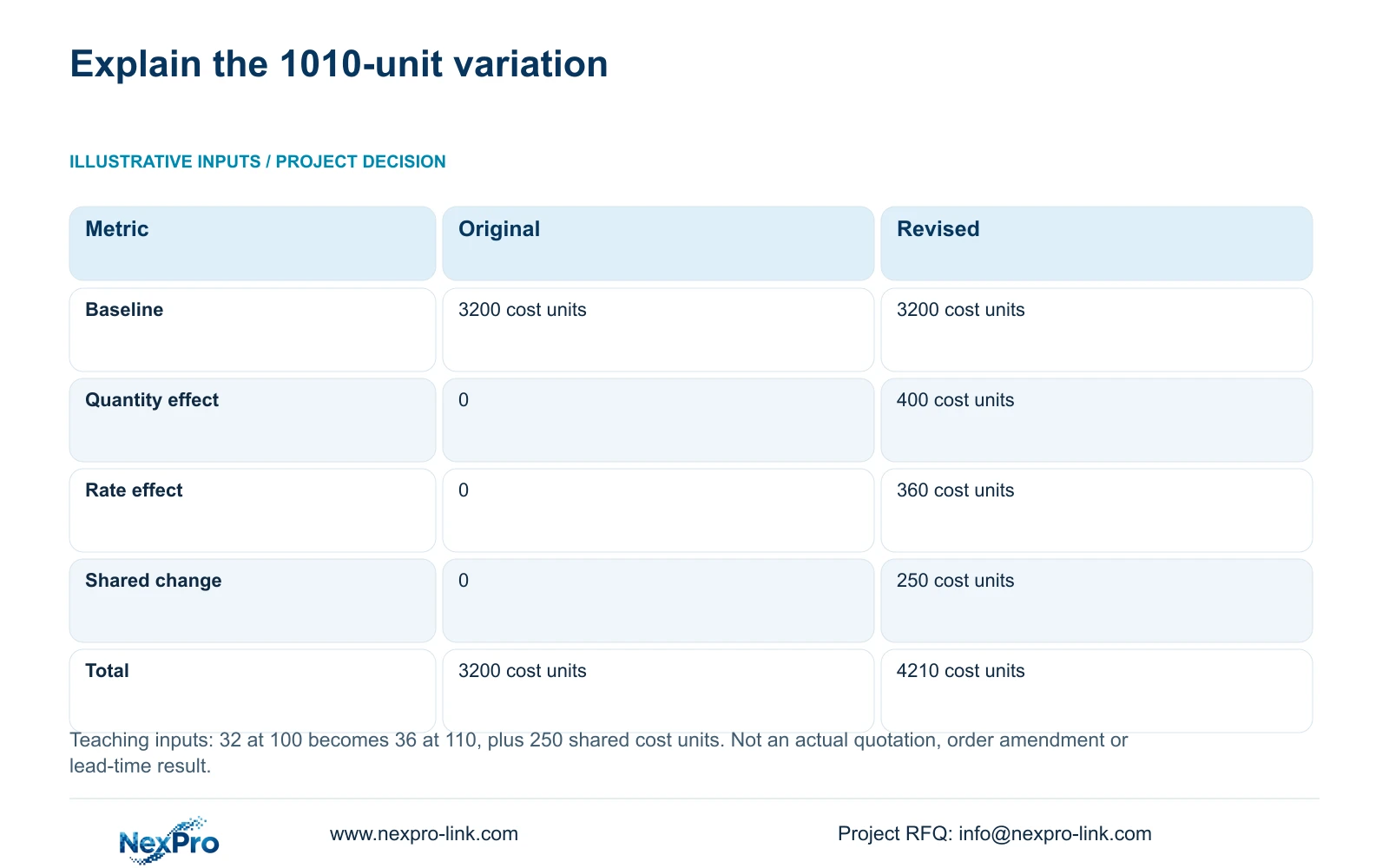
For the independent teaching calculation, the original quantity is 32 at a rate of 100 cost units. The revised quantity is 36 at 110 cost units, with an additional shared item of 250 cost units. These inputs are illustrative, not prices or an actual OEM order. The rate change is deliberately aggregated and does not identify a particular manufacturing process.
Use a fixed calculation order: original equals 32 × 100; quantity effect equals (36 minus 32) × 100; specification/rate effect equals 36 × (110 minus 100). Add the shared item once. CASE02 remains a separate 24-camera reference and supplies no quantity or price input to this variation.
Section 04
Calculate reusable and new work
The calculation produces a 3,200-unit baseline, a 400-unit quantity effect and a 360-unit specification/rate effect. Adding the 250-unit shared change gives 4,210 cost units. The difference of 1,010 units is therefore explained through separate causes that can be reviewed independently.
Do not add another generic uplift for a change already included in the revised rate. Where an actual quotation contains credits for reusable stock or cancelled materials, show those separately with their basis. Unconfirmed reuse is not a saving, and the teaching table does not establish a right to cancel prepared equipment without cost.
Recalculate engineering dependencies before accepting the unit-rate extension. NexPro-NVR4449-4K has published 49-channel and 320 Mbps input fields, but those fields do not establish support for every 49-camera resolution combination; its summary lists 49 × 5MP/9 × 4K. A hardware revision must retain the required mode, storage and operating scope.
| Metric / condition | Original: 32 at 100 | Revised: 36 at 110 |
|---|---|---|
| Original total | 3200 | 3200 |
| Quantity effect | 0 | 400 |
| Rate/specification effect | 0 | 360 |
| Shared-resource change | 0 | 250 |
| Final teaching total | 3200 | 4210 |
Section 05
Compare full and staged release options
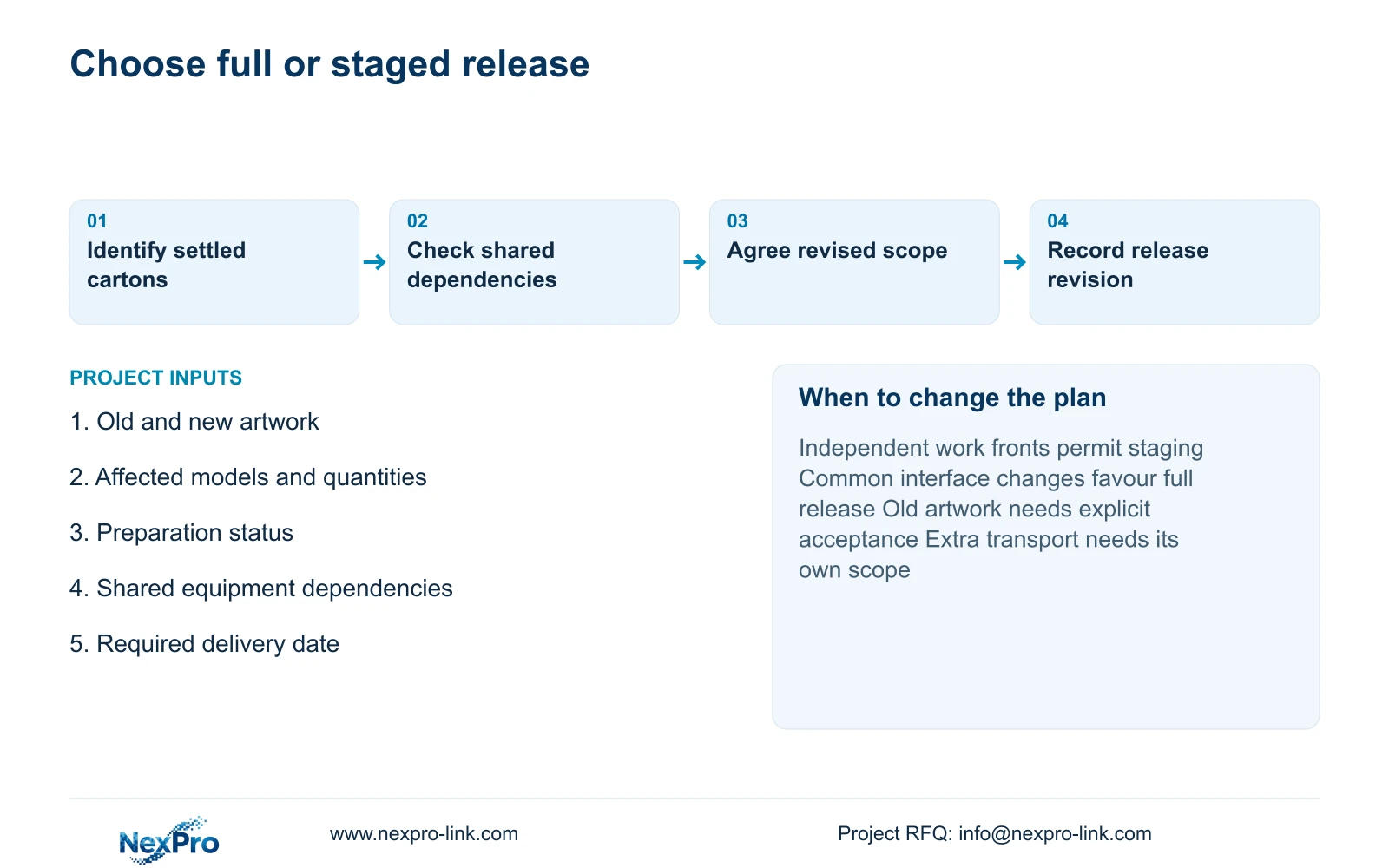
Hold a complete release when the change affects interfaces or identity across the whole shipment. This can keep one configuration together, but it may defer equipment whose scope is otherwise settled. Evaluate the actual preparation and transport sequence; no fixed additional lead time follows from the variation arithmetic.
A staged release is useful where unchanged work fronts can operate with their allocated equipment and the remaining change has a clear boundary. Identify the first-stage cartons, retained configuration and later materials. Include extra handling and transport as quoted inputs. Staging should not leave a camera group without its required recorder, access node or protected power path.
Recommend staged release only after those dependencies are accounted for and the buyer accepts the delivery split. Choose full release when revised brackets, software interfaces or common labels make separation unreliable. If older artwork is proposed for an early batch, record its explicit acceptance; the old approval cannot be silently extended to the new request.
| Retained outcome | Extra scope | When worthwhile | Counter-condition |
|---|---|---|---|
| Install settled work fronts | Separate carton allocation and transport | Unchanged equipment is independently usable | Shared dependencies remain unresolved |
| Receive one consistent configuration | Whole-batch waiting where necessary | Change affects the complete package | Unaffected areas could proceed safely |
Section 06
Record the revised approved version
Issue a revised record connecting artwork, equipment schedule and packing allocation. Keep their revision identities separate so the buyer can accept a logo adjustment without accidentally accepting a model change. The commercial record should explain quantity and rate effects, reused scope and delivery consequences.
Make the release record readable by the receiving and installation teams. It should identify which old material remains permitted, which version has been superseded and which cartons contain the revised configuration. A calculation supports the decision, but it does not authorize production or replace an agreed order amendment.
Send old and new artwork, the affected model/quantity lines, preparation status and required delivery date to info@nexpro-link.com. NexPro-Link can discuss OEM changes and BOQ/model-matching support within a written supply scope. A change proposal should retain mandatory hotel requirements and identify the specific decision needed for the affected release.
Section 07
Buyer questions
Can a late logo change leave the hardware order unchanged? Yes, where only authorized presentation changes and the equipment identity, interfaces and configuration remain valid. The actual marking and packaging status still determines possible rework and any commercial effect.
Is reusable stock automatically credited? No. Identify the actual reusable items and obtain the applicable commercial treatment. Unconfirmed reuse, cancellation or reallocation should not be entered as a guaranteed credit.
Can NexPro-Link assess a change without the full tender package? A focused comparison can start with the old and new revisions, affected quantities, technical interfaces and delivery scope. Provide the relevant mandatory requirements without sending unrelated confidential records.
Engineering references
These sources support the general planning principles. Always use the selected product's current datasheet and applicable project standards for final design.