A hotel security addendum must reach the configuration as well as the quotation. Map each changed requirement to affected resources, distinguish quantity from model changes and retain the revision that governs procurement.
Section 01
Read the changed requirement
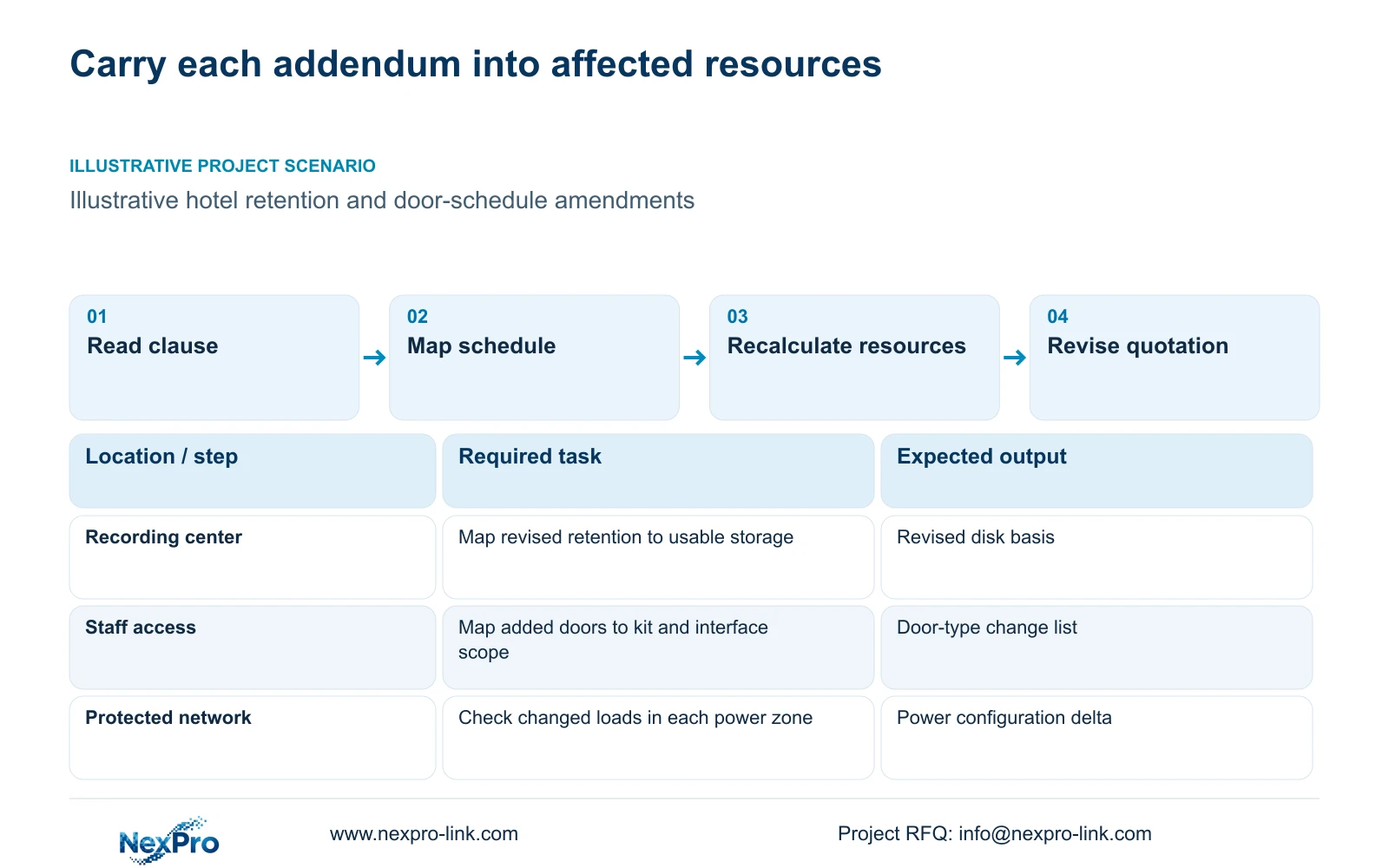
Require a mapped configuration revision when a hotel security tender addendum changes retention, door quantities or operating requirements. A quotation that only acknowledges the addendum is insufficient if it still carries the old resources. Retain the original configuration only where a documented check shows that it satisfies the revised requirement.
Read each amendment against the baseline clause and its affected schedule. Record whether it changes quantity, performance, interfaces, supply responsibility or delivery conditions. Increased retention can require storage without changing camera count; added doors can affect locks, credentials or access equipment without adding CCTV points.
Keep the previous requirement and quotation reference beside the new instruction. If the amendment leaves its applicability unclear, identify the unanswered point before replacing the baseline. This gives the engineer a technical decision to resolve and the cost manager a specific scope difference to evaluate.
| Required task | Changed information | Decision still needed |
|---|---|---|
| Retain approved footage | Retention requirement amended | New usable-capacity and disk configuration |
| Equip scheduled doors | Door count amended | Door types, components and interface scope |
| Maintain outage operation | Protected functions amended | Affected power zones and battery configuration |
Section 02
Locate affected schedule items
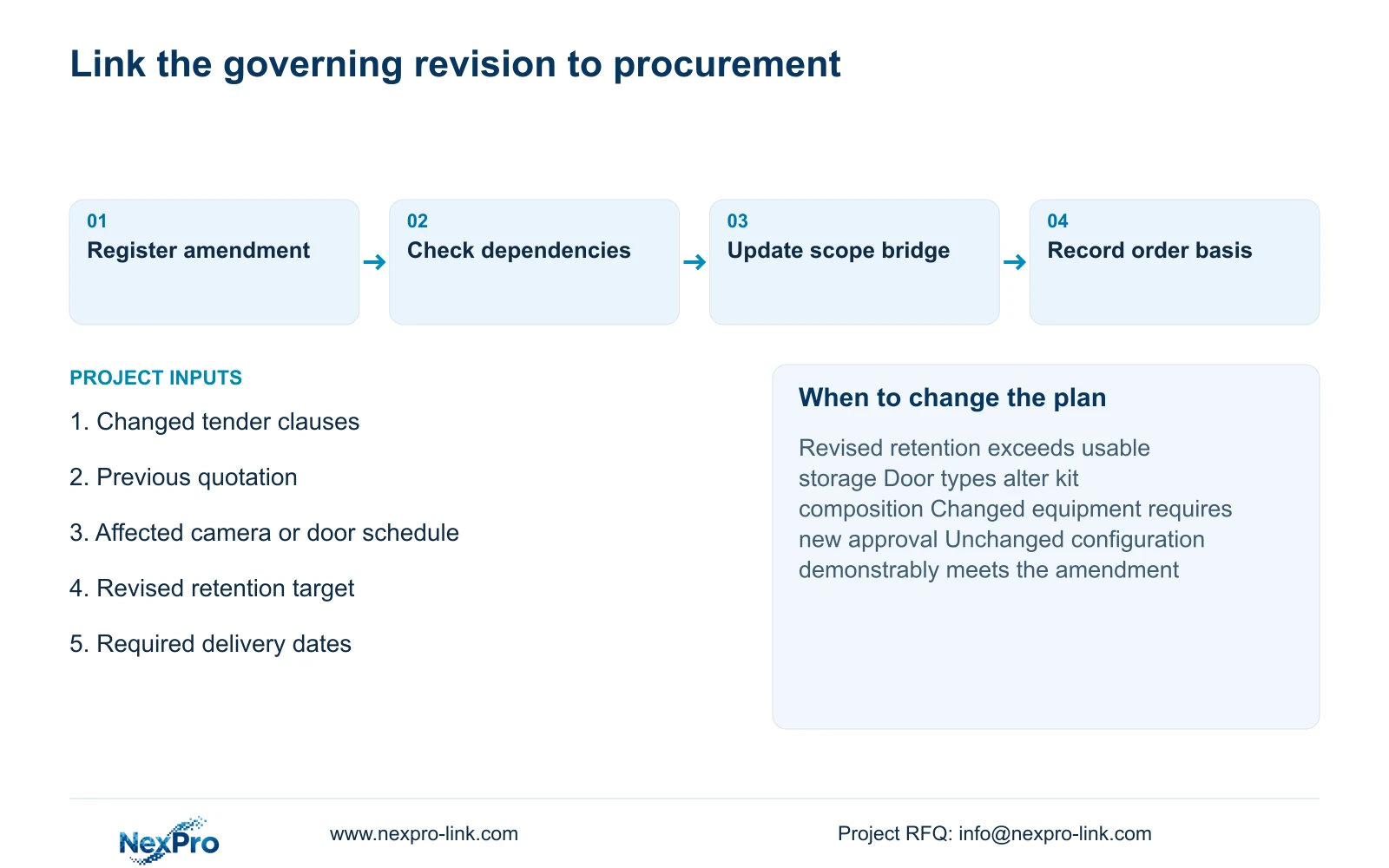
Create a change register linking each addendum clause to BOQ lines, camera or door tags, configuration calculations and quotation rows. Include dependent items that the amended clause does not name. More cameras can affect disks and switches; a new operator platform can affect software, workstation configuration and training.
Map delivery dependencies at the same time. A changed model may require technical approval before preparation. Revised branding can affect artwork, labels and packing. Battery configurations can affect transport planning, while a new platform can require hotel IT access before commissioning. Assign these consequences to their actual tasks.
Independent preparation branches can proceed in parallel only when their inputs are settled. Sequential dependencies still constrain release. Do not turn generic preparation durations into a delivery promise or assume that an unchanged hardware quantity means the installation programme is unaffected.
| Changed item | Baseline | Revised check | Hotel consequence |
|---|---|---|---|
| Retention | Previous disk allowance | Recording volume and usable capacity | Old storage may no longer meet the task |
| Door quantity | Previous door schedule | Door-type kits and supported interfaces | Supply and local commissioning can change |
| Platform | Previous client workflow | Edition, permissions and training scope | Hardware alone may not complete handover |
Section 03
Recalculate the resource envelope
Recalculate resources from the revised task inputs. Storage depends on camera groups, average recording bitrate, daily hours and approved days. A longer period does not itself justify a different frame rate or reduced image task. Check the resulting usable requirement against the actual supported disk arrangement.
CASE01 is an independent illustration: 32 assumed streams at 4 Mbps, continuously recorded for 30 days, produce 41.472 TB of video and require 51.84 TB usable capacity with 20% free. These values describe that case only. If an addendum changes an input, recalculate the case; do not reuse its capacity conclusion unchanged.
Check each PoE group and protected power zone as well. NexPro SW-POE1618G remains a candidate with unresolved access-port speed fields and no stated total PoE wattage in the supplied record. NexPro-NVR2232-4K has conflicting 2×8 TB and 2×18 TB storage descriptions, plus recording/playback differences. Neither unresolved field should be used to claim an amendment fits existing capacity.
Section 04
Separate quantity and model changes
Keep quantity additions separate from specification changes even when both affect one BOQ line. Identify the original and proposed model, changed interface and revised accessories. Disclose any reusable equipment and any cancellation or rework consequence. A substituted model should retain the required task or appear as an explicit deviation.
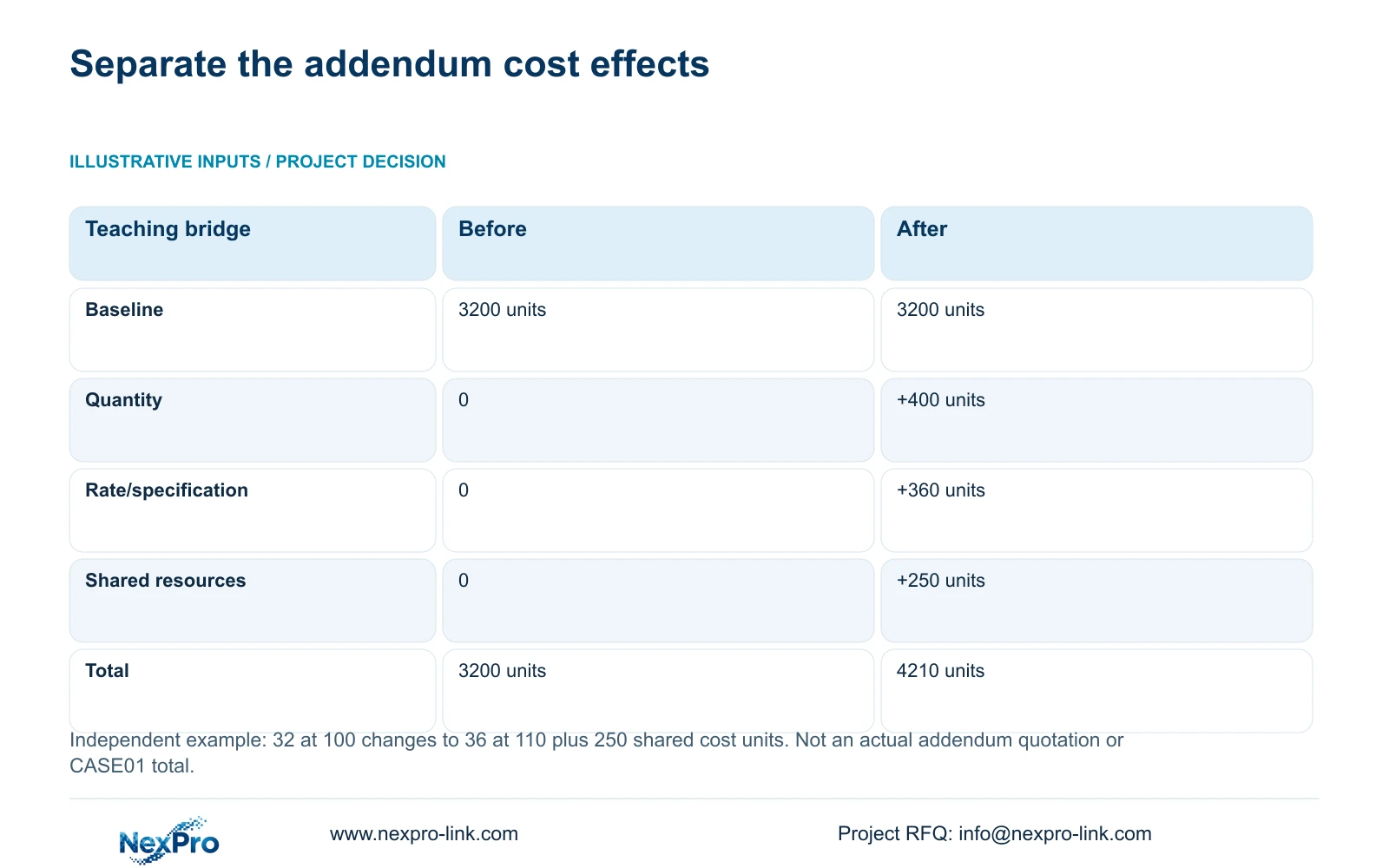
The independent cost demonstration starts with 32 units at 100 cost units and changes to 36 at 110, adding a shared item of 250. Calculate the baseline as 32 × 100 = 3200; the quantity effect as (36 − 32) × 100 = 400; and the rate effect as 36 × (110 − 100) = 360.
The resulting 4210 total includes the 250 shared-resource change once. It is not an actual addendum price or a CASE01 commercial total. The method supports an itemized change response: determine the revised technical scope first, then apply actual rates to that scope without hiding an infrastructure upgrade inside the device line.
| Metric / condition | Original: 32 at 100 | Revised: 36 at 110 |
|---|---|---|
| Original total | 3200 | 3200 |
| Quantity effect | 0 | 400 |
| Rate/specification effect | 0 | 360 |
| Shared-resource change | 0 | 250 |
| Final teaching total | 3200 | 4210 |
Section 05
Compare before and after totals
Show a commercial bridge from the previous accepted scope to the revised response. In the teaching example, the 1010-unit increase contains 400 for quantity, 360 for rate/specification and 250 for shared resources. These categories allow the buyer to address each cause separately.
Use a separate disposition for retained, reused, cancelled and newly supplied items. Do not assume that a cancelled item generates a full credit or that a late configuration change has no preparation cost. Actual quotations and the controlling order establish those amounts and any delivery consequences.
Distinguish required amendment work from optional enhancements. If the new retention requirement is mandatory, removing storage to preserve the old price does not produce a conforming alternative. A later display release can be considered only where the approved viewing and incident workflow remains available. Keep every comparison on the same retained outcome.
| Changed item | Trace and recalculate | Release record |
|---|---|---|
| Clause or drawing revision | Old/new reference and affected point tags | Author and controlling revision |
| Camera position or quantity | Coverage, ports, power, streams and usable storage | Revised schedule and BOQ line |
| Retention or platform requirement | Profile/disk inputs or version/licence/support evidence | Updated calculation and quote exclusions |
| Commercial change | Added, omitted and shared scope; actual rates or unresolved prices | Owner approval and superseded offer identified |
Section 06
Record the governing revision
The final response should name the incorporated addenda and map them to updated schedules, calculations and quotation lines. Record the governing drawing and requirement revisions with the order scope. A general statement that all amendments are included should be supported by a register showing which changes reached each configuration.
Recommend revising every affected resource before commercial acceptance when an addendum changes a required function. Keep unchanged equipment only after its suitability is documented. If the authorized instruction removes or narrows a requirement, revise the related quantities and dependencies together rather than deleting one price line in isolation.
Send info@nexpro-link.com the changed clauses, relevant prior quotation lines, affected camera or door schedule and revised retention or outage requirement. Include the destination and required delivery dates. Through /project-supply/boq-tender-support, NexPro-Link can discuss model matching and coordinated supply scope; this does not authorize substitutions or imply that local statutory design and third-party commissioning are included.
Section 07
Buyer questions
Does acknowledging an addendum prove the quotation incorporates it? No. Ask for the affected model, quantity, calculation and quotation references. A change register can show incorporation; an acknowledgment alone cannot demonstrate that the revised resources satisfy the requirement.
Can unchanged equipment be retained after a retention amendment? Yes, if its supported disk arrangement and usable recording budget meet the recalculated requirement. Preserve the evidence for that conclusion. Channel count alone cannot establish sufficient storage.
Will an addendum always delay the complete order? No fixed delay follows from an amendment. Identify which approval, preparation, transport or site tasks it affects. Partial release is useful only when the released scope remains technically independent and is authorized.
Engineering references
These sources support the general planning principles. Always use the selected product's current datasheet and applicable project standards for final design.