Preserve the specified baseline and submit an alternate as a separately identified package. Compare technical differences and complete service costs before deciding whether the alternative deserves approval.
Section 01
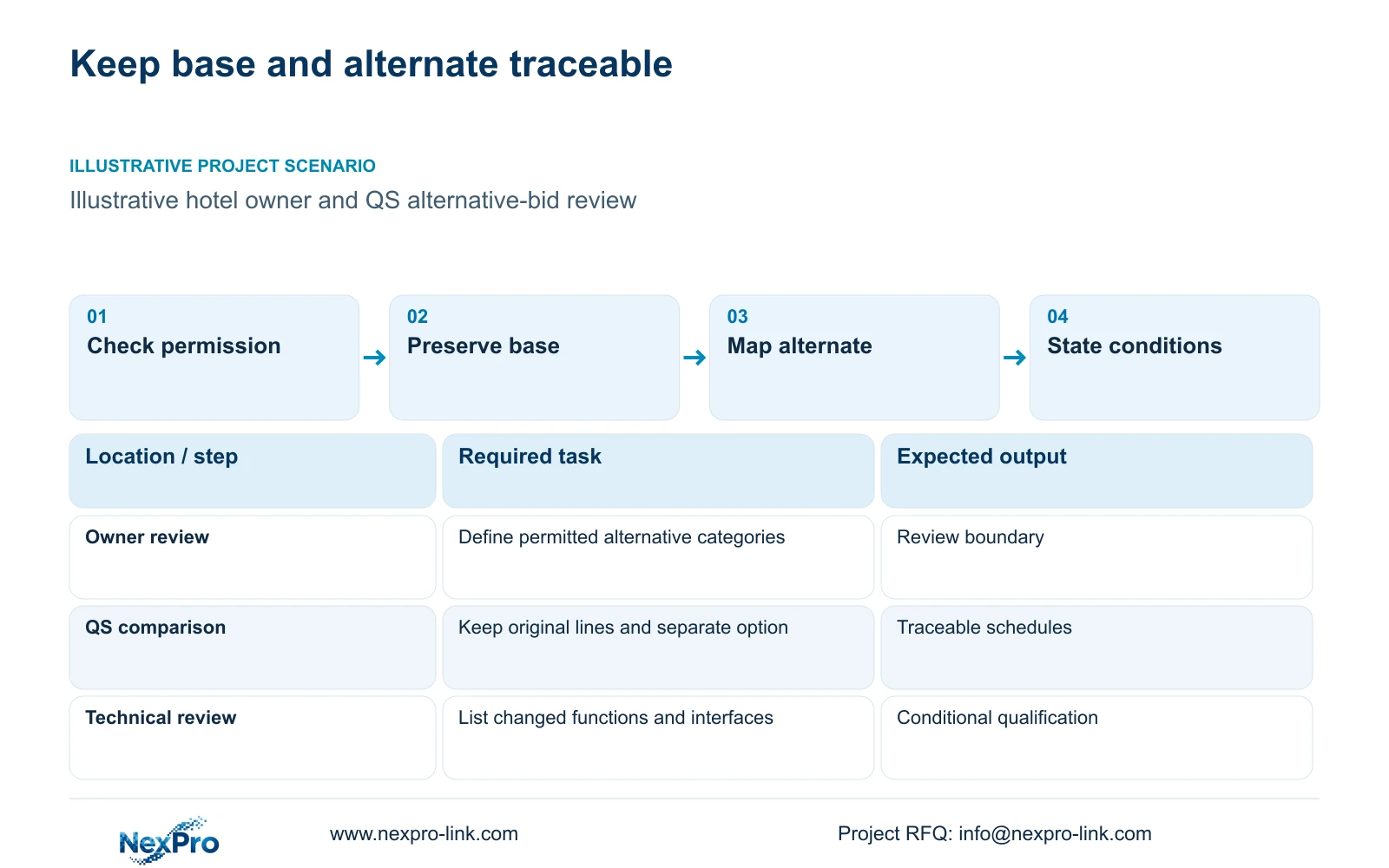
Confirm where an alternate offer is permitted
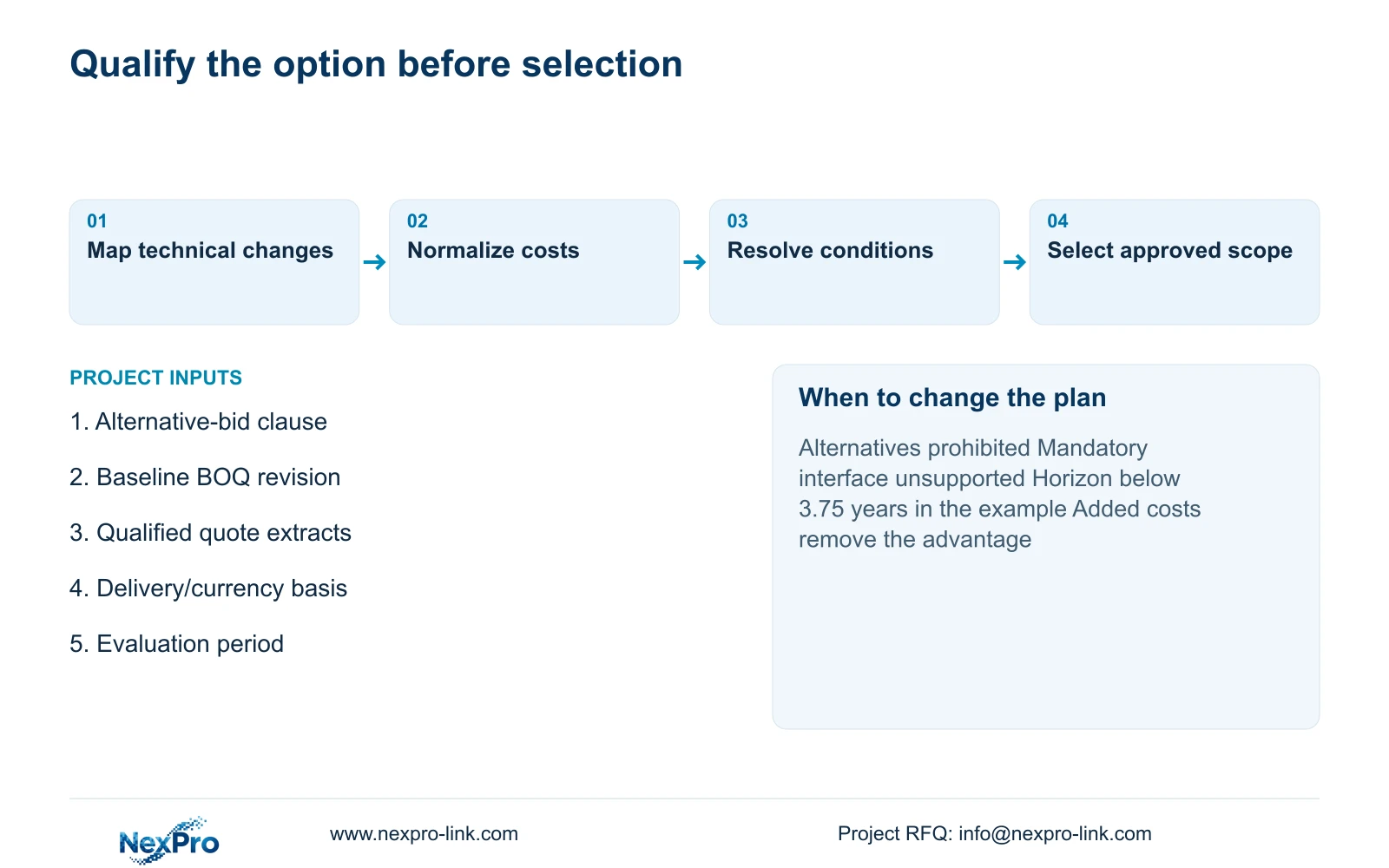
Keep the specified baseline intact and present a NexPro-Link alternate separately only where the buyer permits alternatives. Recommend an alternate after its technical and complete commercial scope qualifies. Retain the baseline if the operator prohibits substitution, a mandatory platform is unsupported or unresolved costs could reverse the comparison.
Identify the applicable tender rule and the decision authority before changing any line. Permission to discuss an alternative does not approve a brand, model or purchase order. Record whether the buyer will consider individual substitutions, a subsystem or a complete equipment package. Keep the baseline reference and alternate reference visible in every schedule.
Fix the common evaluation boundary: hotel tasks, quantities, retention, destination, currency and service period. Alternatives may use different equipment arrangements, but each must deliver the same required outcome. If a requirement itself is being changed, submit that as a separate scope decision so the owner can distinguish value engineering from a like-for-like equipment alternative.
| Required task | Given information | Decision still needed |
|---|---|---|
| Price the tender baseline | Specified brand and schedule | Clarified inclusions and current revision |
| Submit an alternate | Buyer willing to consider options | Permitted categories and approving authority |
Section 02
Price the specified baseline without hidden substitutions
Prepare the base offer against the specified model references and quantities. Preserve tender line numbers and identify any departure. Separate equipment from installation, freight, taxes, software and later services. If the baseline supplier excludes an essential item, carry that item into the evaluated scope rather than letting the exclusion become an apparent price advantage.
Use the same treatment for common resources. Shared network work or installation can remain identical across both packages, but it should appear once in each completed comparison. Confirm whether storage, adapters and commissioning already belong to an equipment bundle. Repeated allowances can distort the difference as much as omitted items.
Keep price evidence attached to its scope and quotation revision. A product catalogue is insufficient for a current brand-price ranking. An unquoted service remains an open input. The cost manager can still issue a qualified comparison identifying the missing amount, but should not label the cheaper visible subtotal as the complete economic winner.
| Item | Base offer | Alternate offer |
|---|---|---|
| Required recording | Specified qualified configuration | Same retention and retrieval outcome |
| Delivery | Named destination and basis | Same evaluated destination and basis |
| Later services | Actual applicable terms | Actual applicable terms; unknowns visible |
Section 03
Build a scoped alternate equipment package
Map the alternate to the same camera tasks and operating functions as the baseline. Show exact models, changed quantities and the reason for each change. A different recorder arrangement may affect maintenance and retrieval; a camera change may affect optical adjustment or night operation. Describe these consequences alongside the proposed hardware.
NexPro-Link can support model matching, project documents and coordinated equipment supply. State its CCTV manufacturing core separately from supporting categories supplied through coordination. A common order does not establish native software integration or included local installation. If an alternate changes the client or platform, identify migration, training and supported workflows.
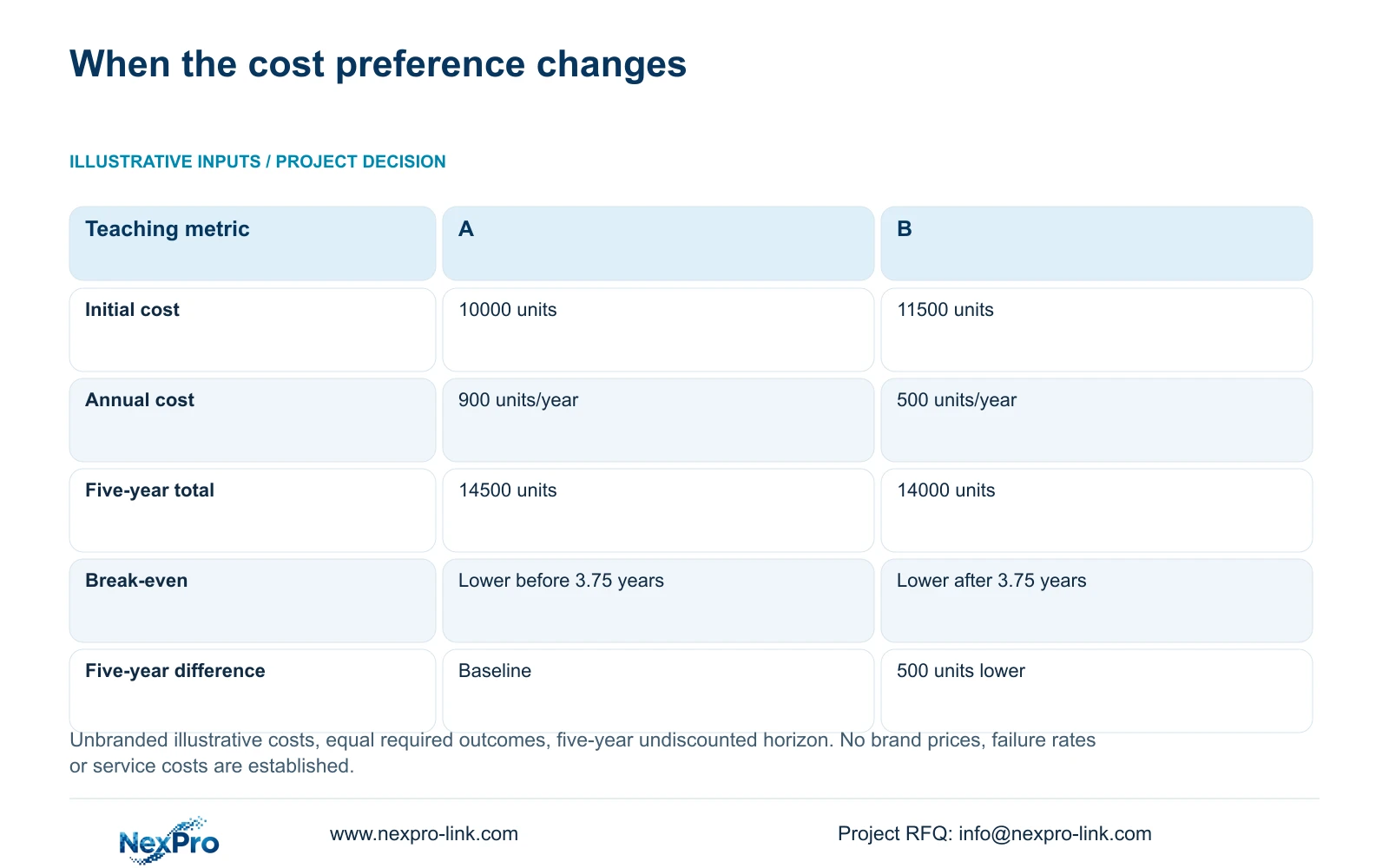
Build the cost model from actual one-time and recurring terms when available. The teaching comparison used here assumes equal outcomes and a five-year undiscounted horizon. A starts at 10000 cost units with 900 annually; B starts at 11500 with 500 annually. Those inputs are unbranded, and the recurring amounts are not failure-rate or service claims about any manufacturer.
Section 04
Calculate common costs and the differences that matter
Five-year total equals initial cost plus five times annual cost. Under the teaching assumptions, A totals 14500 units and B totals 14000. Break-even time equals the 1500-unit additional initial cost divided by the 400-unit annual difference, giving 3.75 years. At that point the modeled totals are equal.
This result supports B only when both outcomes qualify, the annual difference is credible and the evaluation period extends beyond 3.75 years. A remains lower before that point. At five years, B is 500 units lower. These amounts establish no current NexPro-Link, Hikvision or Dahua ranking, and they are independent of the complete hotel reference case.
Common unchanged costs do not alter the difference, although they still belong in the complete totals. A changed license, installation activity or delivery charge does alter it. If an uncertain added cost exceeds the modeled advantage, reconsider the recommendation. Longer-term evaluation may also need financial assumptions beyond this simple undiscounted demonstration.
| Comparison field | Base offer | Alternate entry |
|---|---|---|
| Technical basis | Required schedule and approved baseline | Changed lines, retained outcomes and explicit deviations |
| Initial cost scope | Supply, installation and delivery boundary | Same boundary plus priced additions/omissions |
| Later obligations | Applicable service and software terms | Actual changed terms; unknown amounts not zero |
| Status | Unaltered compliant offer remains available | Permission, evidence owner and approval decision still needed |
Section 05
State the conditions for accepting the alternate
List outstanding technical decisions in the alternate submission. Separate company registration, brand acceptance, model approval and order authority. Samples and project documents inform those decisions without guaranteeing them. Where one disputed function controls acceptance, define a representative task that can resolve it rather than request an unrestricted project-wide approval.
For a camera alternative, that task could involve recorded movement at the assigned entrance followed by retrieval through the selected client. Record the equipment and software versions and relevant conditions. An intended test result cannot be marked passed in advance, and a limited demonstration supports only its observed scope.
Compare service boundaries before approval. The supplied policy record describes a 24-month limited hardware baseline from receipt for applicable main equipment, with controlling written order terms. Batteries, disks, cable and OEM arrangements require their own scope. That baseline does not promise free local labor or establish the annual cost assumptions in the teaching model.
| Retained outcome | Additional scope | Acceptance condition |
|---|---|---|
| Required platform workflow | Interface or migration work | Supported and fully priced |
| Required image task | Representative recorded comparison | Observed result meets the agreed task |
| Same service boundary | Local labor and transport terms | Written scope supports the cost comparison |
Section 06
Present one comparison the owner can decide from
Present the base and alternate side by side with their technical status, completed totals and unresolved conditions. Keep optional improvements outside the common baseline. Describe the change in each cost layer so that the owner can see whether the difference comes from equipment, delivery or continuing service.
Recommend the economical qualified option over the agreed evaluation period. In the illustrative model, choose B for a five-year horizon only if its 500-unit annual assumption is substantiated and no additional scope removes the advantage. Change to A for a shorter period below 3.75 years, or reassess either option when actual quotations change. Technical qualification remains a prerequisite.
For an alternate-bid response, send info@nexpro-link.com the alternative-bid clause, relevant baseline BOQ and scope-matched quotation extracts. Include currency, delivery destination and evaluation period. NexPro-Link's BOQ and tender support can help structure a separate equipment option while preserving the buyer's approval authority and the specified base offer.
Section 07
Buyer questions
Should we overwrite the specified BOQ with the alternate? No. Preserve the baseline and provide a mapped alternate schedule. If accepted, identify the exact replacement lines and approved revision so the procurement record shows which option controls the order.
Can a higher initial price still be recommended? Yes, when the complete qualified cost over the agreed period is lower on supported inputs. The teaching example illustrates that condition; actual recurring terms and additional scope must substantiate the recommendation.
Can an alternate be reviewed while one interface remains unresolved? It can receive a conditional technical review, with the interface and responsible party identified. Keep that status separate from final acceptance and avoid declaring a commercial winner if the unresolved interface could change cost or functionality.
Engineering references
These sources support the general planning principles. Always use the selected product's current datasheet and applicable project standards for final design.