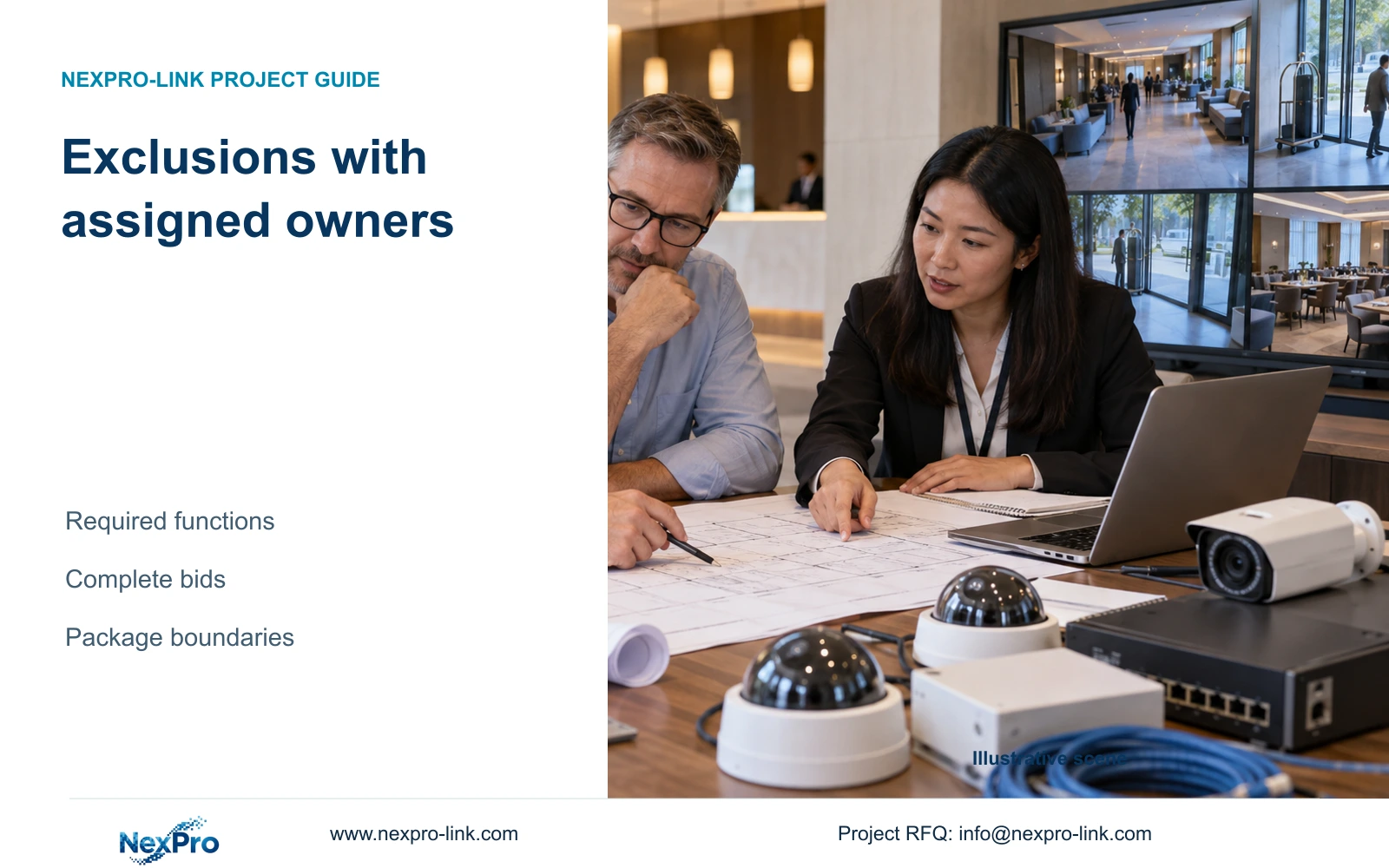
A CCTV exclusion moves required work to another package only when that package accepts it. Restore omitted storage, installation and operating dependencies to the evaluated scope before comparing hotel bids.
Section 01
Read the exact exclusion before assigning work
Put every exclusion affecting a required CCTV function into a responsibility and cost table before award. Assign it to an agreed package or return it for pricing. An equipment bid with excluded disks, installation or network work can remain viable, but only when the complete evaluated scope restores those dependencies.
Copy the exclusion accurately and identify the quotation revision and BOQ line it qualifies. Supply only may exclude installation while saying nothing about configuration. Disks excluded is a specific omission from recording storage. Display excluded needs the owner to distinguish a required operator screen from an optional wall. Ask for clarification where the wording does not establish the boundary.
Record exclusions as separate items rather than a general note that all other work belongs to the contractor. That broad wording does not establish who supplies a missing component, who configures it or who demonstrates operation. Keep any mandatory brand or model requirement attached to the affected line when proposing a different allocation.
| Required task | Given information | Decision still needed |
|---|---|---|
| Retain footage | Disks excluded | Storage supplier and configuration responsibility |
| Retrieve incidents | Display excluded | Required operator equipment and provider |
| Operate installed cameras | Installation excluded | Installer, termination and commissioning scope |
Section 02
Map each omission to an operating function
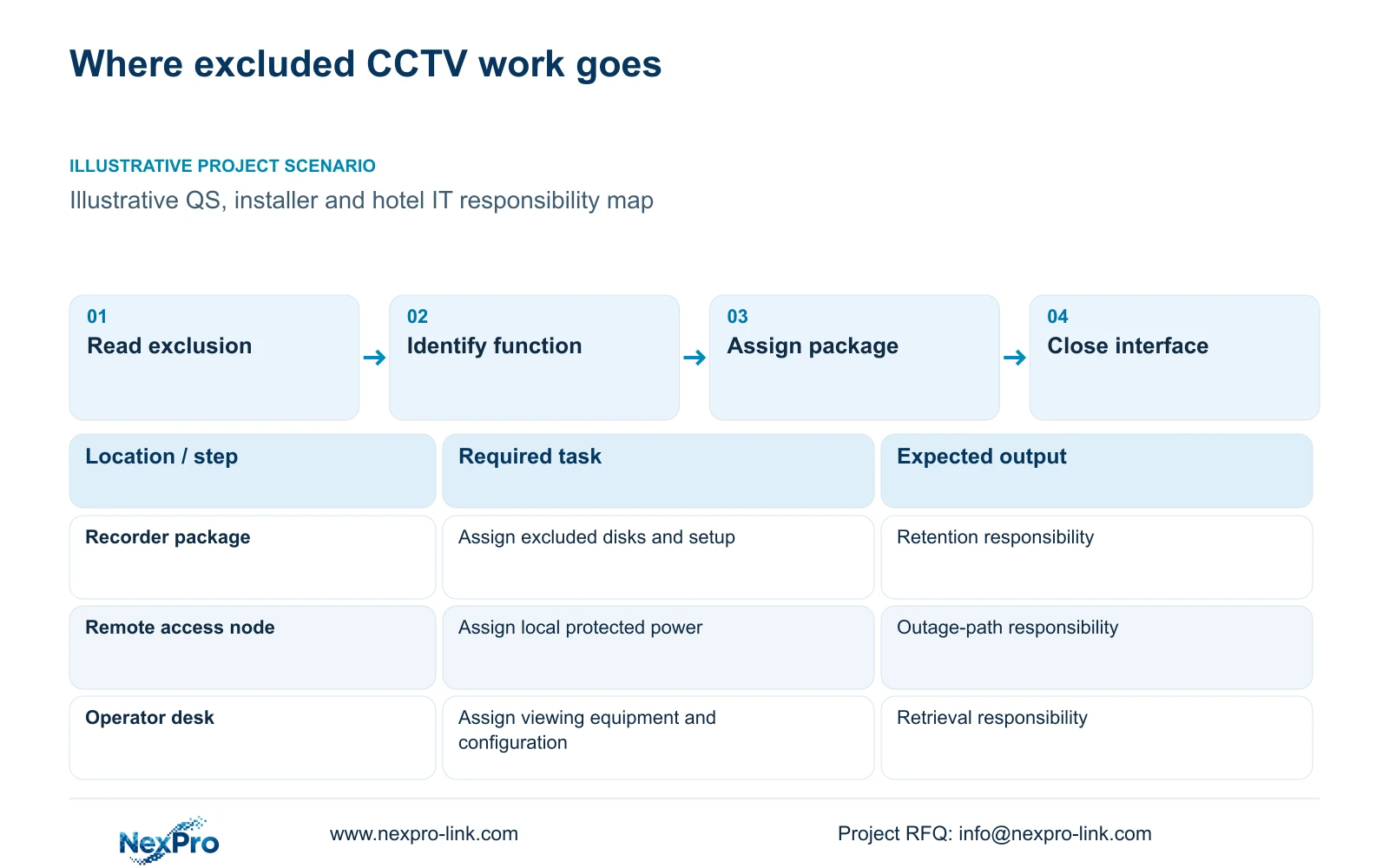
Trace the effect of the omission through the actual system. Without the necessary disks, a recorder offer cannot meet the agreed retention task. Without a configured network path, installed cameras may not reach recording. Without required local power at an access node, keeping the central recorder powered does not preserve that node's cameras during an outage.
Use the public-zone camera schedule to connect each position to a recorder and network route. Show protected power separately from data transport. A display is a viewing endpoint, so recording should not depend on a wall remaining on. The chosen operator arrangement must still provide authorized access to live views, playback and export.
Distinguish an optional improvement from a missing essential function. A larger display can add viewing area, while a required workstation may already satisfy the retrieval task. An analytics integration has its own scope and acceptance condition. These distinctions let the owner remove an optional item without unintentionally deleting a recording dependency.
| Omitted item | Function affected | Scope response |
|---|---|---|
| Disks | Retention | Add compatible storage and configuration |
| Remote-node power | Outage recording | Assign local protected supply |
| Optional wall | Expanded observation | Keep separate from essential recording |
Section 03
Assign supply, installation and configuration responsibilities
Name the package responsible for the item and its interfaces. A storage supplier can provide disks while the CCTV integrator configures them; the installer may mount equipment while hotel IT approves network access. Identify who accepts the combined result. An assigned supplier alone does not close configuration or testing work.
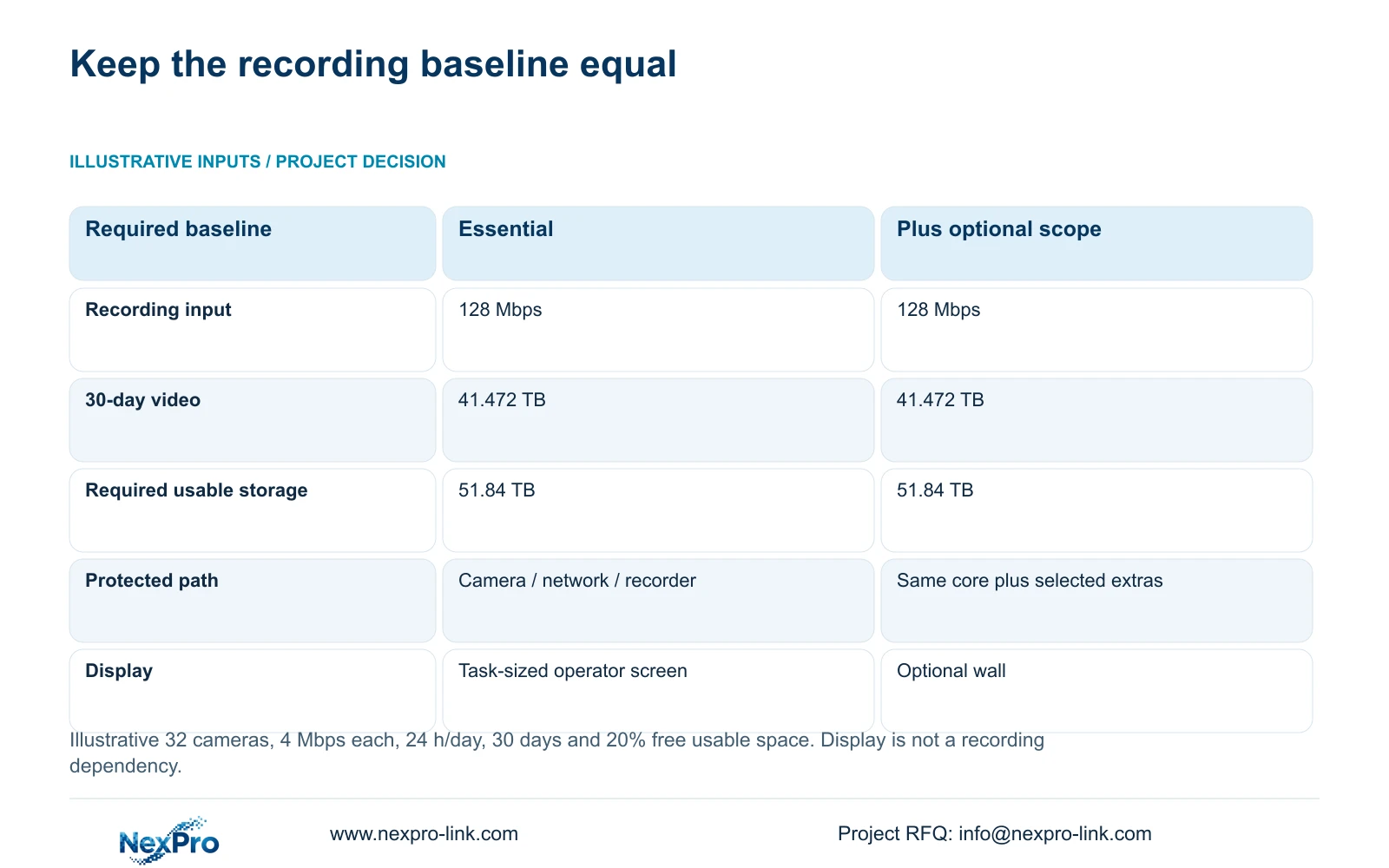
For the illustrative system below, both offers retain 32 cameras at an assumed average 4 Mbps, recording continuously for 30 days. Input traffic is 32×4 = 128 Mbps. Video capacity in decimal TB is 0.0108×32×4×30 = 41.472. Retaining 20% of usable space free requires 41.472÷0.80 = 51.84 TB of usable capacity.
The 4 Mbps rate and retention period are scenario inputs, not camera specifications or legal rules. Both packages need the same recording provision. A wall or recovery option cannot justify reducing it. When disks are excluded, assign a storage configuration that meets the usable requirement after the actual layout and formatting effects.
An exclusion is closed only when the required activity has a named owner and its commercial treatment is agreed. Mark unquoted work as unresolved rather than excluding it from the hotel's evaluated cost. The original recording illustration explains the service to preserve, not the cost of completing these activities.
| Activity | Responsible party to name | Evidence and commercial status |
|---|---|---|
| Supply and delivery | Equipment and logistics scope owner | Exact items, destination and included/excluded charges |
| Mount and connect | Local installation owner | Access, supports, routes, terminations and reinstatement |
| Configure and integrate | Device, IT and platform owners | Versions, network/account boundary and actual supported interface |
| Test and accept | Executor plus independent approval authority | Required tasks, witnessed records and unresolved defects |
| Restore and maintain | Hotel and scoped support provider | Escalation, replacement work and separately priced exclusions |
Section 05
Compare bids after restoring required scope
Prepare an evaluated total for each offer by adding the confirmed cost of necessary excluded work. Keep unpriced gaps visible. Use common delivery, currency and service boundaries, and identify common items once. A low equipment total with unpriced disks and commissioning is not ready to rank against a complete installed package.
Check any owner-supplied or existing equipment before treating reuse as free. The device must support the required function, its configuration must be accessible to authorized personnel and the responsible party must accept the integration scope. A similar housing or matching connector does not establish equivalent lens, power or firmware behavior.
Keep support and restoration scope in the comparison. The supplied policy record states a 24-month limited hardware baseline from receipt for applicable main equipment, subject to written order terms. Batteries, storage and cable require specific coverage. Local labor and transport remain separate where not included. A spare arrangement can support restoration but cannot be assumed to eliminate downtime.
| Retained outcome | Additional scope | When to include it |
|---|---|---|
| Approved retention | Excluded disks and setup | Always when absent from the required baseline |
| Outage recording | Remote-node protected supply | When that node lies on the protected path |
| Larger observation canvas | Optional wall and decoder | When a defined operator task needs it |
Section 06
Close unassigned work before award
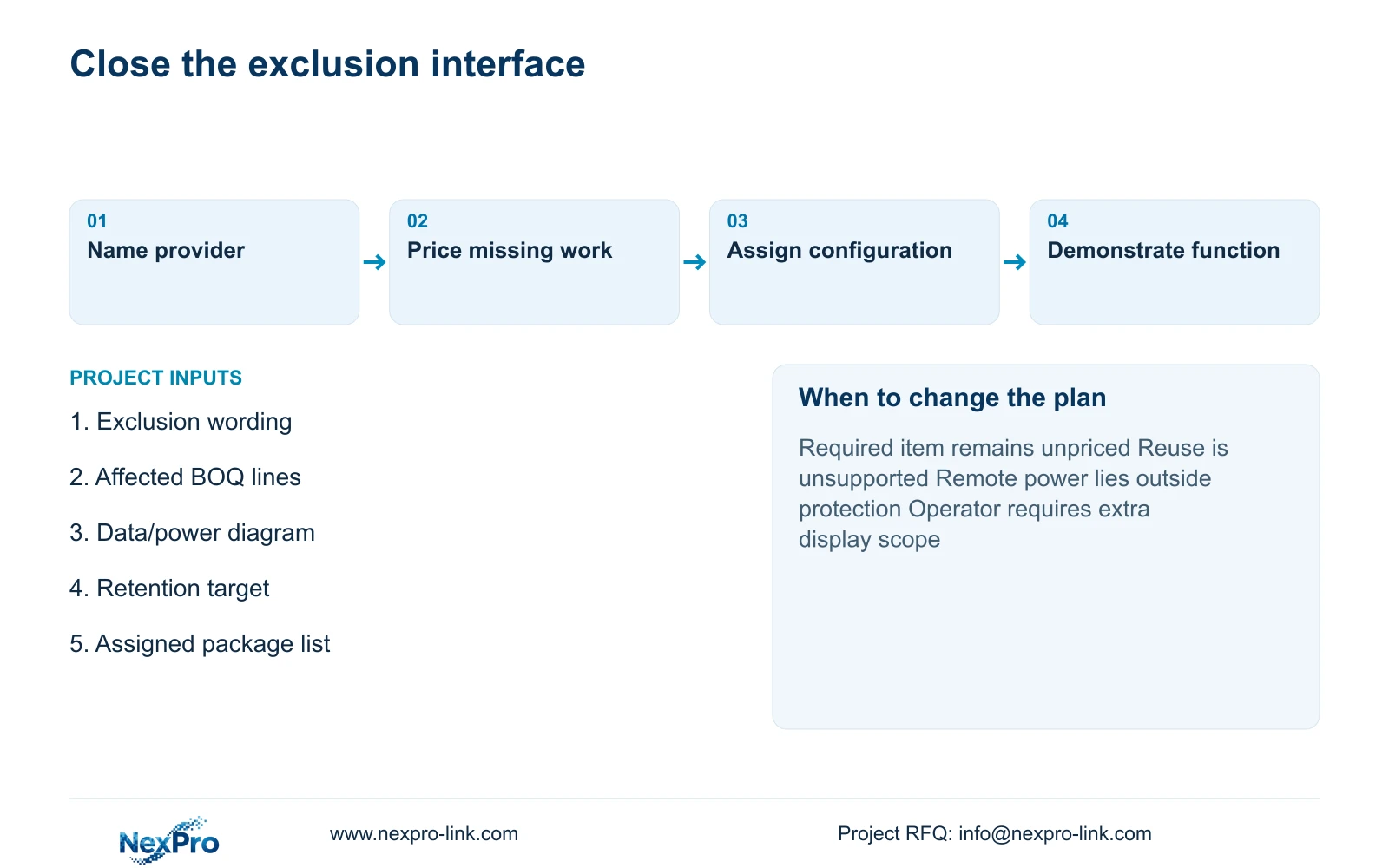
For each necessary exclusion, obtain a named package, a defined deliverable and an agreed interface. Record the cost status and the task that demonstrates completion. A disk allocation closes only when its supply and configuration support retention; an installation allocation also needs termination and relevant commissioning responsibilities.
Recommend the essential recording-first package when it meets approved viewing and outage tasks. Add display or recovery scope when the operator requirement establishes its benefit and the complete incremental cost is known. Change that recommendation if operator standards make the additional system mandatory or an existing dependency cannot support the baseline.
Send info@nexpro-link.com the quoted exclusion page, affected BOQ extract and a simple data and protected-power diagram. Include the retention requirement and identify packages already assigned to hotel IT or the local installer. NexPro-Link can discuss equipment coordination and model matching through hotel project support, with local work and third-party interfaces stated separately.
Section 07
Buyer questions
Can excluded disks be bought from another supplier? Yes, if the exact disks and layout are supported and configuration responsibility is agreed. Evaluate the completed storage scope, including setup and usable capacity, rather than adding a raw TB figure alone.
Is an owner-supplied monitor a valid exclusion? It can be, when the monitor and its signal path support the required operator task and the owner accepts supply responsibility. Any client, decoder or configuration work still needs an assigned package.
What if an excluded item still has no price at bid review? Keep the evaluated total qualified and request the missing scope price. Do not assign zero or declare a complete commercial winner while a necessary operating dependency remains unpriced.
Engineering references
These sources support the general planning principles. Always use the selected product's current datasheet and applicable project standards for final design.