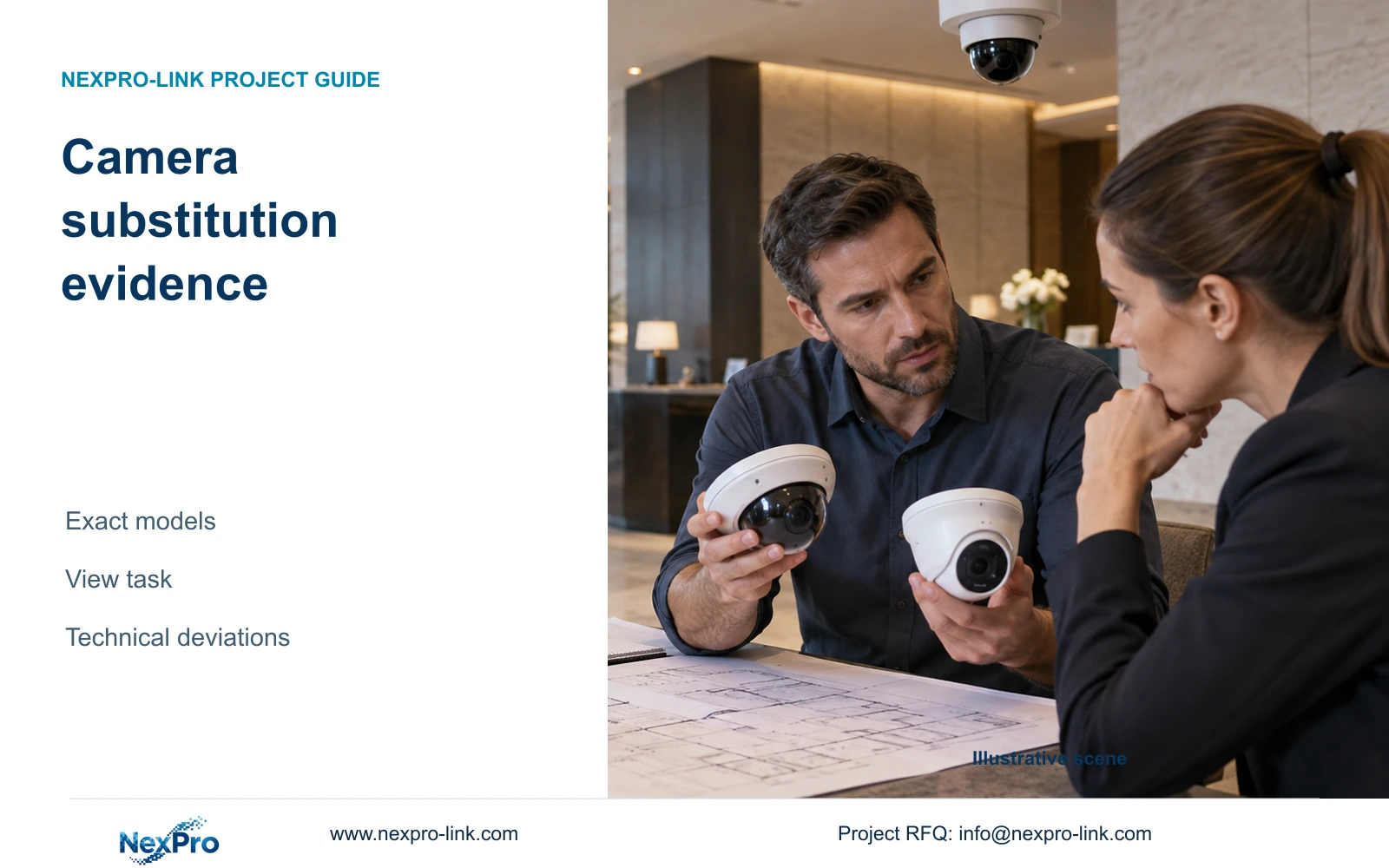
Accept a camera substitution only when its documented image, recording and operating functions preserve the assigned hotel task. A usable deviation table keeps missing evidence separate from confirmed differences.
Section 01
Preserve the specified and proposed model identities
Accept a proposed camera substitute only for the positions where its documented configuration preserves the required view and system functions. Keep the specified model in the tender baseline and identify the proposed model separately. If the operator prohibits alternatives, or a required function remains unsupported, retain the specified equipment for that scope.
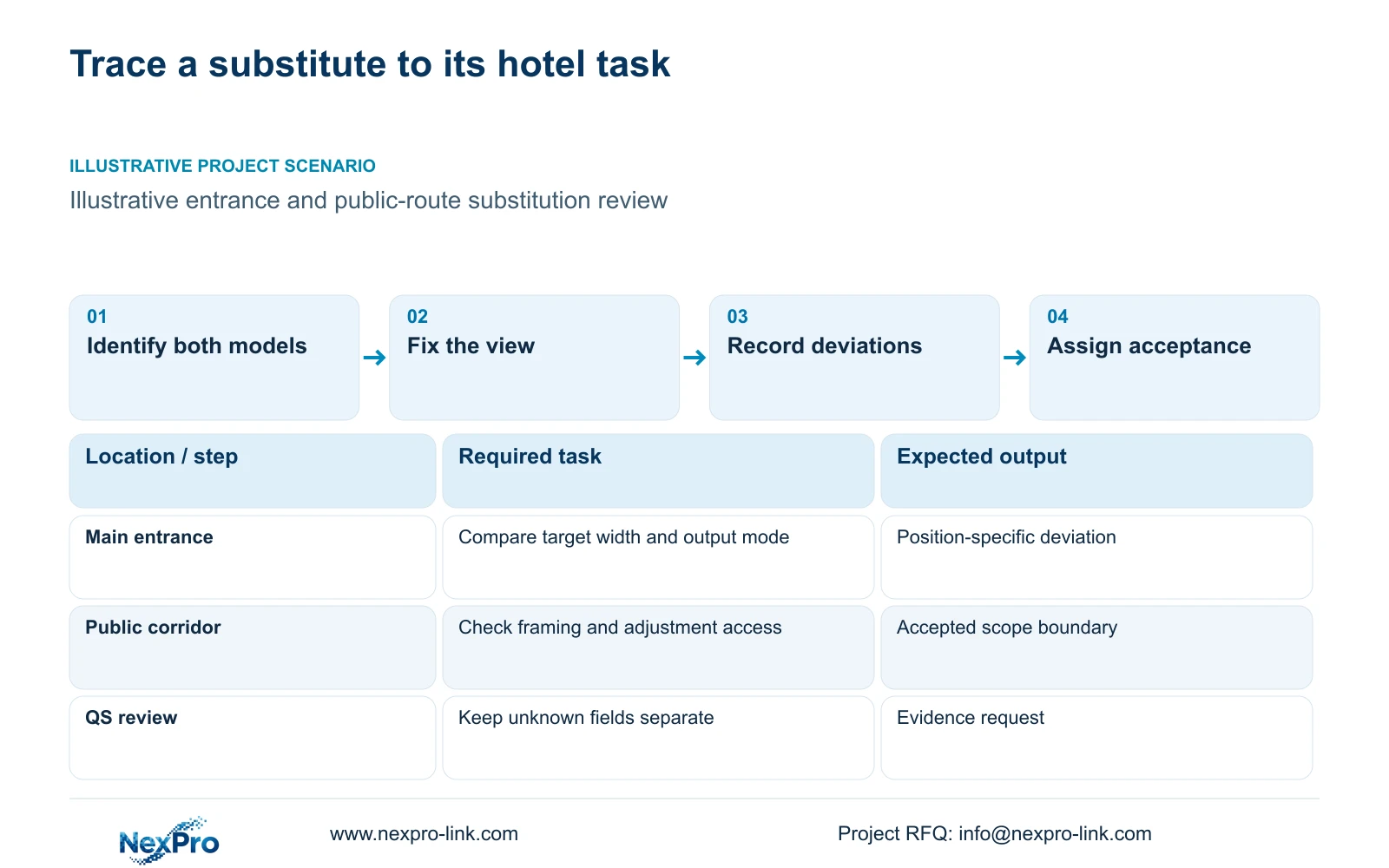
Start each comparison with the BOQ line, camera position, full model reference and relevant document revision. A family name such as 8MP dome leaves too much unresolved. Lens variants, output modes and software behavior must belong to the exact offered device. Record the mounting distance, target-plane width and permitted position before judging whether either model can frame the task.
The supplied DM2812M product PDF identifies NexPro-DM2812M55-5MP-DIC-AI with a 1/2.7-inch sensor, a listed 2880×1620 main output and a 2.8-12 mm motorized lens. NexPro-DM2812M88-8MP-DIC-AI lists a 1/1.8-inch sensor and 3840×2160 at 25 fps. Preserve those fields as written. The Dome series name establishes neither an IK10 rating nor PTZ operation.
| Required task | Given information | Decision still needed |
|---|---|---|
| Entrance detail | Exact model and output mode | Target width and permitted mounting position |
| Public corridor overview | Motorized lens range | Framing, privacy boundary and adjustment access |
Section 02
Compare the complete image and lens chain
Read sensor, lens, output mode and exposure requirements together. The same megapixel label does not establish the same image at the operator's required point. A wider view distributes available pixels over more of the scene, while an oblique target plane and obstruction can reduce useful detail even when the nominal output is unchanged.
A 2.8-12 mm focal-length range describes available optical adjustment. Without the relevant sensor dimensions or an official field-of-view specification, it does not establish an exact angle at a selected focal length. Motorized adjustment can help refine a fixed camera's framing at an awkward mounting location. Digital enlargement cannot add detail absent from the recorded image.
For an entrance with changing daylight, include backlight and moving-subject conditions in the comparison. For a public route near reflective glass, compare permitted lighting modes and mounting positions. A dual-light label alone does not resolve reflections or light disturbance. Price any necessary relocation or lighting work alongside the substitute, because those changes determine whether the proposed view remains usable.
Record each exception against the original requirement, not just a side-by-side feature list. The existing 2880-versus-3840 illustration explains a geometric pixel budget at equal width; it cannot close an environmental, compatibility or motion-detail deviation.
| Requirement | Baseline and candidate evidence | Disposition needed |
|---|---|---|
| Framing and lens duty | Full models, focal range, mounting and target plane | Match / deviation / not stated; assess actual view |
| Recorded detail | Resolution, fps, exposure and relevant recorded task | A pixel ratio is not a night or recognition result |
| Environmental and power scope | Exact enclosure fields, installation conditions and peak PoE | Absent evidence stays open |
| Recorder/client workflow | Model, firmware, mode, event and account requirements | Document support and demonstrate required functions |
| Approval | Document revision, exception owner and corrective scope | Do not release a substitute on brand or appearance alone |
Section 03
Match recording modes and client functions
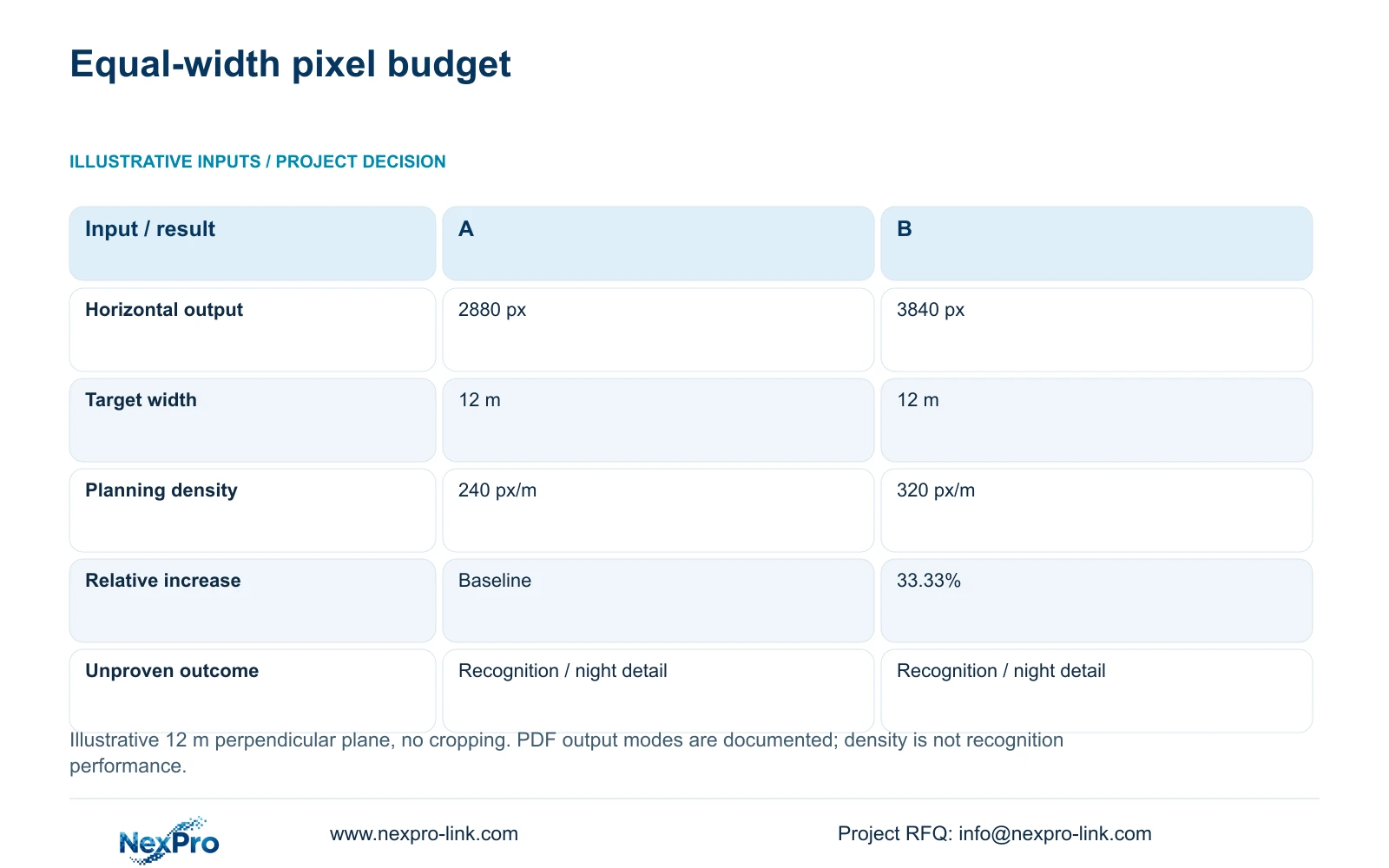
Carry the proposed output mode into the recorder and viewing checks. The following calculation uses documented horizontal outputs from the supplied PDF, but the common 12 m target width is illustrative. Planning density equals horizontal output pixels divided by target-plane width in metres. It assumes a perpendicular plane without cropping.
The result gives the 3840 px mode a 33.33% larger geometric pixel budget at that width. It supports further evaluation where more detail is required, but it does not demonstrate recognition or night performance. A substitute must still retain the required frame rate and image mode through recording, playback and export.
Check the actual recorder, firmware and client workflow for the proposed combination. ONVIF Profile matching is a starting point for relevant interoperability checks; it does not establish every event, audio or cloud-binding function. Local recording, remote access and cloud storage require separate descriptions. Any changed license, server, migration or training requirement belongs in the substitution scope.
| Metric / condition | Documented 2880 px output | Documented 3840 px output |
|---|---|---|
| Output width (px) | 2880 | 3840 |
| Same target width (m) | 12 | 12 |
| Planning pixel density (px/m) | 240 | 320 |
| Increase relative to A | Baseline | 33.33% |
| What is not proven | Recognition / night performance | Recognition / night performance |
Section 04
Separate confirmed differences from missing information
Give each comparison field an explicit status: documented match, documented difference, not stated or awaiting confirmation. A blank maximum-power field cannot be treated as low consumption. An unlisted protection rating cannot be accepted through similarity of housing. These distinctions allow the cost manager to identify a real deviation without converting incomplete evidence into a rejection or an unsupported pass.
The 240 and 320 px/m results apply only to the stated geometry. If either camera needs a different view width, recalculate using that width. Neither the focal-length range nor the density ratio proves shutter performance. Keep the unresolved view and night task beside the calculated result so that a larger number does not obscure the remaining decision.
Record replacement and support implications as well. A spare with a matching appearance may have different power, lens or firmware behavior. Before an RMA, establish authorization, device identity and symptoms. Any handling of storage containing hotel footage or credentials needs an approved process; a technical deviation review should never imply unrestricted return of recorded data.
Section 05
Price the qualified combination
Compare the complete installed combination after technical qualification. Separate camera price from mounts, adapters, changed network or storage requirements and commissioning. Retain common items once. If the substitute needs a different client edition or an additional adjustment visit, show that increment against the affected BOQ line.
An apparent saving remains unresolved while a necessary item lacks a quote. Ask for that item or express the decision as a threshold: the substitute remains economical only while its total additional scope stays below the documented equipment saving. Use actual scope-matched figures before selecting a commercial winner. The pixel calculation supplies no price evidence.
Support terms also need a common boundary. The supplied policy record states a 24-month limited hardware baseline for applicable main equipment from receipt, subject to controlling written order terms. Batteries, disks, cable and OEM scope need their own treatment. Remote technical support does not automatically include site labor or return transport.
| Retained outcome | Extra scope | Purchase condition |
|---|---|---|
| Required entrance view | Optical adjustment and mounting work | Buy when the permitted position needs adjustment |
| Required playback and export | Client or recorder changes | Include only a supported, fully priced combination |
| Existing fixed view | Higher output mode | Upgrade only when the task needs the extra detail |
Section 06
Define a targeted acceptance task
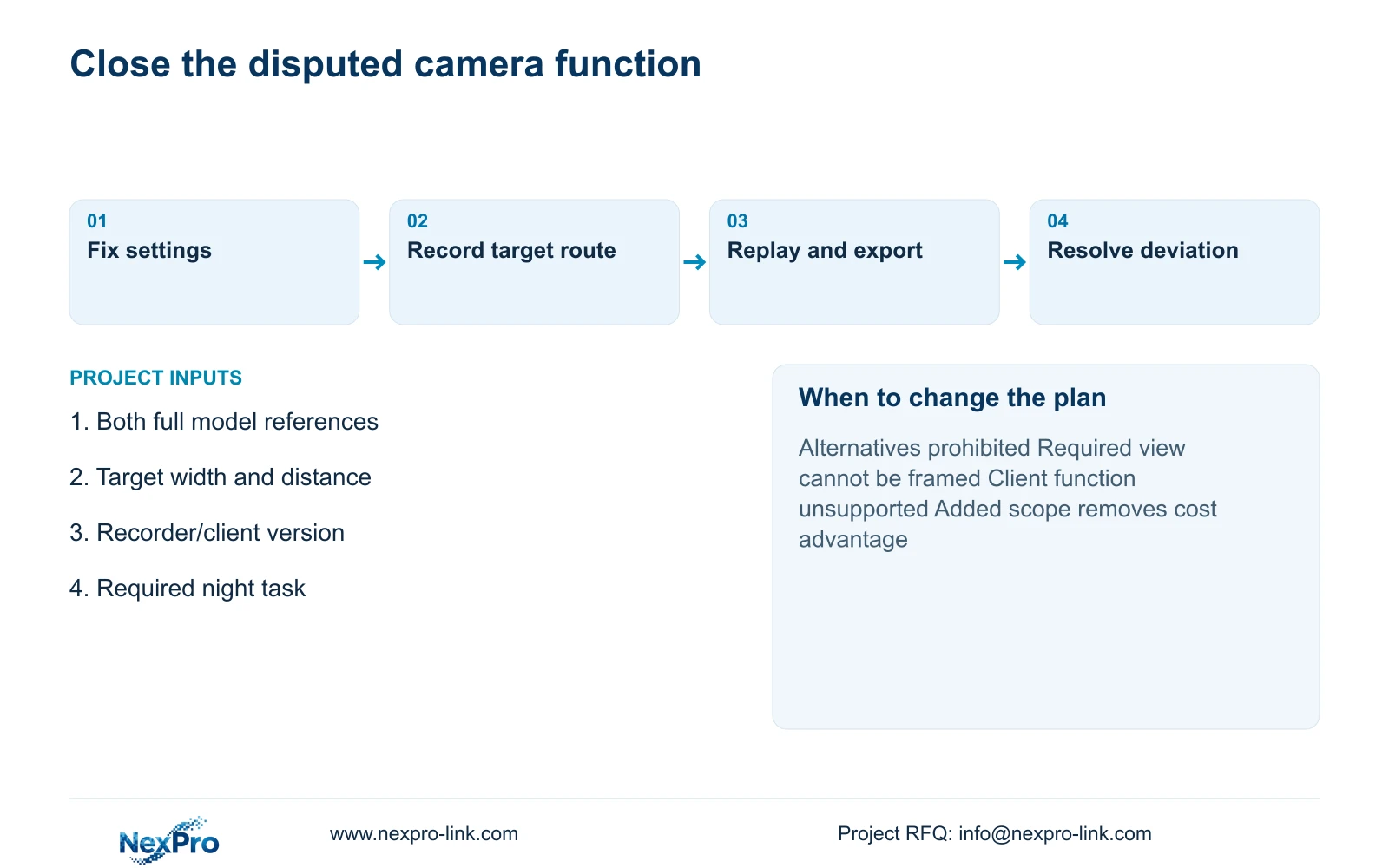
Define acceptance around the disputed function. For an entrance substitute, record a moving subject on the agreed route under relevant daylight and night conditions, then retrieve and export the specified time window through the proposed recorder and client. Record model, firmware, mounting position and selected image settings. These are proposed tasks, not completed test results.
Recommend the lowest complete-cost substitute that preserves the approved view and operating workflow. Change the recommendation if permitted framing cannot retain the detail, night operation fails the agreed task, or the required platform function is unsupported. A representative sample supports only the conditions observed; it cannot establish batch-wide reliability.
For a scoped response, send info@nexpro-link.com the affected BOQ lines, both full model references, a drawing showing target distance and view width, and the recorder or platform requirement. NexPro-Link can support model matching and technical documents through BOQ and tender support. Supply coordination does not imply automatic approval, universal integration or included local installation.
Section 07
Buyer questions
Can one substitute be accepted for only some camera positions? Yes, if the tender permits that arrangement. Identify the accepted positions and quantities separately, retain the baseline elsewhere, and update spare and configuration records so partial acceptance does not become an undocumented project-wide replacement.
Does an unspecified parameter automatically fail the substitute? It remains unresolved. If the parameter controls a mandatory task, obtain evidence before acceptance. If it is irrelevant to the assigned position, record that reasoning without inventing a value.
Can NexPro-Link prepare the comparison before all drawings are final? A limited comparison can start from the affected schedule and known geometry. Mark uncertain positions and request the specific dimensions or interface details that could change the recommendation.
Engineering references
These sources support the general planning principles. Always use the selected product's current datasheet and applicable project standards for final design.