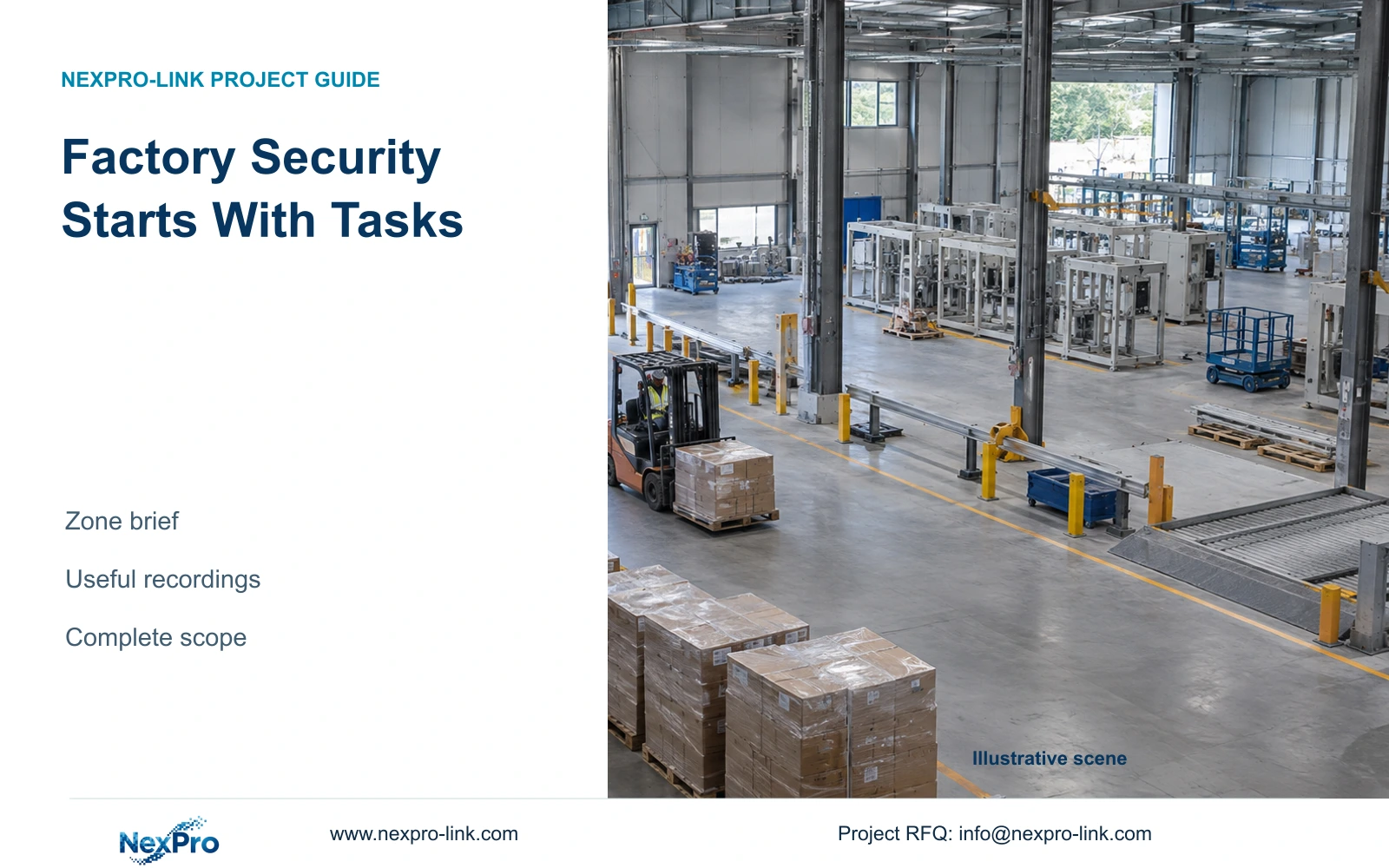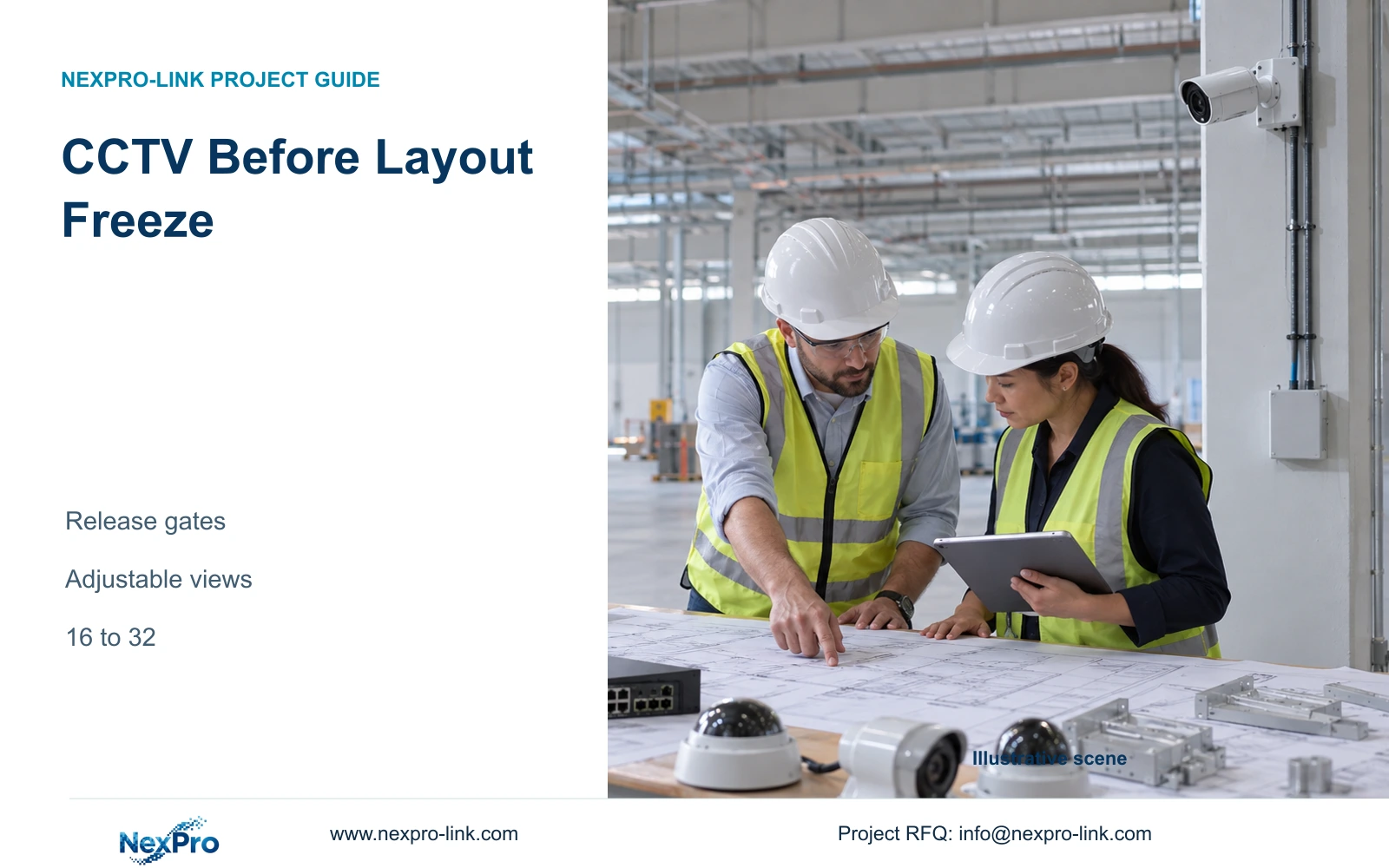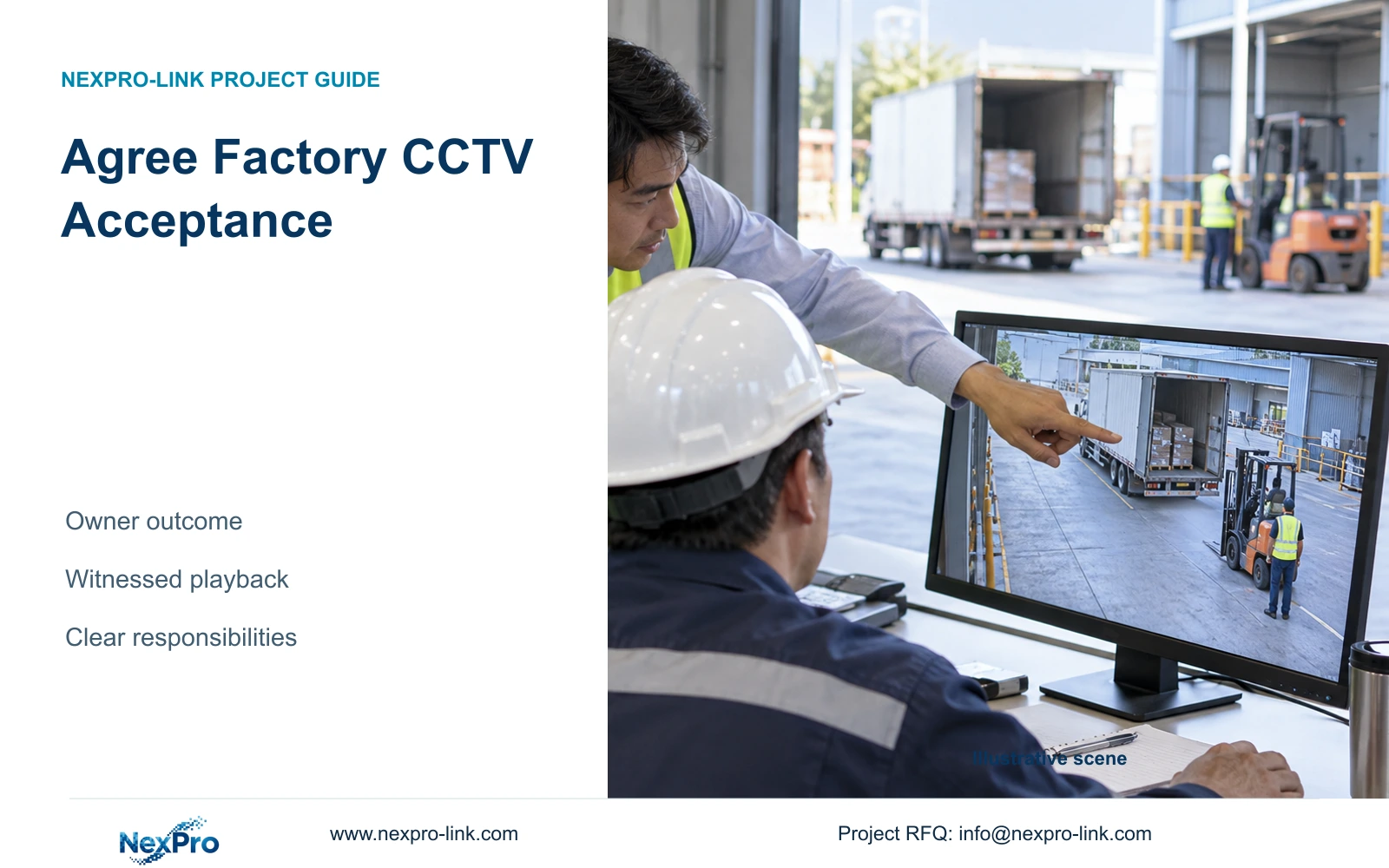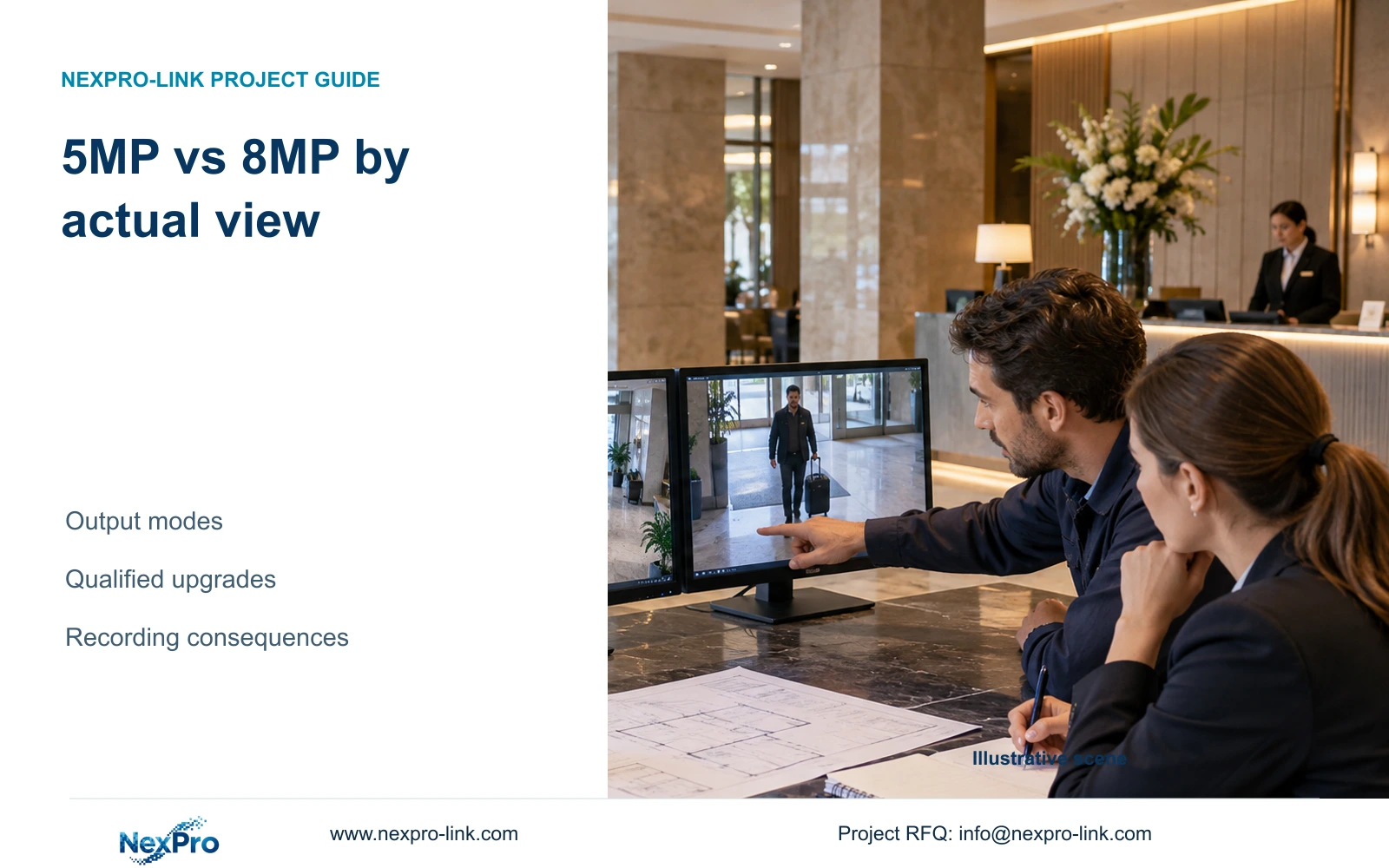
Upgrade hotel cameras where additional recorded detail is needed at a view that must stay wide. Where framing can narrow without losing a task, evaluate that change before spending on more pixels.
Section 01
Read the recording mode before buying more pixels
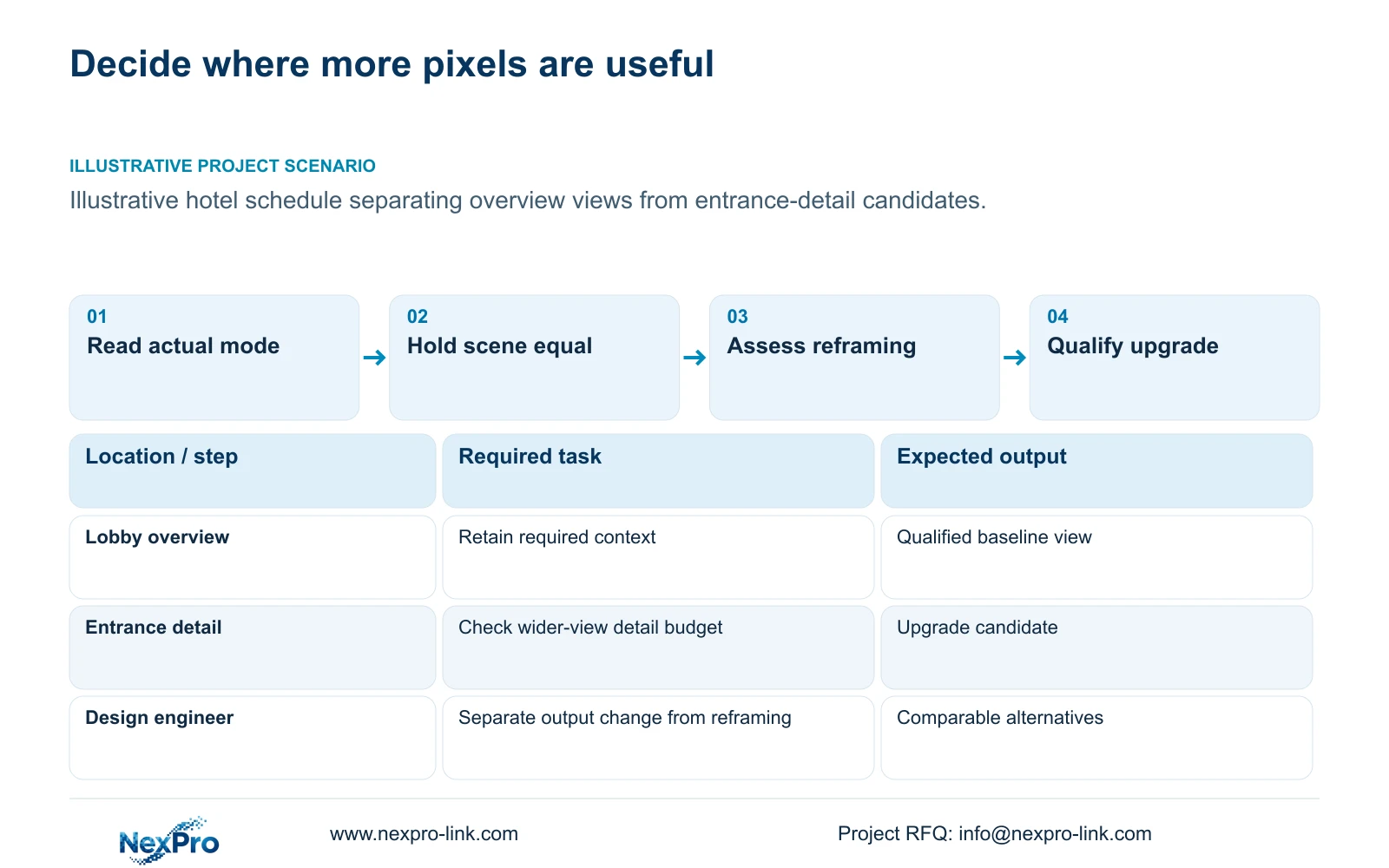
Retain a qualified 5MP-series candidate where its actual output and framing meet the hotel task. Consider 8MP where the necessary view must remain wide and additional detail is useful. First assess whether narrowing the optical view can meet the requirement without losing coverage. The purchase decision should compare complete recorded views, including their downstream equipment costs.
The supplied DM2812M PDF lists a 2880×1620 main-stream mode for NexPro-DM2812M55-5MP-DIC-AI. For NexPro-DM2812M88-8MP-DIC-AI, it lists 3840×2160 at 25 fps. Use those actual modes in the comparison. Do not replace the documented 5MP-series output with a conventional resolution inferred from its label.
Assign a task before evaluating either mode. A lobby overview, an entrance passage and a public corridor endpoint do not require identical framing. The room count is background information, not a quantity formula. Record whether the camera must provide overview, localized detail or both, because that determines what a resolution upgrade needs to retain.
| Required task | Given information | Decision still needed |
|---|---|---|
| Lobby overview | 2880×1620 and 3840×2160 modes documented | Which qualified view meets the overview task |
| Entrance detail | Required passage can be marked | Whether width must stay fixed or can narrow |
Section 02
Keep the target scene equal for the first comparison
Compare the same target plane, width and permitted coverage when isolating the effect of output resolution. If one camera is aimed at a narrower entrance while another covers the whole lobby, the resulting images compare two design changes at once. They cannot show the benefit of resolution alone.
After that equal-scene comparison, evaluate reframing as a separate alternative. An optical view narrowed around the entrance can allocate more of the available pixels to the target. Keep any required circulation context visible through the same view or another justified position. A lower-priced arrangement that removes an assigned task is not a qualified alternative.
Hold relevant lighting and movement conditions comparable too. The listed 8MP model has a 1/1.8-inch sensor, while the listed 5MP-series model has a 1/2.7-inch sensor. Those specifications do not establish equal night performance or prove a winner. Review actual recorded movement under the required conditions before treating either as a complete substitute.
Section 03
Calculate the detail budget for each required view
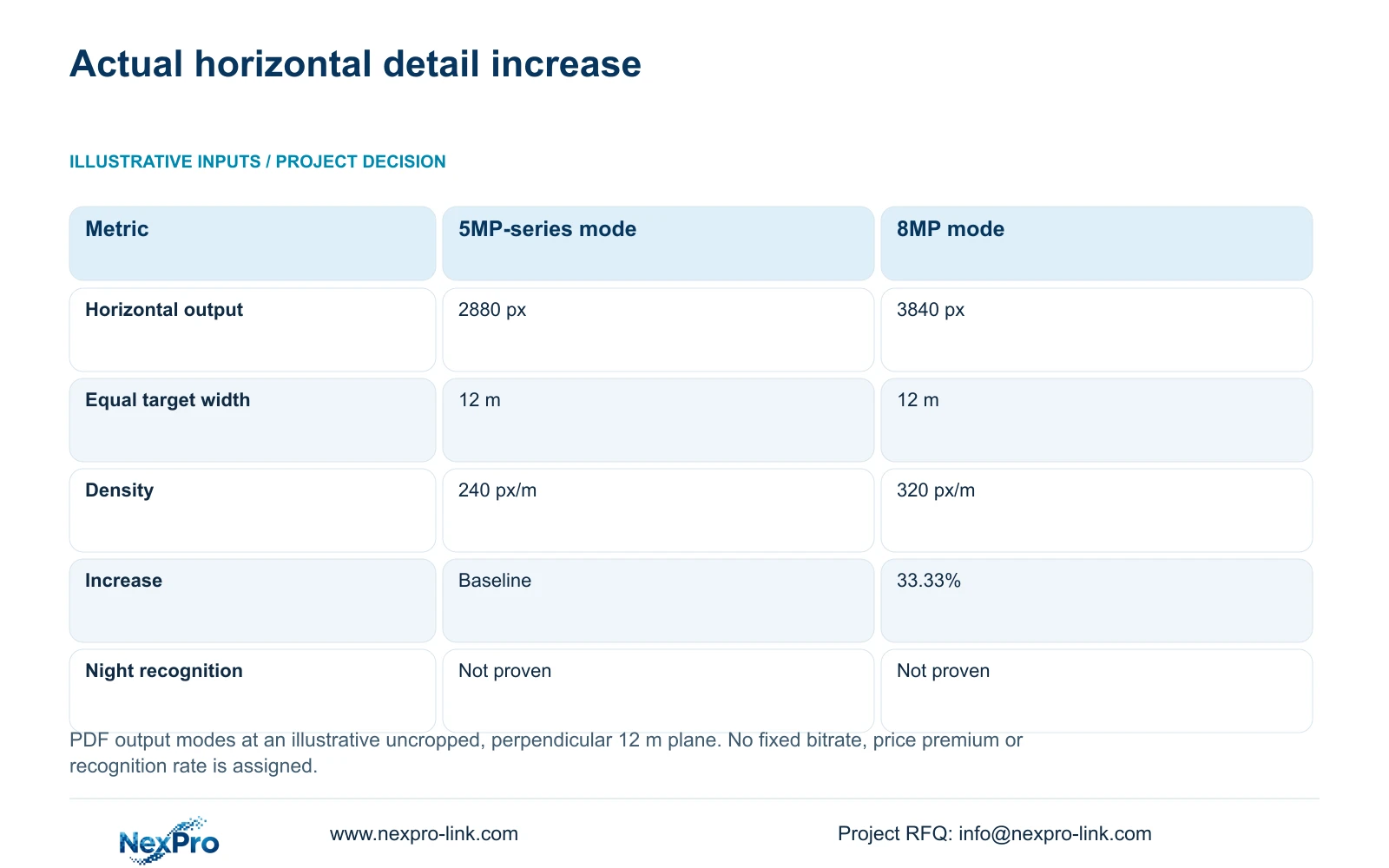
Planning pixel density equals horizontal output pixels divided by target width in metres. The illustrative example holds width at 12 m and uses the documented 2880 and 3840 horizontal outputs. It assumes an uncropped image and a perpendicular target plane. The width is a teaching input, not a surveyed hotel measurement.
The results are 240 and 320 px/m, respectively, with a 33.33% increase in horizontal density. That increase differs from simply comparing the marketing megapixel labels. It is relevant when the same required width must remain in view, but it does not prove recognition, exposure performance or night detail.
Calculate each proposed view separately. A useful entrance allocation cannot establish that a distant parking target or wide lobby receives the same detail. Where the lower-output candidate meets the agreed task after permitted reframing, retain it for cost evaluation. Where essential coverage prevents narrowing, the higher-output candidate remains worth assessing.
| Metric / condition | Documented 2880 px output | Documented 3840 px output |
|---|---|---|
| Output width (px) | 2880 | 3840 |
| Same target width (m) | 12 | 12 |
| Planning pixel density (px/m) | 240 | 320 |
| Increase relative to A | Baseline | 33.33% |
| What is not proven | Recognition / night performance | Recognition / night performance |
Section 04
Price alternatives that preserve the same outcome
Ask suppliers to quote the accepted view tasks with complete model references and recording profiles. Separate the camera increment from changes to disks, network capacity and installation. A reframing option may have little additional equipment scope, while a separate detail position needs its own cable and power allocation. Compare those differences explicitly.
Keep one-time purchases separate from recurring software or support costs. Use actual scope-matched quotations and a stated evaluation period if ongoing charges affect the decision. No supplied evidence establishes a price gap, failure rate or maintenance saving between these camera models or competing brands.
The 320 px/m example justifies considering more horizontal sampling at equal width; it does not establish that the premium is worthwhile. Pay that premium when the added budget supports a required task and the full configuration qualifies. Retain the economical alternative when it meets the same outcome. The conclusion changes if the lower-priced option needs an extra view or downstream upgrade omitted from its initial quotation.
For applicable main equipment, the supplied policy record gives a 24-month limited hardware baseline from receipt. Batteries, storage, cabling and special orders follow their scoped written terms; site labour and technical support should not be treated as unlimited free repair.
Section 05
Recalculate recording and storage after the view is selected
Calculate aggregate recorder input from the selected stream rates, then calculate storage from bitrate, recording hours and approved retention. Megapixels do not determine one fixed Mbps value. A resolution change therefore requires the proposed recording profile, not a guessed multiplier applied to the old storage total.
The separate CASE01 teaching reference assumes 32 cameras at 4 Mbps each, producing 128 Mbps input and 41.472 TB of video over 30 days of continuous recording. Its 20% free-space target requires 51.84 TB usable capacity. These values describe that reference profile; they are not measured rates for every 5MP or 8MP camera and do not change automatically with a model label.
Check recorder image modes independently of bandwidth. NexPro-NVR4449-4K lists 320 Mbps input, while its summary identifies 49×5MP/9×4K. Its channel count cannot establish arbitrary 49-camera 8MP recording. NexPro-NVR2232-4K also has unresolved disk and playback fields in the supplied source record, so its larger stated capacity must not be adopted without resolving that conflict.
Price storage or recorder changes only after the intended image mode, disk layout and operating tasks have been confirmed. Playback and client decoding remain separate limits.
Section 06
Use a mixed schedule where the tasks justify it
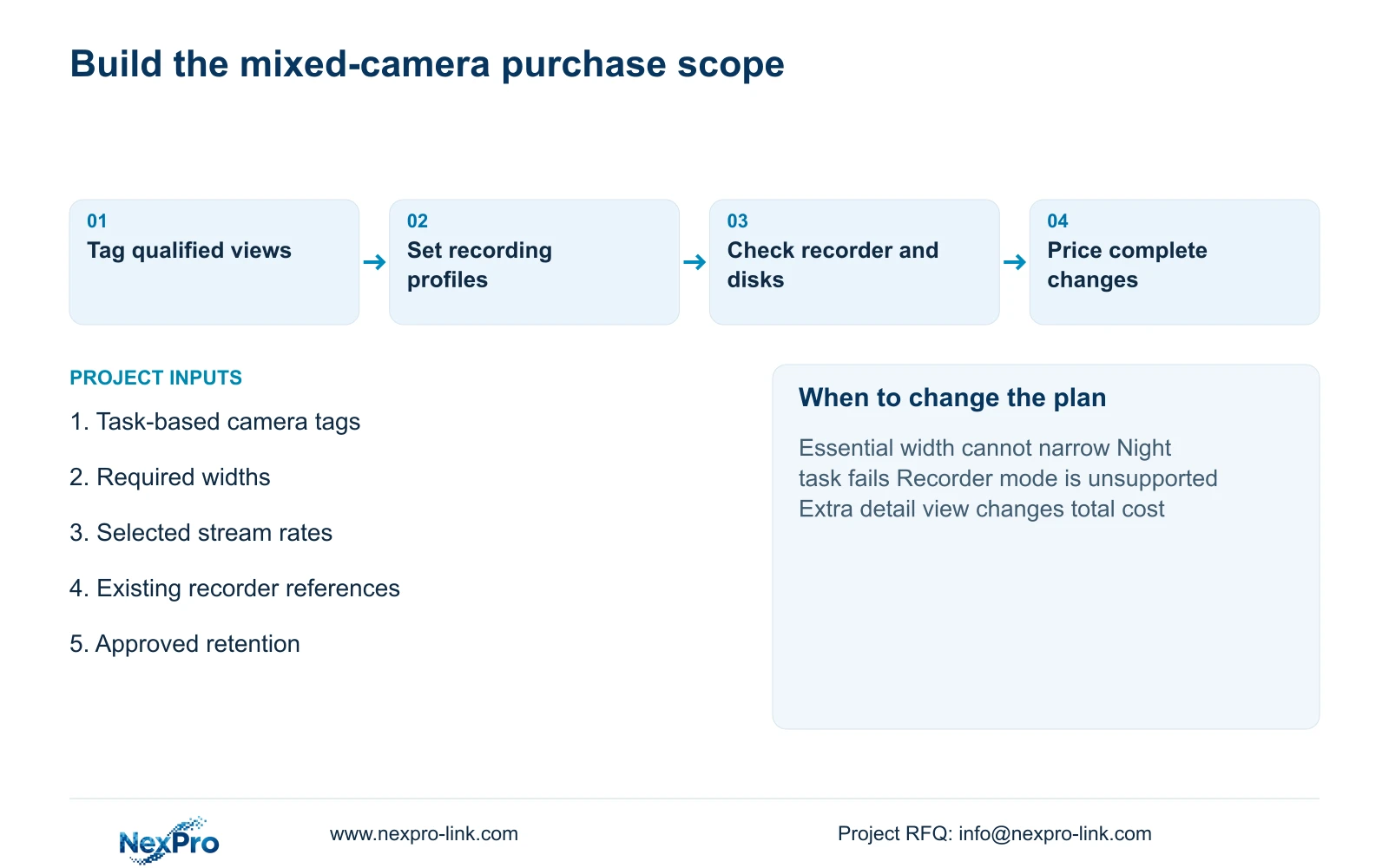
A mixed schedule can retain qualified lower-output views in ordinary public areas and reserve higher-output candidates for positions that need the additional budget. Tag each choice with its task and accepted width. This lets procurement see why an upgrade appears at one entrance without applying it automatically to every camera.
Change the mix if the operator requires a mandatory platform or output mode, if night movement fails the agreed check, or if the required scene width changes. Release stable positions for project review while keeping unresolved positions identifiable; an indicative schedule is not an instruction to place an order.
Send a tagged camera schedule, target widths, existing recording profiles and proposed upgrade positions to info@nexpro-link.com. State which coverage must remain unchanged and whether alternatives are allowed. NexPro-Link can discuss model matching and BOQ support with the CCTV manufacturing and coordinated supply boundaries stated in the proposal.
Section 07
Buyer questions
Does an 8MP upgrade automatically increase retention cost by a fixed percentage? No. Storage depends on the chosen average bitrate, recording hours and retention. Request the intended profile and calculate its consequences. The supplied example does not assign a universal bitrate to either resolution.
Can a narrower 5MP-series view be a qualified alternative? Yes, when it preserves every assigned task and provides usable recorded detail. If narrowing removes required context, include the separate overview scope before comparing cost with the wider 8MP option.
What should an upgrade quotation identify? Ask for full camera references, selected output modes and rates, affected recorder and disk changes, and installation differences. Keep recurring charges and scoped warranty terms visible so the evaluated total is complete.
Engineering references
These sources support the general planning principles. Always use the selected product's current datasheet and applicable project standards for final design.