A credible hotel tender comparison can explain documented capabilities and break-even conditions before prices arrive, while keeping unknown costs separate from illustrative figures.
Section 01
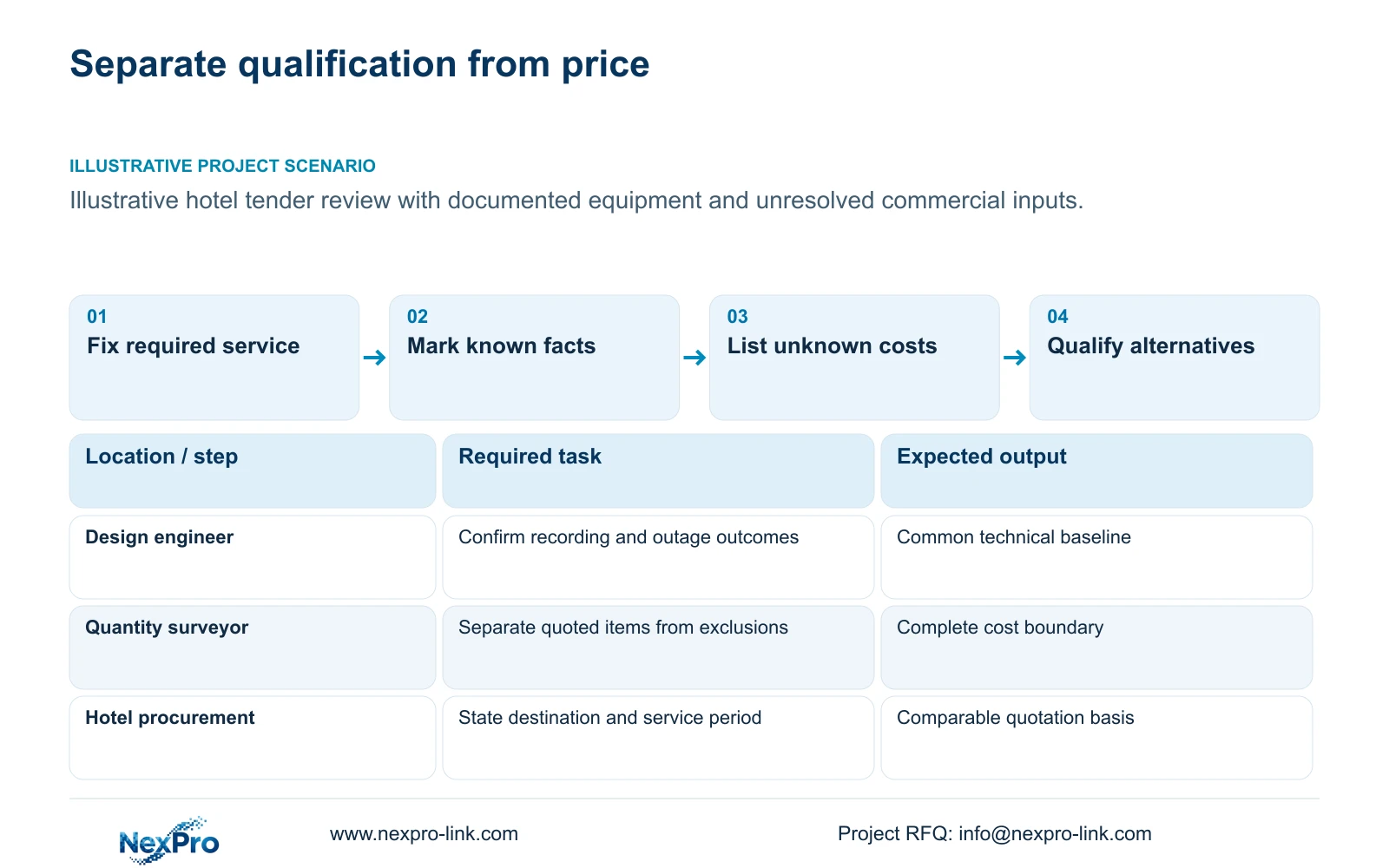
Separate documented facts from unknown prices
Use documented technical facts to identify qualified alternatives, then use an explicitly unbranded cost model to show when their economic preference would change. Without scope-matched quotations, do not declare a commercial winner among NexPro-Link, Hikvision or Dahua. The illustrative model here favours the lower recurring-cost option after 3.75 years, provided both options retain the same required hotel service.
Separate known product fields, project assumptions and unresolved prices. For example, NexPro-NVR4449-4K has published 49-channel, 320Mbps input and four-SATA fields. Those facts help assess a recorder proposal, but do not establish its installed price or that every 49-channel resolution combination is supported. Its source summary lists 49×5MP/9×4K, and RAID details require separate confirmation.
An unknown freight, licence or service item must remain an open input. Treating it as zero can manufacture an apparent saving. Record the quotation boundary next to each cost so the quantity surveyor can distinguish an equipment allowance from a delivered or installed package.
| Required task | Given information | Decision still needed |
|---|---|---|
| Assess recorder capacity | Published model fields and stream requirement | Confirm exact recording and disk configuration |
| Compare delivered cost | Equipment scope can be listed | Obtain freight, exclusions and service prices |
Section 02
Hold required outcomes constant
Freeze the comparison's public-zone observation tasks, quantities, retention policy and outage behaviour. Two packages with the same camera count can still provide different results because lens choices, recording settings or protected network nodes differ. A cheaper alternative that omits a required function needs its scope repaired before it joins the price comparison.
The linked illustrative 32-camera hotel reference provides one possible baseline: 4Mbps average per camera, continuous recording for 30 days and a 20% usable-space reserve. It produces 41.472TB of video and requires 51.84TB of usable capacity. Those are scenario values, not universal hotel requirements. Actual offers should use the hotel's approved schedule and policy.
Keep optional wall displays or recovery enhancements outside the essential baseline unless the hotel requires them. Compare their incremental scope separately while retaining required recording. Destination and local installation responsibility must also remain constant; an overseas equipment supply quote cannot be treated as equivalent to a locally installed system without adding the missing work.
Section 03
Define comparable cost components
Build the evaluated initial cost from the equipment, storage, network, protected power and cabling required by the approved task. Add installation and commissioning where they belong in the comparison, then identify software, delivery, taxes and training scope. Remove duplicated items already included within a package so the same disk, accessory or service is not counted twice.
Separate recurring service from one-time preparation. A licence renewal, planned support charge or maintenance allowance should have an applicable basis and period. An assumed replacement event must be labelled as an assumption; it cannot imply a measured failure rate for a brand. Costs outside a supplier's responsibility still matter to the hotel if they are necessary to obtain the required outcome.
RICS New Rules of Measurement distinguishes cost-planning, detailed-measurement and maintenance-cost purposes. The simple model below is an original teaching comparison, not a RICS contract template. Its cost units deliberately have no currency or supplier identity. They demonstrate how initial and annual amounts interact before actual quotations are available.
Section 04
Calculate an illustrative break-even condition
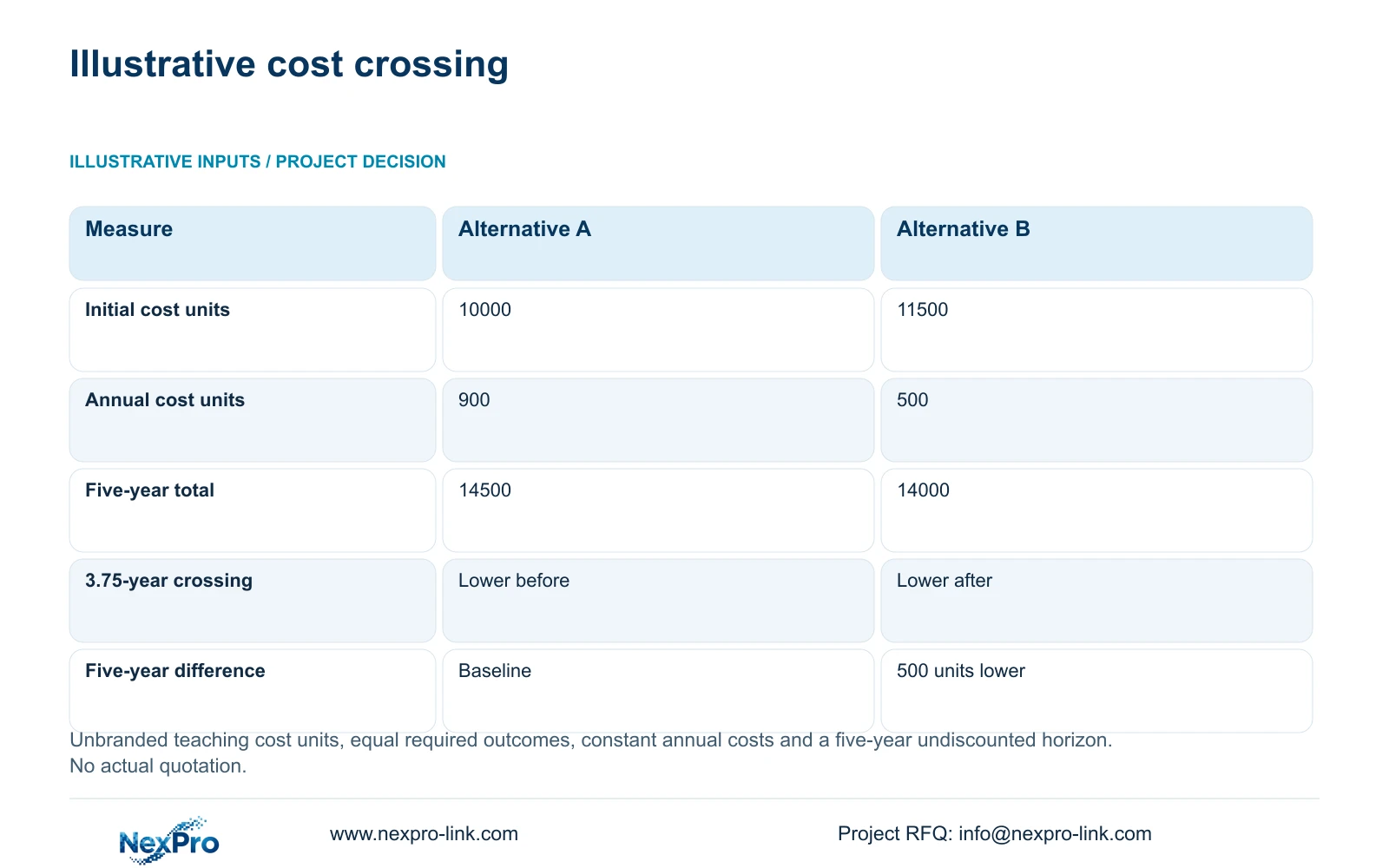
Assume equal required outcomes and a five-year undiscounted horizon. Alternative A has an initial cost of 10000 teaching units and annual cost of 900. Alternative B has an initial cost of 11500 and annual cost of 500. Calculate each total as initial cost plus five times the annual amount: A totals 14500 and B totals 14000.
The break-even time is the additional initial cost divided by the annual saving: (11500 − 10000) ÷ (900 − 500) = 3.75 years. Before that point A is lower; after it B is lower. At 3.75 years they are equal under this continuous annual-cost model. At five years B is lower by 500 cost units.
This result supports a conditional economic preference, not a supplier-price claim. B is preferable over the stated horizon only if its additional initial scope and lower annual cost are real, comparable and compatible with the required outcome. The calculation excludes discounting and uses constant annual assumptions; a real evaluation should follow the project's approved financial method.
| Metric / condition | Alternative A | Alternative B |
|---|---|---|
| Initial teaching cost | 10000 | 11500 |
| Annual assumed cost | 900 | 500 |
| Five-year undiscounted total | 14500 | 14000 |
| Break-even condition | Lower before 3.75 years | Lower after 3.75 years |
| Actual tender ranking | Requires scope-matched quotations | Not established by this example |
Section 05
Explain factors that can reverse the ranking
Test the input carrying the claimed advantage. In this example B pays back an additional 1500 units through a 400-unit annual difference. Over five years, an annual difference of 300 units would only reach equality. A smaller saving would leave B above A, assuming the initial difference and all other scope remain unchanged.
An omitted charge can consume the five-year 500-unit advantage. A shorter evaluation period can also favour A before the 3.75-year crossing. If required performance or service is missing, the cost model must include the corrective scope or reject the alternative as unqualified. A lower incomplete total does not settle the hotel's purchasing decision.
Warranty and operational support affect scope differently. The supplied NexPro-Link policy states a usual 24-month limited hardware baseline for applicable main equipment from receipt, subject to written order terms. Batteries, disks and cable require their own terms. A five-year evaluation does not create a five-year warranty, and technical support does not automatically include local labour or expedited replacement.
| Retained outcome | Cost input | Effect on preference |
|---|---|---|
| Same required hotel service | Evaluation ends before 3.75 years | A is lower under the stated model |
| Same five-year outcome | Annual difference falls below 300 units | B no longer recovers its 1500-unit premium |
| Required service restored | Previously excluded work added | Recalculate the complete totals |
Section 06
Ask for scope-matched quotations
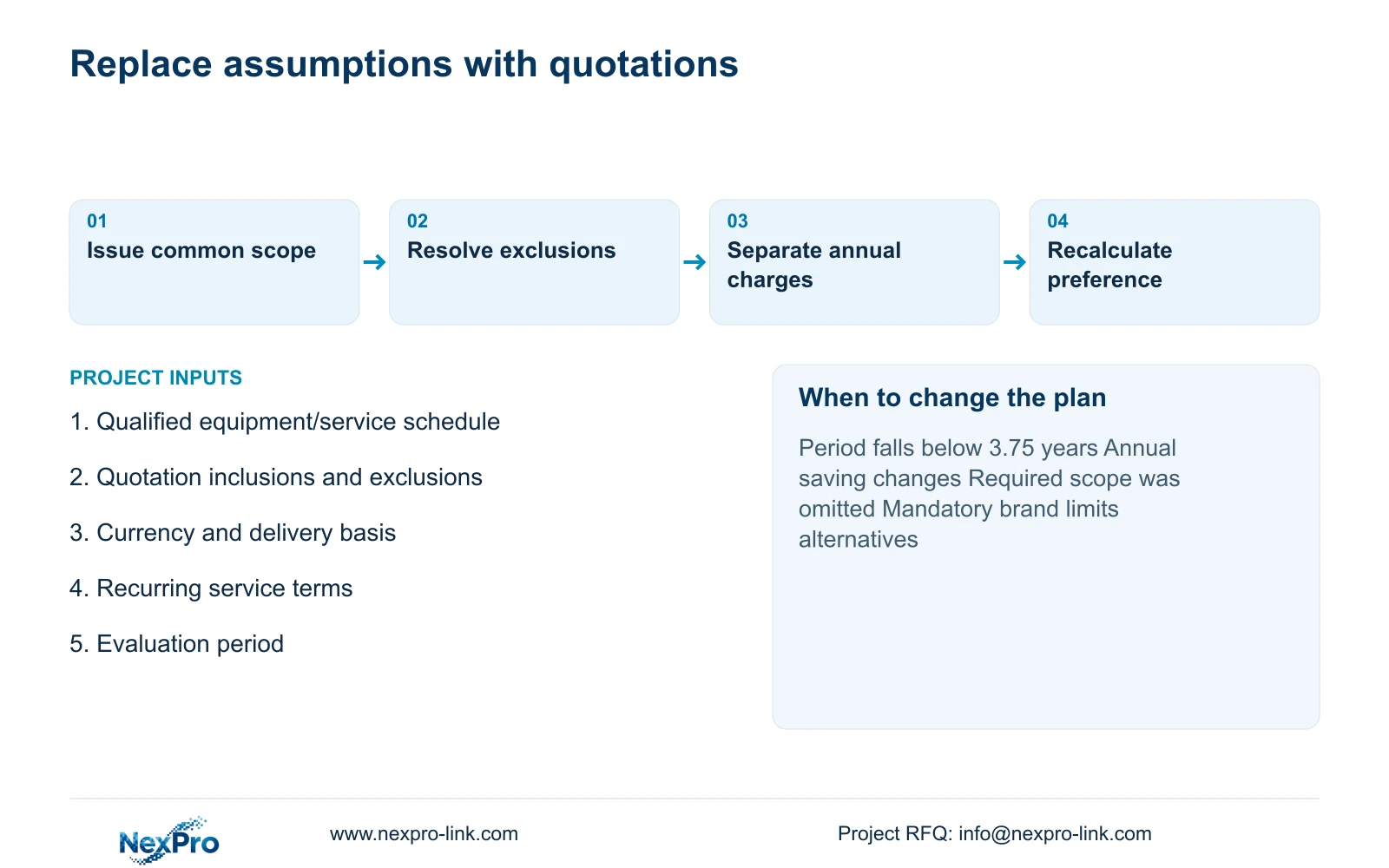
Request offers against one dated equipment and service schedule, with alternatives and exclusions clearly identified. State the currency, delivery basis and evaluation period. Ask suppliers to separate initial supply from recurring obligations and identify unresolved items. A mandatory brand or operator platform may limit acceptable alternatives before cost evaluation begins.
For the teaching inputs, choose B for a period beyond 3.75 years when the same required outcome and 400-unit annual difference hold. Choose A for a shorter period under those same assumptions. For an actual tender, withhold a brand-price recommendation until the qualified scope and commercial inputs are complete.
NexPro-Link can discuss BOQ matching and coordinated hotel equipment supply without promising tender approval. Email info@nexpro-link.com with a scope schedule, available quotation inclusions and exclusions, delivery destination and currency, plus the evaluation period and service terms. Identify the missing cost that blocks the decision. Unrelated guest images and access credentials have no role in this comparison.
Section 07
Buyer questions
Can we publish a useful comparison before three quotations arrive? Yes. Compare documented capabilities and define the missing commercial inputs. An unbranded cost equation can show decision thresholds, but it cannot establish current brand prices or a supplier winner.
Should an excluded licence be entered as zero? Only if applicable terms explicitly establish that no charge is required for the defined scope. Otherwise retain it as an unresolved input and obtain the relevant edition and service terms.
What should a supplier receive for a comparable quotation? Provide the required task and equipment schedule, retention and outage requirements, destination, currency, delivery boundary and service period. Ask for deviations and recurring charges separately so missing work remains visible.
Engineering references
These sources support the general planning principles. Always use the selected product's current datasheet and applicable project standards for final design.