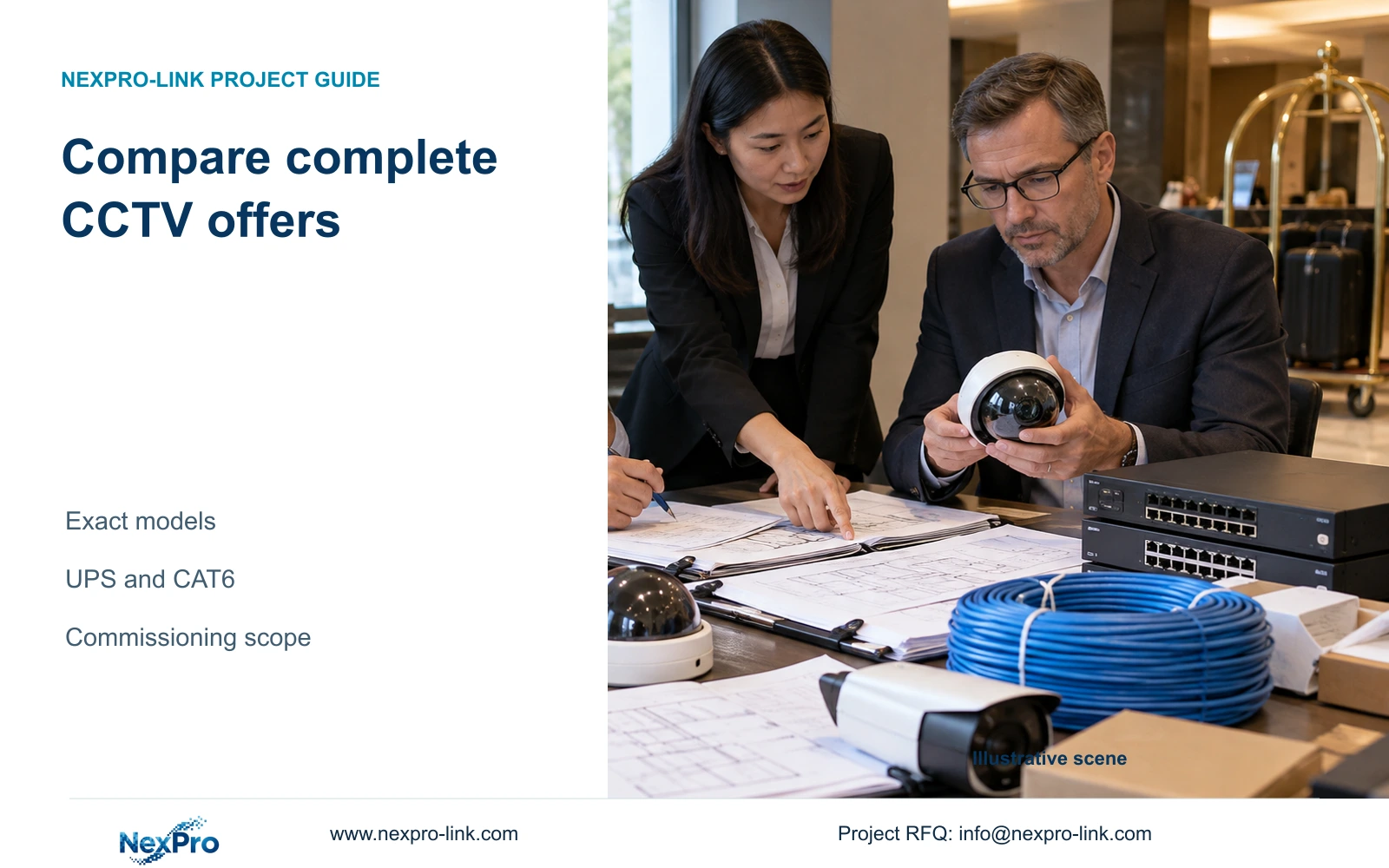
A lower CCTV purchase price can be offset by later costs. Compare qualified offers over the same period and calculate how much recurring expenditure would reverse the initial advantage.
Section 01
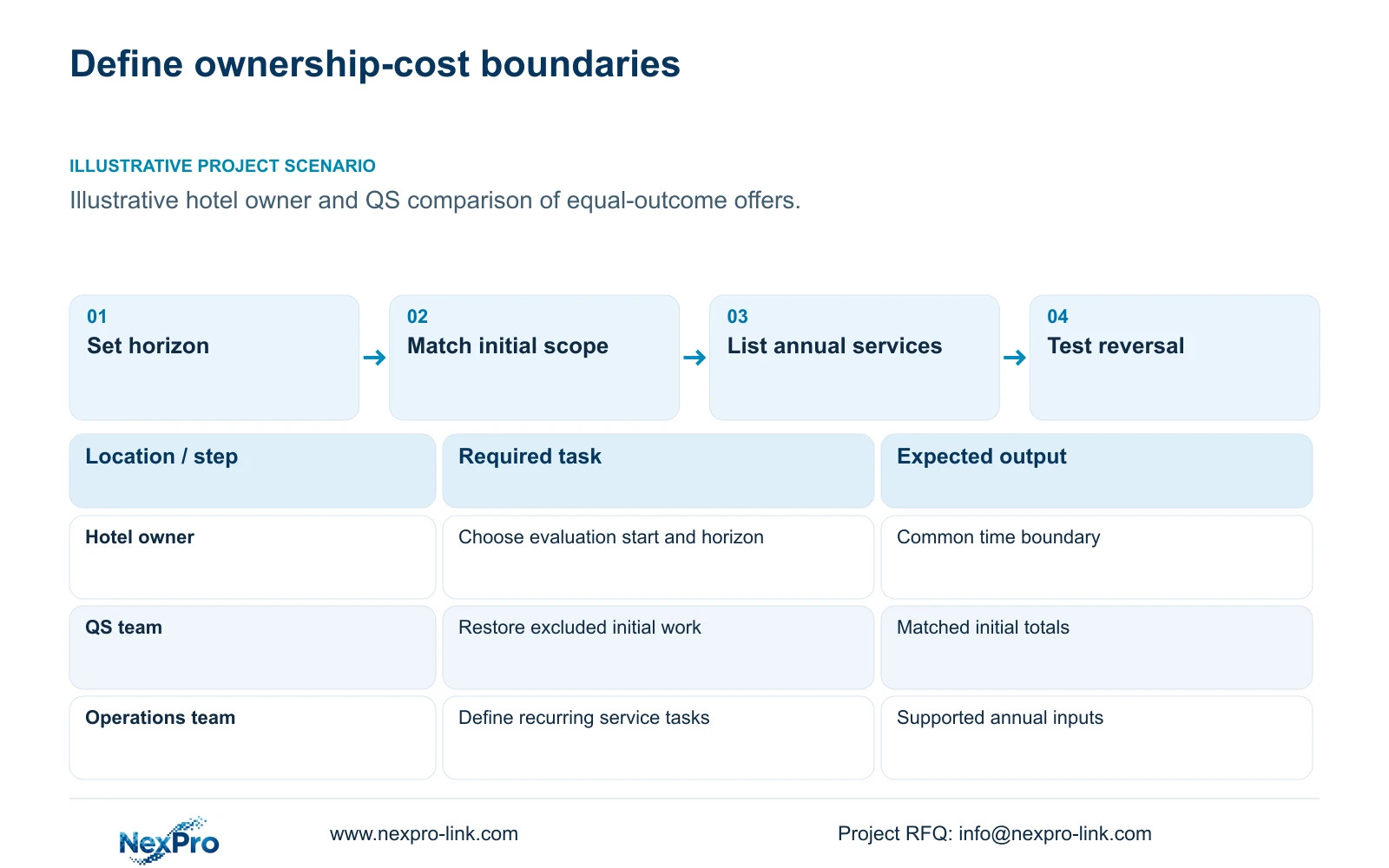
Choose the evaluation period before ranking offers
Choose the higher initial-cost option only when supported recurring-cost differences recover its premium within the hotel's evaluation period. In the illustrative five-year comparison below, option B costs 500 units less overall, but its advantage disappears if the evaluation ends before 3.75 years. Hardware price alone cannot settle that decision.
Define when the comparison starts and which years of operation it includes. Equipment receipt, installation and hotel opening may occur at different times. Apply the same timing convention to both offers, and identify whether setup, operating services and later expenditure sit inside the evaluation boundary.
Five years is the stated teaching horizon here, not a predicted equipment life or a warranty period. Fix the destination, currency and required security task before calculating totals. If the owner needs discounted cash flows or different escalation assumptions, use those explicitly; the example below is undiscounted.
| Required task | Given information | Decision still needed |
|---|---|---|
| Operate the agreed CCTV service | Equipment offers | Common scope and evaluation start |
| Fund recurring support | Service descriptions | Frequency, inclusion and annual price |
| Compare expenditure over time | Five-year teaching horizon | Owner's actual evaluation method |
Section 02
Normalize the initial equipment and installation scope
Match public-zone coverage, recording policy and incident retrieval before comparing purchase totals. Restore excluded cabling, disks, software or installation to the evaluated scope. Identify whether freight and destination charges are included. A cheaper offer delivering a shorter retention period is a different service and requires an explicit owner decision.
The supplied 32-camera hotel reference illustrates a useful functional boundary: required views, recording and the complete protected network path, with enhanced display scope shown separately. It is an illustrative engineering case, not a delivered hotel. Its quantities and power assumptions do not price the independent A/B cost model in this article.
Normalize replacement scope too. A spare camera must suit the mounting, power, recording mode and client behaviour required for its role. Similar resolution or housing appearance does not establish interchangeability. Keep batteries, storage and accessories identifiable because their support and replacement arrangements may differ from those of the main equipment.
| Item | Incomplete offer | Matched offer | Effect |
|---|---|---|---|
| Storage | Disks or retention unresolved | Same approved recording policy | Preserves the retrieval task |
| Installation | Equipment delivery only | Site work separately normalized | Makes initial totals comparable |
| Spare provision | Appearance-based substitute | Functional replacement scope | Defines a usable restoration route |
Section 03
List recurring services by payment and responsibility
Separate one-time configuration from periodic software, support and site-service payments. For each recurring line, record the service supplied, its charging basis and responsible party. A remote-access application, local recording and cloud storage are different services; a statement about one does not establish the price or availability of the others.
Use actual license and service terms when comparing brands. Record channel, user, site or feature limits where they apply to the selected platform. Include migration or training when a change requires them, but do not assume every later upgrade or service visit will occur.
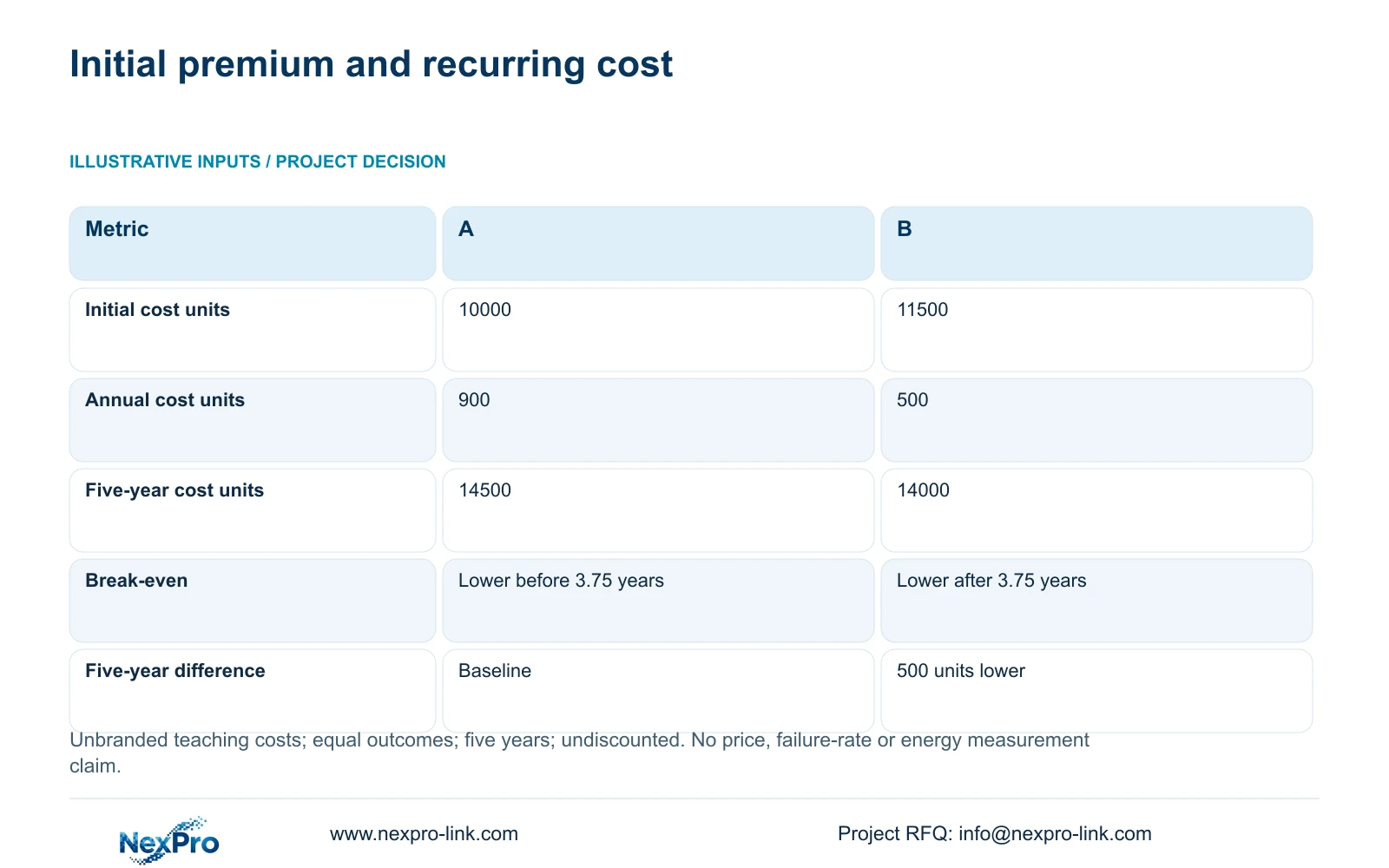
For the numerical example, A has an initial cost of 10000 units and an assumed annual cost of 900. B has an initial cost of 11500 and an assumed annual cost of 500. These unbranded teaching inputs represent equal required outcomes. Five-year total equals initial cost plus five times annual cost; the inputs do not describe NexPro-Link or another manufacturer's pricing.
Section 04
Model energy and service assumptions transparently
Build real annual totals from separately supported inputs. Energy expenditure needs an equipment input-power boundary, operating hours and the applicable tariff. A switch's measured AC input may already include its PoE cameras, so adding those camera loads again would overstate expenditure. UPS conversion losses need a consistent boundary as well.
Keep planned spares and service events separate from predictions of failure. Without relevant failure records, an assumed repair event can illustrate exposure but cannot establish expected brand reliability or a future maintenance schedule. The annual costs below are aggregate teaching assumptions; no energy split or repair frequency has been supplied.
A totals 10000 + 5 × 900 = 14500 units. B totals 11500 + 5 × 500 = 14000. B's 1500-unit premium is offset by the assumed annual difference. The resulting 500-unit advantage is small enough that an omitted service or delivery cost could change the ranking, which makes inclusion checks important.
| Metric / condition | Option A | Option B |
|---|---|---|
| Initial teaching cost | 10000 cost units | 11500 cost units |
| Annual assumed cost | 900 cost units/year | 500 cost units/year |
| Five-year undiscounted total | 14500 cost units | 14000 cost units |
| Break-even time | Before 3.75 years: A lower | After 3.75 years: B lower |
| Actual tender ranking | Requires scope-matched quotes | Not established by this example |
Section 05
Calculate the condition that reverses the ranking
Break-even years equal the initial premium divided by the annual-cost reduction. Here, (11500 − 10000) ÷ (900 − 500) = 3.75 years. At that point the two teaching totals are equal. Earlier, A retains the lower cumulative cost; later, B does, provided the stated recurring costs continue.
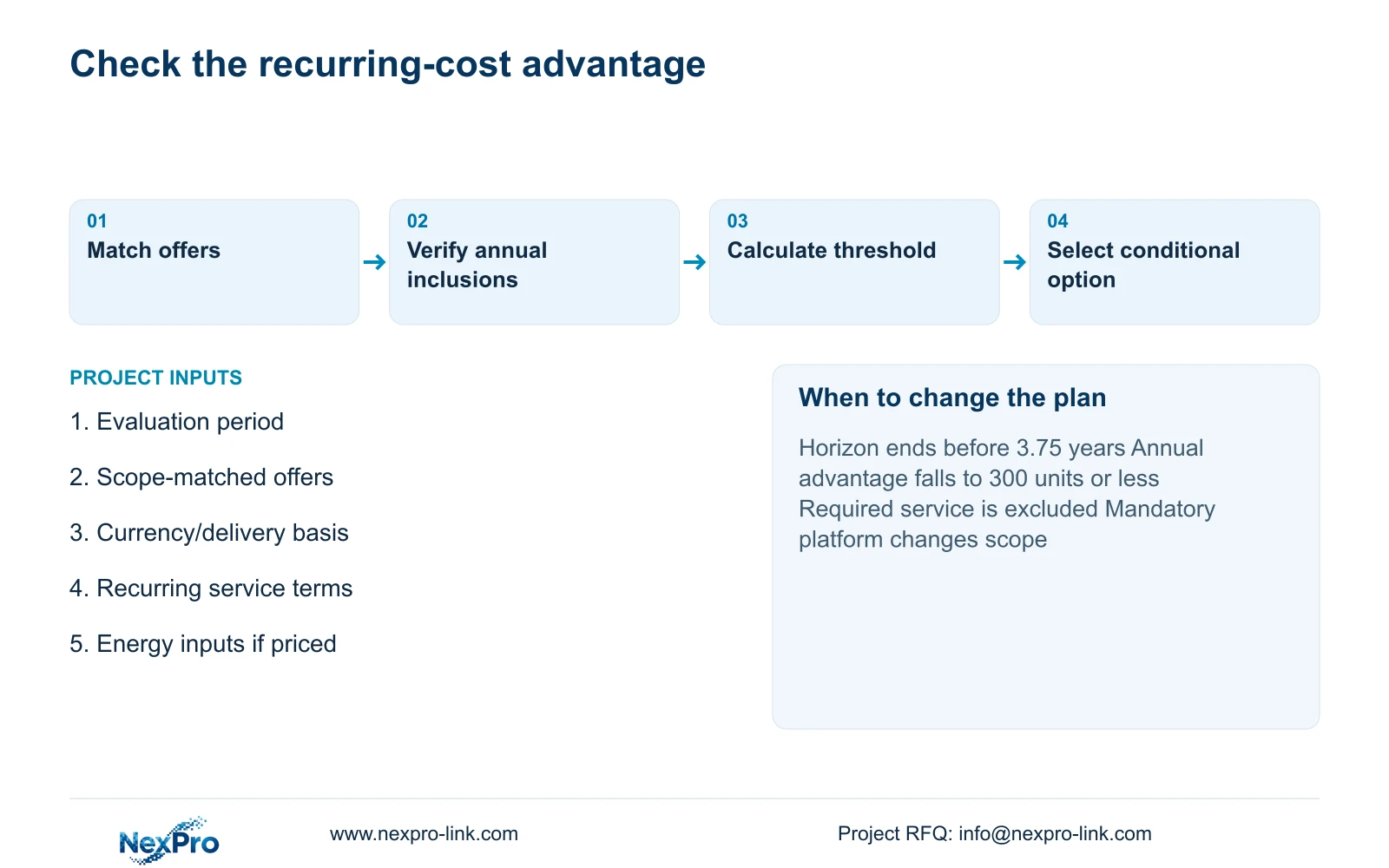
The equation also identifies the commercial input worth checking. To recover B's 1500-unit premium over five years, its annual advantage must exceed 300 units for B to finish cheaper. Equality at 300 gives equal totals. This derived threshold is a sensitivity condition, not a new quotation or a promise of annual savings.
An owner should therefore examine the recurring line that creates the difference and whether the quoted service actually covers the hotel's task. If a cost reduction depends on removing needed support, the offers cease to be equivalent. Required performance and operational responsibilities remain constraints on the economic choice.
| Retained outcome | Extra initial scope/cost | Worth buying when | Counter-condition |
|---|---|---|---|
| Same required CCTV service | 1500-unit premium for B | Annual advantage exceeds 300 units over five years | Advantage is smaller or unsupported |
| Same service boundary | B's higher initial allowance | Evaluation extends beyond 3.75 years | Evaluation ends earlier |
Section 06
Recommend the economic option with its limits stated
Under the stated assumptions, recommend B for a five-year evaluation with equal required outcomes. Change to A when the horizon is shorter than 3.75 years, or recalculate when actual recurring costs, delivery scope or platform requirements differ. Describe the 500 units as an illustrative difference, not measured hotel savings.
Warranty terms need their own cost boundary. The supplied policy record gives applicable main equipment a 24-month limited hardware baseline from receipt, subject to controlling written order terms. Batteries, disks, cable and OEM scope are separate. Ongoing technical support does not imply unlimited free repairs, local labour or travel, and a five-year evaluation does not extend the warranty.
Send info@nexpro-link.com scope-matched offers, the evaluation period, currency and delivery basis, and the proposed service terms. NexPro-Link can discuss equipment matching and coordinated supply through hotel project equipment support and BOQ and tender support. Local installation and third-party service commitments should be identified separately in the comparison.
Section 07
Buyer questions
Can an unpriced recurring service be entered as zero? Only if its absence or inclusion is established for the required scope. Otherwise mark the amount unresolved and show the annual-cost threshold that would change the recommendation.
Does a five-year total establish five years of equipment life? No. It defines an evaluation period. Replacement assumptions need their own evidence, and the model does not establish reliability, service life or warranty coverage.
Can NexPro-Link compare offers from different suppliers? It can discuss equipment schedules and supply-scope differences. Share relevant inclusions and requirements, with commercially sensitive material removed where necessary; the final commercial selection remains the buyer's decision.
Engineering references
These sources support the general planning principles. Always use the selected product's current datasheet and applicable project standards for final design.