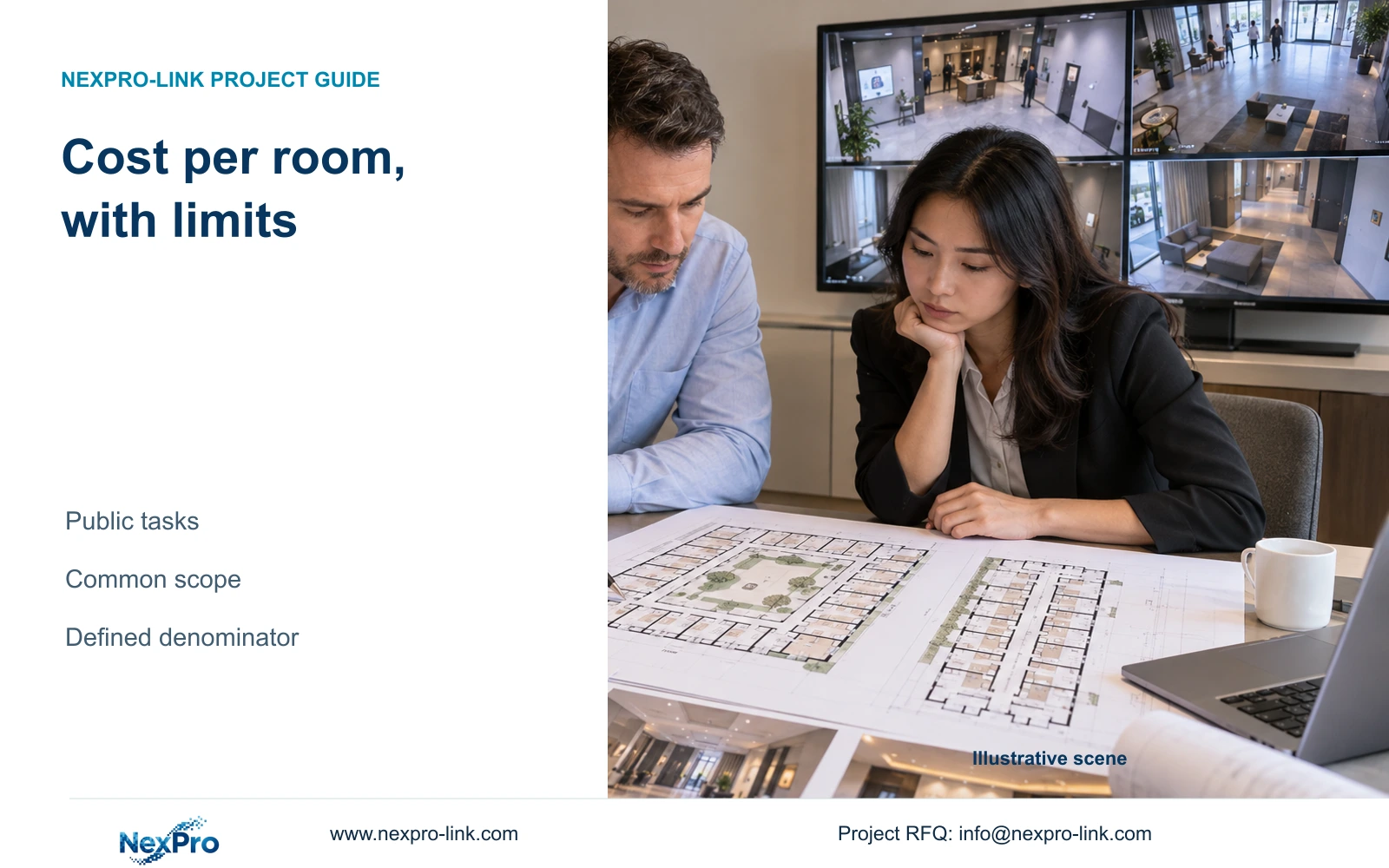
Cost per room can summarize a hotel CCTV budget, but it cannot establish the necessary camera count or a fair supplier comparison without a defined scope.
Section 01
Choose the benchmark's purpose
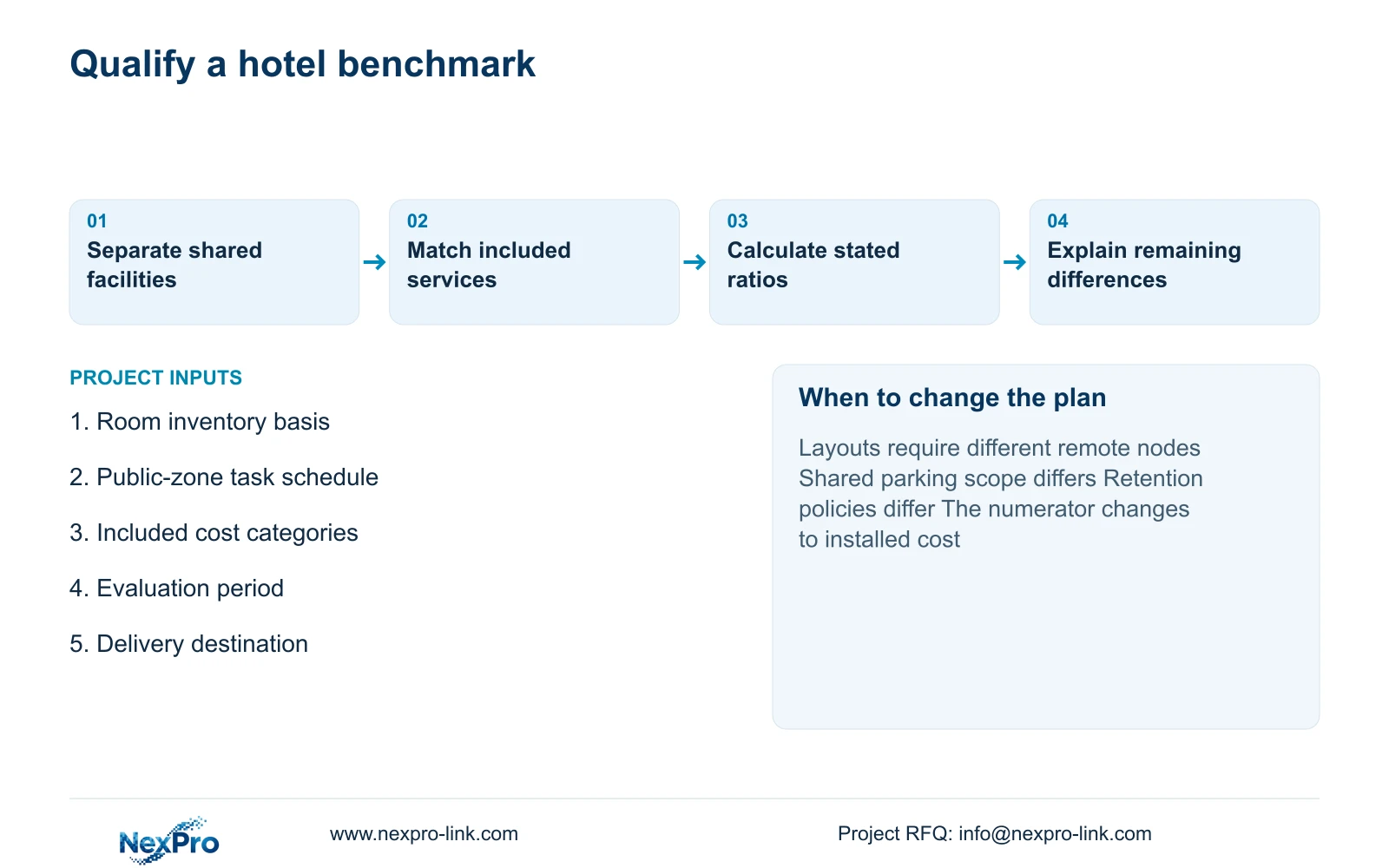
Use hotel CCTV cost per room to describe the intensity of an approved budget, provided the numerator and room count are defined consistently. Select equipment and compare suppliers against public-area tasks, building layout and complete supply scope. Stop using the ratio as a direct comparator when the properties have different shared facilities, recording policies or installation boundaries.
The numerator needs a clear identity. Equipment purchase cost divided by rooms differs from installed cost divided by rooms, and both differ from a total that includes several years of services. State the currency, destination and evaluation period before presenting the result. An omitted freight or software amount should remain visible as an unresolved input.
Define the denominator with equal care. Record which room inventory the calculation uses and preserve that basis between estimates. A changed denominator can lower the ratio without reducing expenditure or improving the system. For an early owner discussion, present the total alongside the per-room figure so the scale of the procurement remains visible.
| Required task | Given information | Decision still needed |
|---|---|---|
| Summarize capital intensity | Initial equipment allowance | Installed or equipment-only numerator |
| Compare ownership expenditure | Initial and annual costs | Common evaluation period and room basis |
Section 02
Separate bedrooms from monitoring demand
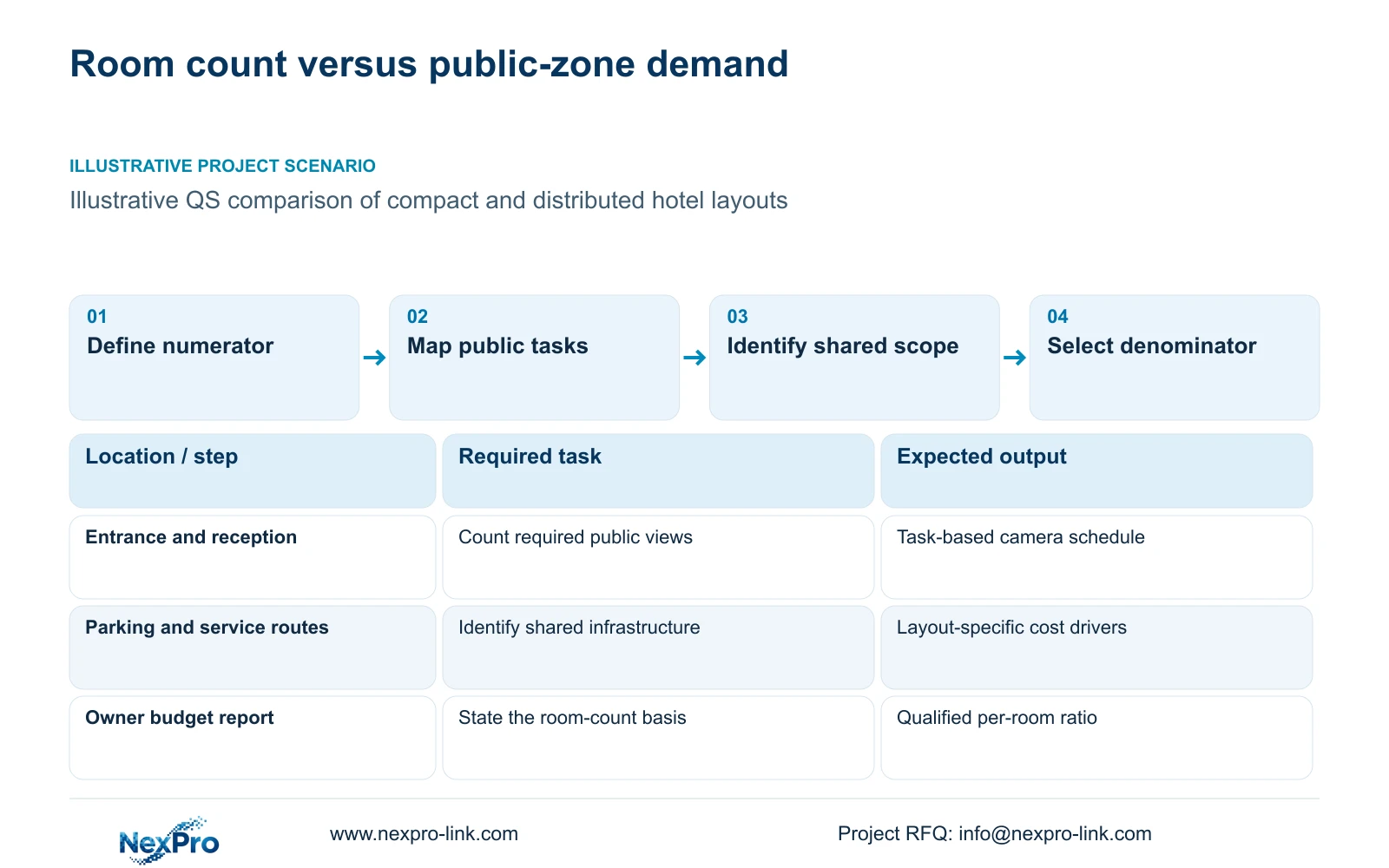
Camera demand follows required public views. Entrance geometry, reception activity, corridor endpoints and service routes determine the observation tasks. Bedrooms are background context for this calculation; the article's planning scope excludes guest-room interiors, bathrooms and changing spaces. Public corridor views also need boundaries that avoid unnecessary views through open doors.
The supplied illustrative city-hotel reference has 100 rooms and 32 camera tasks: four entrance views, four lobby/reception views, twelve guest-floor public-route views, four back-of-house views, six parking views and two exterior service-route views. These quantities come from its assigned tasks. They are not a rule that every 100-room hotel needs 32 cameras.
Operator displays provide another reason room count cannot determine equipment. A larger display is justified by viewing distance and simultaneous operating tasks. Four Full HD panels form a nominal 3840 × 2160 canvas, but an overview tile still shows only part of that pixel budget. Screen size and room inventory do not establish the detail available to an operator.
Section 04
Compare two hotel layouts
Compare a compact layout with a distributed layout by tracing the public tasks each must support. A compact arrangement may bring access nodes and recording equipment close together. Separate buildings can introduce backbone routes, remote cabinets and local protected power. Treat these as layout-dependent scope questions, without assuming that either property automatically needs more cameras or costs more.
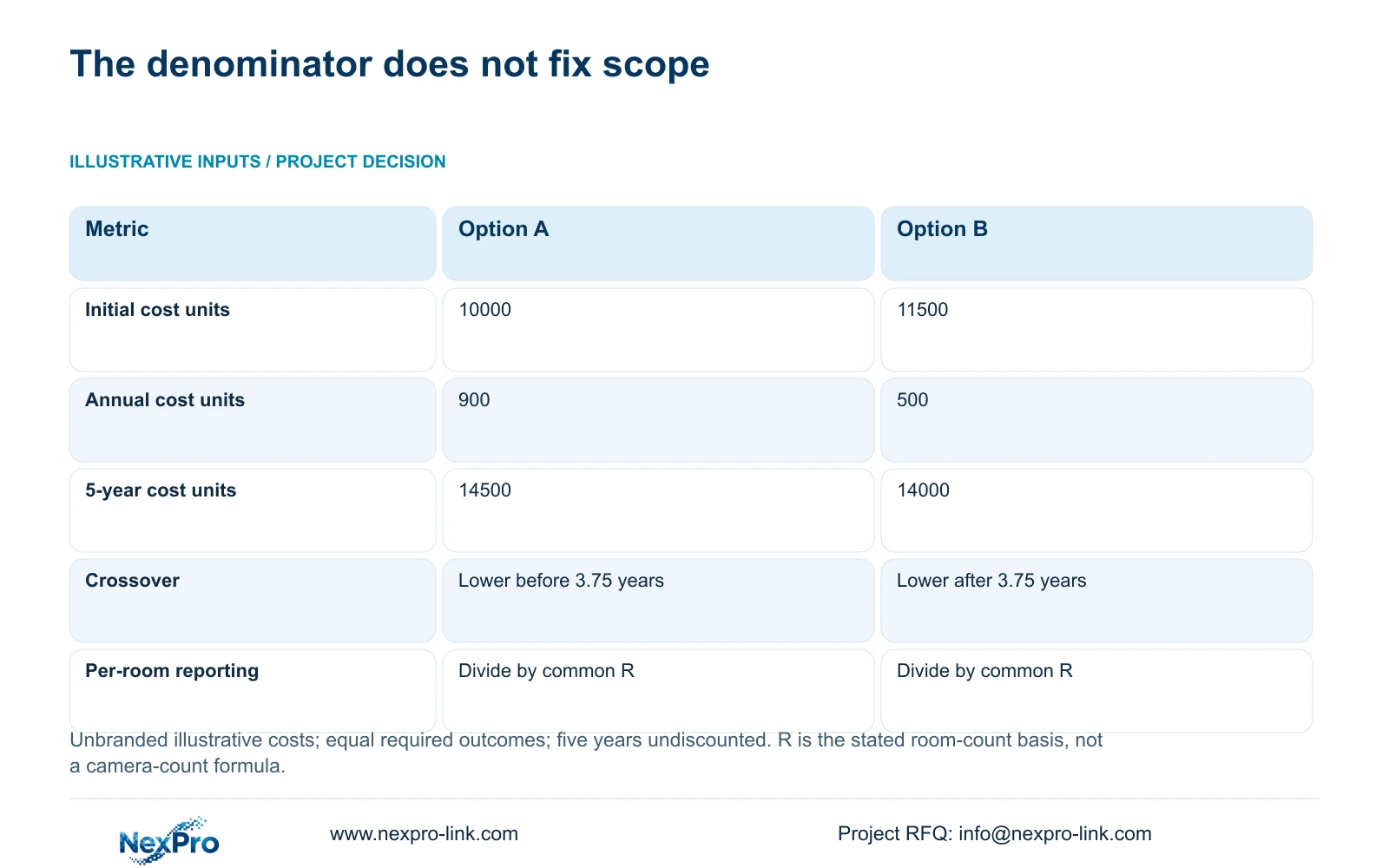
Keep each layout's required outcomes visible while comparing initial and recurring costs. For the teaching alternatives, five-year total equals initial cost plus five times annual cost. A produces 14500 units and B produces 14000. The break-even time is (11500 minus 10000) divided by (900 minus 500), or 3.75 years.
A has the lower modeled cost before 3.75 years; B has the lower modeled cost afterward, including a 500-unit advantage at five years. At the break-even point they are equal. These totals are undiscounted and depend on the stated annual inputs. They cannot rank real layouts or brands until scope-matched quotations replace the assumptions.
| Teaching metric | Option A | Option B | Condition for use |
|---|---|---|---|
| Initial total | 10000 units | 11500 units | Equal required outcomes and stated initial scope |
| Initial cost per room | 10000 / R | 11500 / R | Same positive room-count basis R |
| Five-year undiscounted total | 14500 units | 14000 units | Assumed annual costs 900 and 500 |
| Five-year cost per room | 14500 / R | 14000 / R | Do not change R or the included cost period |
| Crossover | Lower before 3.75 years | Lower after 3.75 years | A common denominator does not fix unequal property scope |
Section 05
Calculate alternative denominators
Use several denominators only when each answers a defined question. Initial cost divided by the approved room inventory describes capital intensity. Cost divided by the number of scheduled public views describes expenditure per planned view. A cable-work subtotal divided by its measured route length can help examine that package, provided termination and testing inclusions are consistent.
These ratios are not interchangeable. Cost per camera can look high where shared recording and protected power are included, or low where they are omitted. Cost per meter can change when one package includes containment and another includes cable alone. Keep the relevant total, denominator and inclusions beside every ratio.
The teaching cost comparison can be expressed as 10000 divided by R and 11500 divided by R for initial cost per room, where R is the chosen common room count. Five-year values become 14500/R and 14000/R. Dividing both options by the same R preserves their ranking and the 3.75-year crossover. Different room counts require a separate explanation of property scope.
Section 06
Use the metric with explicit limits
Recommend a per-room figure for owner reporting after the budget scope is defined. Use a task-based equipment schedule for procurement. If two hotels differ in public routes, parking, backbone topology or required retention, explain those differences before drawing a conclusion from their ratios. Do not remove required work merely to reach another property's benchmark.
Within the equal-outcome teaching model, choose B for a five-year cost objective if its recurring inputs are accepted and its initial amount is affordable. Choose A for an evaluation period shorter than 3.75 years under the same assumptions. Actual fees, installation scope or a mandatory platform can reverse that recommendation. RICS distinguishes cost-planning and maintenance-cost purposes; the model here is an explanatory calculation.
NexPro-Link can support equipment matching and coordinated supply against a common hotel scope. Send the room-count basis, public-zone schedule or layout, included cost categories and evaluation period to info@nexpro-link.com. State the destination and any mandatory operator system. Hotel project support and BOQ support can then address the specific scope differences behind the benchmark.
Section 07
Buyer questions
Can a per-room target set the maximum number of cameras? No. Use the target as a budget check after assigning the required public views. If the estimate exceeds it, identify the cost drivers and qualified alternatives before changing coverage.
Can two equipment-only offers be compared before installation is priced? Yes, for an equipment purchase decision with matching inclusions. Label the result equipment-only and keep the missing local work outside the claimed installed-system comparison.
What is needed to explain a higher per-room figure? Provide the numerator breakdown and the property-specific tasks that create the difference. Shared facilities, recording duration and remote power nodes are useful explanations when they appear in the actual scope.
Engineering references
These sources support the general planning principles. Always use the selected product's current datasheet and applicable project standards for final design.