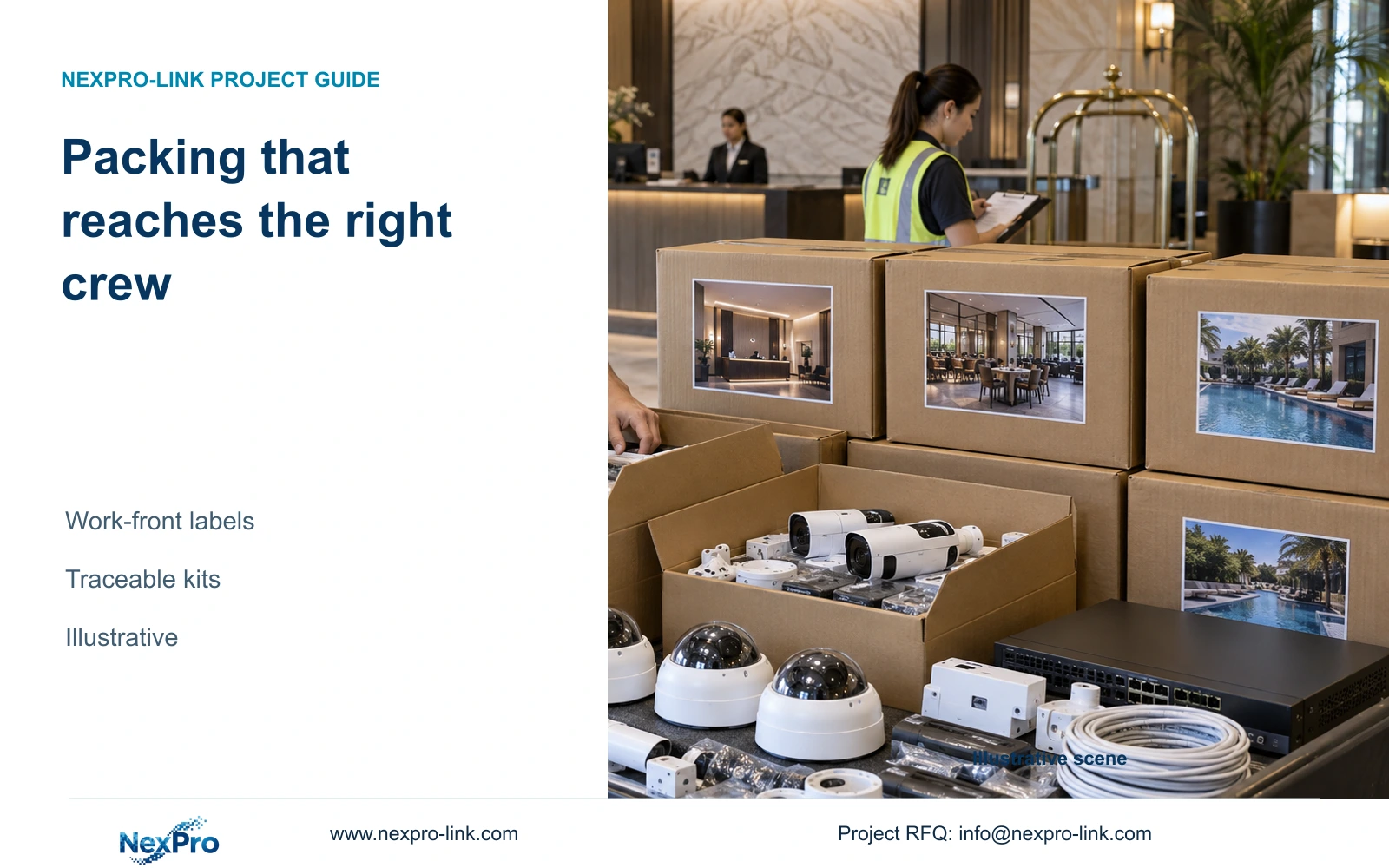
Hotel CCTV packaging should connect each carton to its installation task while preserving equipment identity. Authorized branding, zone labels and matching packing records make that possible.
Section 01
Select the authorized branding assets
Choose project-labelled packaging when crews need to receive equipment by hotel work front. Add custom printed boxes when the owner requires branded presentation or an established repeat-order format. In either arrangement, connect the authorized artwork to the exact model, accessories and carton record before releasing the shipment.
Identify who may authorize the logo and which files represent the accepted design. A contractor's name, a hotel operator's mark and the equipment manufacturer's identity have different purposes. The project manager should establish which appears on the outer carton, individual box and enclosed instructions. Approval for one surface should not be treated as permission for every surface.
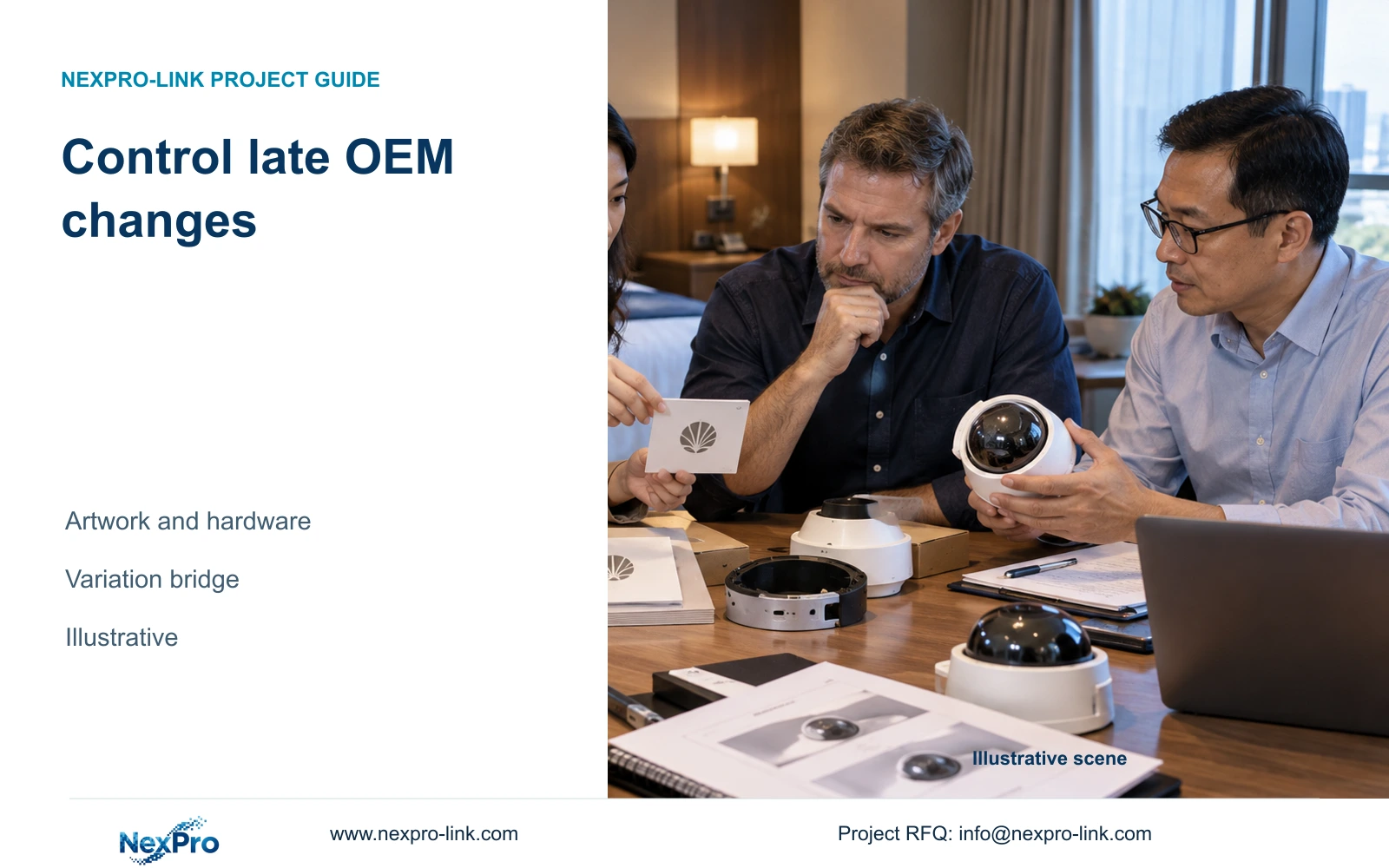
NexPro-Link's OEM/ODM scope includes branding and project packing options. Laser marking, labels, printing and color boxes require separate material and process decisions. An attractive digital layout cannot establish how a mark will appear on the selected housing or carton. Hardware customization also does not grant permission to rename third-party client software.
| Required task | Given information | Decision still needed |
|---|---|---|
| Present the customer brand | Customer supplies logo artwork | Authorized version and permitted surfaces |
| Identify equipment for service | Exact model and serial identity | Label position that remains readable |
| Direct cartons to crews | Installation zones are listed | Zone grouping and carton fields |
Section 02
Map cartons to hotel work fronts
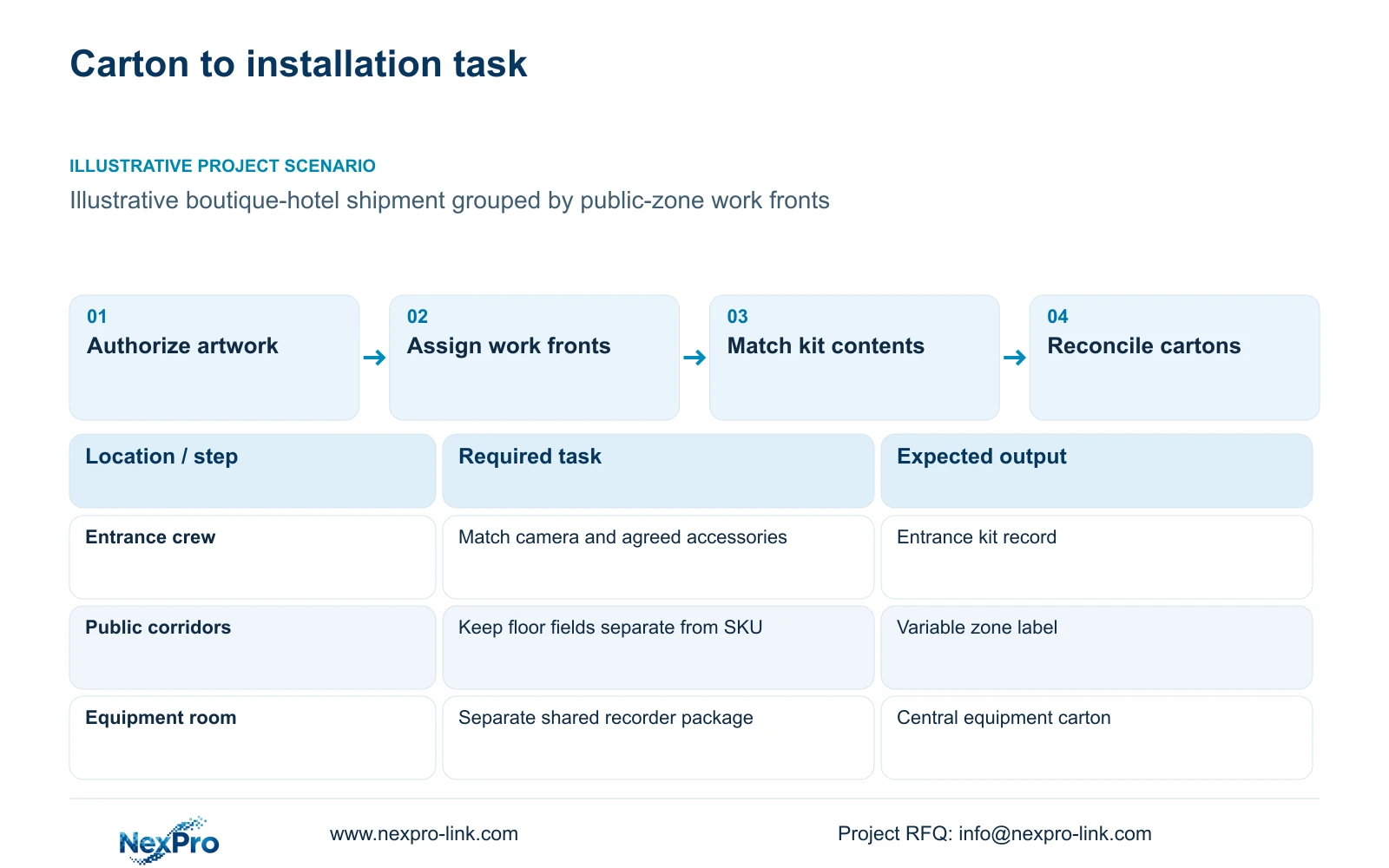
Use the installation sequence to organize cartons. Entrances, lobby areas, public corridors and service routes may have different access dates or installation teams. The packing schedule should tell receiving staff which cartons can move directly to a work area and which belong in controlled storage. A floor name alone is insufficient when several models or accessory combinations serve that floor.
The illustrative boutique-hotel reference has 24 camera tasks: four entrances, four lobby views, eight public-corridor views, four service-route views and four exterior parking approaches. These groups offer a useful packing structure, but they do not establish actual carton counts. Box dimensions, accessory quantities and the agreed handling arrangement still determine the shipment layout.
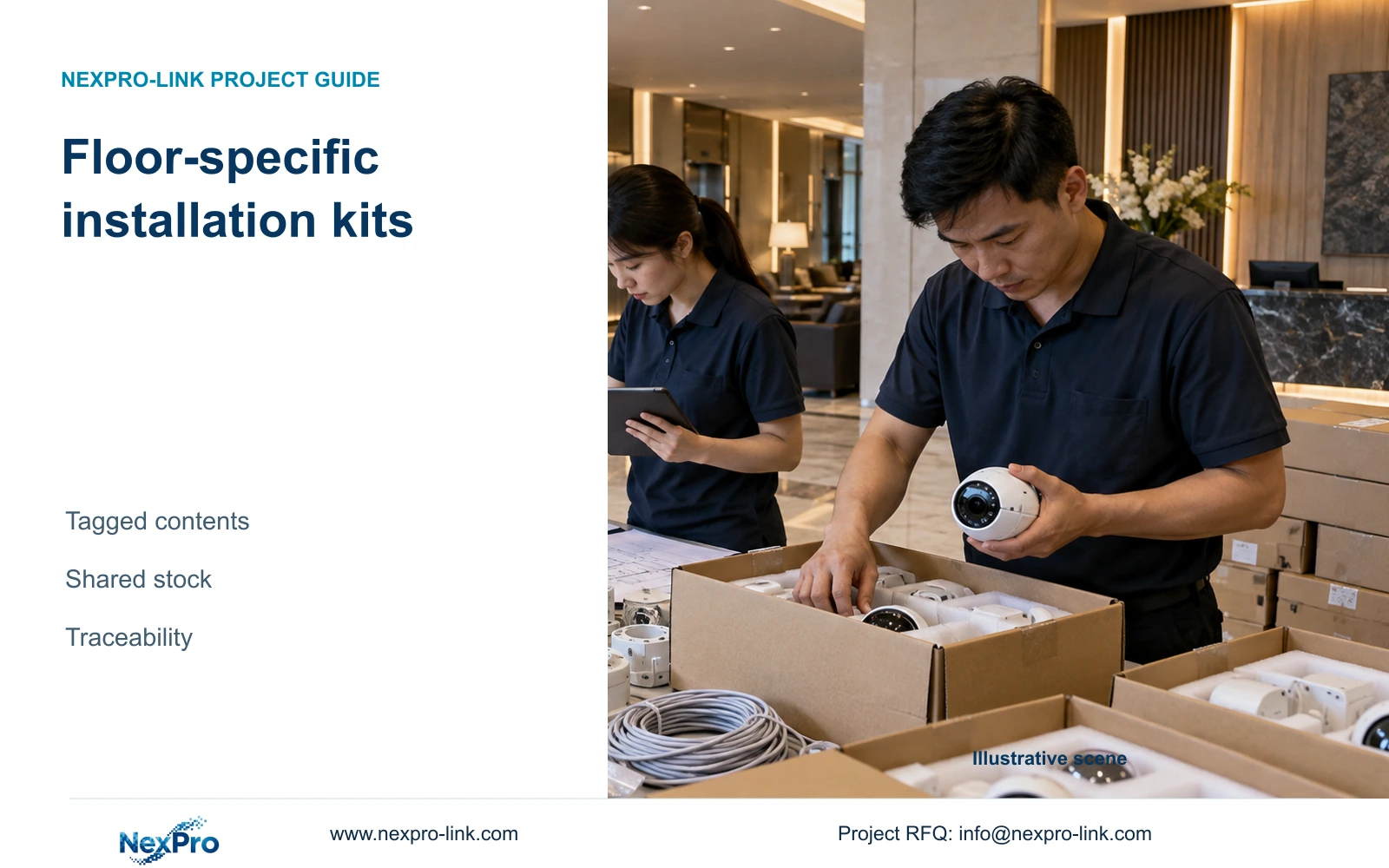
Keep shared equipment separate from point-specific kits. A recorder belongs to the equipment-room work package, while a camera and its agreed mounting accessories can follow a public-zone installation package. Sending every item under one broad floor label can leave the crew searching for shared components or mistakenly distributing equipment that must remain centralized.
| Item | Model-grouped cartons | Work-front cartons | Effect on installation |
|---|---|---|---|
| Camera allocation | Sorted after receipt | Mapped to scheduled zones | Changes where sorting occurs |
| Agreed accessories | Separate accessory stock | Matched to the relevant kit | Makes missing kit items easier to identify |
| Shared recorder | Central equipment carton | Dedicated equipment-room package | Prevents allocation to a camera point |
Section 03
Separate model identity from project labels
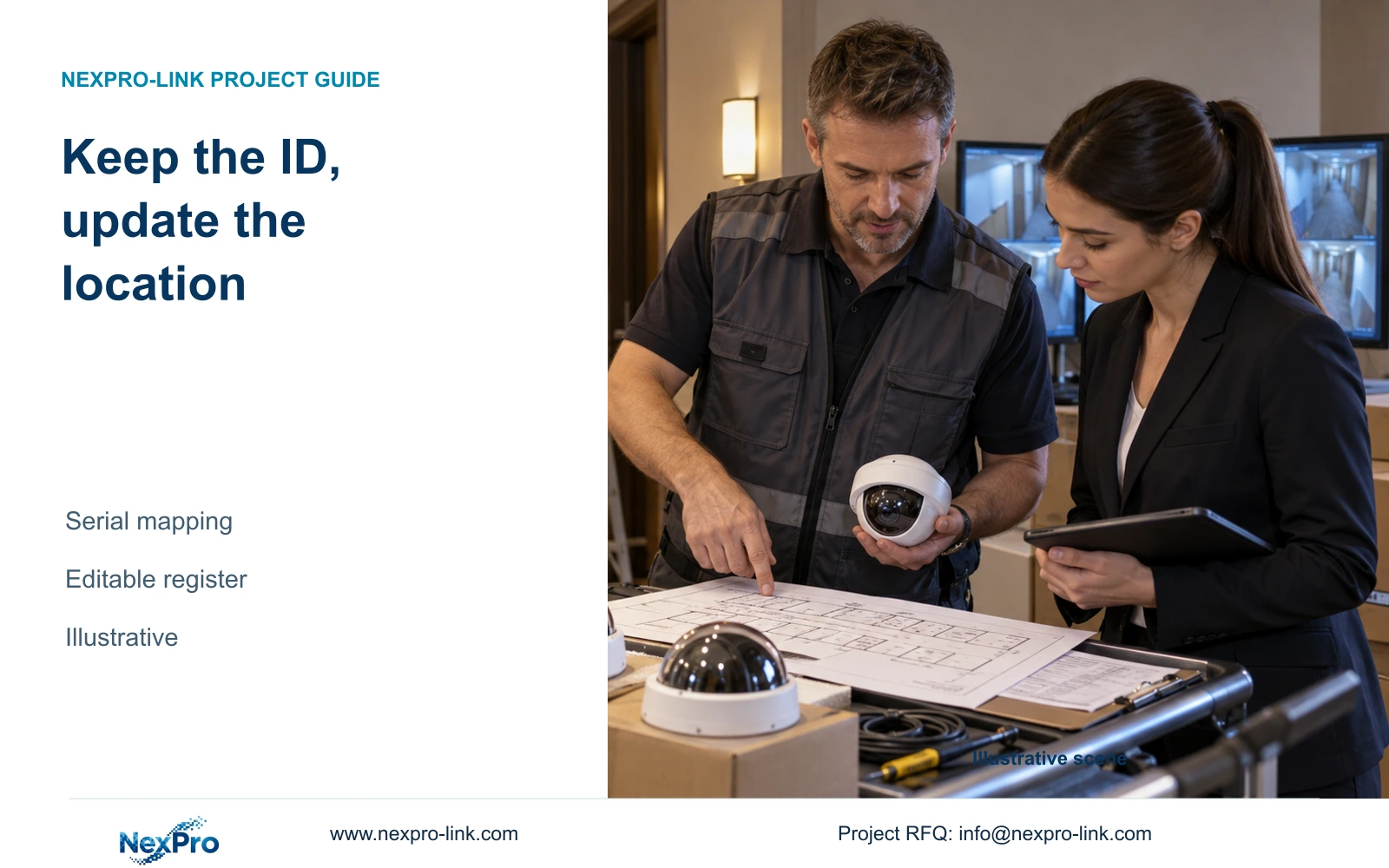
Retain the manufacturer's exact SKU, serial number and necessary markings. Put the installation point, floor and carton number in separate project fields. For example, NexPro-BL2812M55-5MP-DIC-AI identifies a product; an entrance tag identifies its intended task. Replacing the SKU with a customer-friendly location name would weaken later replacement and support records.
The individual box, carton list and enclosed instructions should refer to the same equipment identity. Where a serial-to-point assignment is provisional, describe it as provisional until receiving or installation confirms the actual unit. This allows crews to exchange units without losing the distinction between a physical device and the view it must provide.
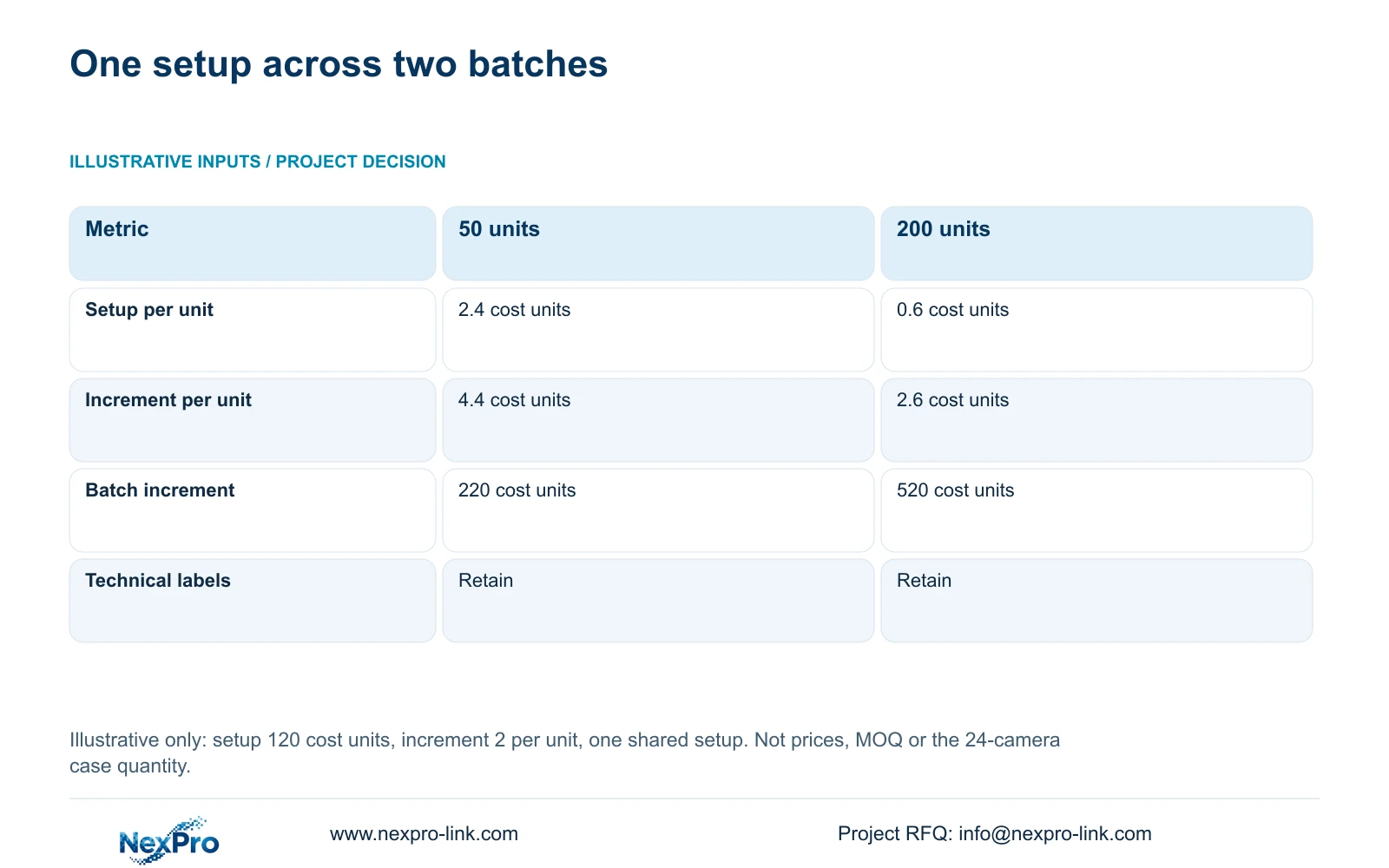
Cost planning follows the same separation. The illustrative customization model uses 120 cost units for one-time artwork/setup and 2 cost units per unit for marking, labelling or packing. Increment per unit equals 120 divided by batch quantity, plus 2. These are teaching inputs, not NexPro-Link prices, minimum quantities or laser-process specifications.
Section 04
Count the packaging variants before ordering
Count distinct artwork versions, box formats and accessory combinations separately from the total equipment quantity. A common brand design can remain stable while variable labels identify installation zones. Printing a different permanent box for every floor introduces revisions that may provide little benefit when the floor schedule is still changing.
The calculation below assumes one setup shared by the entire stated batch. At 50 units, setup contributes 2.4 cost units to each unit; at 200 units, it contributes 0.6. Total incremental batch cost equals setup plus quantity multiplied by the per-unit increment. The larger batch lowers allocation per unit while increasing total expenditure.
Neither batch represents the 24-camera reference hotel. Use the comparison to question unnecessary variants and request an actual process quotation. If separate artwork or materials require separate setups, the single-setup model must change. A lower unit allocation is not a reason to purchase equipment beyond the approved installation and spare requirements.
| Metric / condition | 50-unit teaching batch | 200-unit teaching batch |
|---|---|---|
| Batch quantity | 50 units | 200 units |
| Setup cost per unit | 2.4 cost units | 0.6 cost units |
| Total incremental cost per unit | 4.4 cost units | 2.6 cost units |
| Total incremental batch cost | 220 cost units | 520 cost units |
| Model and required labels | Retain | Retain |
Section 05
Compare retail presentation with installation packing
Compare both formats against the same protection, identification and accessory requirements. A color box may satisfy an owner-facing presentation requirement. A neutral individual box with a controlled project label may suit equipment moving directly from receiving to installation. Neither appearance establishes protective performance; the actual packing arrangement needs agreement.
Keep spare units recognizable as stock rather than assigning them to uninstalled camera points. Their model and technical version should remain available for compatibility checks. A branded box does not establish that an older spare will operate as a suitable replacement in a changed system.
Service handling also needs equipment identity. Before an RMA shipment, confirm authorization, symptoms and the device record. Recorders and storage media can contain credentials or hotel footage, so the return arrangement requires an approved handling process. Packaging choices should support that process without implying that all return transport or local labor is included.
| Retained outcome | Extra scope | Worth buying when | Change condition |
|---|---|---|---|
| Traceable protected shipment | Custom color box | Owner-facing branding is required | No branded presentation requirement |
| Complete installation kits | Zone sorting and kit labels | Crews receive by work front | Site performs an agreed central allocation |
| Identifiable spare stock | Spare-specific packing record | Units remain in storage | Actual spare quantity changes |
Section 06
Release a matching artwork and packing sample
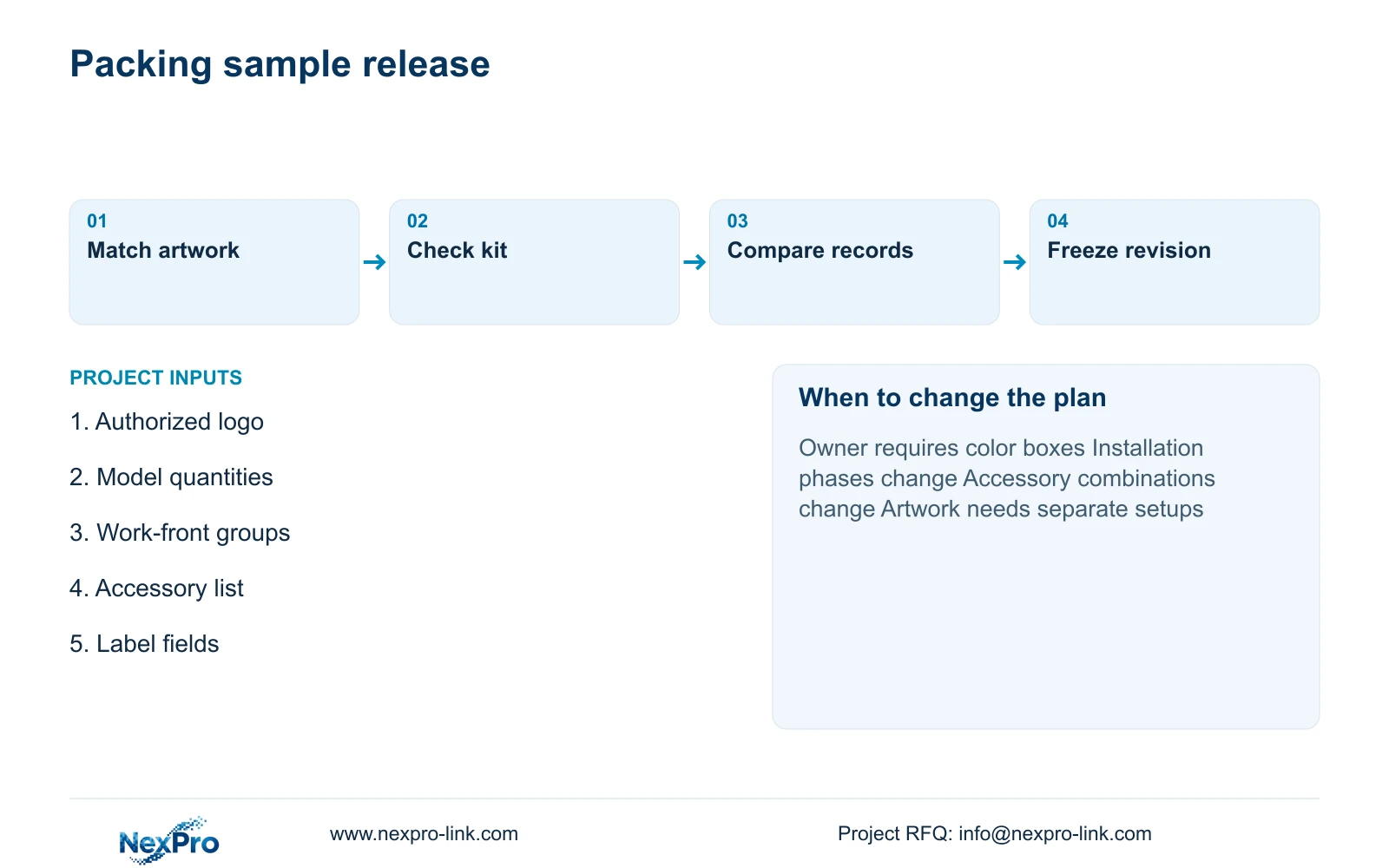
Review a representative packing sample together with its label, accessory list and enclosed instructions. Check that the receiving team can identify the model and destination without opening unrelated cartons. Record the accepted artwork revision and packing schedule so later quantity changes do not silently alter the agreed format.
For a hotel shipment delivered directly to installation crews, use stable branded elements with variable work-front labels and matching carton records. Change to a more elaborate color-box format when a documented presentation requirement justifies it. Revisit grouping when installation phases or accessory combinations change.
Send authorized logo files, the model-and-quantity schedule, requested label fields and zone-packing needs to info@nexpro-link.com. NexPro-Link can discuss OEM packing and coordinated hotel equipment supply, with CCTV manufacturing and supporting-category coordination identified separately. Include the delivery destination so the quotation can define its shipment boundary.
Section 07
Buyer questions
Can floor labels be finalized before every camera serial is allocated? Yes, the zone and carton structure can be prepared first. Keep serial assignments provisional, then reconcile the shipped units with the packing list and installed asset record.
Does a customized box include a renamed mobile app? No. Box artwork and hardware branding are separate from third-party software identity. Any software customization must have its own supported, authorized scope.
Must spare cameras use separate artwork? Usually a separate stock-status label and packing record can identify spares while retaining the common artwork. Use a distinct box only when the agreed handling task requires it.
Engineering references
These sources support the general planning principles. Always use the selected product's current datasheet and applicable project standards for final design.