Use camera tags and mounting requirements to assemble floor-specific installation kits. Keep shared resources and spares separate, with traceable carton records.
Section 01
Map camera tags to approved work fronts
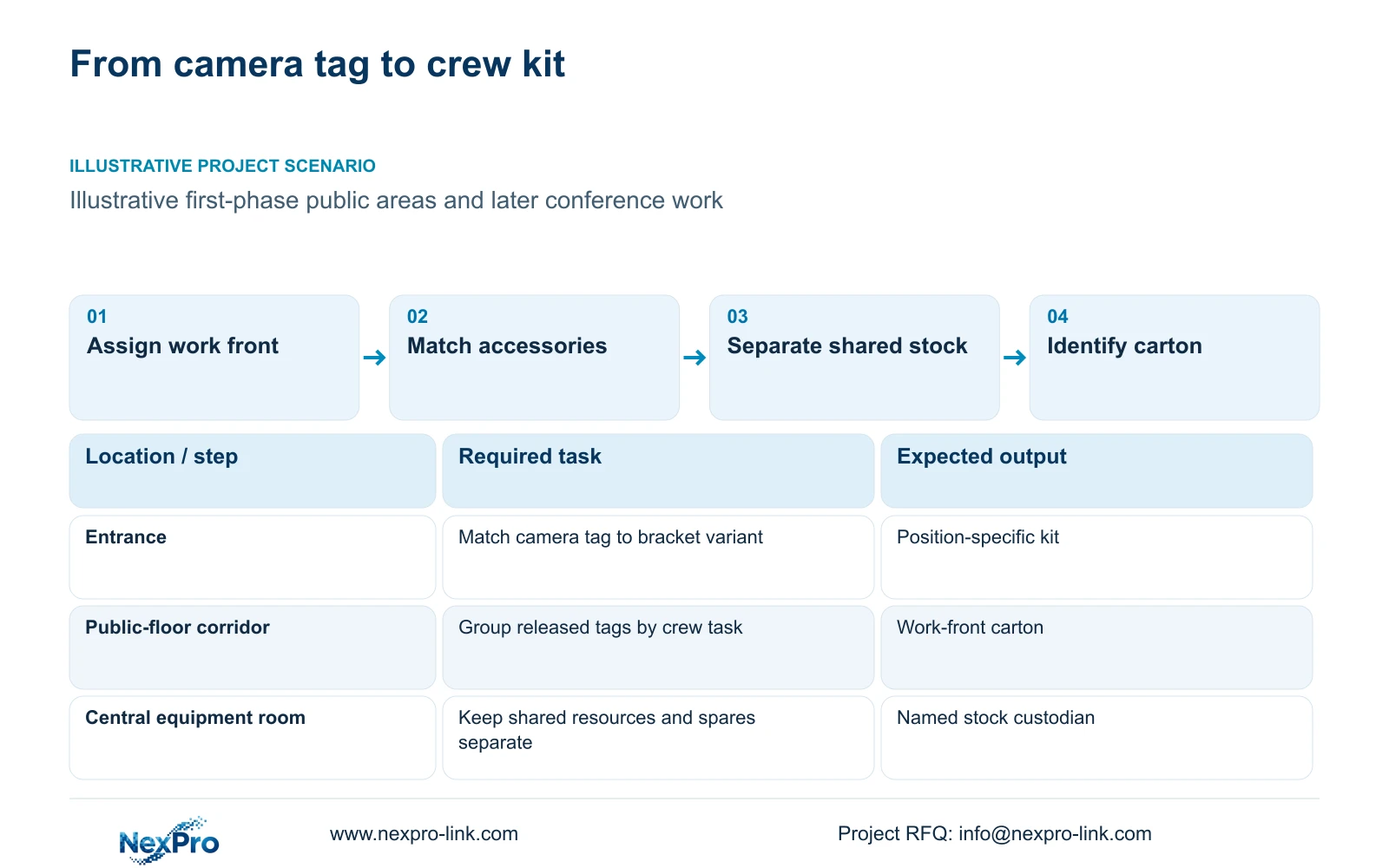
Choose floor-specific installation kits when camera locations and accessory variants are stable enough to pack accurately. Group each camera with the items and documents needed for its assigned task, and identify shared equipment separately. Change to controlled common stock when work fronts are still moving or the contractor already has a reliable central issue process.
Start with the camera schedule, then assign every tag to an approved work front. Public entrances, lobby positions and corridor routes can use different supports even when their cameras share a model. Dividing the overall order equally between floors ignores those differences and can leave a crew with the right camera count but the wrong mounting accessories.
CASE06 illustrates a 32-camera first operating release within a final 64-camera hotel design. That split provides a phase boundary, not equal floor quantities. Packing should follow the actual tagged positions within each phase. A room count does not establish camera or carton quantities, and this illustrative case is not evidence of a delivered customer project.
| Required task | Given information | Decision still needed |
|---|---|---|
| Entrance views | First-phase camera tags | Bracket and accessory variant per position |
| Public-floor routes | Approved installation work front | Tag-to-carton assignment |
| Later conference extension | Second-phase scope | Separate release and shared-resource allocation |
Section 02
Define the crew-kit contents
Define a kit as an installation issue unit with an explicit contents list. Depending on the position, it can contain the camera, specified bracket, agreed connection accessories, labels and a relevant installation reference. Include patch cords where their length and termination role are known. Do not describe a kit as complete if essential items remain outside its scope without being identified.
Keep project cartons, printed labels and device branding as separate purchase choices. A floor label helps the crew locate stock; a laser logo addresses brand presentation. Their artwork and process requirements differ. Authorized artwork must be confirmed, while actual marking suitability and appearance depend on the surface and agreed process.
Preserve the exact model and serial identity alongside the project tag. Customer branding must not obscure necessary markings or service references. Hardware OEM work also does not grant permission to rename third-party software. A useful installation kit can use neutral packaging with clear task labels without adopting a retail-style presentation.
| Item | Loose delivery | Grouped delivery | Effect |
|---|---|---|---|
| Bracket variant | Separate bulk accessory stock | Assigned to camera tag | Crew receives the specified mounting item |
| Location label | Applied during site sorting | Matched to released schedule | Earlier traceable allocation |
| Device identity | Manufacturer information retained | Manufacturer information retained | Service traceability stays intact |
Section 04
Compare loose and grouped deliveries
Loose delivery can suit a contractor with a controlled store and an established accessory-issue process. Grouped delivery can suit stable work fronts where crews should receive specified combinations directly. Compare actual packing effort with site sorting, handling and the consequences of later design changes. No supplied evidence establishes a measured reduction in labour or installation time.
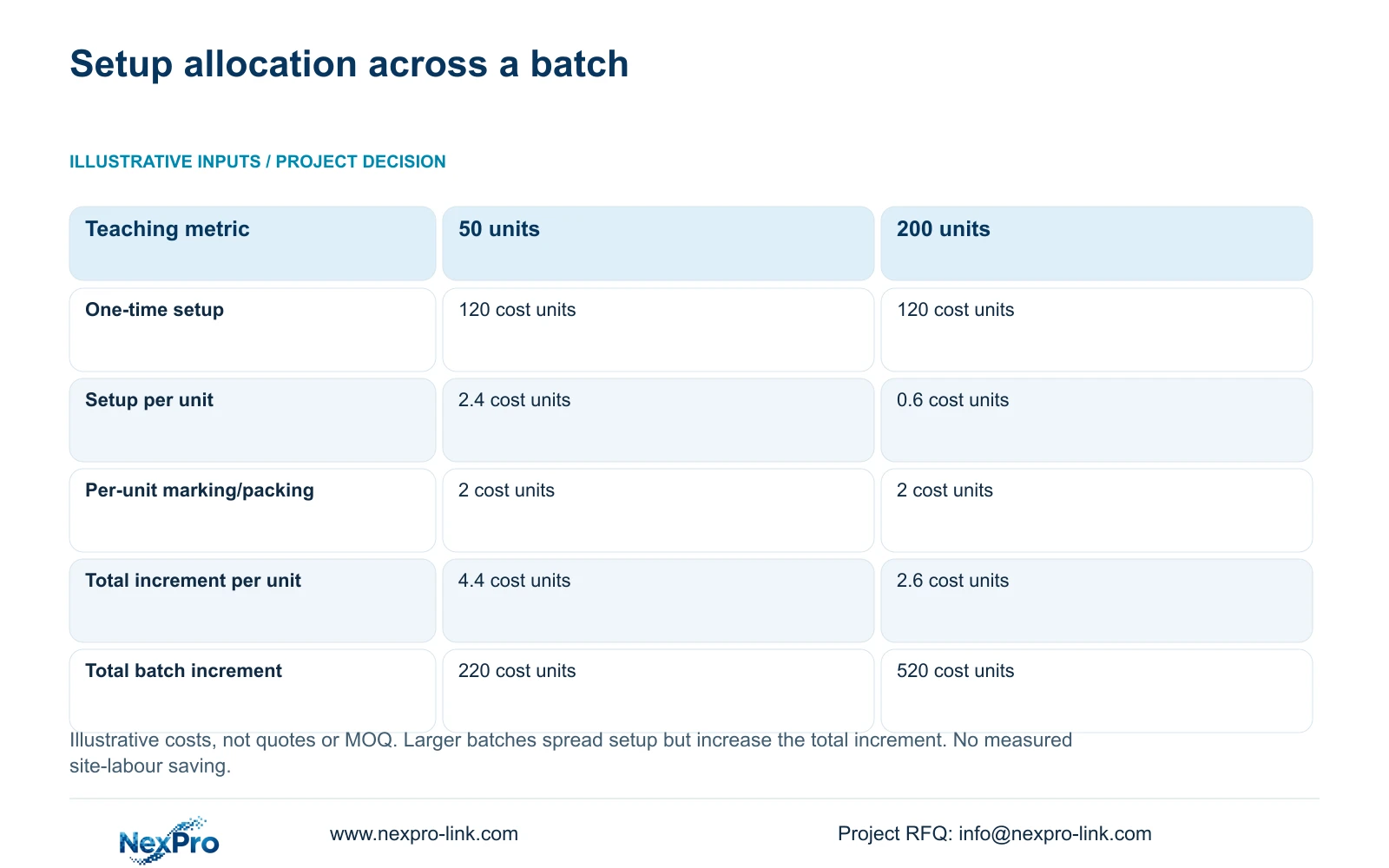
The teaching calculation gives 120 / 50 + 2 = 4.4 incremental cost units per device for a 50-unit batch. At 200 units, it gives 120 / 200 + 2 = 2.6. Total incremental batch costs are 220 and 520 units respectively. The setup allocation falls, while the total rises because more units receive the per-device work.
The table does not compare a priced loose package with a priced grouped package. It demonstrates why a larger approved batch can spread one-time setup without proving that buying more is economical. Keep the quantity tied to the project requirement. Request actual quotations for grouped contents, artwork revisions and any later repacking before choosing the commercial arrangement.
| Metric / condition | 50-unit teaching batch | 200-unit teaching batch |
|---|---|---|
| Batch quantity | 50 | 200 |
| Setup cost per unit | 2.4 | 0.6 |
| Total incremental cost per unit | 4.4 | 2.6 |
| Total incremental batch cost | 220 | 520 |
| Model and required labels | Retain | Retain |
Section 05
Count labels and accessories
Count accessories from the tagged installation arrangement. A camera mounted directly and one requiring a separate bracket should generate different kit contents. Check which accessories are already included in the device package before adding separate BOQ rows. This prevents a packing exercise from duplicating supplied items or concealing a genuine omission.
Define labels by their role. Device location, cable endpoint and outer carton references are different identifiers, even when they share a camera tag. Decide the required fields and quantities from the actual installation method. Keep stable model and serial information separate from variable floor, zone and work-front fields so later orders can reuse the correct core records.
Reconcile the released schedule against installed-position kits, shared resources and spares. A total device count can match the order while the allocation remains wrong. Check each kit's accessory variant and drawing reference, then record exceptions explicitly. Avoid silently filling a missing bracket with a visually similar item whose fit or functional suitability has not been established.
| Retained outcome | Extra scope | Worth choosing when | Counter-condition |
|---|---|---|---|
| Correct accessories at each position | Tag-specific kit assembly | Mounting variants and work fronts are stable | Locations change frequently |
| Traceable common stock | Controlled site issue records | Contractor can manage sorting and allocation | No reliable store or issue process |
| Readable project identity | Approved carton and label fields | Receiving team uses those references | Decorative packaging adds no task value |
Section 06
Link cartons to the installation schedule
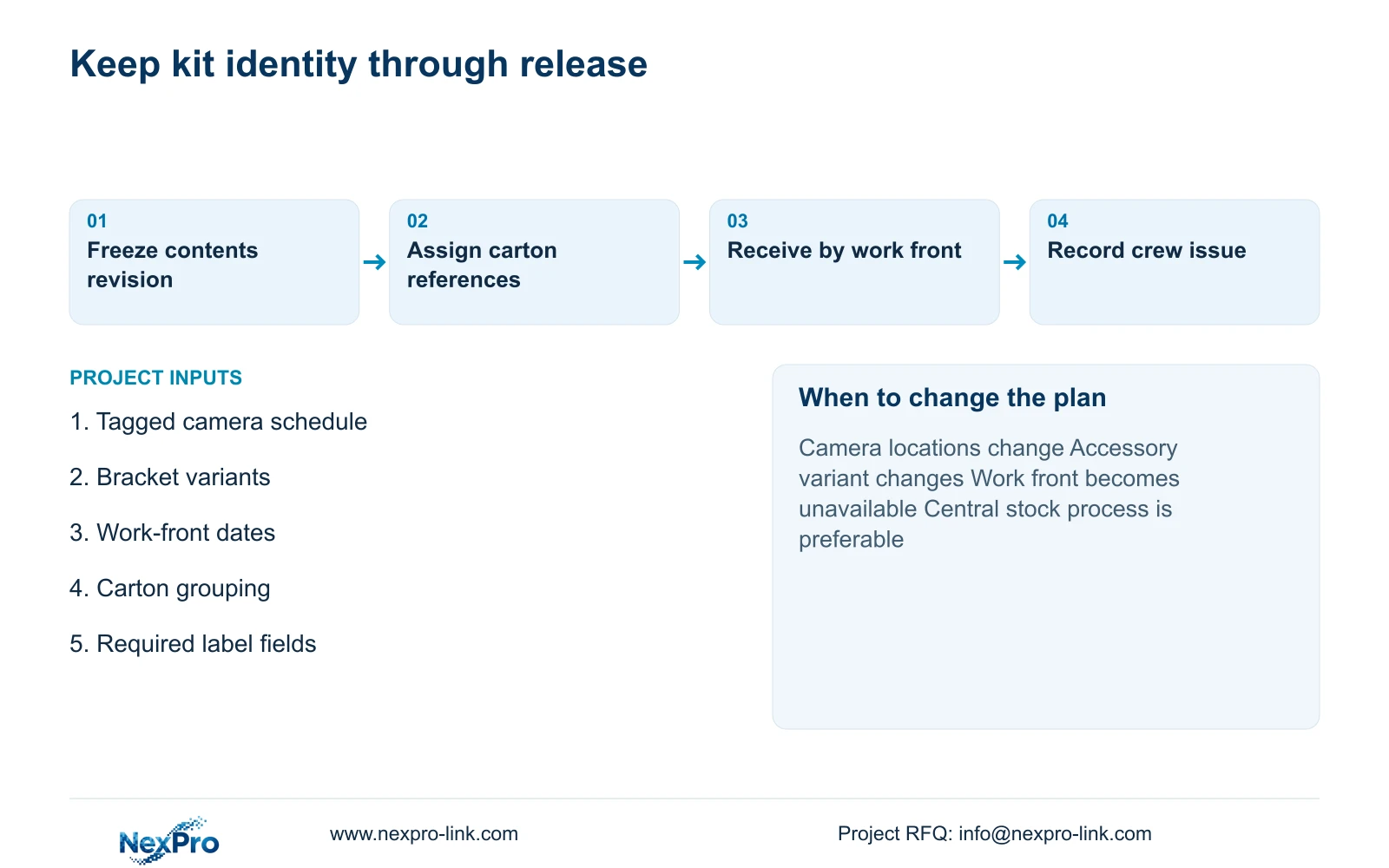
Link each carton group to a released work front and the revision that defined its contents. Distinguish expected arrival, receipt and issue to the crew. If a floor becomes unavailable, retain the carton identity during storage or transfer; moving stock should not erase its assignment or make it appear installed.
Freeze accepted artwork and technical contents for the release. When a position changes, revise the allocation and identify affected cartons before repacking. Reuse stable branding fields on repeat orders while updating location-specific information. Neither late changes nor separate deliveries should be assumed free or without programme consequences.
Recommend grouped kits where the approved schedule contains meaningful accessory differences and the receiving team can use the grouping. Switch to controlled common stock if layout changes would repeatedly invalidate kits. Send the tagged camera schedule, bracket variants, work-front dates, carton grouping and required label fields to info@nexpro-link.com. NexPro-Link can discuss project packing and coordinated supply, with CCTV manufacturing and supporting-category responsibilities stated separately.
Section 07
Buyer questions
Do floor kits require a custom color box? No. Neutral project cartons with clear work-front references can support receiving and installation. Choose custom color boxes only when their agreed branding or distribution purpose justifies the additional artwork and process scope.
Should every floor receive the same spare quantity? Allocate spares by replacement task and custody, separately from installed kits. A shared compatible spare may belong in central stock. The supplied material provides no failure-rate basis for equal percentages across floors or device categories.
Does the 200-unit example establish a better order size? It establishes lower setup allocation per unit under the stated assumptions, alongside a higher total increment. Buy the required quantity and compare actual packing quotations. Neither example is a published MOQ or an offered price.
Engineering references
These sources support the general planning principles. Always use the selected product's current datasheet and applicable project standards for final design.