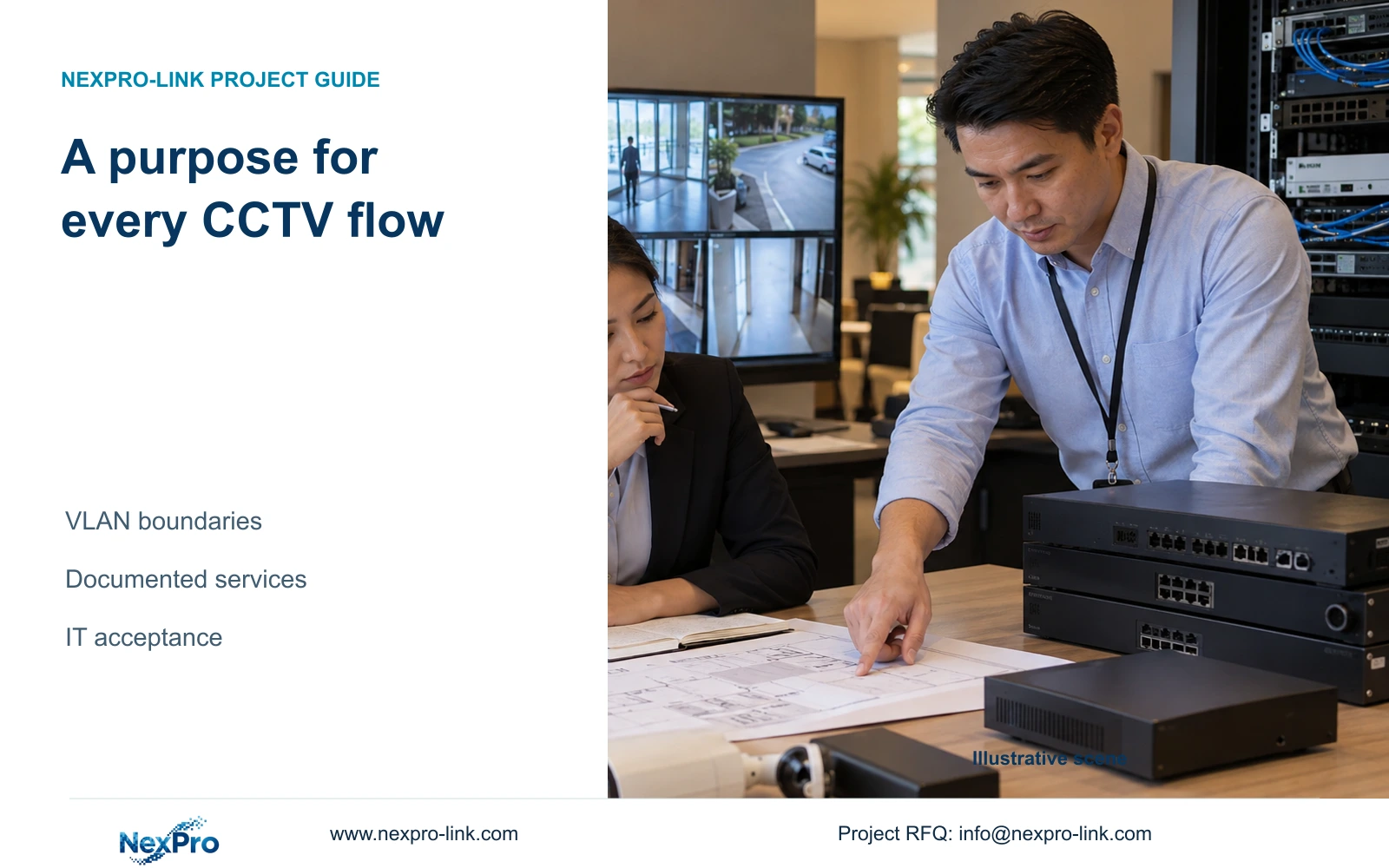
A CCTV equipment list cannot define firewall rules. Submit each required communication purpose and confirm services against the exact device documentation.
Section 01
Define which communications the hotel needs
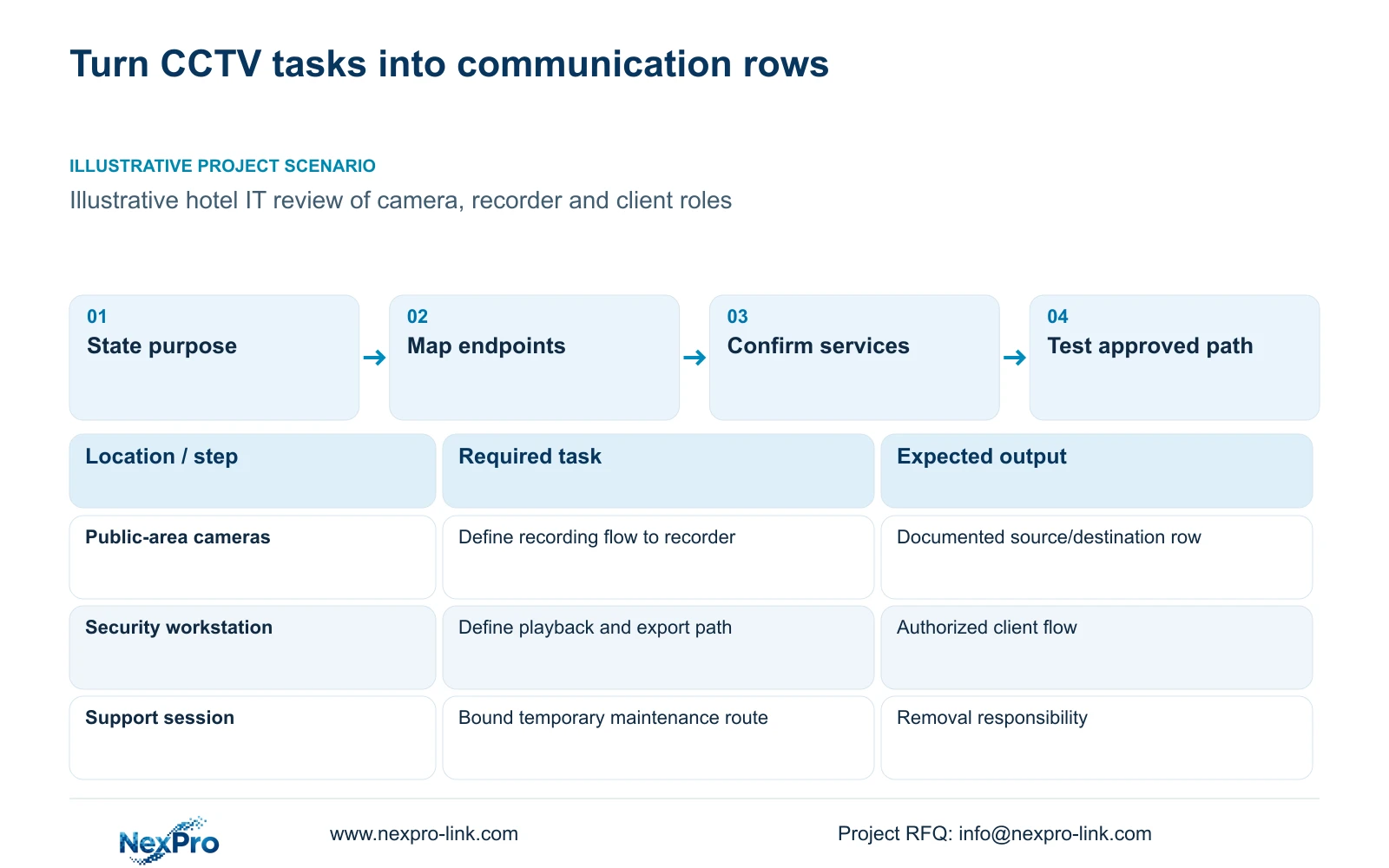
Submit a purpose-based communication schedule to hotel IT before requesting firewall changes. For every necessary flow, identify the source, destination, protocol and direction, then confirm services and ports from the selected equipment documentation. If a required function cannot operate through the approved design, investigate that specific dependency instead of opening every device to the internet.
Begin with operating tasks: cameras supplying recording video, an authorized client retrieving an event, or a supplier diagnosing an approved fault. These tasks have different endpoints and permissions. The equipment list tells IT what is being purchased, but it does not tell IT which systems should communicate or why.
Make the schedule usable for a rule decision. State the responsible owner and whether a flow is permanent or limited to maintenance. Keep recording requirements separate from optional owner access. This allows IT to assess an external connection without assuming that every camera needs it. A proposed flow remains a requirement until its implementation and supporting documentation are confirmed.
| Required task | Given information | Decision still needed |
|---|---|---|
| Record public-area video | Camera group and recorder role | Documented service and initiation direction |
| Review an incident | Authorized client and recorder | Supported playback/export path |
| Remote diagnosis | Target device and approved fault | Time-limited IT connection route |
Section 02
Map source and destination roles
Draw the actual data path between camera groups, access nodes, recorder and authorized clients. Add external destinations only when a required workflow uses them. Record which endpoint initiates each connection and how the return traffic is handled in the approved network design. Do not infer direction from a diagram arrow showing the general movement of video.
Keep application identity separate from network placement. A CCTV VLAN defines a network grouping within the design; it does not specify who may export footage. The application must enforce supported user tasks, while hotel IT controls reachability between relevant zones. Both layers need an owner and an acceptance check.
CASE01 illustrates four access nodes feeding a recorder, with a separate client or decoder display path. That structure helps identify roles but is not a ready-made firewall configuration. Replace its generic backbone with the hotel's actual topology. Preserve the distinction between data and protected power: a reachable remote switch still needs its separately designed power supply.
Section 03
Identify documented services without guessing ports
For each flow, attach the relevant model and version documentation that identifies the service, protocol, port and connection behavior. The supplied public records do not contain a complete firewall port list, so no universal list can be derived here. Do not copy a familiar recorder's requirements onto a different camera or client.
Separate ordinary recording services from discovery, administration and optional external functions. A discovery workflow used during installation may have different network requirements from steady operation. Record that distinction and ask whether the proposed deployment supports the intended routed or segmented arrangement. An unresolved dependency should remain visible in the submission.
The Seetong source supports discussion of app and PC workflows without proving every network behavior or cross-brand feature. ONVIF Profiles provide a function-matching reference, not a complete firewall specification. If an operator requires a particular platform, verify that platform's edition and the chosen devices together. Network permission alone cannot establish supported playback, export or account binding.
Section 04
Compare restricted and broad access
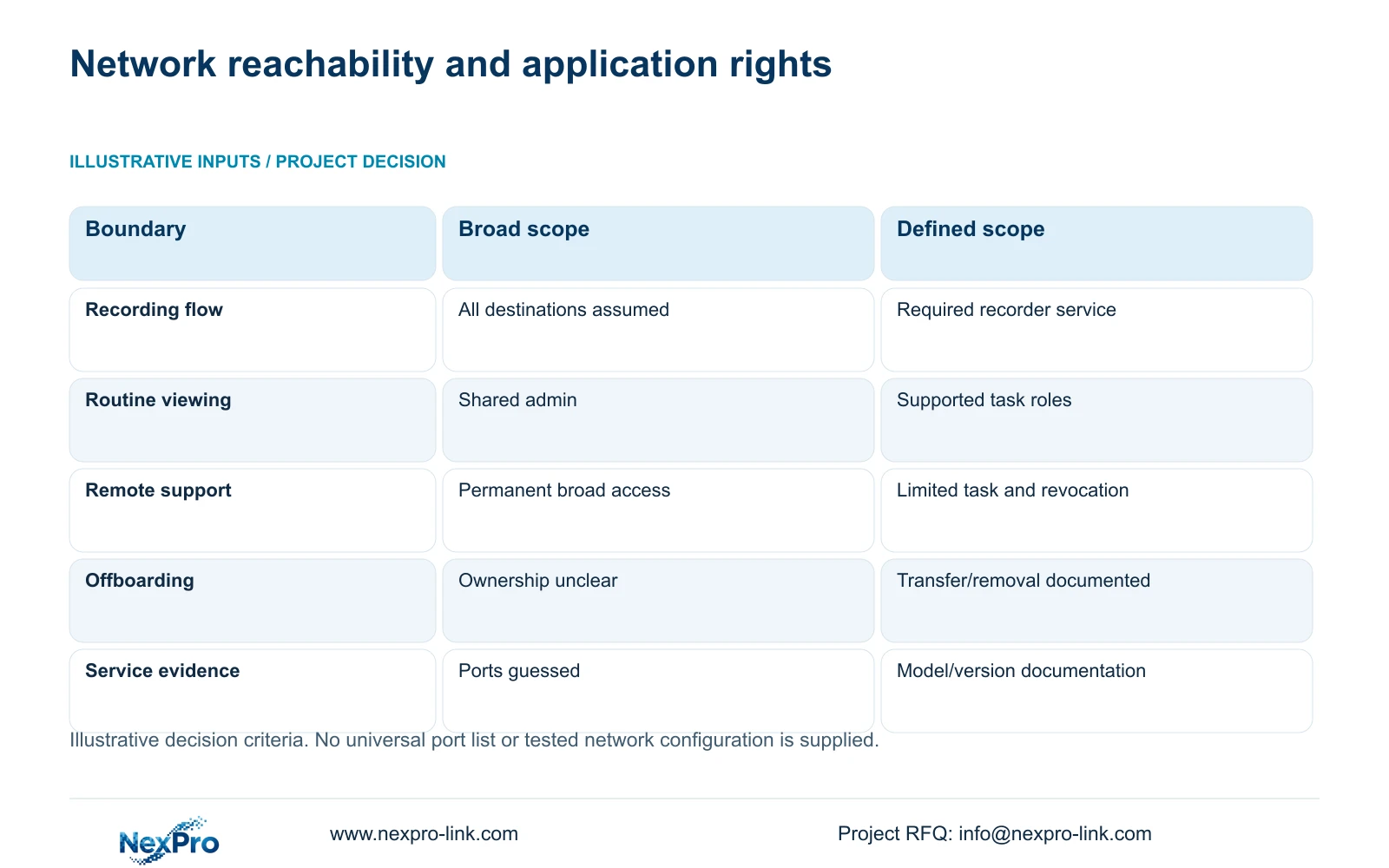
The original illustration separates network reachability from application rights. Convert that principle into a communication record for hotel IT using the fields below. Complete one row per necessary service, with model/version evidence; do not infer a port from a familiar device or an arrow showing video movement. The separate role matrix must still govern who may view, export or administer.
A broad network rule and a shared administrator account leave both boundaries poorly defined. Restricted reachability with an unrestricted application account still does not meet a limited-export requirement. Conversely, supported roles do not justify unexplained network destinations. Identify both shortfalls separately so the buyer can see whether the remedy is an IT rule, a client configuration or different equipment.
Recommend documented, purpose-limited flows paired with verified application controls. When a required feature needs an additional dependency, add only the documented scope and retest it. If the hotel's mandatory segmentation or access rules are incompatible with the proposed platform, compare another supported architecture rather than hiding the conflict in the installation scope.
| Flow field | Required entry | Acceptance boundary |
|---|---|---|
| Purpose and owner | Recording, approved retrieval or named support task | Necessary hotel function and accountable owner |
| Endpoints and initiator | Actual source/destination roles and connection initiator | Do not infer initiation from general video direction |
| Protocol/service/port | Exact model/version documentation reference | Unconfirmed service remains unresolved |
| Access duration | Permanent required service or authorized temporary window | Remove temporary access after the task |
| Function and restriction | Actual client role, allowed task and prohibited route/action | Observe required operation and denied access separately |
Section 05
Plan update and support traffic separately
List updates and remote support as their own communication purposes. Identify who approves them, which endpoints are involved and when access ends. Confirm any required external service from actual documentation. A maintenance task should not become a permanent allowance for unrelated devices because that was convenient during commissioning.
Assess bandwidth on the link that carries the traffic. CASE01 assumes 32 cameras at 4 Mbps each, giving 128 Mbps of recording input; each eight-camera group's recording traffic is 32 Mbps. These are teaching inputs, not measured traffic. Additional viewing, export or maintenance demand belongs only on the paths it actually traverses.
A move from gigabit to 10 Gb/s should follow demonstrated concurrency or expansion requirements. It does not follow automatically from a camera count. Also resolve equipment limits before promising the topology: the NexPro SW-POE1618G source has conflicting access-port speed fields and no stated total PoE budget. Its title cannot serve as proof of the final network or power requirement.
Section 06
Test required functions under the approved rules
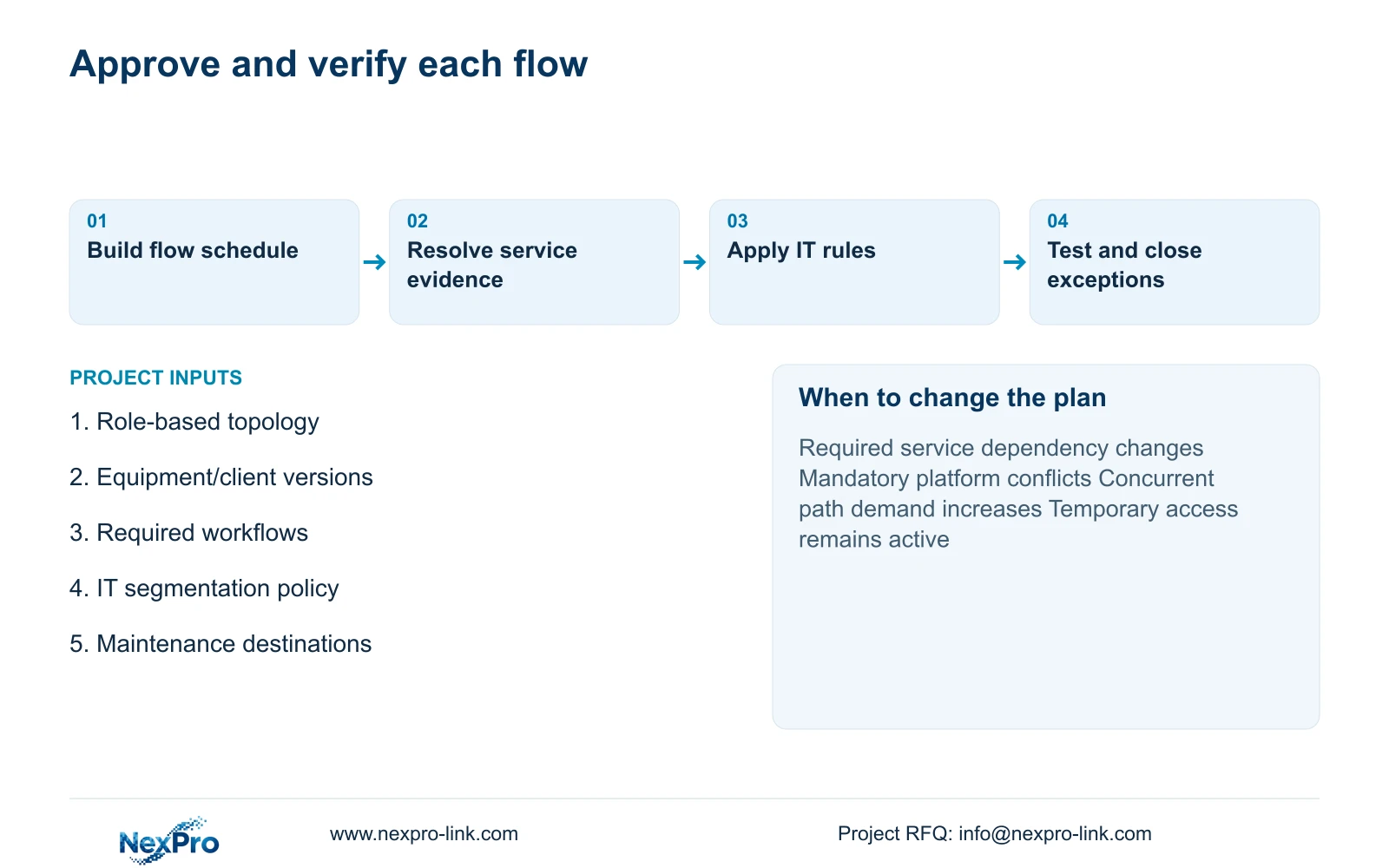
Test recording, authorized live view, incident playback and export through the proposed rules. Use the actual user role and client version for each action. Include a check that an unauthorized route or action remains unavailable. Record observations rather than treating a saved firewall rule or an online device icon as a complete result.
Then remove temporary maintenance access and repeat the required ordinary tasks. Check that optional remote access loss does not interrupt local recording where the design requires independence. An outage exercise also needs the necessary camera, recorder and network power path; successful firewall testing cannot prove backup continuity. Keep those acceptance responsibilities separate.
Choose the restricted design when it supports the required functions with documented services and enforceable roles. Reconfigure if a mandatory platform or verified dependency changes the path. Send a role-based topology, equipment and client versions, required workflows and hotel IT restrictions to info@nexpro-link.com. NexPro-Link's hotel project and BOQ support can help coordinate the equipment submission; hotel IT retains the firewall implementation and access-policy responsibility.
Section 07
Buyer questions
Can IT approve firewall rules from the BOM alone? The BOM needs a communication schedule explaining purpose, endpoints, direction and documented services. Model names alone do not identify the required connection behavior or whether external access is necessary.
Does a CCTV VLAN replace user permissions? No. Network reachability and application privileges solve different parts of the access requirement. Verify both the permitted communication path and the selected client's ability to restrict viewing, administration or export.
When is a faster backbone justified? When the actual shared path's concurrent recording, viewing, export and planned expansion demand requires it. Calculate those flows on their relevant links and confirm endpoint limits before changing the backbone specification.
Engineering references
These sources support the general planning principles. Always use the selected product's current datasheet and applicable project standards for final design.