A disk can be online while required footage is missing or the retained history is too short. Hotel storage monitoring needs playback checks and a clear alarm response alongside hardware status.
Section 01
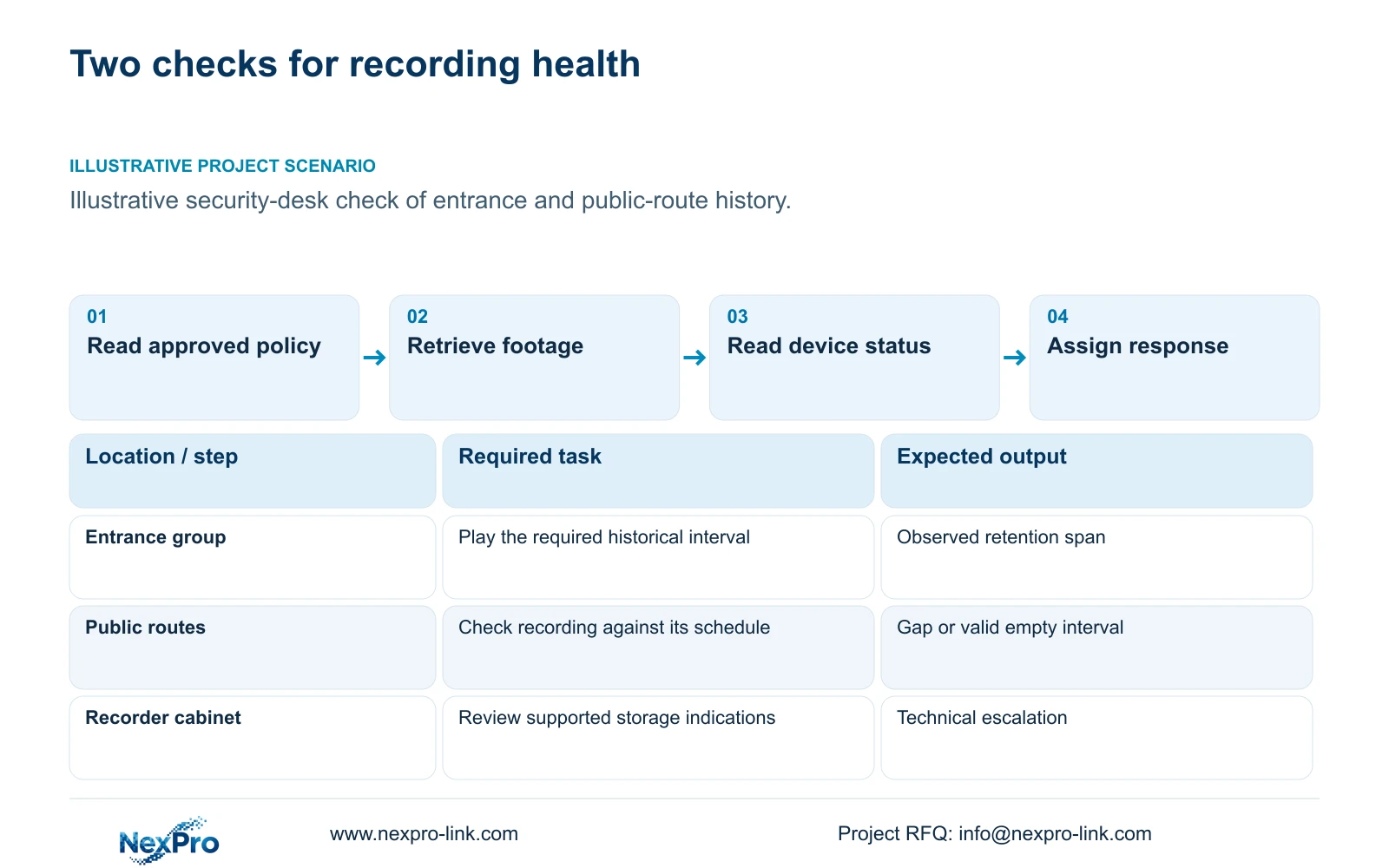
Check retention separately from disk status
Require both a storage-status check and a playback-history check before accepting hotel recording health. An online disk or a single SMART indication does not establish that every required camera has recorded continuously or retained the approved period. Use task-based operator checks alongside supported device alarms. If the chosen recorder or client cannot expose a required condition, provide a documented manual check or select a platform that supports the workflow.
Retention depends on recorded stream rates, recording hours and usable video capacity. Hardware status describes a different condition. A disk may remain available while a changed recording schedule or higher bitrate shortens the history. Conversely, a healthy-looking timeline can conceal a gap that affects a particular entrance or service-route event.
Keep three observations distinct in the operating record: the approved retention target, the actual retrievable span and the reported storage condition. The target is a project input, not a universal hotel legal period. Comparing these observations gives staff a reason to escalate a service shortfall even when the hardware screen shows no fault.
| Required task | Available observation | Decision still needed |
|---|---|---|
| Retrieve approved history | Oldest playable footage by camera | Whether the target span is met |
| Confirm recording continuity | Selected playback intervals | Whether gaps require investigation |
| Assess storage condition | Supported device status and alarms | Responsible technical response |
Section 02
Define alarms by the response they require
For each required alarm, state what the operator should observe and what action follows. Missing recording, insufficient retained history and a reported disk problem need different investigations. A general instruction to 'check storage' leaves staff without a useful first step and makes it difficult to distinguish an operating change from a hardware fault.
Verify which indications and notification routes the actual recorder and software version support. Do not specify a remote disk-health alert merely because a client offers remote viewing. Record whether staff must check locally, receive a supported notification or perform a scheduled retrieval task. Any threshold or check interval should follow the hotel's agreed service requirement.
Assign permissions to those tasks. Security staff may need to retrieve a selected interval and report a gap, while IT or the local installer handles configuration and replacement. The hotel owner decides retention changes. Sharing administrator access across these roles makes responsibility unclear and can allow an alarm response to alter the recording policy unintentionally.
Section 03
Measure the history that can actually be played
Use the camera schedule to identify the required recording groups and their policies. Open the oldest expected interval and a recent interval for the selected camera, then confirm that footage plays with the expected camera identity and time context. Record the observed result. A displayed date range or live image alone does not prove that the requested recording can be retrieved.
The operating check should distinguish continuous recording from an approved event-based schedule. An empty interval may be consistent with one policy and a fault under another. Avoid averaging all cameras into a single 'days available' figure when public-route and entrance groups have different duties. Keep the method aligned with the actual configuration.
Playback checks also need a defined exception path. If remote access is unavailable, an authorized local check may still be possible where the system supports it. A WAN outage and a recording failure are separate observations. Representative checks help expose problems, but a sample should not be described as proof that every recorded interval is complete.
Section 04
Compare menu training with task-based response
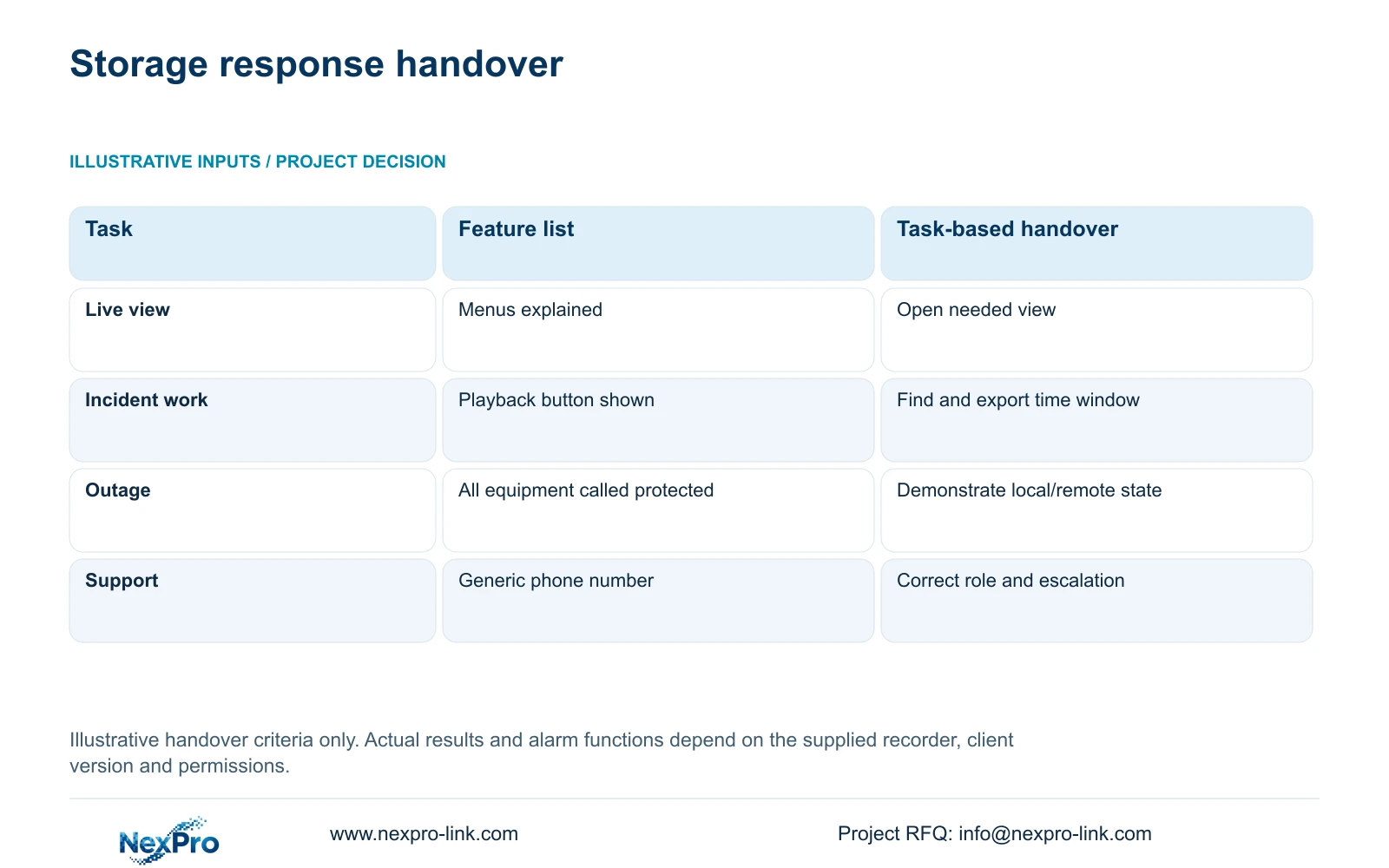
The illustrative comparison below sets out handover criteria, not completed test results. A feature-list session can explain where playback and storage menus are located. A task-based session asks an authorized user to retrieve a defined interval, identify the relevant fault state and contact the correct support role.
For storage monitoring, the practical output is a repeatable response that staff can follow during ordinary operation and exceptions. Instructions should name the supplied interface and version, explain the local fallback where supported and distinguish a lost display from lost recording. Refresh the handover when permissions, equipment or the operator team changes.
Select task-based handover because storage alarms demand decisions after the notification appears. If the supported interface lacks a required retrieval or escalation function, change the workflow or platform before describing the task as available. The table does not claim reduced response minutes, measured training success or a brand performance ranking.
| Task | Feature-list handover | Task-based operator handover |
|---|---|---|
| Live view | Menus explained | Authorized user opens the needed view |
| Incident work | Playback button shown | Find and export a defined time window |
| Outage | All equipment called protected | Demonstrate the selected local/remote state |
| Support | Generic phone number | Correct role, contact and escalation boundary |
Section 05
Plan technical escalation and replacement duties
Give operators a short support record containing equipment identity, software version and the responsible contact for each fault category. Staff should report the affected camera group, observed period and alarm wording without sending guest footage or credentials through an ordinary commercial inquiry. Professional support can then investigate the configuration or component involved.
Compare local replacement stock with a supported substitute and replenishment. Stock is useful when a responsible technician can perform the replacement and the disk is compatible with the approved arrangement. It does not remove the need to preserve important events, restore configuration and verify recording afterward. A generic spare percentage cannot answer those service questions.
Separate hardware coverage from site labour and restoration. The supplied policy gives applicable main equipment a 24-month limited hardware baseline from receipt; disks, batteries, cables and special orders follow their specific terms. Continuing technical support does not establish unlimited free repairs or local attendance. Buy additional local support when the hotel's required response cannot be met by its existing staff and supply arrangement.
Section 06
Close the alarm with a recorded recovery check
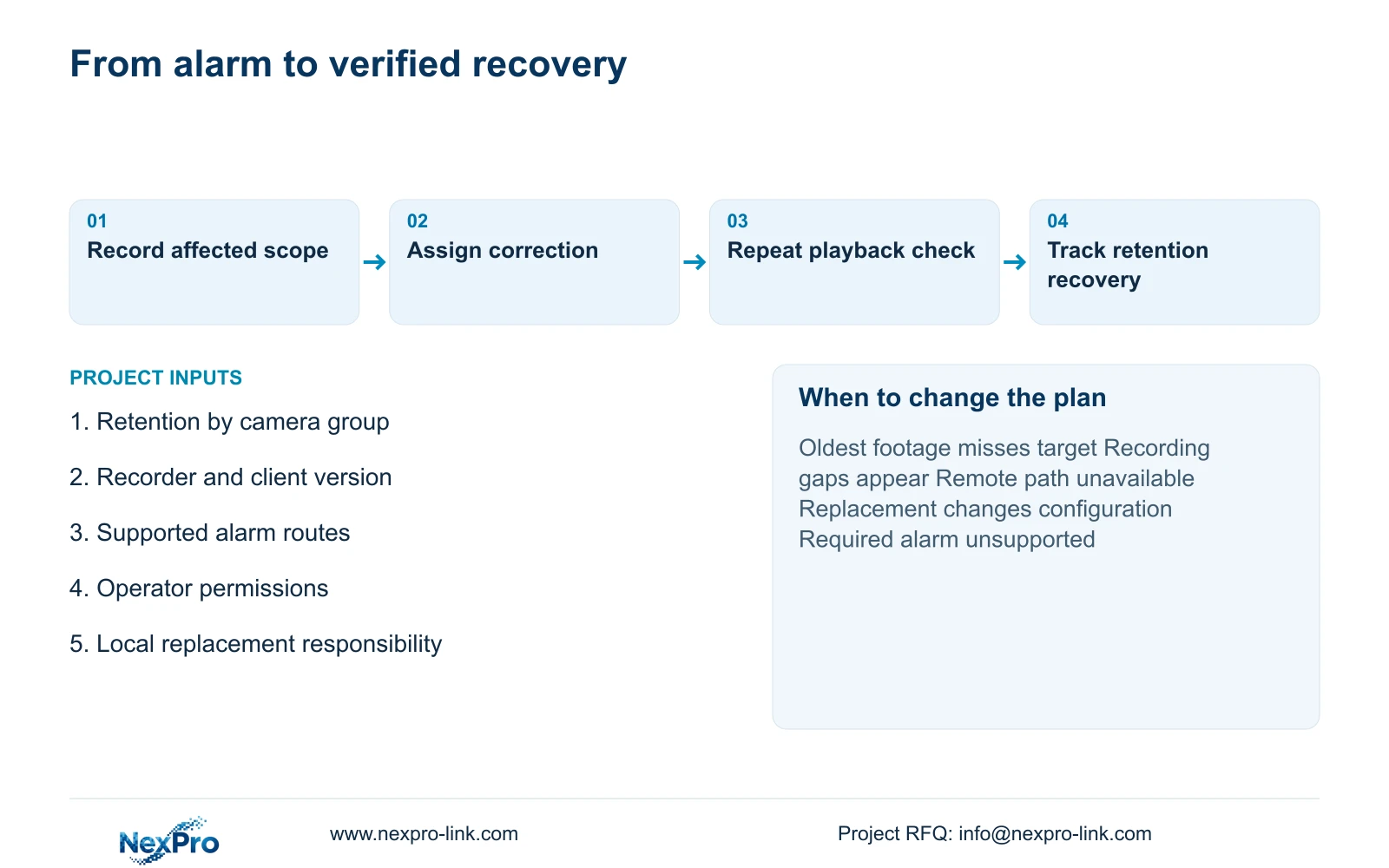
Record the original symptom, affected scope and corrective action. After a configuration change or replacement, repeat the retrieval or recording task that exposed the fault. A cleared warning is one observation; successful recording and playback are separate observations. If footage was already lost, restoring future recording does not recreate that history.
A newly commissioned or restored system may need time to accumulate the approved retention span. Record that state accurately and distinguish current recording recovery from full retention recovery. Preserve the previous and revised settings so a shortened history can be investigated later. The cost manager should also receive any added disk, support or platform scope instead of an unexplained service uplift.
Recommend combined playback, continuity and supported hardware checks with named responses. Revise the approach when camera groups, retention requirements or available notification functions change. Send the recorder/client identity, required retention by group, available alarm functions and operator roles to info@nexpro-link.com. NexPro-Link can discuss model matching and the equipment support scope; the hotel retains responsibility for its operating policy and local response assignments.
Section 07
Buyer questions
Does SMART status prove the hotel has its required recording history? No. Keep the available hardware indication alongside actual retrieval checks. The recorded span, gaps and approved recording schedule need their own observations.
Should remote viewing be mandatory for a storage alarm response? Only if the hotel requires it and the selected system supports the necessary workflow. Define an authorized local response for WAN unavailability where possible, and identify any remaining service gap.
Can a disk alarm be closed immediately after replacement? Record the replacement, then verify recording and playback for the affected scope. Full retention recovery may remain pending while new history accumulates.
Engineering references
These sources support the general planning principles. Always use the selected product's current datasheet and applicable project standards for final design.