At an assumed 4 Mbps per camera, 32 hotel cameras need 41.472 TB of video space for 30 days. The disk selection must also account for reserve, formatting and recorder support.
Section 01
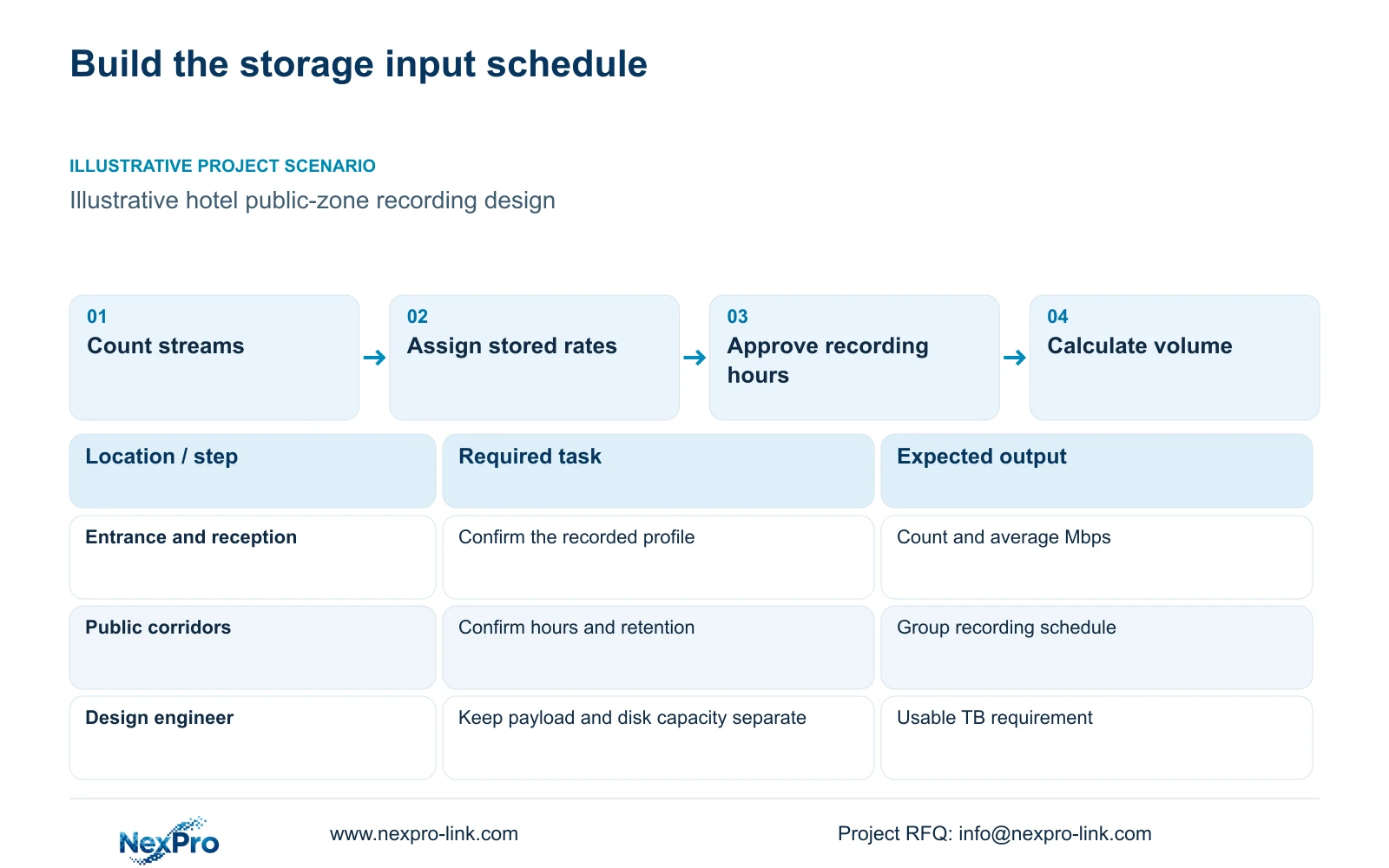
Set the camera count and stored bitrate
For 32 cameras recording continuously at an assumed average 4 Mbps each, specify at least 51.84 decimal TB of usable capacity to retain 30 days while leaving 20% free. Select the disk arrangement only after accounting for formatting and checking recorder support. Under the illustrative disk assumptions below, four 16 TB drives meet the capacity target; four 12 TB drives do not.
The calculation begins with recorded streams. List camera counts by stream profile, average stored bitrate, daily recording hours and approved retention. The 4 Mbps value is a teaching input. It is not derived from the 5MP or 8MP labels in the supplied BL2812M and DM2812M product PDFs.
For an existing hotel, obtain representative recording settings or measured data volumes. For a design-stage project, label provisional rates explicitly. An entrance view and a quiet service corridor can require different profiles, so their quantities and rates should remain separate until each group's volume has been calculated.
| Required task | Given information | Decision still needed |
|---|---|---|
| Retain routine recordings | 32 cameras; illustrative 30 days | Approve hours and retention by group |
| Budget the stored stream | Illustrative average 4 Mbps each | Confirm settings or representative measurements |
| Select supported disks | Capacity target calculated below | Confirm recorder, drive models and layout |
Section 02
Convert the stream rates into decimal terabytes
The combined illustrative input is 32 × 4 = 128 Mbps. Convert this to 128,000,000 bits per second, then multiply by the recording duration. Thirty days of continuous recording contains 24 × 3,600 × 30 = 2,592,000 seconds.
Dividing the resulting bits by eight gives bytes. Dividing bytes by 1,000,000,000,000 gives decimal TB: 32 × 4 × 10^6 × 24 × 3,600 × 30 ÷ 8 ÷ 10^12 = 41.472 TB. Use the same units throughout the calculation.
TB and TiB are different capacity units. A capacity displayed in binary units should not be compared numerically with a decimal disk label without conversion. For mixed profiles, apply the formula to each group and add the volumes. This avoids hiding different recording hours or retention periods inside one system-wide average.
Section 03
Apply free-space reserve separately from system overhead
A 20% free-space target allows video to occupy 80% of usable capacity. Required usable capacity therefore equals video volume ÷ 0.80. The 30-day result is 41.472 ÷ 0.80 = 51.84 TB.
Multiplying 41.472 by 1.2 produces 49.7664 TB, which does not satisfy that same reserve definition. Formatting and any supported array arrangement require separate treatment before applying the recording-space budget. A hot spare cannot also count as available video storage.
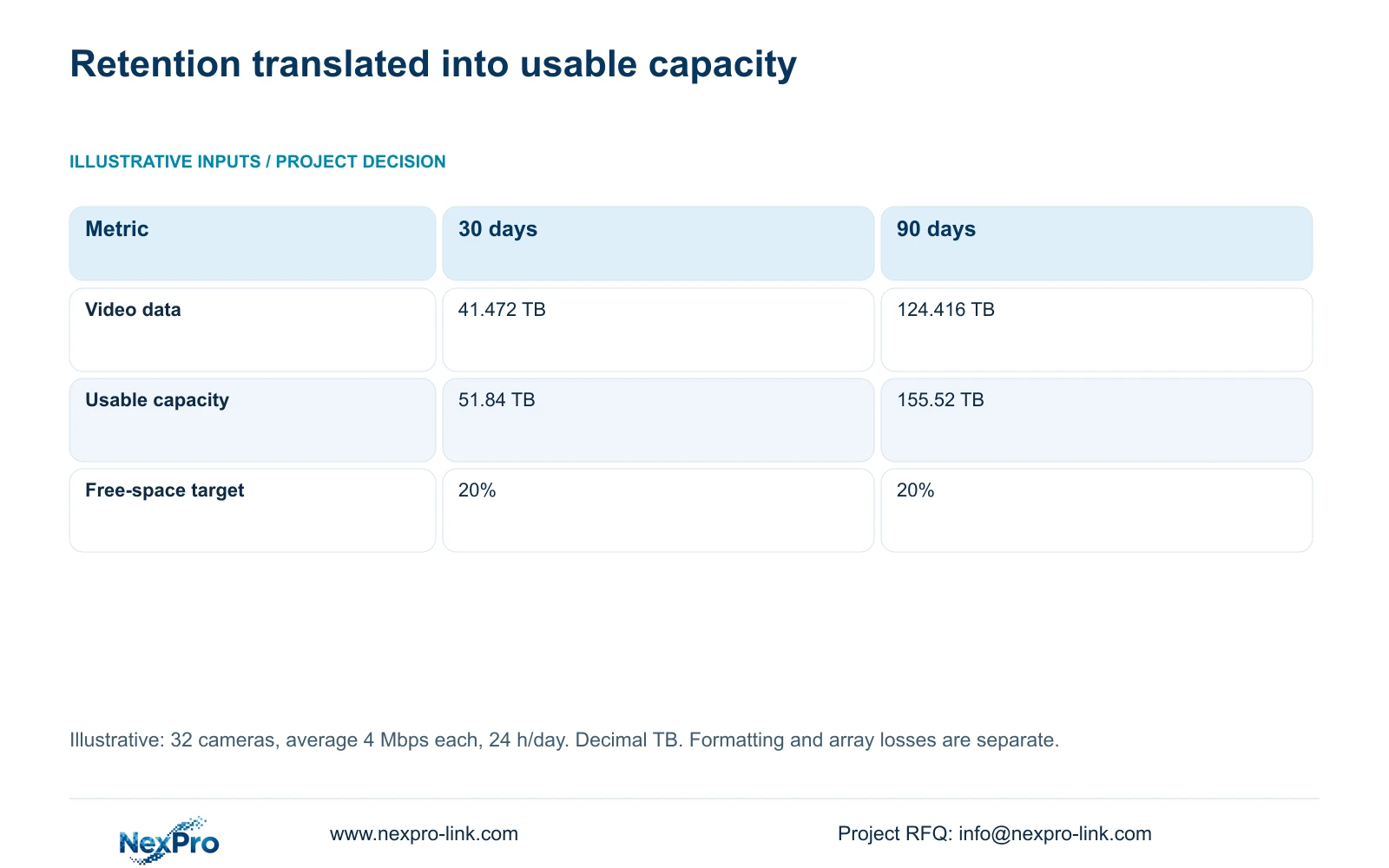
The comparison shows the consequence of extending retention with all other inputs unchanged. Ninety days requires three times the video volume and usable capacity. These periods are scenario inputs, not universal hotel requirements. The larger result calls for a new supported layout, not an assumption that the existing recorder can simply accept more disks.
| Metric / condition | 30-day recording | 90-day recording |
|---|---|---|
| Video data, decimal TB | 41.472 | 124.416 |
| Required usable TB with 20% free | 51.84 | 155.52 |
| Raw disk selection | Depends on supported layout and formatting | Depends on supported layout and formatting |
Section 04
Compare the video budget of candidate disk layouts
The supplied CASE01 reference uses four 16 TB drives as an independent-disk planning arrangement, with no RAID capacity loss. Its 95% formatting factor is a teaching allowance, not a measured filesystem result. Applying that factor and the 20% free-space target gives 64 × 0.95 × 0.80 = 48.64 TB available for video.
Four 12 TB drives provide only 36.48 TB for video on the same basis. This falls below the required 41.472 TB. Four 16 TB drives provide a planning duration of 35.19 days at the stated rate, but the approved policy remains 30 days; spare capacity does not authorize longer retention.
Treat the four-drive arrangement as a capacity candidate. Exact drive compatibility, recording mode and disk handling still determine whether it is suitable for purchase. If disk fault tolerance is required, select hardware that explicitly supports the intended arrangement and recalculate its usable capacity.
| Capacity stage | 4 × 12 TB | 4 × 16 TB |
|---|---|---|
| Raw capacity | 48 TB | 64 TB |
| Assumed formatted usable capacity | 45.6 TB | 60.8 TB |
| Video budget with 20% free | 36.48 TB | 48.64 TB |
| Meets 41.472 TB video target | No | Yes, subject to equipment support |
Section 05
Check recording, playback and disk constraints independently
NexPro-NVR4449-4K is a preliminary candidate because its supplied public record lists 49 channels, 320 Mbps input, four SATA positions and an 18 TB limit per drive. The illustrative 128 Mbps input is below its published input figure. That comparison establishes neither playback concurrency nor compatibility with a particular drive.
The same record summarizes 49 × 5MP and 9 × 4K modes. Channel count therefore cannot justify an arbitrary 49-camera 8MP configuration. RAID levels are not explicit in the supplied record, so the independent-disk example must not become a RAID5 procurement claim.
NexPro-NVR8864-4K lists eight SATA positions and 320 Mbps input, making it relevant when more disk positions are needed. Its additional bays require a complete configuration check. NexPro-NVR2232-4K has conflicting 2 × 8 TB and 2 × 18 TB capacity fields, plus recording or playback differences; neither favorable field is a settled purchase limit.
Section 06
Recalculate when bitrate or policy changes
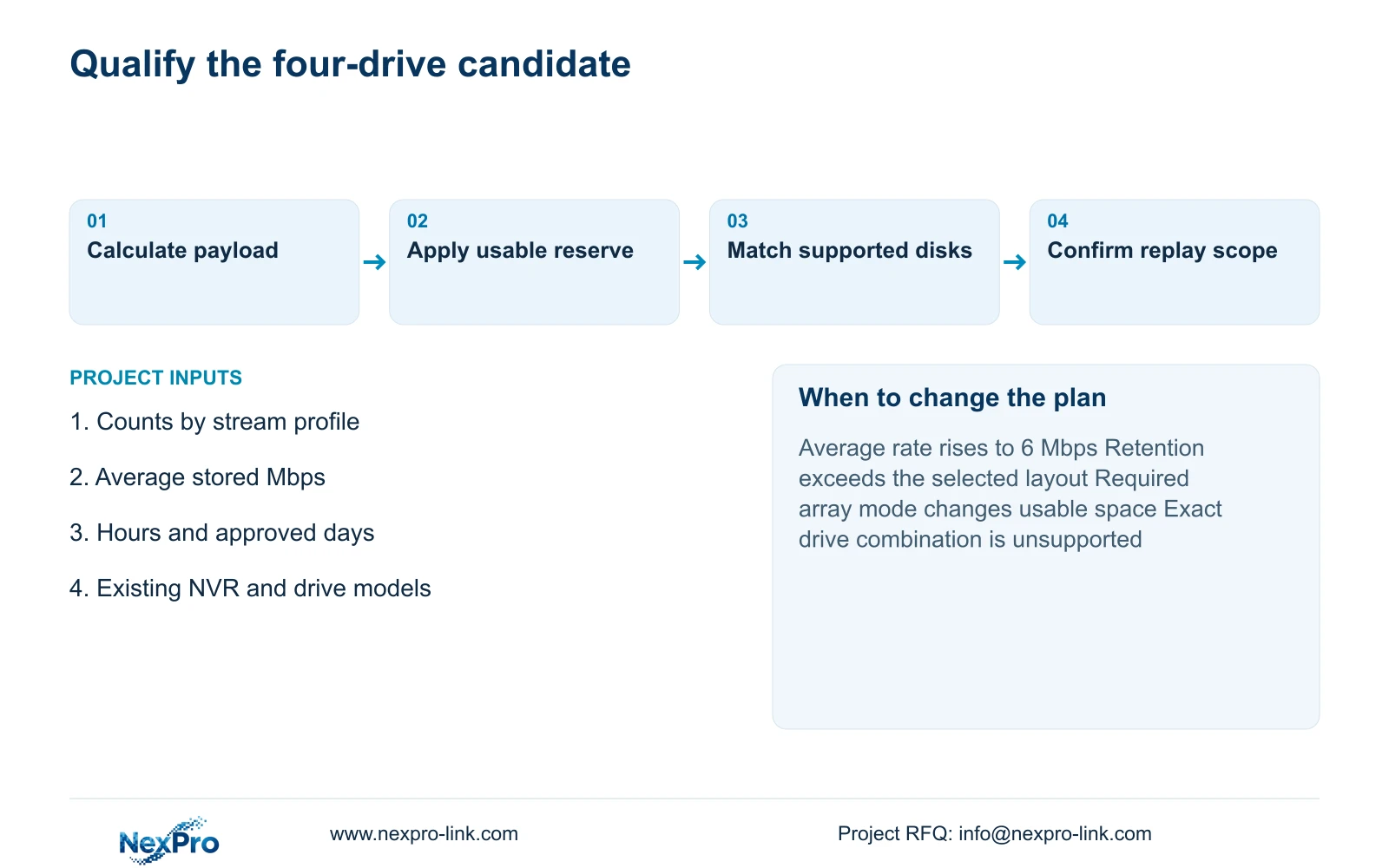
Storage varies directly with average stored bitrate when camera count, hours and retention stay constant. Using the 48.64 TB video budget above, 32 cameras averaging 3, 4 or 6 Mbps would have planning durations of approximately 46.91, 35.19 or 23.46 days respectively. The 6 Mbps profile would miss the 30-day target.
Compare recorded movement and low-light detail before accepting a lower rate. A quiet daytime sample cannot establish the average for busy reception periods or noisy night scenes. No fixed saving percentage follows from an encoding name.
Use the four 16 TB independent-disk candidate only while the approved 30-day policy, qualified recording profile and exact supported configuration remain valid. Change the layout if measured rates exceed the allowance, retention increases or fault tolerance changes. For a scoped proposal through Hotel project equipment support or BOQ and tender support, email info@nexpro-link.com with counts by profile, rates, recording hours and retention. Include existing recorder and drive identities if they will be reused.
Section 07
Buyer questions
Does a RAID arrangement replace incident backup? No. A supported array can address specified disk-failure conditions, but authorized incident preservation remains a separate task. Include its destination and export workflow in the storage scope.
Can existing disks be retained by lowering bitrate? Only if recorded detail still meets the approved observation task. Compare a qualified lower-rate profile with added supported capacity, and keep the resulting retention calculation visible.
What should the supplier confirm for the four-drive option? Request the exact recorder and drive combination, supported recording modes, usable-capacity basis and required replay tasks. A bay count and maximum disk label alone are insufficient.
Engineering references
These sources support the general planning principles. Always use the selected product's current datasheet and applicable project standards for final design.