Longer retention increases video volume proportionally, but recorder bays and supported disk layouts change in steps. Compare complete storage architectures for the same hotel recording task.
Section 01
Choose the retention period from the retrieval purpose
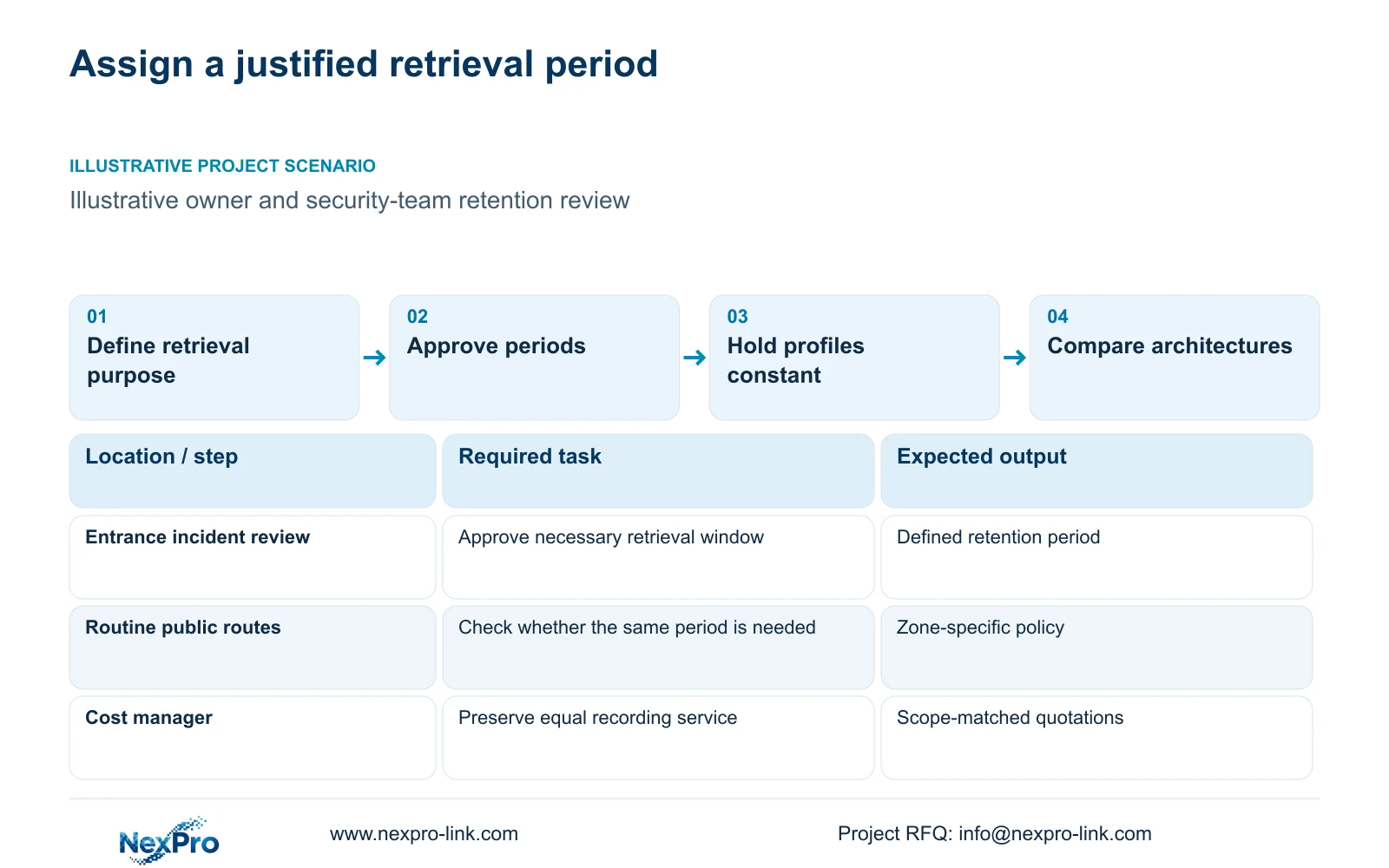
Buy the shortest recording period that satisfies the hotel's approved retrieval purpose and applicable requirements, then select hardware that can deliver it. If 30 days is sufficient, extending every camera to 90 days adds a storage obligation without establishing a better operating outcome. When 60 or 90 days is required, compare complete supported architectures because disk bays and capacity limits can force a different recorder arrangement.
Define the purpose for each public-zone group before requesting prices. Entrance incident review may have a different retrieval window from routine service-route monitoring. The hotel should identify who authorizes the periods and whether a separate incident-preservation process is needed.
Thirty, 60 and 90 days are illustrative comparison periods here. They are not global legal defaults. The supplied ICO guidance concerns the UK, addresses purpose-based retention and access, and is identified as under revision. Local requirements and the hotel's approved purpose must determine the policy.
| Required task | Given information | Decision still needed |
|---|---|---|
| Retrieve routine public-zone footage | Candidate periods: 30, 60 or 90 days | Approve the necessary period |
| Preserve a selected incident | Routine overwrite remains separate | Define authorized export and preservation |
Section 02
Hold recording settings constant across the options
Compare retention periods with the same camera counts, qualified recording quality and daily hours. This article assumes 32 cameras averaging 4 Mbps each, recording 24 hours per day. Those inputs remain unchanged in all three options. The average bitrate is a teaching assumption, not a performance field of a listed camera.
If a 90-day quotation lowers bitrate or changes continuous recording to event recording, it describes a different service. Show that change separately and qualify the recorded result before treating the proposal as equivalent. A longer calendar period cannot compensate for missing movement detail or unrecorded time.
Keep the free-space definition identical too. This comparison leaves 20% of usable capacity free, so video volume is divided by 0.80. Formatting, array capacity loss and hot-spare allocation follow the selected hardware arrangement and remain outside that reserve calculation. Mixed stream groups require separate calculations before their volumes are added.
Section 03
Calculate the 30-, 60- and 90-day requirements
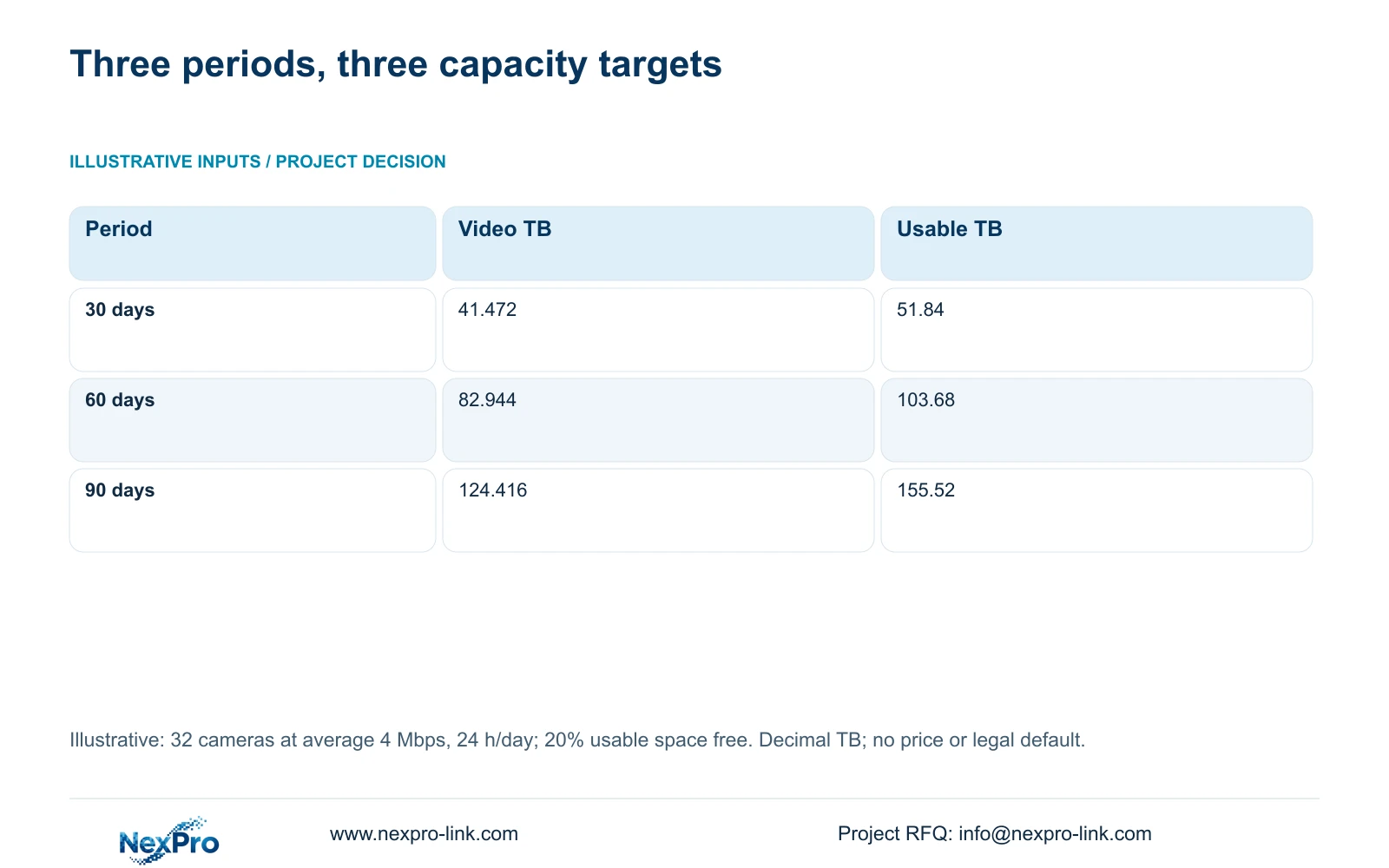
Video TB equals the sum of camera count × average Mbps × 10^6 × hours per day × 3,600 × days, divided by eight and then by 10^12. The conversion produces decimal TB. At the fixed illustrative profile, the system records 1.3824 TB per day.
Thirty days therefore produces 41.472 TB, 60 days produces 82.944 TB and 90 days produces 124.416 TB. Dividing each by 0.80 gives the usable-capacity targets below. The supplied topic comparison covers 30 and 60 days; the 90-day column uses the same stated formula and unchanged inputs.
These are requirements before selecting raw disks. Doubling the period doubles the calculated payload, but the purchase cannot assume that a recorder with occupied bays can double its usable capacity. The next decision is which supported layout crosses each target.
| Metric | 30 days | 60 days | 90 days |
|---|---|---|---|
| Video data, decimal TB | 41.472 | 82.944 | 124.416 |
| Required usable TB with 20% free | 51.84 | 103.68 | 155.52 |
| Raw disk selection | Supported layout and formatting | Supported layout and formatting | Supported layout and formatting |
Section 04
Identify the point where the disk layout must change
CASE01 provides a separate 30-day reference with four 16 TB independent disks, 64 TB raw and an assumed 95% formatted usable factor. Its 60.8 TB usable capacity becomes a 48.64 TB video budget after leaving 20% free. That covers the illustrative 30-day payload, but cannot cover 60 or 90 days.
NexPro-NVR4449-4K lists four SATA positions and up to 18 TB per drive. Even 4 × 18 TB equals only 72 TB raw, below the 103.68 TB usable requirement for 60 days. Formatting cannot turn that raw total into the required larger usable total.
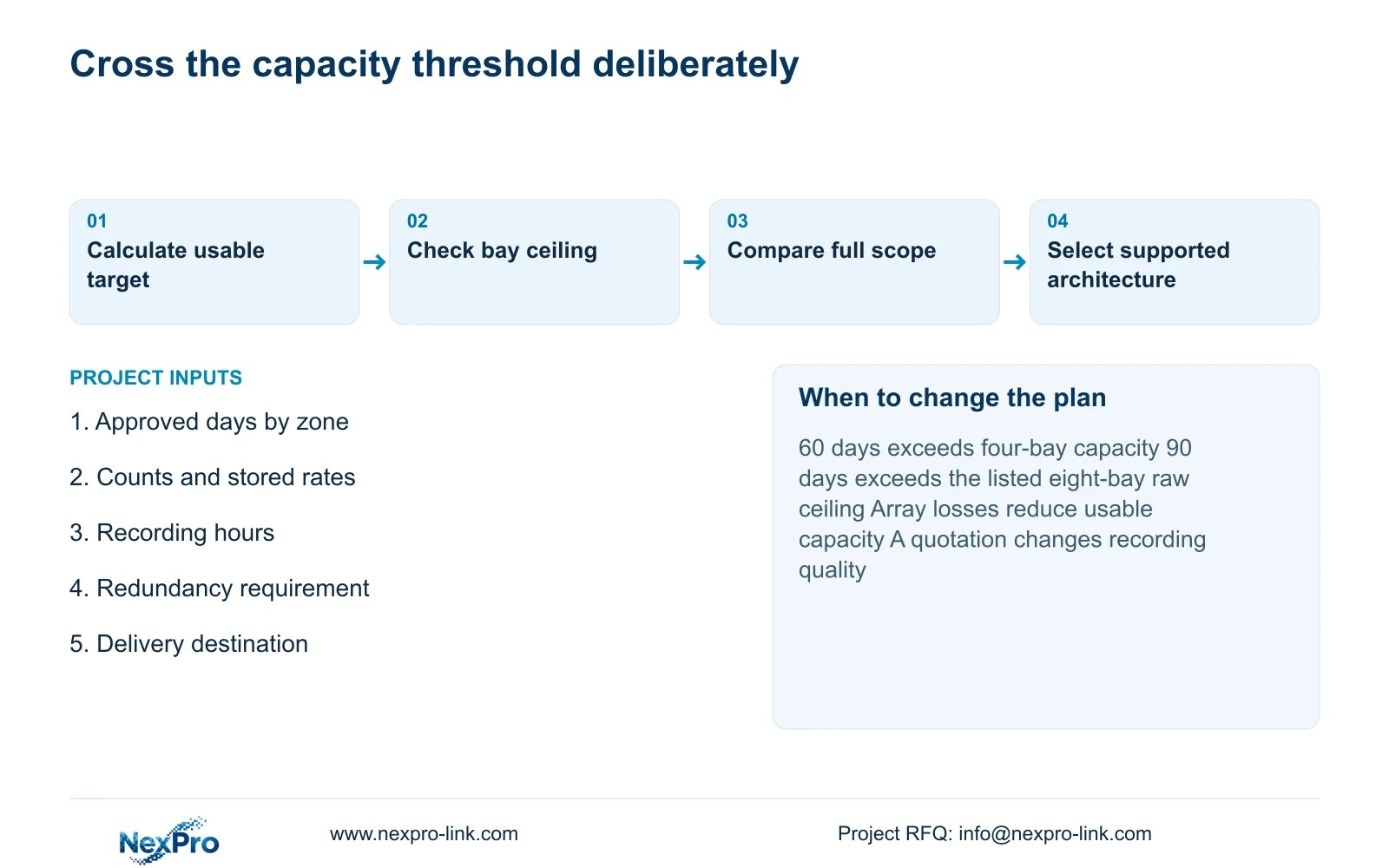
NexPro-NVR8864-4K lists eight SATA positions and up to 18 TB per drive. Its 144 TB raw ceiling is below the 155.52 TB usable target for 90 days at this profile, even before overhead. Sixty days merits a supported eight-bay configuration assessment; 90 days requires a different capacity architecture or an explicitly approved change to the recording inputs.
Section 05
Compare complete architectures and evaluated costs
A larger recorder and several distributed recorders can both be candidates, but they create different retrieval and maintenance arrangements. Compare how operators search footage, which recordings a recorder failure affects and whether the required client can handle the proposed configuration. Do not assume a common search workflow merely because equipment shares an order.
Request scope-matched quotations covering recorders, exact disks, required networking and protected power, software inputs, installation and support boundaries. Additional recorders may add equipment and maintenance tasks beyond disk cost. There are no actual prices in this comparison, so no cost multiplier or brand saving can be claimed.
Published fields establish preliminary limits. Both named recorder records list 320 Mbps input, but input bandwidth does not establish playback or decode concurrency. Required recording modes also need confirmation. Array support is not inferred from bay count, and any redundancy option needs its own usable-capacity calculation.
| Retained outcome | Extra scope | Purchase condition | Counter-condition |
|---|---|---|---|
| Approved longer retention | Larger supported disk arrangement | Usable target fits confirmed hardware | Published bay limit still falls short |
| Same camera recording profiles | Distributed recorders and retrieval workflow | Capacity and service boundary justify added nodes | Search or maintenance scope is unresolved |
| Defined disk-failure response | Explicitly supported redundancy | Required resilience survives recalculation | Array loss removes required retention |
Section 06
Specify the justified target and its change conditions
Retain the 30-day reference candidate when the hotel approves that period and the qualified stream profile stays within its video budget. Move to a larger supported architecture when 60 days is necessary. For 90 days at the stated profile, neither the four-bay nor eight-bay raw ceiling discussed here reaches the usable target.
Reopen the comparison when measured average bitrate, camera count or recording hours change. Keep incident exports separate from routine retention and confirm any group-specific policy in the actual software. Spare disk capacity should remain a capacity allowance until the hotel authorizes a different policy.
For BOQ and tender support, send info@nexpro-link.com the camera groups, representative rates and recording hours, approved periods and any redundancy requirement. Include the delivery destination for scope-matched pricing. NexPro-Link can discuss model matching and coordinated equipment supply; local installation and third-party platform responsibilities should appear explicitly in the proposal.
Section 07
Buyer questions
Will 90-day recording cost three times as much as 30 days? The payload triples at unchanged settings, but cost does not have a fixed multiplier. Bay limits, recorder changes, software and site work require actual scope-matched quotations.
Can a shorter period be assigned to some cameras? Yes, as a design proposal, when each group's purpose supports it. Confirm that the chosen recorder or platform implements the required retention policy; the arithmetic alone does not prove that function.
What should a reusable-equipment quotation identify? List existing recorder and drive models, the supported layout and actual usable capacity. Also identify any migration or export work needed to protect authorized recordings before equipment changes.
Engineering references
These sources support the general planning principles. Always use the selected product's current datasheet and applicable project standards for final design.