For each resolution group, record the measured interval, scene state, configured codec and retained average-rate assumption. Replace provisional rates group by group, then recalculate storage and recorder input separately.
Section 01
Group cameras by their recording task and profile
For each resolution group, record the measured interval, scene state, configured codec and retained average-rate assumption. Replace provisional rates group by group, then recalculate storage and recorder input separately. Do not label equal teaching rates as measured equivalence or transfer one quiet corridor measurement to a busy entrance group.
Calculate storage separately for each group of cameras sharing a stored bitrate, recording schedule and approved retention period. Use a grouped policy when those requirements differ and the selected recorder can implement it. A single daily allowance for every 5MP or 8MP camera can conceal the group that determines the purchase.
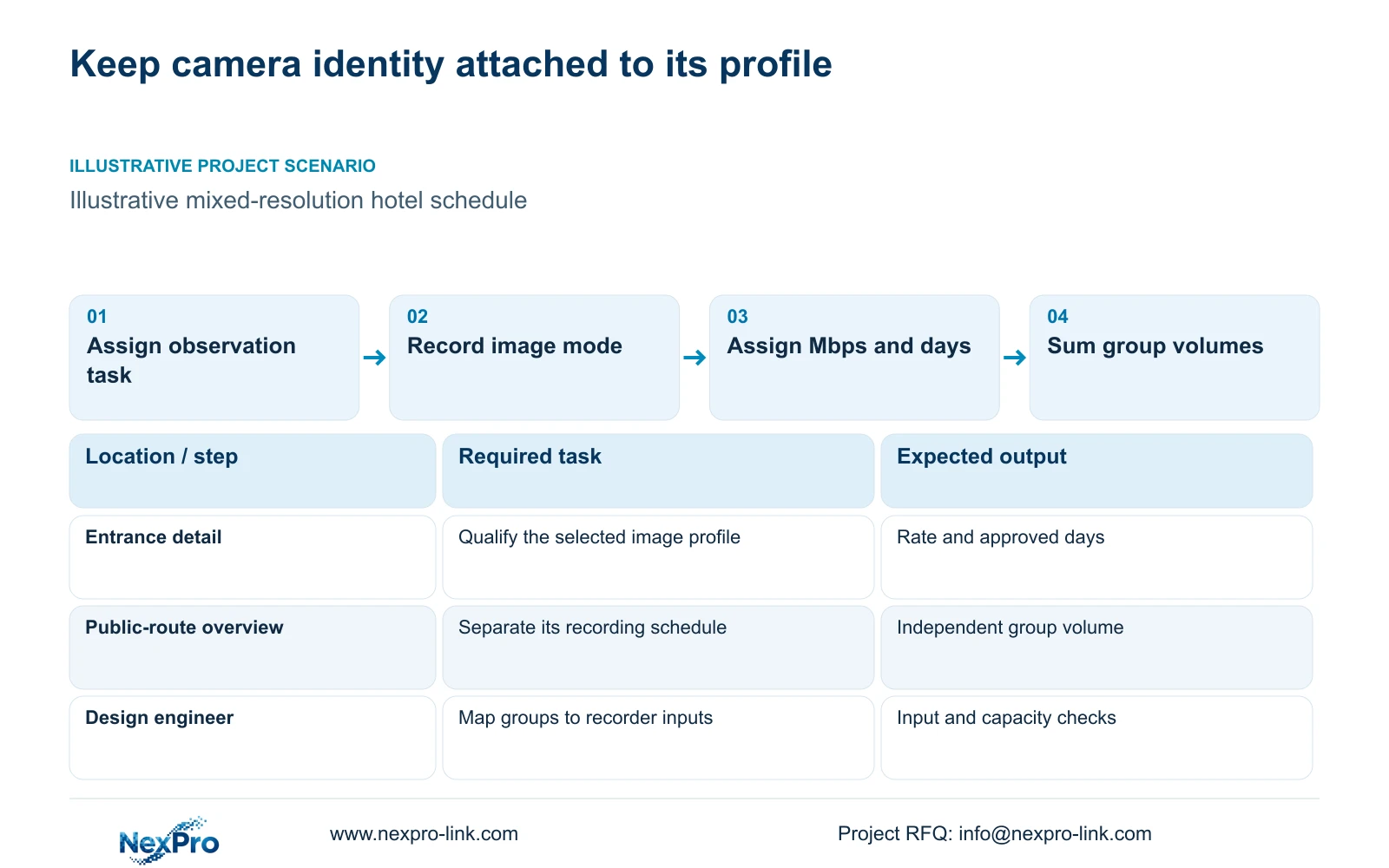
Begin with the observation task in permitted public areas. Entrance detail, a reception overview and public-route monitoring may lead to different image settings. Resolution belongs in the schedule, but it does not supply average Mbps or required days. Cameras with the same pixel dimensions can therefore sit in different storage groups.
The supplied BL2812M and DM2812M PDFs identify 5MP modes including 2880 × 1620 and 8MP modes at 3840 × 2160. Those are product facts. They do not establish a fixed daily data volume. Maintain the connection between each camera identity, its selected recording mode and the group used in the calculation.
| Hotel task | Profile record | Decision still needed |
|---|---|---|
| Entrance detail | Camera identities and selected image mode | Qualified stored rate and retrieval period |
| Public-route overview | Camera identities and recording hours | Approved retention and image usefulness |
| Recorder allocation | Groups mapped to recorder inputs | Supported modes and policy controls |
Section 02
Assign rates without deriving them from megapixels
Record whether each bitrate comes from a provisional design allowance, a configured setting or representative stored footage. These are different evidence types. A configured maximum does not automatically describe the long-term average used for capacity, and a quiet sample may not represent the group's operating conditions.
This article's supplied numerical comparison deliberately assumes 4 Mbps for every camera. It isolates the effect of retention grouping; it is not a measured mixed-resolution bitrate comparison. Assigning the eight longer-retention cameras to 8MP and the remaining 24 to 5MP would still require their actual rates before sizing a real system.
Keep decimal units consistent. Mbps describes bits per second, while TB describes bytes. Formatting and array losses reduce usable capacity separately. Once group payloads are summed, divide by 0.80 to retain the illustrative 20% free-space target. Do not embed that reserve inside a guessed rate for each resolution.
Section 03
Calculate each group's volume before adding the total
For continuous recording, group video TB = camera count × average Mbps × 10^6 × 24 × 3,600 × days ÷ 8 ÷ 10^12. For another daily schedule, replace 24 with the approved recorded hours. Add group volumes only after their different periods have been applied.
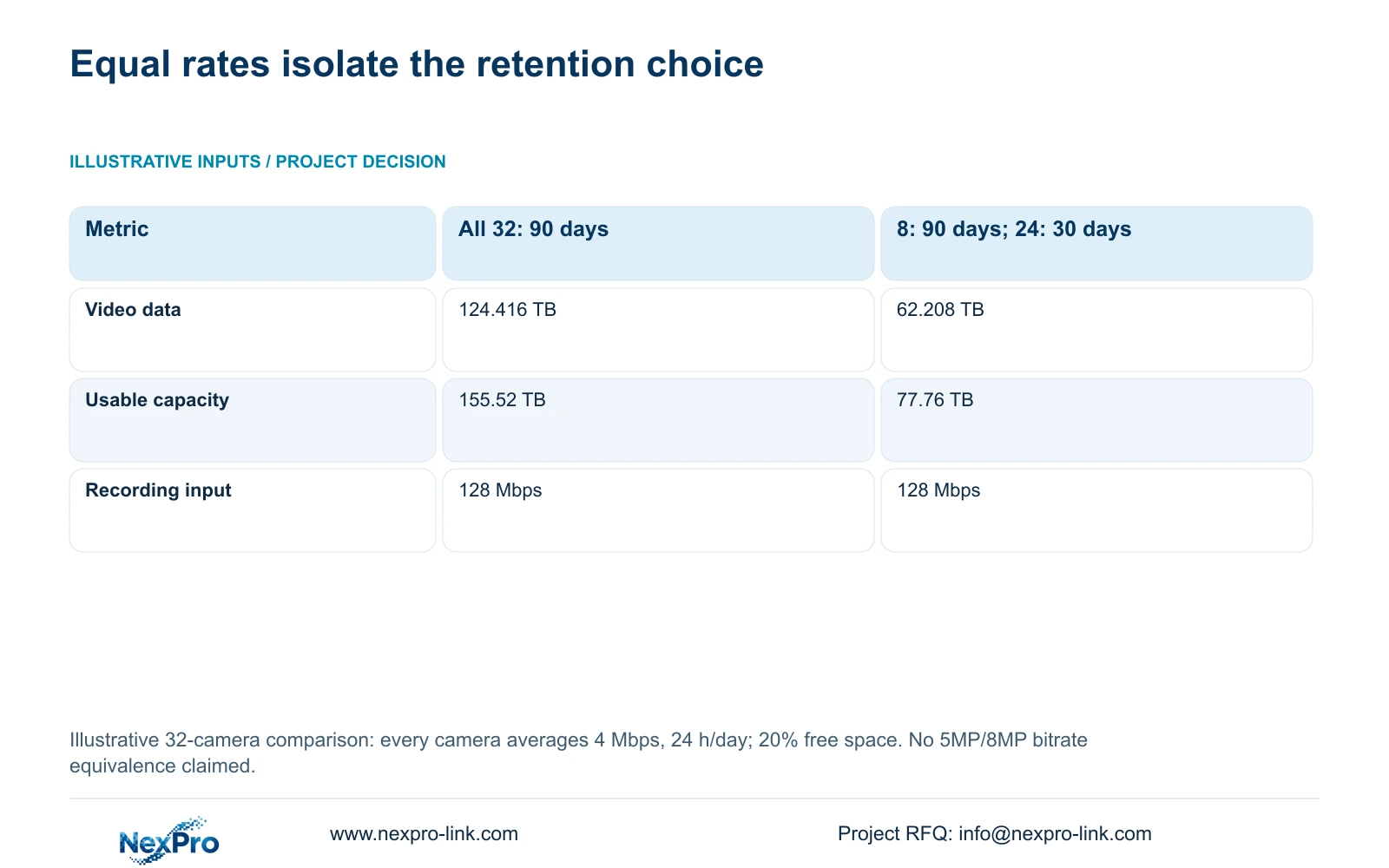
Eight cameras at 4 Mbps for 90 days produce 31.104 TB. Twenty-four cameras at the same assumed rate for 30 days also produce 31.104 TB. Their combined volume is 62.208 TB, requiring 77.76 TB usable with 20% free.
Recording all 32 cameras for 90 days instead produces 124.416 TB and requires 155.52 TB usable. The difference comes entirely from the approved days assigned to 24 cameras. It provides no evidence that one resolution or encoding technology saves half the storage.
| Metric / condition | All cameras: 90 days | 8 cameras: 90 days; 24: 30 days |
|---|---|---|
| Camera count | 32 | 32 |
| Video data, decimal TB | 124.416 | 62.208 |
| Required usable TB with 20% free | 155.52 | 77.76 |
| Raw disk selection | Depends on supported layout and formatting | Depends on supported layout and formatting |
Section 04
Compare policies without removing required retrieval
Choose the mixed policy only when 30 days meets the approved purpose for the 24-camera group and 90 days remains available for the eight-camera group. If the hotel requires a 90-day investigation window across a route spanning both groups, the shorter policy may remove footage needed to reconstruct that route.
Confirm how the actual recorder or platform applies retention. A spreadsheet can describe separate periods even when the proposed software cannot enforce them. Check routine deletion and incident preservation independently, including who authorizes exports and where selected recordings are kept.
The supplied CASE01 reference uses 32 cameras for 30 days and calculates 41.472 TB of video. That is a separate policy. Its four 16 TB disk example cannot be carried over to this article's 77.76 TB usable target. Resolution changes also require a fresh profile calculation; copying either total into a mixed-camera BOM would hide a changed requirement.
Section 05
Check recorder input separately from retained volume
Input bandwidth uses the simultaneous incoming rates: sum camera count × stream Mbps for every group assigned to a recorder. With all 32 cameras at the illustrative 4 Mbps, input remains 128 Mbps under both retention policies. Shortening stored history reduces capacity demand without reducing that incoming stream total.
NexPro-NVR4449-4K lists 320 Mbps input, four SATA positions and up to 18 TB per drive. Its maximum listed raw total is 72 TB, below the mixed policy's 77.76 TB usable requirement. Its published 49-channel count also does not establish arbitrary 49 × 8MP recording; the supplied summary distinguishes 49 × 5MP and 9 × 4K.
NexPro-NVR8864-4K lists 320 Mbps input and eight SATA positions with up to 18 TB per drive. It merits assessment for the mixed policy, subject to exact drives, modes and management support. Playback concurrency and any array mode require their own confirmation. NexPro-NVR2232-4K's conflicting capacity fields should remain unresolved inputs rather than a favorable assumed limit.
Section 06
Replace provisional profiles with representative measurements
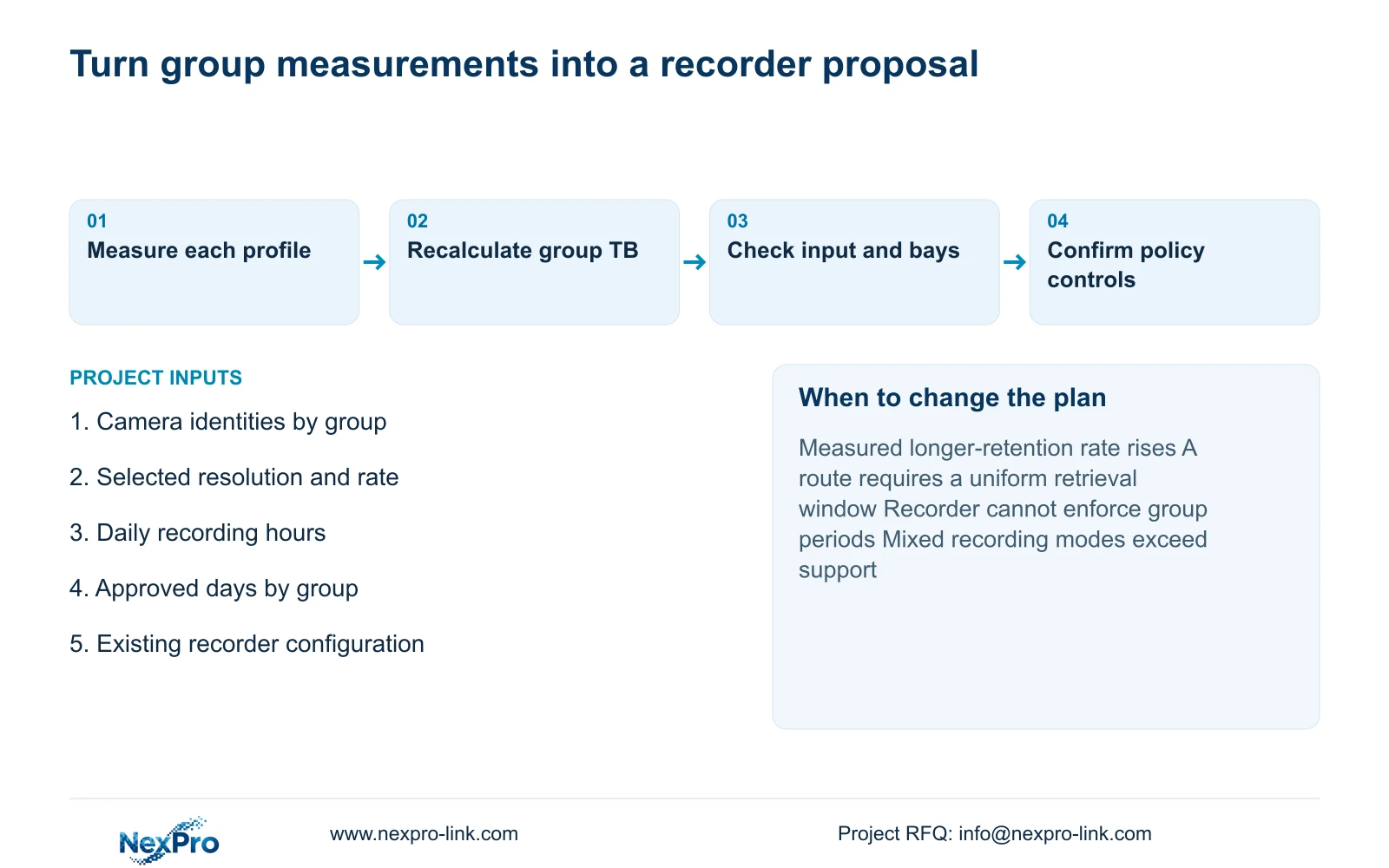
Measure each group under the conditions that determine its recorded usefulness. Include relevant activity and night conditions, then record the selected resolution, frame rate, codec and rate-control settings alongside the measured period. Group averages should remain traceable to those conditions.
Update payload and simultaneous-input calculations separately. A higher average in the longer-retention group has a different capacity consequence from the same increase in a shorter-retention group. Reducing rate is acceptable only when the resulting recordings still satisfy the observation task.
Recommend group-based sizing and the mixed retention policy when the hotel approves the shorter group's period and the exact equipment supports its implementation. Revert to a uniform longer policy if the retrieval purpose requires it, or change capacity when measured rates exceed the allowance. Email info@nexpro-link.com with the grouped camera schedule, profile settings or representative rates, approved days and proposed recorder. Hotel project equipment support and BOQ and tender support can use that schedule for a scoped model and supply comparison.
| Situation | Required record | Decision boundary |
|---|---|---|
| Quiet corridor measurement | Interval, scene and codec | Use only for the represented group |
| Busy entrance not measured | Provisional rate and missing observation | Retain uncertainty; do not import corridor results |
| Measured rate replaces an assumption | Group-specific source record | Revise storage and input bandwidth separately |
Section 07
Buyer questions
Can the quoted 8MP cameras use the same rate as 5MP cameras? They can be evaluated at an explicitly chosen rate, but equal Mbps does not prove equal recorded usefulness. Qualify each selected mode against its observation task before using that rate in the purchase calculation.
Does a mixed-period spreadsheet prove the NVR can enforce it? No. Request confirmation of the exact recorder or platform's policy controls, including deletion and incident preservation. Keep the proposed calculation separate from verified software behavior.
Which inputs are needed if the existing recorder stays? Provide its exact model, drive arrangement, available usable capacity and required replay workflow. Add the new camera profiles so input, recording modes and retention can be checked together.
Engineering references
These sources support the general planning principles. Always use the selected product's current datasheet and applicable project standards for final design.
- BL2812M supplied camera modes and power-field boundaries
- DM2812M supplied camera modes and power-field boundaries
- N04: NexPro-NVR4449-4K recording and disk fields
- N06: NexPro-NVR8864-4K input and disk fields
- N03: NexPro-NVR2232-4K source-field conflicts
- N01: Hotel project equipment support
- N02: BOQ and tender support