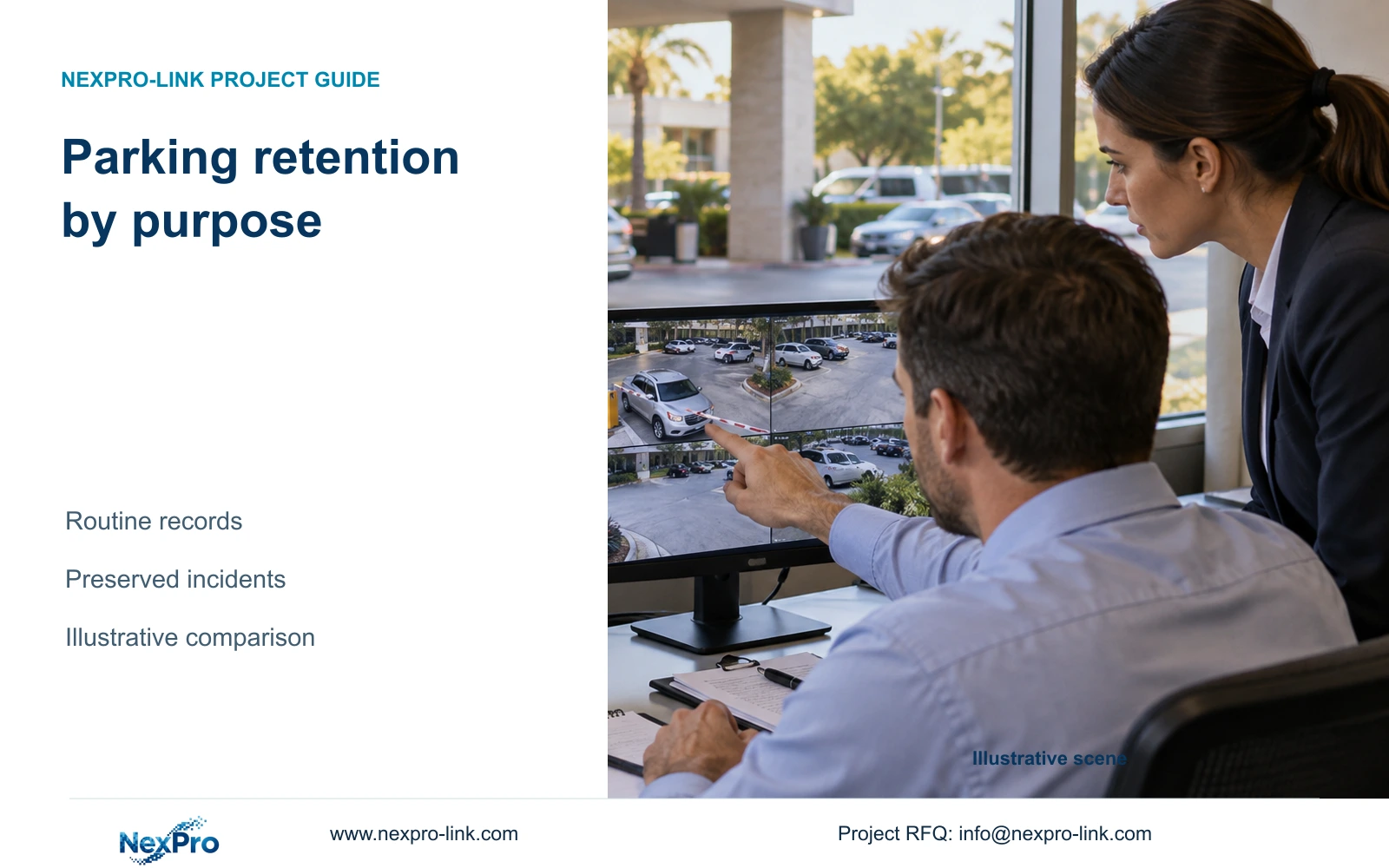
Set routine parking retention by approved purpose, then preserve selected incidents separately. A mixed schedule can reduce storage demand only when the recorder supports it and the required retrieval window remains intact.
Section 01
Separate routine recordings from preserved incidents
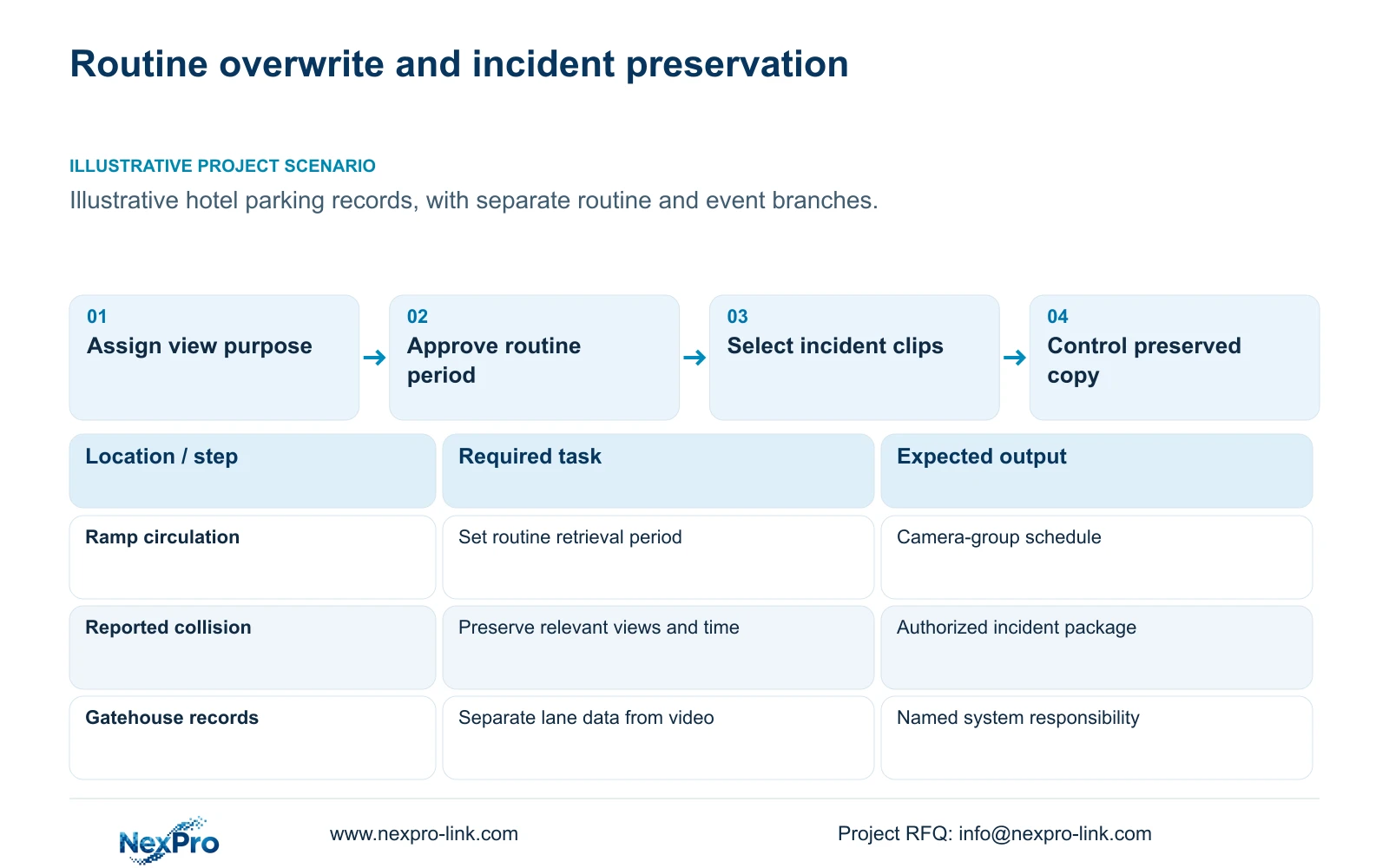
Choose a purpose-based routine recording schedule and a separate incident-preservation process. Use longer routine retention only where the hotel has an approved reason for that particular camera group. A reported collision may need selected footage preserved beyond normal overwrite, but that does not establish the same requirement for every parking view.
Group the camera schedule by observable task. Ramp views document movement between levels; pedestrian approaches show access to the parking facility; entrance overviews provide context around arrival and departure. A dedicated plate-reading database and barrier-control record belong to their respective systems. Ordinary person or vehicle detection does not establish ANPR capability or automatic correlation with lane transactions.
Give incident preservation its own owner and retrieval trigger. The responsible person needs a reported time, relevant location and authorized event scope before selecting clips. Establish this workflow before footage reaches normal overwrite. Preserved incidents need a separate retention decision, access boundary and eventual disposal instruction; exporting a clip should not create an indefinite archive by default.
| Required task | Given information | Decision still needed |
|---|---|---|
| Routine circulation review | Ramp and circulation camera groups | Approved retrieval period for each group |
| Preserve a reported incident | Location and reported event time | Authorized clips, recipient and preservation period |
| Check a lane transaction | Separate vehicle-access workflow | Supported record correlation and responsible system |
Section 02
Define the purpose behind each retention period
Ask the owner to describe the operational need behind each period, including when an issue is normally reported and which views are necessary to investigate it. Record the approved period against a camera group, with the responsible decision-maker. Storage capacity then follows that decision. Spare disk space alone supplies no operational reason to extend recording.
The 30-day and 90-day periods used below are illustrative inputs, not universal hotel requirements. Applicable local requirements and the hotel's authorized purpose determine the real periods. The supplied ICO guidance concerns the United Kingdom and was recorded as undergoing revision; its principles cannot establish a worldwide parking retention rule.
Keep continuous recording hours separate from retention days. A camera recording only during an approved operating window has a different volume from one recording continuously. Event-based recording also needs an explicit capture and retrieval assessment before replacing continuous coverage. Neither a codec name nor a megapixel count supplies a reliable average stored bitrate.
Section 03
Model uniform and grouped recording schedules
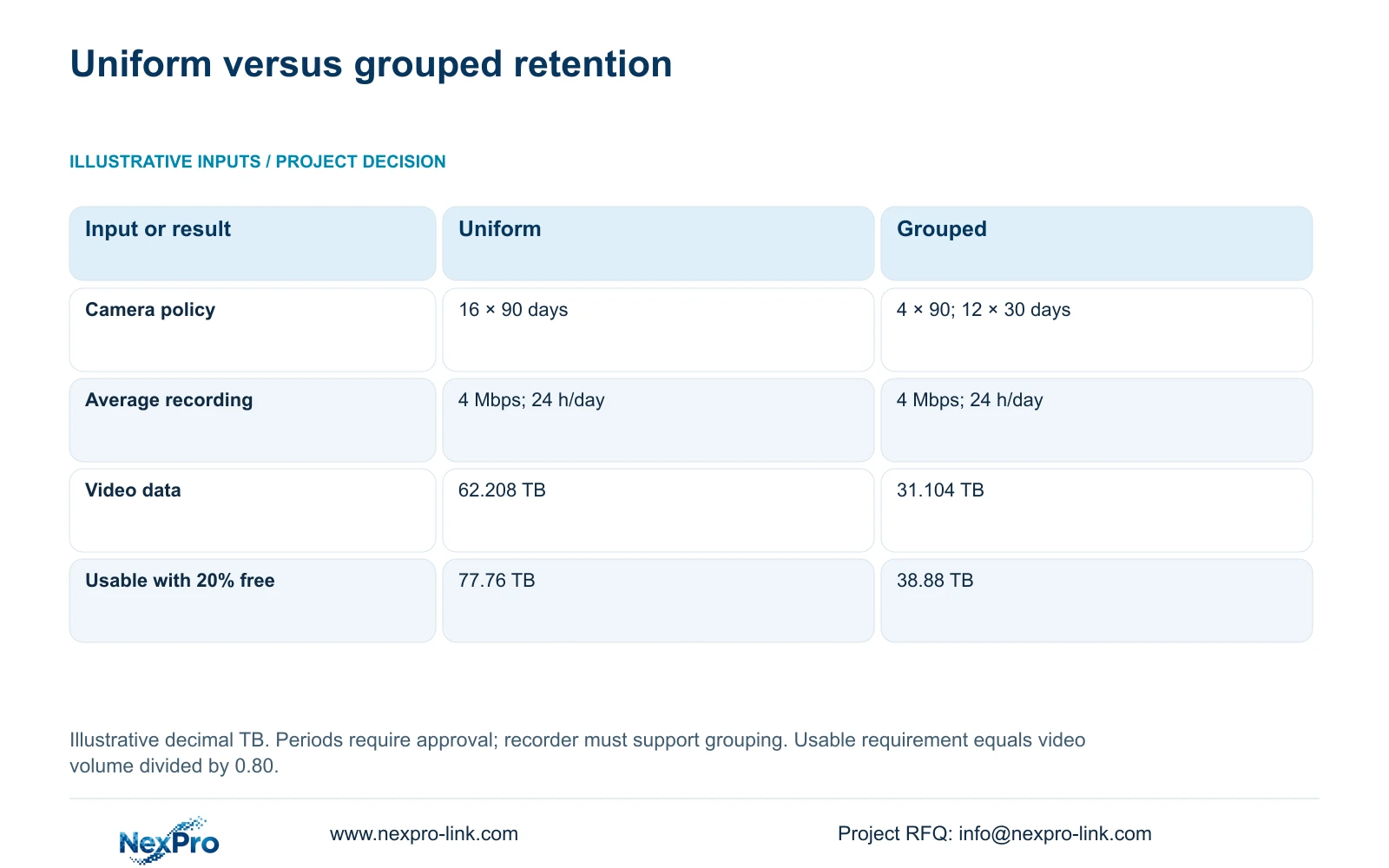
For this comparison, assume 16 cameras, each averaging 4 Mbps, recording 24 hours per day. Option A keeps every camera for 90 days. Option B keeps four cameras for 90 days and twelve for 30 days. The four longer-retained views are a planning group, not an instruction to assign extended retention to particular entrances without owner approval.
Calculate each group separately: video TB = cameras × Mbps × 10^6 × hours/day × 3600 × days ÷ 8 ÷ 10^12. Add the group results to obtain decimal terabytes. Dividing by eight converts bits to bytes; dividing by 10^12 expresses the result in decimal TB. The 4 Mbps figure remains a teaching assumption and does not describe a verified camera setting.
Option A produces 62.208 TB. In Option B, the four-camera group produces 15.552 TB and the twelve-camera group also produces 15.552 TB, giving 31.104 TB total.
Section 04
Convert video volume into usable storage
With 20% of usable capacity reserved as free space, divide video volume by 0.80. Multiplying by 1.20 would leave a smaller reserve than intended. The resulting requirement is usable capacity after the selected disk arrangement and formatting, before setting aside the stated free-space allowance.
The grouped policy reduces the illustrative usable requirement from 77.76 TB to 38.88 TB. Choose it only if both approved retrieval needs and the recorder's policy controls support the grouping. Confirm how channel-specific deletion, overwrite and incident preservation operate. A spreadsheet can allocate different periods even when the selected recording platform cannot.
NexPro-NVR4449-4K has published four-SATA and 18 TB-per-disk fields; NexPro-NVR8864-4K lists eight SATA positions and 18 TB per disk. Raw totals still require configuration-specific capacity checks. RAID support and losses must not be assumed. CASE09 independently uses 16 cameras for 30 days, requiring 25.92 TB usable; its 32 TB raw-disk example is not the mixed-policy configuration above.
| Metric / condition | Option A | Option B |
|---|---|---|
| Recording policy | All cameras: 90 days | 4 cameras: 90 days; 12: 30 days |
| Video data (decimal TB) | 62.208 | 31.104 |
| Required usable TB with 20% free | 77.76 | 38.88 |
| Raw disk selection | Depends on supported layout and formatting | Depends on supported layout and formatting |
Section 05
Control access to exported vehicle events
Limit an export to the cameras and time window needed for the authorized incident. An entrance overview may need accompanying ramp footage to explain movement, but unrelated recordings should remain outside that export. Record the event reference, selected source views, recipient and permitted handling route without placing guest identities or credentials in a public equipment schedule.
Confirm that the receiving user can replay the exported footage with the required time information and any supported playback tool. Complete that check before removing the source recording or relying on the export as the preserved copy. Define who can authorize disclosure and who manages expiry separately from the person operating the export controls.
Additional archive storage, controlled transfer and operator training belong in the evaluated scope when they serve an approved preservation task. Compare those costs with blanket longer retention while keeping required incident outcomes unchanged. A remote-viewing application does not by itself establish cloud archiving, unrestricted sharing or an independent evidence-preservation service.
Section 06
Review the supported policy with the owner
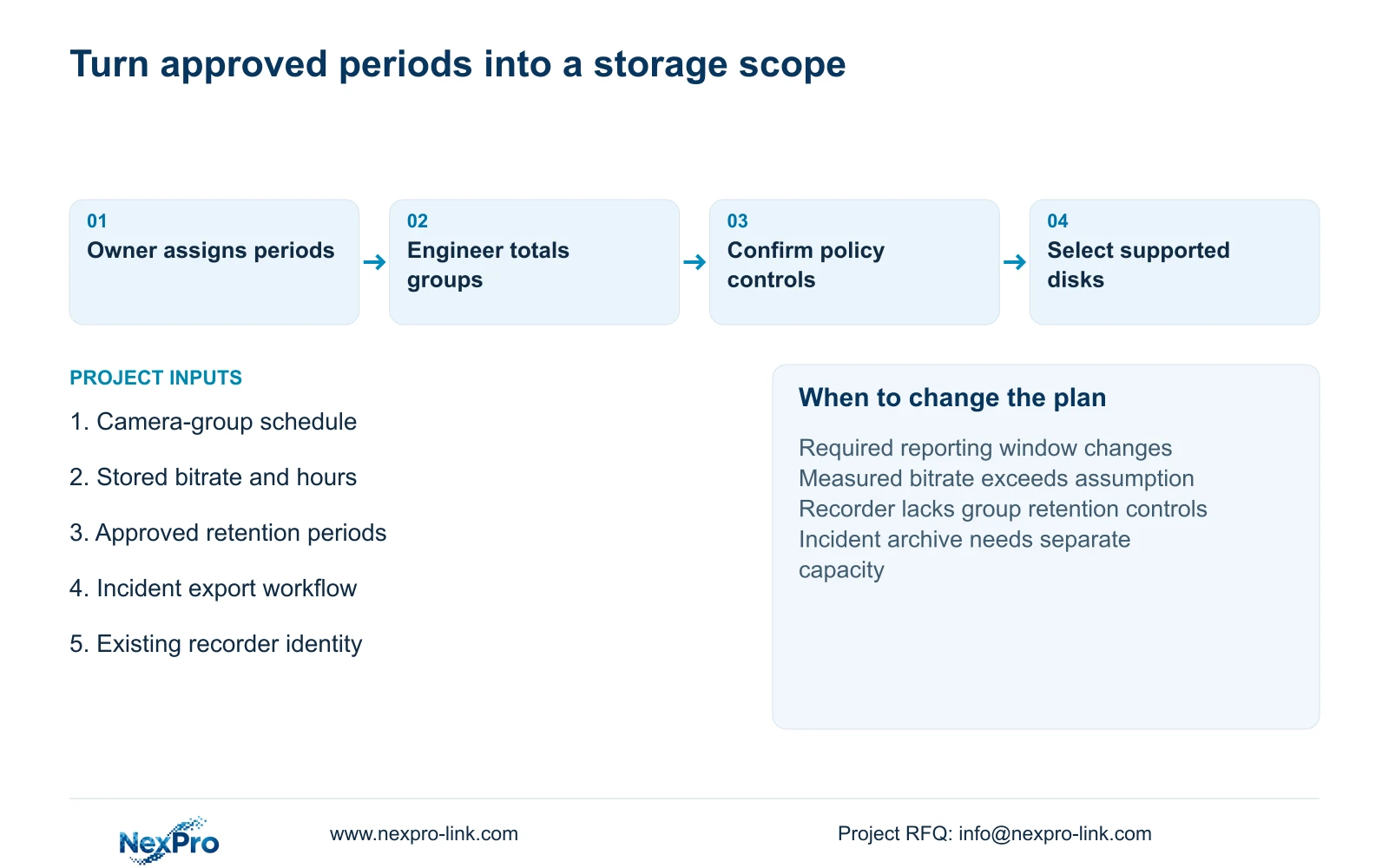
Recommend the grouped schedule where the owner approves different purposes and periods, and the selected recorder demonstrably implements them. Change to a revised uniform or grouped configuration if local requirements demand longer retention, reporting needs change, measured bitrates rise or the platform lacks the necessary controls. Preserve required incident handling under every option.
The design engineer should present the camera groups, retention decisions and usable-capacity calculation together. The cost manager can then compare supported disk layouts and archive scope without treating a larger raw capacity as a better policy. The owner's decision should identify who reviews the schedule when parking operations or system responsibilities change.
Send the parking camera-group schedule, proposed routine periods and incident-preservation workflow to info@nexpro-link.com, with the existing recorder model and delivery destination. Hotel project equipment support and BOQ and tender support can help translate those inputs into model matching and a scoped proposal. Initial correspondence does not need guest footage, passwords or unrelated commercial records.
Section 07
Buyer questions
Can unused disk space automatically extend retention? No. Keep the approved period unless the responsible hotel decision-maker changes it for a defined purpose. Available space is a capacity condition, not authorization for broader collection.
Does a larger NVR guarantee mixed retention policies? No. Obtain confirmation of the exact model and software behavior for channel or group retention, overwrite and incident preservation. Disk capacity and policy controls are separate purchase checks.
What should a first retention RFQ contain? Provide camera groups, average stored bitrates or proposed profiles, daily recording hours and approved periods. Include the existing recorder identity and whether preserved events need separate storage or controlled transfer.
Engineering references
These sources support the general planning principles. Always use the selected product's current datasheet and applicable project standards for final design.