A higher-resolution replacement cannot correct every night-image problem. Test the required moving detail under the hotel's actual lighting before buying.
Section 01
Choose the night detail the camera must retain
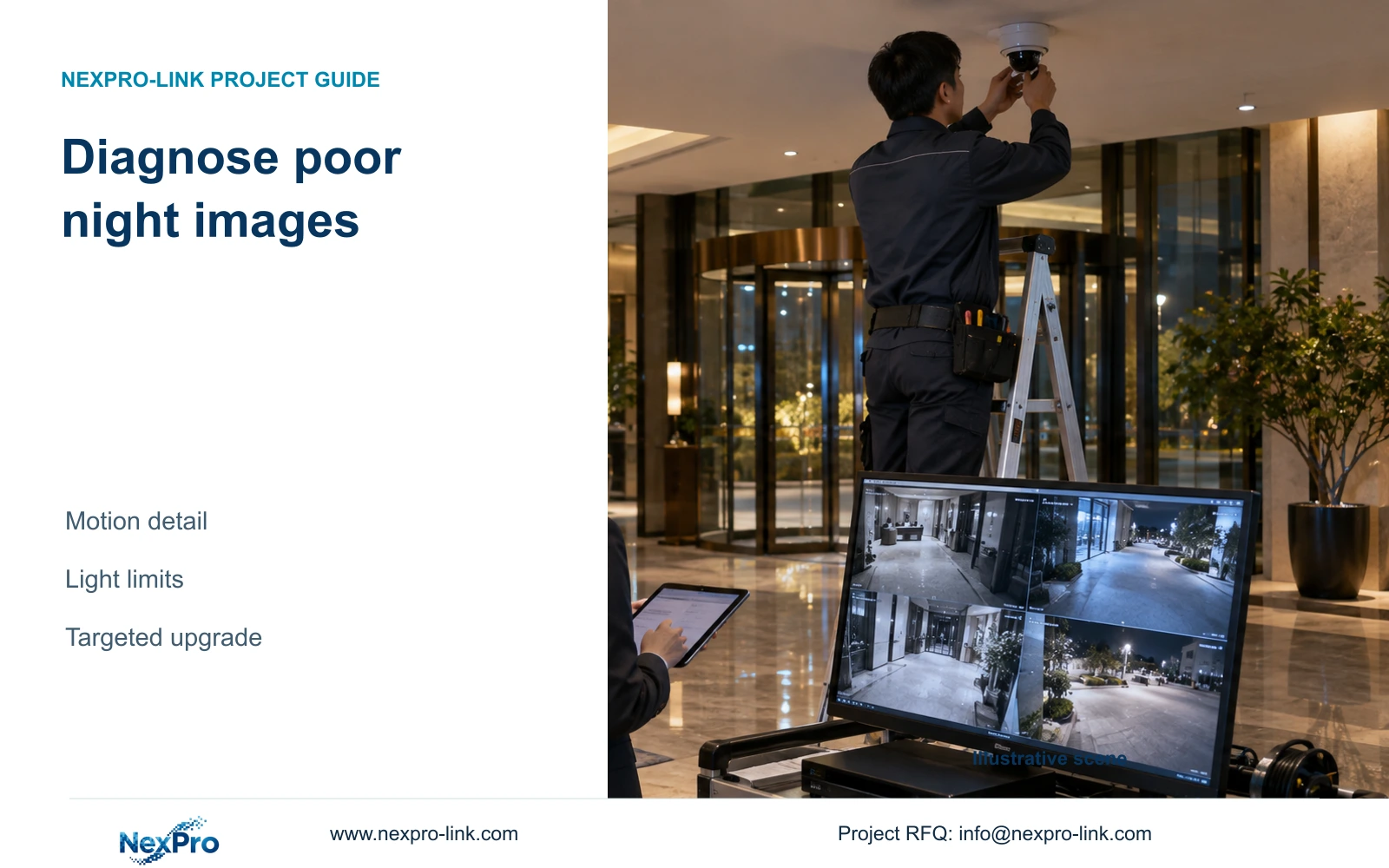
Diagnose framing, focus, exposure and recorded-stream quality before replacing a hotel camera for poor night images. Buy a replacement only when the existing arrangement cannot achieve the required task after practical adjustments. A brand change becomes justified when a representative comparison demonstrates the missing capability under permitted lighting.
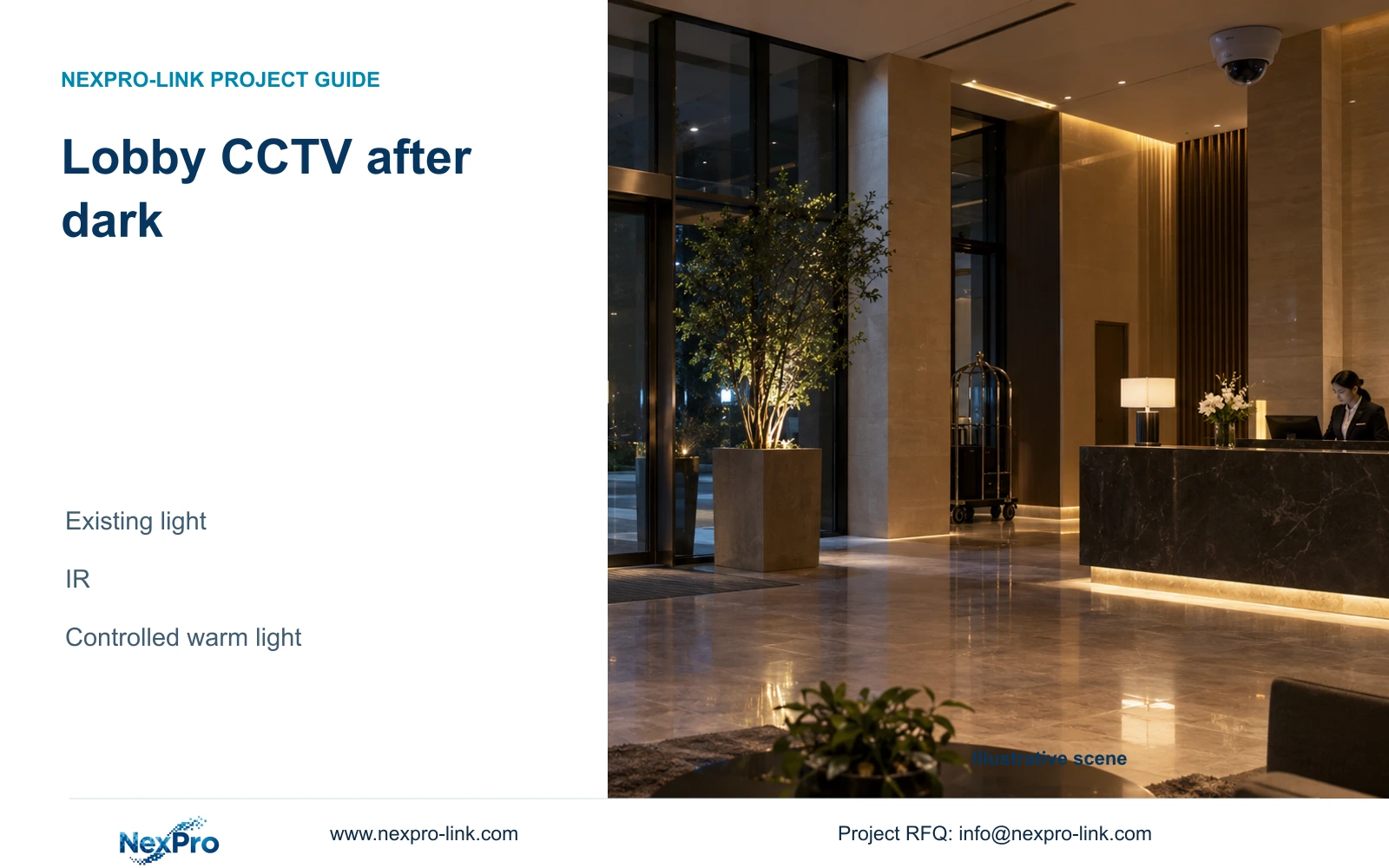
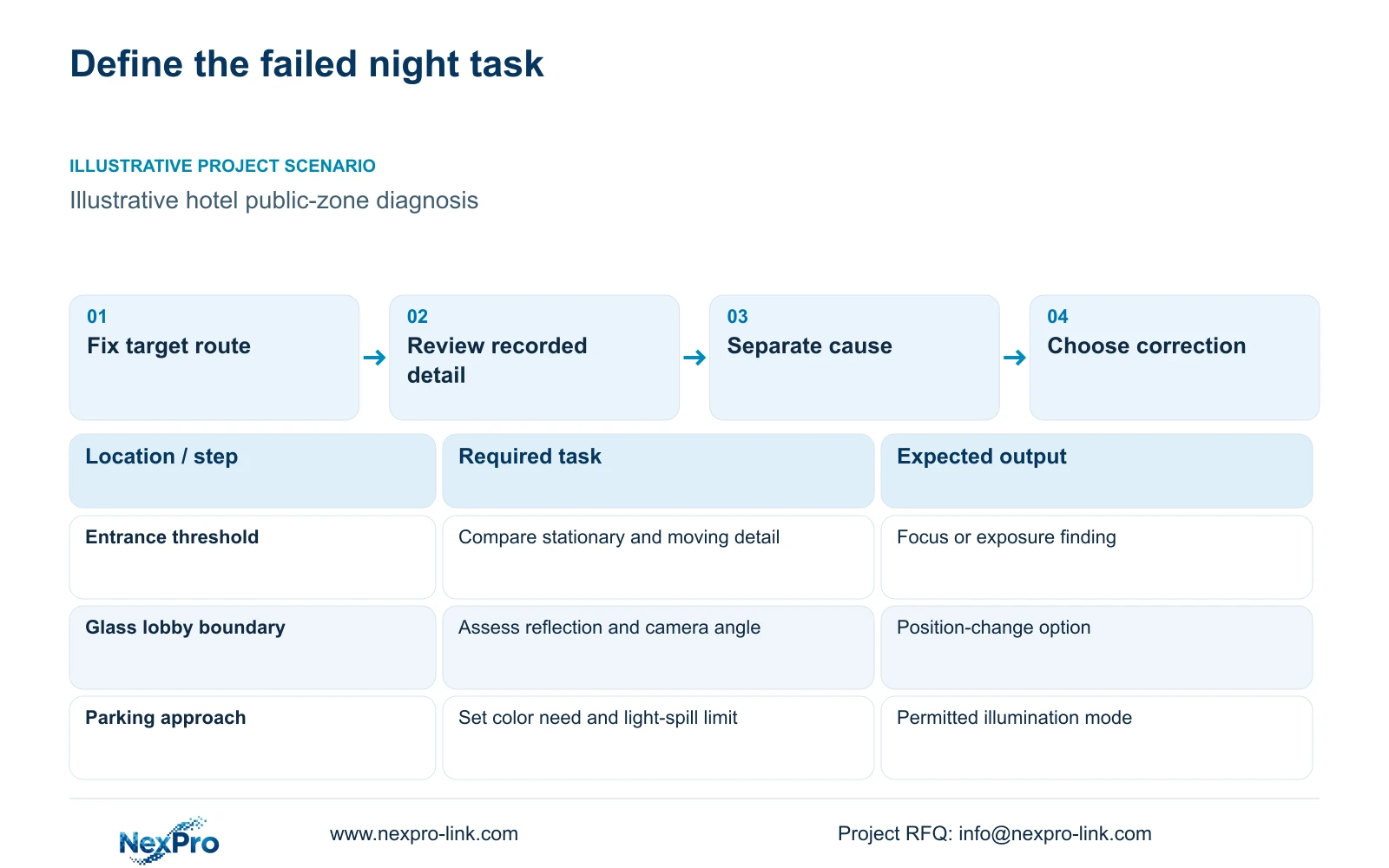
Define the subject and the point where detail matters. At a public entrance, the hotel may need a usable view of a person passing a particular threshold. A parking approach may require vehicle color or an overview of movement. Seeing a silhouette, retaining color and preserving moving detail impose different conditions.
Record the target route, expected movement direction, relevant light and allowed illumination changes. Include glass doors, reflective surfaces and transitions between bright and dark areas. Compare the task at the intended target plane, rather than choosing the most attractive part of a general scene. Exclude guest-room interiors and unnecessary views through open doors.
Make the acceptance task observable. The operator should review a recorded passage at the agreed location and identify whether the required detail survives. A still preview taken elsewhere in the scene cannot answer that question.
| Required task | Given information | Decision still needed |
|---|---|---|
| Moving entrance detail | High-resolution camera installed | Target plane, route and exposure |
| Color on parking approach | Visible light may disturb nearby areas | Permitted illumination and operating mode |
Section 02
Separate focus, exposure and compression effects
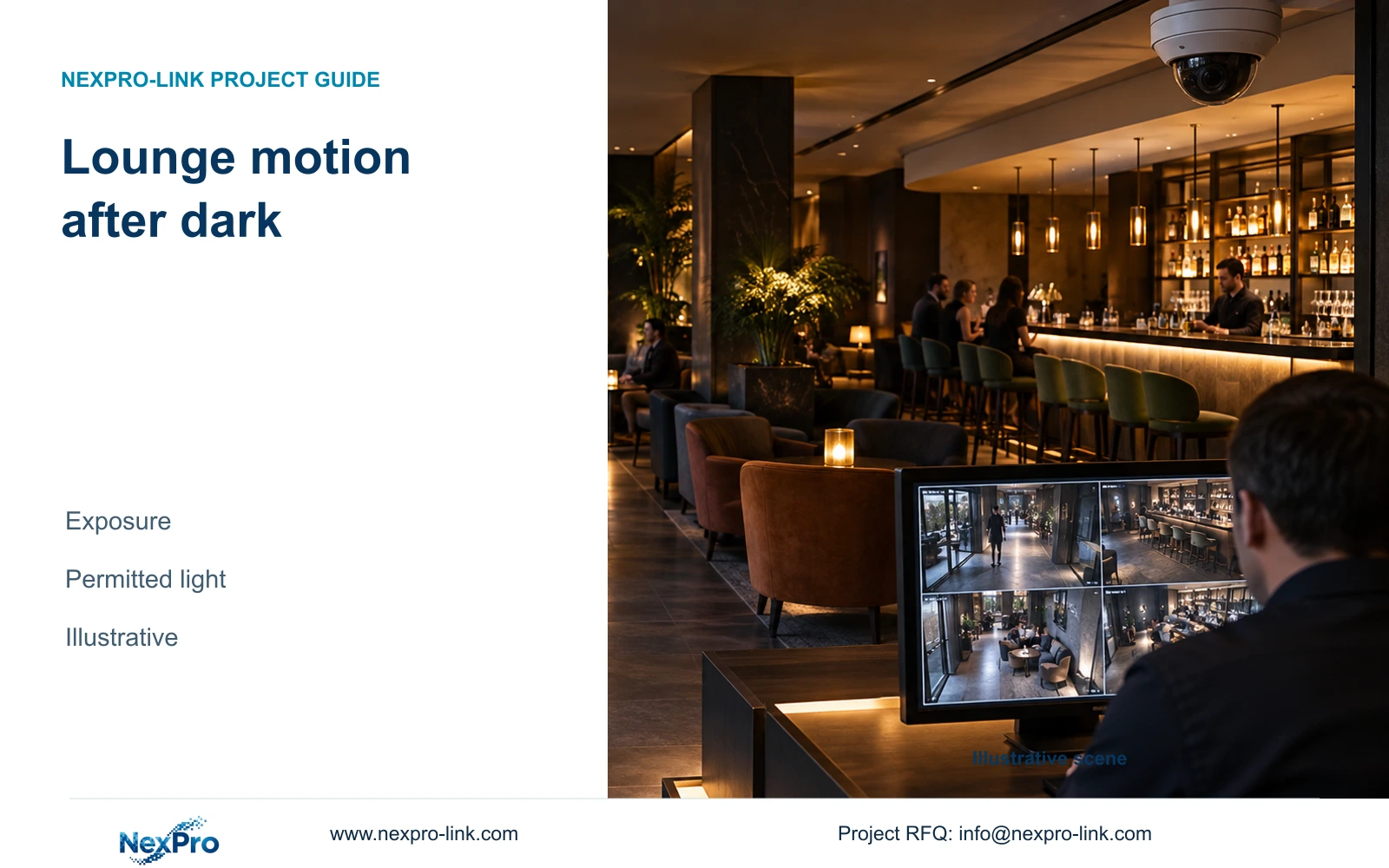
Review a stationary target and a moving target at the same intended distance. If both lack detail, investigate framing and focus before attributing the result to movement. If stationary detail is usable while movement smears, examine exposure together with the available light. Then compare the recorded file with the live view to investigate stream settings.
Frame rate and exposure describe different effects. The supplied teaching model assumes transverse movement at 1.5 m/s, a planning density of 240 px/m and 25 fps. Exposure travel equals speed×exposure time×pixel density. At 1/50 s it is 7.2 pixels; at 1/250 s it is 1.44 pixels. Frame-to-frame travel remains 14.4 pixels at either exposure.
Shortening exposure changes the light and noise balance. Preserve the movement task while evaluating that change; a darker or noisier result may still lose required detail. The linear model explains a mechanism and does not predict face-recognition performance.
Compression should be investigated on the actual recording profile. Higher megapixel output does not establish a fixed bitrate, and an attractive live preview does not prove that the stored stream retains the same detail. Avoid applying an assumed intelligent-codec saving to all scenes.
| Metric | 1/50 s exposure | 1/250 s exposure |
|---|---|---|
| Exposure time | 0.02 s | 0.004 s |
| Travel during exposure | 7.2 px | 1.44 px |
| Frame-to-frame travel | 14.4 px | 14.4 px |
| Light requirement | Review image quality | Review changed light/noise balance |
Section 03
Compare lighting and position corrections
Evaluate a position change when glass reflections, a steep angle or a bright background interferes with the required view. Narrowing the target width can allocate more source pixels to the task, but may remove an overview the hotel still needs. Document that tradeoff before moving the camera.
Treat infrared, visible light and event-triggered illumination as separate operating choices. Review the exact model's supported modes and the hotel's permitted light spill. Dual light is a candidate where visible illumination is acceptable. Sensitive boundaries may require a suitable IR arrangement or another supported solution.
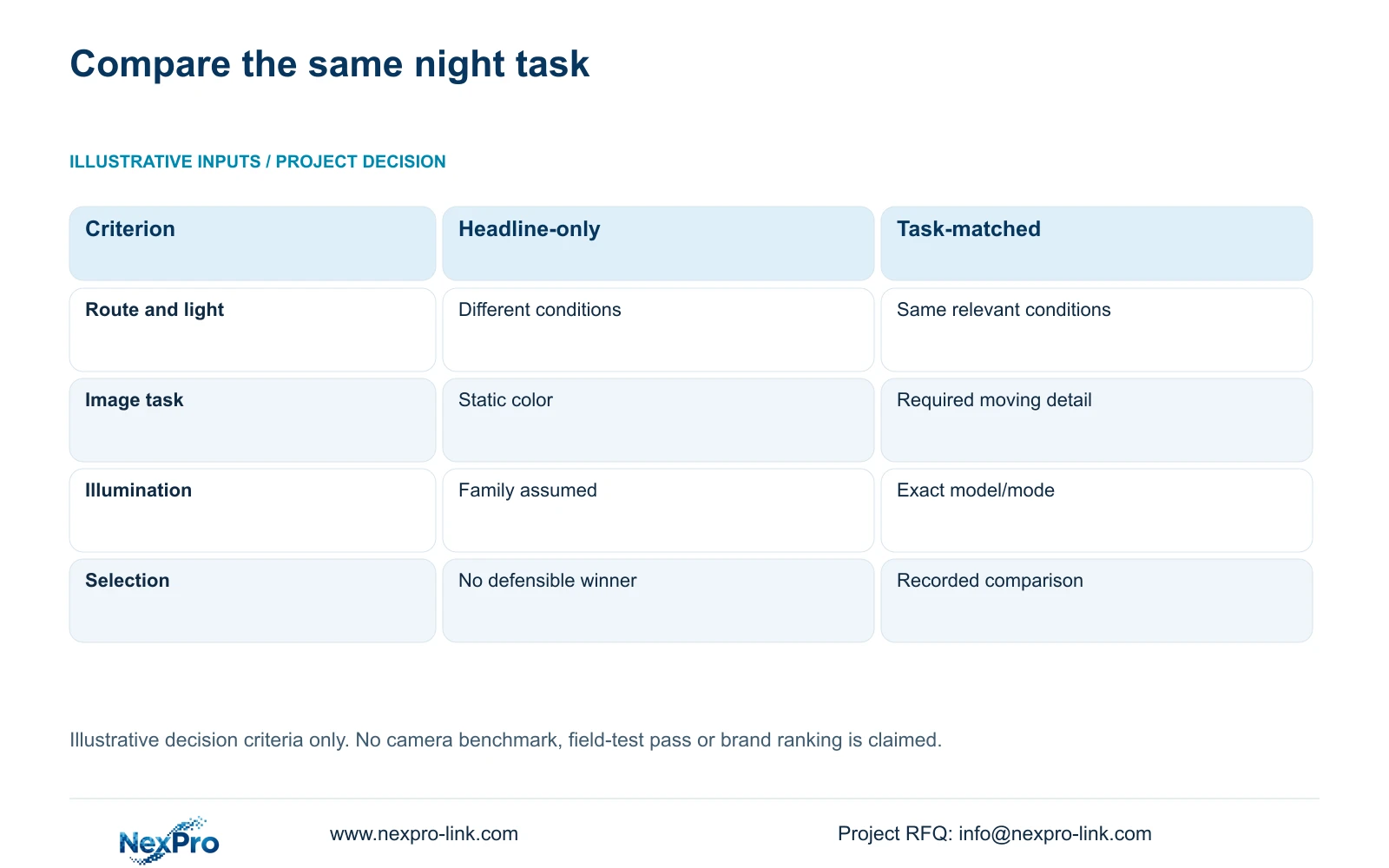
The following comparison uses planning criteria without invented test scores. Minimum-lux figures require their exposure, aperture and gain conditions to be meaningful. When those conditions differ or are missing, they cannot establish a defensible winner for a moving hotel subject.
Price adjustments separately from replacement. Retain reusable equipment where it still achieves its assigned task; list relocation labor, illumination work and any canceled purchase independently. A correction can change installation scope even when no new camera is bought.
| Metric / condition | Single low-lux headline | Task-matched night comparison |
|---|---|---|
| Scene | Different light and shutter conditions | Same target route and relevant light |
| Image task | Static color appearance | Motion detail plus required color/overview |
| Light control | Assumed by marketing family | Exact model and selected mode |
| Decision | No defensible winner | Choose after recorded task comparison |
Section 04
Test representative camera alternatives
If adjustments leave a documented capability gap, compare candidate cameras on the same route and under the relevant night conditions. Record the selected image mode, exposure, illumination behavior and recording settings. Keep the footage review authorized and focused on the defined task.
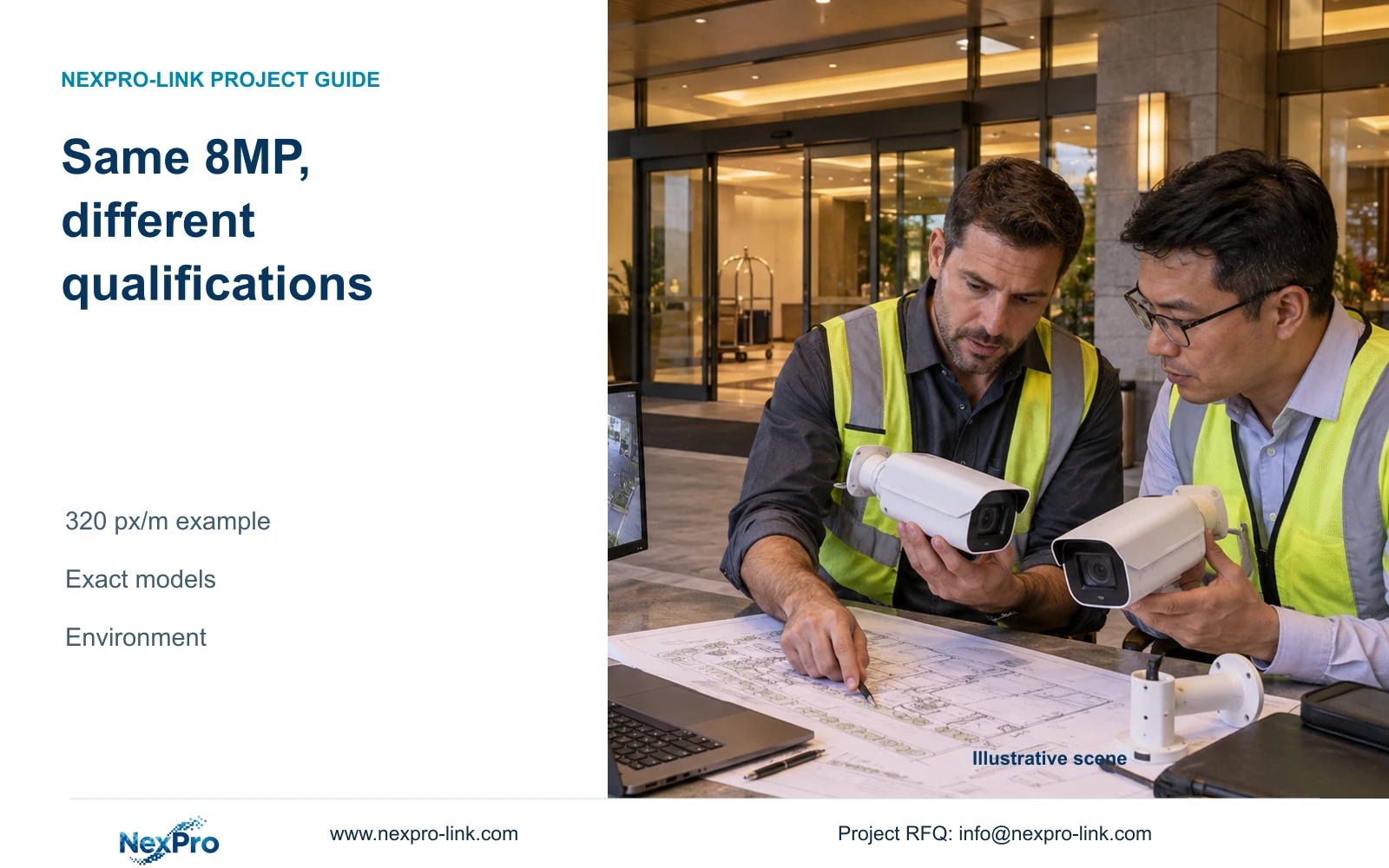
The DM2812M product PDF lists NexPro-DM2812M55-5MP-DIC-AI with a 1/2.7-inch sensor, a 2880×1620 main-stream mode and a 2.8-12 mm lens. NexPro-DM2812M88-8MP-DIC-AI lists a 1/1.8-inch sensor, 3840×2160 at 25 fps, dual light and a 2.8-12 mm lens. These are candidate specifications, not comparative night-test results.
Neither a larger sensor field nor higher pixel output establishes the required result by itself. Motorized zoom provides framing adjustment and does not imply PTZ patrol. The Dome series name does not establish an impact rating.
A factory demonstration can address reproducible equipment behavior. Hotel-site lighting and reflections still require site assessment. Record unresolved tasks and repeat the same comparison after correction; a limited sample cannot support a claim about every installed point.
Section 05
Calculate the supporting system impact
Carry the selected stream into the recorder and storage review. A camera replacement may alter bitrate, supported image mode or replay demand without changing the number of channels. Check the actual disk arrangement and input allowance before releasing a wider replacement batch.
The separate CASE07 teaching renovation assumes 32 cameras averaging 4 Mbps and produces 128 Mbps input and 41.472 TB of 30-day video. Those figures are independent of the qualitative night-comparison table. A new profile must be recalculated from its own inputs; it cannot inherit CASE07's storage result simply because the camera count remains 32.
Check night illumination power at each PoE node. The camera PDFs do not provide verified peak W, so CASE07's 12 W per camera remains a teaching assumption. Keep data and power paths separate, include required remote nodes in backup planning and avoid counting camera power twice through a complete switch AC load.
Section 06
Recommend the smallest supported correction
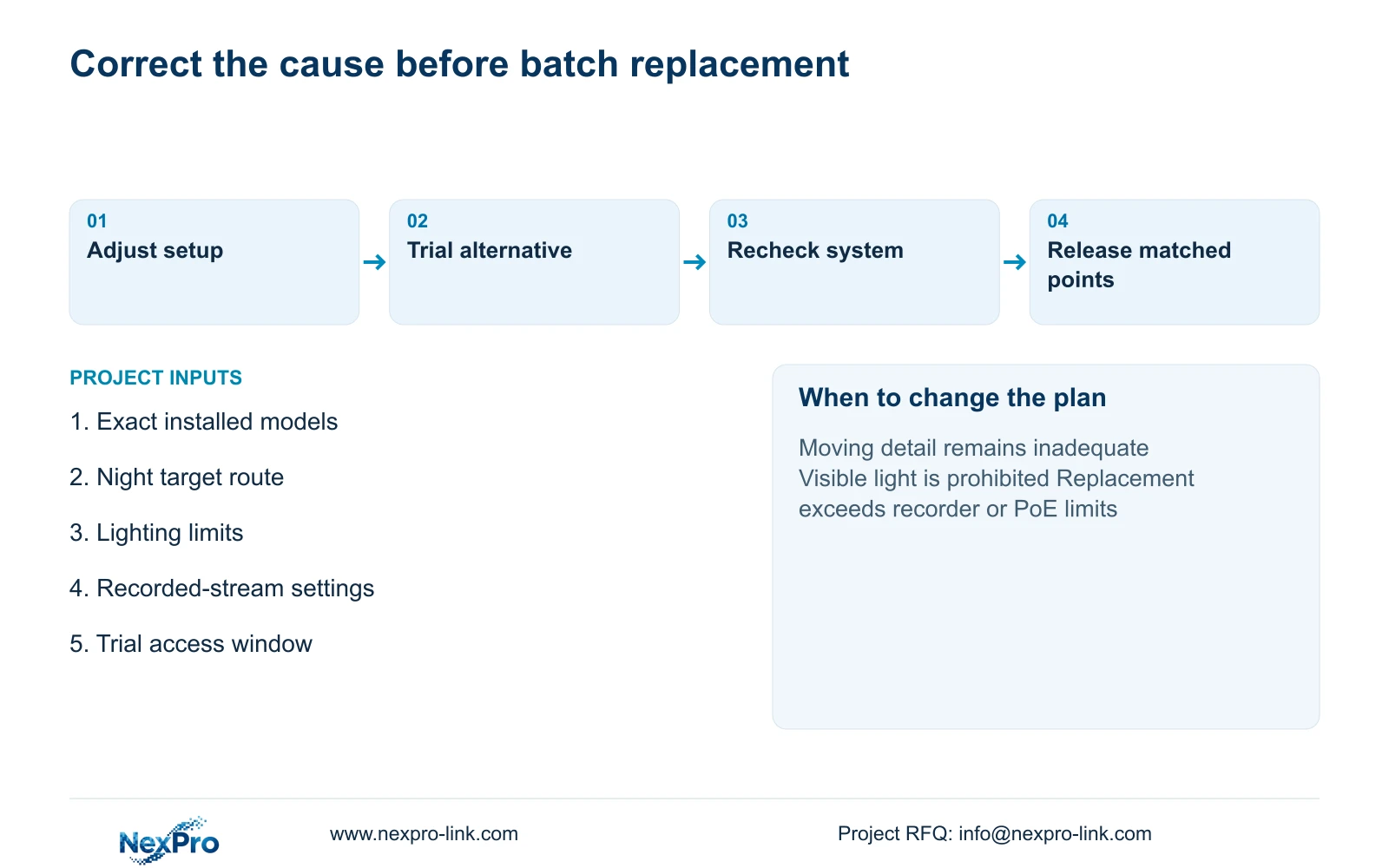
Retain and adjust the existing camera when its recorded output meets the task after an authorized framing, exposure or lighting correction. Choose a targeted replacement when the representative test still exposes a capability gap. Expand that replacement only to positions with equivalent requirements.
Change the illumination recommendation if visible light is restricted, the environment exceeds the candidate's supported conditions or the operator requires a different platform. An ordinary camera should not be presented as thermal imaging or dedicated plate recognition. Keep audio as a separate authorized decision even when hardware includes it.
Send the exact installed models, the required night task, permitted light-spill limits and the allowed trial window to info@nexpro-link.com. NexPro-Link's hotel project and BOQ support routes can help define candidates and supporting equipment. Initial correspondence does not require guest images or account credentials.
Section 07
Buyer questions
Will an 8MP camera necessarily fix blurred moving faces? No. Extra pixels do not remove exposure travel, poor focus or an unsuitable angle. Require a recorded moving-target comparison at the intended location before selecting the higher-resolution alternative.
Can a replacement camera keep the existing app and recorder? Check the required functions on the exact device and software versions. ONVIF support does not establish event handling, audio, retrieval or cloud-account compatibility. Seetong client availability likewise does not prove full interoperability with retained hardware.
What should a night-image quotation include? Separate camera supply from relocation, lighting changes, recording-profile changes and site testing. Identify the retained equipment and any unresolved power or platform requirement so the quotation does not hide a dependent upgrade.
Engineering references
These sources support the general planning principles. Always use the selected product's current datasheet and applicable project standards for final design.